Viking society rested on domestic ritual and enslaved labour across Europe
Excavations across Scandinavia reveal that maritime violence formed only one occupation within a diverse early medieval population shaped by ritual specialists, urban merchants and unfree workers.
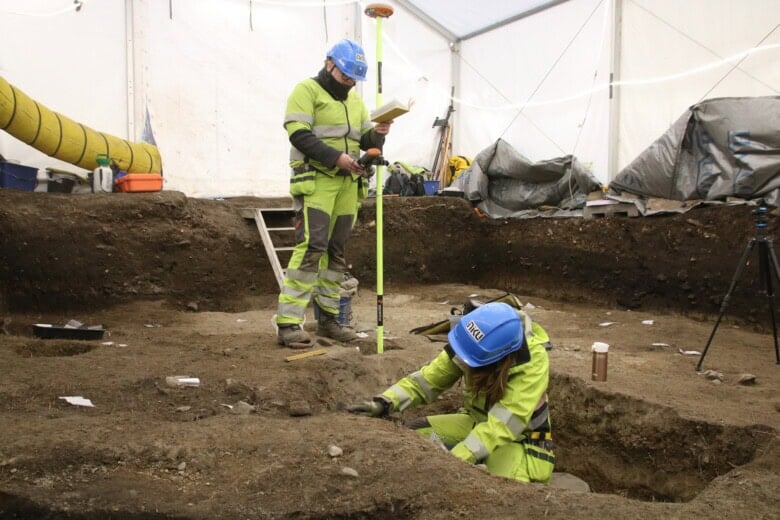
Centuries of popular folklore have reduced early medieval Scandinavia to a single repeating figure, the sea-borne raider armed with an axe and bent on pillage. Physical excavations across northern Europe show a different reality. The men and women who occupied Scandinavia between the late eighth century and the mid-eleventh century were predominantly rural farmers, craftspeople, traders and spiritual practitioners. The violence of maritime raiding existed, but it occupied a specific vocational niche rather than defining an entire culture.1 Archaeological evidence recovered from settlements and cemeteries across the Baltic and North Sea regions demonstrates that Scandinavian society operated through complex local hierarchies, sophisticated domestic economies and far-reaching trade networks that reached deep into Eastern Europe.
Understanding this social landscape matters because the conventional caricature has obscured the structural mechanics of early medieval northern Europe. When the entire Scandinavian population is imagined as uniform sea raiders, historians and the public miss the economic systems that funded maritime voyages, the religious customs that governed domestic life, and the brutal internal inequalities that sustained households. The archaeological record shows that everyday life depended heavily on domestic agricultural output, textile production, specialized spiritual negotiation and the exploitation of enslaved labour. Recovering those details restores human texture to an era long dominated by nineteenth-century romantic myths.
The cultural chain that produced northern maritime expansion began with domestic organisation. Scandinavian farmsteads required intense seasonal labour to survive cold winters, preserve food and maintain livestock. Coastal communities built seaworthy vessels primarily for local communication, resource gathering and regional trade across inland waterways. As shipbuilding techniques improved, small groups of seasonal mariners began venturing across coastal routes to plunder wealth and capture people. Those mobile groups represented a distinct vocational minority who brought foreign materials and captives back into their home communities, feeding wealth into growing administrative and market centres. Maritime raiding was thus an outward extension of a domestic economy, not the baseline occupation of ordinary Scandinavian households.
In his study of more than 20 burial sites, Neil Price, distinguished professor and chair of archaeology at Uppsala University in Sweden, argues that the historical Viking Age was far broader and more varied than traditional military timelines suggest.1 In his book, “The Sea-King and the Sorceress: Life and Death in the Viking Age,” Price details how Scandinavian communities were defined by diverse roles ranging from urban business operators to ritual authorities.1 The Old Norse term víkingr was essentially a job description designating a person engaged in maritime robbery with violence, comparable to a pirate, rather than a name for an entire ethnic population.1 Modern usage that applies the label to every Scandinavian person from that era originated primarily in the nineteenth century, creating an enduring historical distortion.1
When did Scandinavian raiding abroad actually begin?
Maritime expeditions and violent raids began decades before the famous assault on the English island monastery of Lindisfarne in 793.1 Traditional academic timelines established in the twentieth century marked the formal opening of the Viking Age on the eighth of June 793, when raiders struck the coast of northern England.1 Excavations at Salme on the coast of Saaremaa island in Estonia challenge that chronological starting point. At Salme, archaeologists uncovered the remains of two ship burials dating to approximately 750, roughly four decades prior to the Lindisfarne raid, containing a commander and his crew interred alongside weapons and defensive gear.1
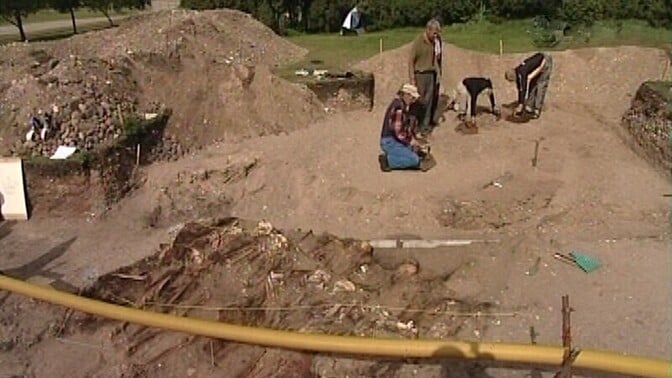
The Salme burials record the physical aftermath of an organized raid into the eastern Baltic Sea rather than the western coastlines of the British Isles. The crewmen were buried in sea-going vessels with their swords and shields, documenting that Scandinavian maritime violence was already active across eastern sea routes by the middle of the eighth century.1 Scandinavian sea voyagers had been conducting armed incursions for generations before chroniclers in western Europe began recording monastic attacks.1 The finds demonstrate that maritime expansion was an ongoing social and technical development across the Baltic basin that subsequently expanded into western waters.
What roles did women hold in early medieval Scandinavian society?
Women managed crucial economic operations, property investments and essential spiritual negotiations within Scandinavian society. While modern accounts frequently highlight monumental male warrior graves, female graves across Scandinavia show that women directed urban commercial ventures and presided over religious communication with the spirit world. Norse religious life did not revolve solely around major deities such as Thor, Odin and Freya. Daily folk practice focused much more heavily on local supernatural beings, ancestral forces and land spirits that were believed to inhabit natural elements such as large stones behind rural farmsteads.1
Mediating with those local environmental spirits fell predominantly within the social sphere of female ritual specialists. Communities viewed these practitioners as essential negotiators who protected households from crop failures, livestock disease and unexplained illnesses.1 As Price observed, “Getting in contact with that world of supernatural creatures and forces and powers — or whatever we call them — was something that was very much in the domain of women.”1 Their ceremonial practices, described across varied Old Norse terms for sorcery and magical craft, held substantial authority within early medieval Scandinavian governance.1
Women also established commercial presence in Scandinavia’s earliest trading centres. In the town of Birka, an urban settlement founded in Sweden that contains approximately 5,000 burial mounds, archaeologists excavated the ninth-century grave of a prominent merchant woman dating to roughly the 840s.1 Her burial contained foreign trade goods and looted treasures transported from across the western maritime world, alongside materials associated with textile commerce.1 Rather than operating looms herself, she likely managed textile manufacturing and merchant importation in an emerging urban environment where permanent town life was replacing traditional agrarian self-sufficiency.1
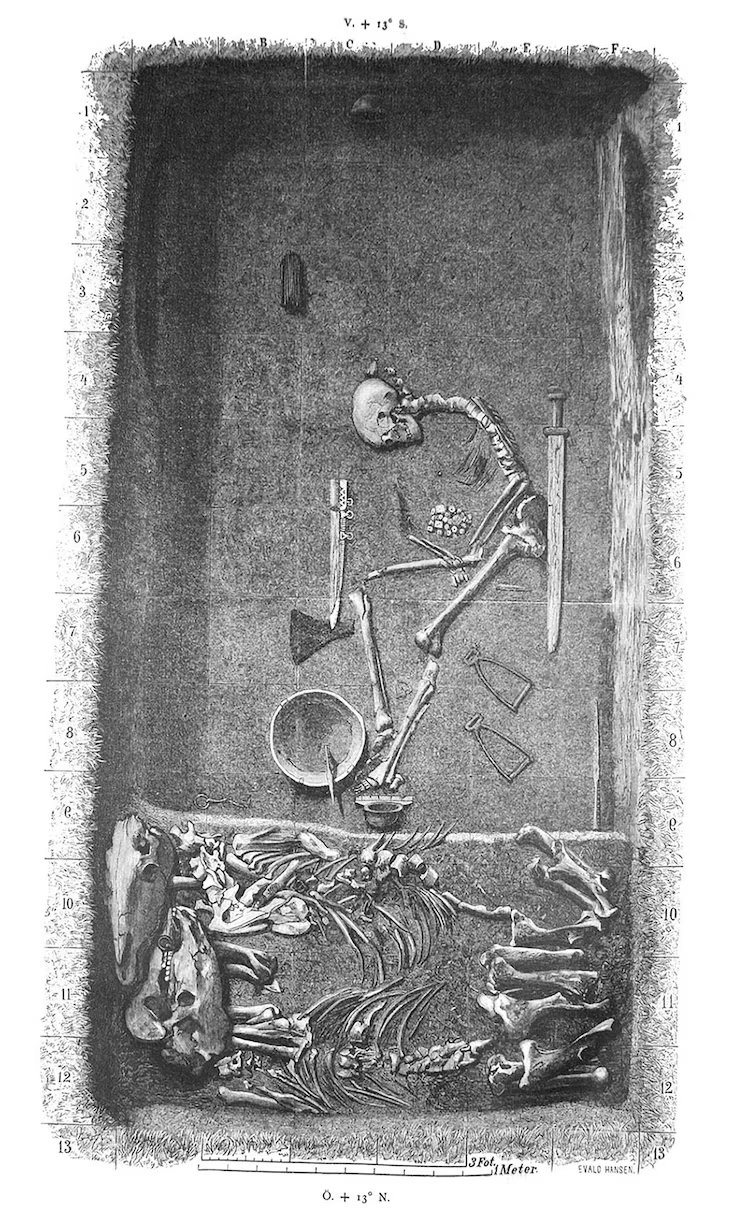
Excavations in Birka also demonstrate the complexity of gender roles in military settings. In the 1870s, antiquarians excavated a high-status grave, designated burial Bj 581, adjacent to Birka’s fortified military garrison.1 The burial contained a full set of war-grade weapons, including swords, arrows, shields and sacrificial horses.1 Out of approximately 1,100 burials excavated at Birka, only two graves contained a complete suite of military equipment.1 For more than a century, historians cited this burial as the definitive example of a male Scandinavian warlord. Between 2011 and 2017, a research team that included Price re-examined the skeletal material using osteological measurements and confirmed through ancient genomic testing that the interred individual was biologically female.1
How did unfree labourers sustain the Scandinavian economy?
Enslaved people, known in Old Norse as thralls, supplied the forced manual labour that underpinned Scandinavian agriculture, household maintenance and seasonal maritime expeditions.1 Despite their economic centrality, identifying the physical graves of thralls remains one of the most challenging tasks in early medieval archaeology. Enslaved individuals were rarely provided independent burial monuments, formal cemetery plots or durable grave goods that would distinguish them after death. Instead, archaeological evidence for enslaved people primarily appears through funerary violence within high-status graves, where additional bodies were placed alongside a primary deceased elite.1
In several dozen Scandinavian burial mounds, excavators have uncovered secondary skeletons whose bodies display evidence of bound hands, violent trauma or deliberate decapitation inflicted at the time of the primary individual’s funeral.1 To determine whether these sacrificed individuals were enslaved domestic thralls or foreign captives, researchers study the chemical composition of their remains. By measuring stable isotope ratios preserved within human teeth and bone tissue, scientists map the foods and regional water sources that individuals consumed during their lives.1 Stable isotope analyses demonstrate that several human victims killed during elite funerals consumed significantly poorer diets than the primary occupants, exhibiting low nutritional values consistent with institutional enslavement.1
What can skeletal analyses tell us about childhood and regional expansion?
Skeletal analysis of ordinary Scandinavian burials reveals that survival through early childhood was precarious and socially unequal. Historical demography derived from cemetery excavations indicates that fewer than 50% of children survived past the age of 10.1 Graves of young children frequently contain scaled-down personal belongings, including miniature bronze jewellery and small tailored garments, while domestic settlements yield carved wooden toys such as horses on wheels and small model boats.1 Young people who survived childhood reached recognized social maturity between the ages of 14 and 16, after which they entered adult communal responsibilities.1
Skeletal traces of nutritional deprivation record sharp gender disparities inside domestic households. Pathological marks preserved on adult bones indicate widespread episodes of juvenile malnutrition across early medieval communities.1 Within studied burial samples, the proportion of adult females showing skeletal signs of childhood nutritional stress is substantially higher than the proportion observed among adult males.1 This physiological pattern indicates that during periods of regional harvest failure or food scarcity, households prioritized allocating available nutrition to young boys over young girls.
Beyond the Scandinavian heartland, maritime trading networks developed multi-ethnic societies along eastern river systems. Beginning in the eighth and early ninth centuries, armed Scandinavian traders established river outposts across what is now Ukraine and western Russia, developing the cultural identity known as the Rus’.1 Like later historical fur traders along North American river systems, these armed groups integrated with local Slavic and Finnic communities.1 Over several generations, their seasonal fortified trading outposts evolved into a permanent political confederation centred around the major administrative capital of Kyiv, illustrating how mobile maritime raiders ultimately transformed into settled continental rulers.1
Interpreting grave goods carries unavoidable scientific limits that must temper sweeping biographical claims. The presence of specific objects inside a burial chamber reflects the decisions of the surviving mourners who conducted the funeral ritual, not an automatic inventory of the deceased person’s daily lifetime possessions. An individual buried with military equipment may have functioned as a warrior during early youth, acquired prestige objects through family inheritance, or received symbolic weapons as funerary gifts from elite kin.1 Similarly, osteological data gathered from small regional cemeteries cannot capture the full range of health conditions across the entire medieval Scandinavian population. These material traces illuminate social possibilities rather than uniform biographical scripts.
The surviving physical evidence shows that early medieval Scandinavian society was fundamentally multifaceted. Across two centuries of continental expansion, northern communities relied on agricultural work, complex spiritual customs, urban craft commerce and unfree domestic servitude. By looking directly at skeletal chemistry, domestic artefacts and burial architecture, researchers continue to recover the broad spectrum of human experiences that built medieval northern Europe.
The record
34 sentences trace to 1 source.
-
1
LG
Laura Geggel Document · livescience.com · 13 Oct 2026 'It gives us a glimpse of a different kind of Viking life': Archaeologist Neil Price on the sea-kings, sorcerers and Sámi who lived during the Viking Age See the source