Two monumental statues of Ramesses II emerge from northern Egyptian farmland
Archaeological excavation in the Nile Delta reveals royal monuments from the 13th century B.C., expanding evidence of royal patronage at an ancient temple complex dedicated to Isis.
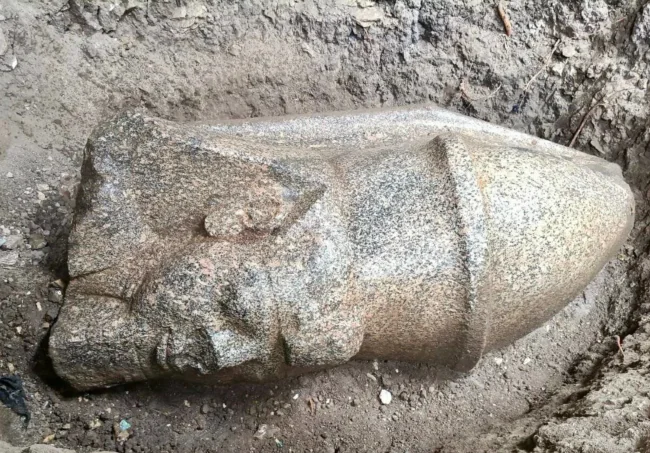
Centuries of agricultural cultivation across the Nile Delta have buried the monumental stone architecture of ancient Egypt beneath silt and expanding villages. In agricultural communities where irrigation canals and modern houses sit directly above ancient settlements, monumental basalt and granite sculptures regularly rest just inches below the plough line. When property owners dig foundations or drainage trenches, they often break into royal sanctuaries that stood thousands of years ago.
A landowner named Khaled el-Shahat encountered that buried past while working on his land in the northern Egyptian village of Behbeit El Hagar.1 After striking buried stone, el-Shahat notified the Egyptian Ministry of Tourism and Antiquities, which dispatched an excavation team to examine and clear the remains.1 The ministry reported in a translated statement that the excavation uncovered the damaged remains of two massive statues depicting the 19th Dynasty pharaoh Ramesses II.1
What did the excavation reveal in the Nile Delta?
The team dispatched by the Egyptian Ministry of Tourism and Antiquities recovered fragments of two colossal stone statues on the western side of the Behbeit El Hagar temple complex.1 The larger of the two figures originally measured nearly 28 feet (8.5 meters) in height, according to the ministry statement.1 Most of that sculpture has been lost to time, leaving behind a severed head measuring 5.2 feet (1.6 meters) tall that shows the pharaoh wearing the double crown representing the unified kingdoms of Upper and Lower Egypt.1
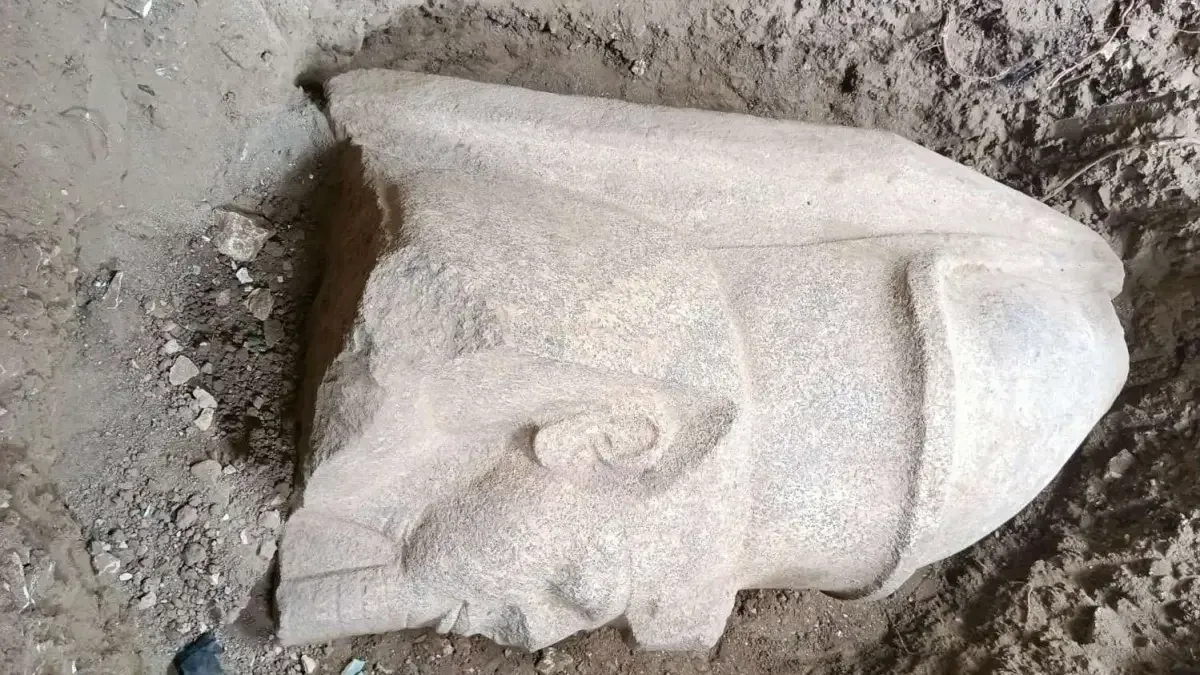
Carved hieroglyphic text on the surviving section of the larger statue's back pillar records the ruler's formal Horus name, Hor-Ka-Nakht-Mery-Maat.1 Joyce Tyldesley, a professor emeritus of Egyptology at the University of Manchester, explained in her 2001 study of the ruler that the title translates to "Strong Bull, Beloved of Right, Truth."1 Ancient Egyptian pharaohs routinely adopted a sequence of titular names honoring divine figures, including the sky deity Horus, to project royal authority and theological alignment across their empire.1
Excavators also uncovered a second statue measuring about 7.9 feet (2.4 meters) in height that likewise depicts Ramesses II, the ministry statement reported.1 This second figure portrays the monarch wearing the Nemes headdress, a pleated cloth headpiece traditionally worn by reigning pharaohs.1 Beside this sculpture, the team documented a separate block of pink granite carved with two distinct hieroglyphic inscriptions identifying Ramesses II as the "King of Upper and Lower Egypt" and the "Son of Ra," invoking the ancient Egyptian solar deity.1
Why were monumental statues placed at Behbeit El Hagar?
Monumental royal statuary at Behbeit El Hagar served as an enduring statement of crown patronage and political control at an influential religious center dedicated to the goddess Isis. Ramesses II reigned from roughly 1279 to 1213 B.C., governing Egypt for 66 years while directing extensive construction initiatives across an empire extending northeast into modern Syria.1 While Behbeit El Hagar is celebrated for surviving granite architecture erected by later Ptolemaic monarchs for Isis, a deity associated with healing and magic, monumental statuary established royal devotion long before those later structures were raised.1
Mahmoud Emam, an Egyptologist at Cairo University who has analyzed antiquities from Behbeit El Hagar, noted that the two newly found sculptures were positioned on the western edge of the temple grounds.1 The location aligns with architectural fragments previously identified at the complex. In a 2017 study, Emam and colleagues published documentation of two earlier stone fragments discovered near the Isis temple carrying the cartouche of Ramesses II, with one originating from a statue and the other from an upper wall section.1
Emam explained that the earlier recovered blocks pointed to significant building programs commissioned by the pharaoh at the sanctuary. "We concluded that Ramesses II had undertaken major building works at the temple and recommended further archaeological investigations to shed more light on the early history of the site," Emam said.1
What can the fragmented carvings tell historians?
The newly unearthed statues provide physical confirmation of royal building activity at Behbeit El Hagar during the 13th century B.C., but they cannot determine the exact architectural layout of the original Ramesside shrine. Fragmented remains leave open whether the statues were designed for an independent temple hall or were rearranged centuries later by subsequent dynasties who quarried and restructured ancient Delta sites. The physical context of the sculptures reflects modern soil deposition rather than an untouched ancient ceremonial chamber.
Archaeologists working in the region face acute preservation pressures that limit the time available to study these monuments in situ. Emam pointed out that modern residential growth and expanding agricultural activity continuously encircle the archaeological precinct, threatening unexcavated cultural layers around the temple.1 The recovery of the two sculptures demonstrates that significant royal remains still lie beneath the village soil, making comprehensive systematic excavations essential before further urban development covers the site permanently.
The record
18 sentences trace to 1 source.
-
1
OJ
Owen Jarus Document · livescience.com · 15 Oct 2026 2 giant Ramesses II statues, one wearing a double crown, discovered by man in Egypt See the source