Quantum strings of attracting atoms emerge inside one-dimensional gas
Physicists observing ultracold cesium atoms confined to laser tubes detected energy signals from collective clusters predicted nearly a century ago, offering fresh insight into complex quantum systems.

When ordinary particles are free to move in every direction, attractive forces draw them together into dense, disorganized clumps. In a typical gas, if individual atoms begin to pull on one another, they quickly collide, bind into conventional molecules, and release bursts of heat that fling the particles outward. That tendency toward rapid collapse makes it extraordinarily difficult to study what happens when dozens or hundreds of quantum particles interact through mutual attraction over sustained periods.
Understanding how collections of attracting quantum particles behave when they cannot collapse into random clumps matters across modern physics. Every solid material, from the magnetic storage inside computer drives to the silicon channels of microprocessors, consists of countless subatomic particles interacting at once. Because the math required to calculate the exact state of so many simultaneous interactions quickly becomes intractable, physicists rely on simplified model systems to observe how collective quantum order forms, evolves, and eventually breaks down.
To see how an orderly chain forms instead of an unruly clump, one must restrict where the particles can go. Imagine a line of beads threaded tightly onto a narrow wire. If the beads attract their nearest neighbors, they cannot slip around one another to pile into a three-dimensional cluster. Instead, any shift in position or magnetic alignment must ripple strictly along the wire. When multiple adjacent particles align or bind under these strict linear constraints, they begin to move together as an indivisible unit, traveling along the line like a single composite object. Physicists call these collective traveling clusters Bethe strings, named after the German-American physicist Hans Bethe who first calculated their mathematics in 1931.1
Now, researchers have reported experimental evidence that such clusters form in crowds within an ultracold atomic gas. In a study published in the journal Nature Communications, an experimental team led by Hanns-Christoph Nägerl at the University of Innsbruck observed signatures indicating that attracting cesium atoms confined to one-dimensional tubes bound themselves into collective strings containing at least six atoms.
Why do atoms behave differently on a line?
Restricting particles to a single dimension prevents the violent three-dimensional molecular collisions that normally destroy an attracting atomic cloud. In 1931, Bethe examined the theoretical problem of why certain crystalline materials exhibit magnetism.1 To simplify the mathematical problem, he analyzed a single line of electrons, each possessing an intrinsic magnetic property called spin, which can point either up or down.1 Bethe derived the equations governing that row and revealed that if several neighboring spins flipped, they could lock together and propagate along the row as a solitary, coherent wave.1
Decades after Bethe introduced his mathematical solution, theoretical physicists realized that the same mathematical framework applies to actual physical particles moving along a straight line, including whole atoms.1 If those atoms attract one another, the underlying quantum mechanics dictates that they will coalesce into bound bundles.1 While individual Bethe strings had previously been observed one by one in magnetic crystals and superconducting circuits, testing whether crowds of these strings form simultaneously across many different sizes required an environment where atoms could be held in strict alignment without instantly clumping together.1
In ordinary three-dimensional space, a cloud of attracting atoms rapidly forms standard diatomic molecules.1 That bonding process releases kinetic energy, kicking atoms out of the experimental trap and causing the entire gas to disintegrate in an instant.1 By trapping the atoms on a one-dimensional line, researchers prevent them from passing each other. Because the particles are held like pearls on a string, the system avoids immediate collapse, allowing multi-atom quantum bound states to form along the axis.1
How did the researchers detect the clusters?
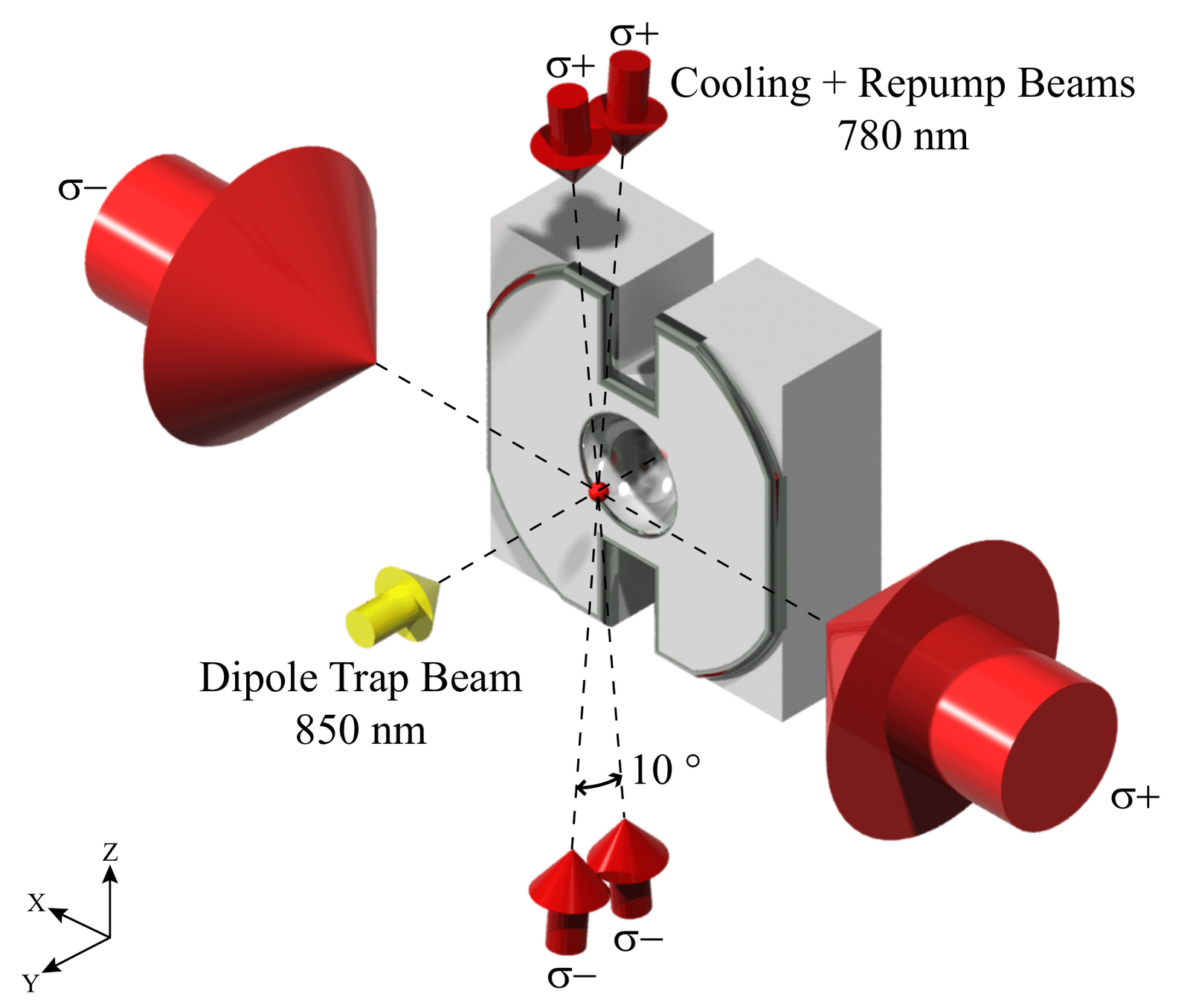
The University of Innsbruck team detected the presence of these composite clusters by comparing how much energy the atomic gas released when it was allowed to expand in one dimension versus all three dimensions. To create the necessary conditions, the researchers started with tens of thousands of cesium atoms and cooled them to temperatures near absolute zero to form a Bose-Einstein condensate, an exotic state of matter in which a large collection of atoms falls into the same quantum ground state.1 The researchers then crossed intersecting laser beams through the condensate, carving the cloud into thousands of microscopic, parallel tubes.1 Each optical tube acted as a tiny, isolated guide that held up to a few dozen atoms in a straight line.1
Initially, the cesium atoms naturally repelled one another.1 The experimentalists applied an external magnetic field to tune the interaction, steadily dialing the repulsive force down to zero before flipping it into an attractive force.1 Because individual Bethe strings are too microscopic to image directly with standard laboratory optics, the team released the optical confinement and measured how quickly the expanding cloud spread outward.1

When the researchers switched off the trap along only the direction of the tubes, the atoms expanded solely along their linear axes, and the bound strings remained intact.1 But when the researchers switched off the trap in all three dimensions simultaneously, the linear confinement vanished instantly.1 Without the one-dimensional geometry holding them in place, the strings broke apart into loose particles and ordinary molecules, shedding their binding energy into kinetic motion.1 The team measured that the clouds expanding into three dimensions dispersed with roughly three times as much kinetic energy as those confined to one dimension, a clear difference reflecting the stored binding energy of the clusters.1 That energy gap matched calculations for strings comprising at least six bound cesium atoms, agreeing closely with predictions from generalized hydrodynamics, a theoretical framework that treats the multi-particle gas as a fluid carrying strings of diverse lengths.1
What can the measurement tell us?
The experimental observations do not provide a visual photograph of individual atomic strings, nor do they prove that the clusters persist as stable objects over long durations. The measurement is an indirect thermodynamic energy readout, capturing the collective kinetic energy released when the spatial boundaries holding the system together are removed. The agreement between the observed kinetic energy release and the theoretical predictions of generalized hydrodynamics provides strong circumstantial support for the formation of Bethe strings, though matching a mathematical model does not constitute absolute proof that the physical entities exist precisely as imagined.1
Furthermore, the clusters are fleeting. Even inside tight optical tubes, atoms continue to experience subtle forces from the surrounding three-dimensional environment, causing the strings to decay steadily into conventional cesium molecules.1 In the coldest experimental runs conducted by the Innsbruck team, approximately 40 percent of the total atoms were lost to these decay processes.1 The results show that multi-atom Bethe strings can form transiently in significant numbers, but they do not demonstrate an enduring or permanent state of matter.
What comes next for quantum strings?
To examine these transient quantum bundles more closely, researchers are exploring experimental methods that can shield the atoms from colliding at close range or image them individually before they decay. One prospective avenue involves using microwave fields to shield ultracold molecules from destructive close-range impacts, which might keep linear strings stable for long enough to allow direct probing.1 Another experimental possibility is quantum gas microscopy, a technique that uses high-resolution optical objectives to detect fluorescence from individual atoms frozen on an optical grid.1
For the Innsbruck team, measuring Bethe strings represents a step toward the broader ambition of understanding how complex quantum systems with many interacting components exchange energy and reach equilibrium. Because Bethe strings inevitably assemble whenever attractive forces are switched on in a one-dimensional geometry, mapping their formation is essential for modeling linear quantum gases. The researchers have begun working on subsequent experiments that utilize focused lasers to control the individual spins of atoms trapped in one-dimensional tubes, working toward building quantum matter piece by piece under absolute laboratory control.1
The record
27 sentences trace to 1 source.
-
1
LG
Larissa G. Capella Document · livescience.com · 16 Oct 2026 Physicists froze a 'necklace' of atoms — and witnessed a quantum phenomenon predicted 100 years ago See the source