Water clouds thicken and thin across a nearby failed star
Atmospheric changes on the cold brown dwarf WISE 0855 reveal condensing moisture and churning deep gases, providing a clear baseline for understanding weather systems on giant planets beyond the solar system.
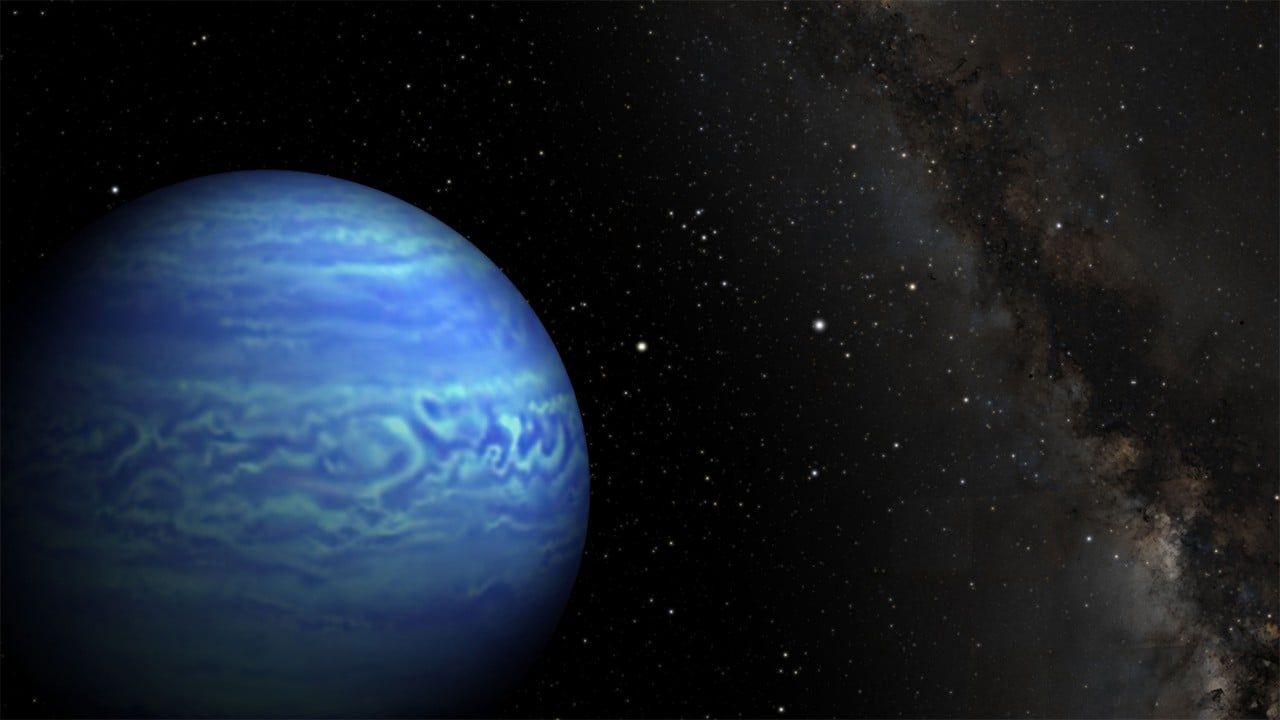
Weather is generally understood through the familiar cycles of terrestrial air and water, where warmth sets moisture circulating across the sky. In the deeper reaches of the galaxy, atmospheres also form around dark, free-floating spheres that do not orbit a host star. These cold worlds drift in isolation through space, generating faint internal warmth while carrying complex envelopes of gas. Studying their weather matters because these unattached failed stars provide a direct window into the physical behaviours that govern giant gas planets across the galaxy, without the blinding stellar glare that washes out exoplanet atmospheres.1
Before any measurement can be evaluated, the physical chain of events that creates weather on a cold substellar body must be traced step by step. Heat preserved from the gravitational formation of the object gradually moves outward from the interior toward the surface. As that warmth rises, it creates convective currents that carry gases upward from deeper, hotter layers.1 High in the atmosphere, where temperatures fall low enough for volatile molecules to condense, moisture gathers into clouds. As the entire sphere rotates, these shifting cloud decks pass into and out of view, producing measurable changes in the filtered light that escapes into space.1
Astronomers have now observed this sequence of events in action on WISE 0855, a cold brown dwarf located 7.5 light-years from Earth.1 Using the James Webb Space Telescope, a research team led by scientists at the University of Arizona recorded light variations that confirm water clouds outside the solar system thicken and thin over time. The findings, accepted for publication in The Astrophysical Journal and posted as a preprint on the arXiv repository, supply the first direct confirmation of dynamic water clouds on a world beyond the solar system.1
How does a failed star sustain water clouds?
A brown dwarf sustains water clouds when its outer envelope cools to temperatures where water vapour condenses, while its interior remains warm enough to drive steady convective motion. Astronomers classify these objects as brown dwarfs, a category of substellar body that occupies the intermediate territory between giant gas planets and small stars.1 Brown dwarfs can accumulate significantly more mass than planets, yet they never gather enough material to achieve the core temperatures required to sustain nuclear fusion.1 Without nuclear reactions to generate persistent stellar energy, they slowly radiate away their initial gravitational heat into space.1
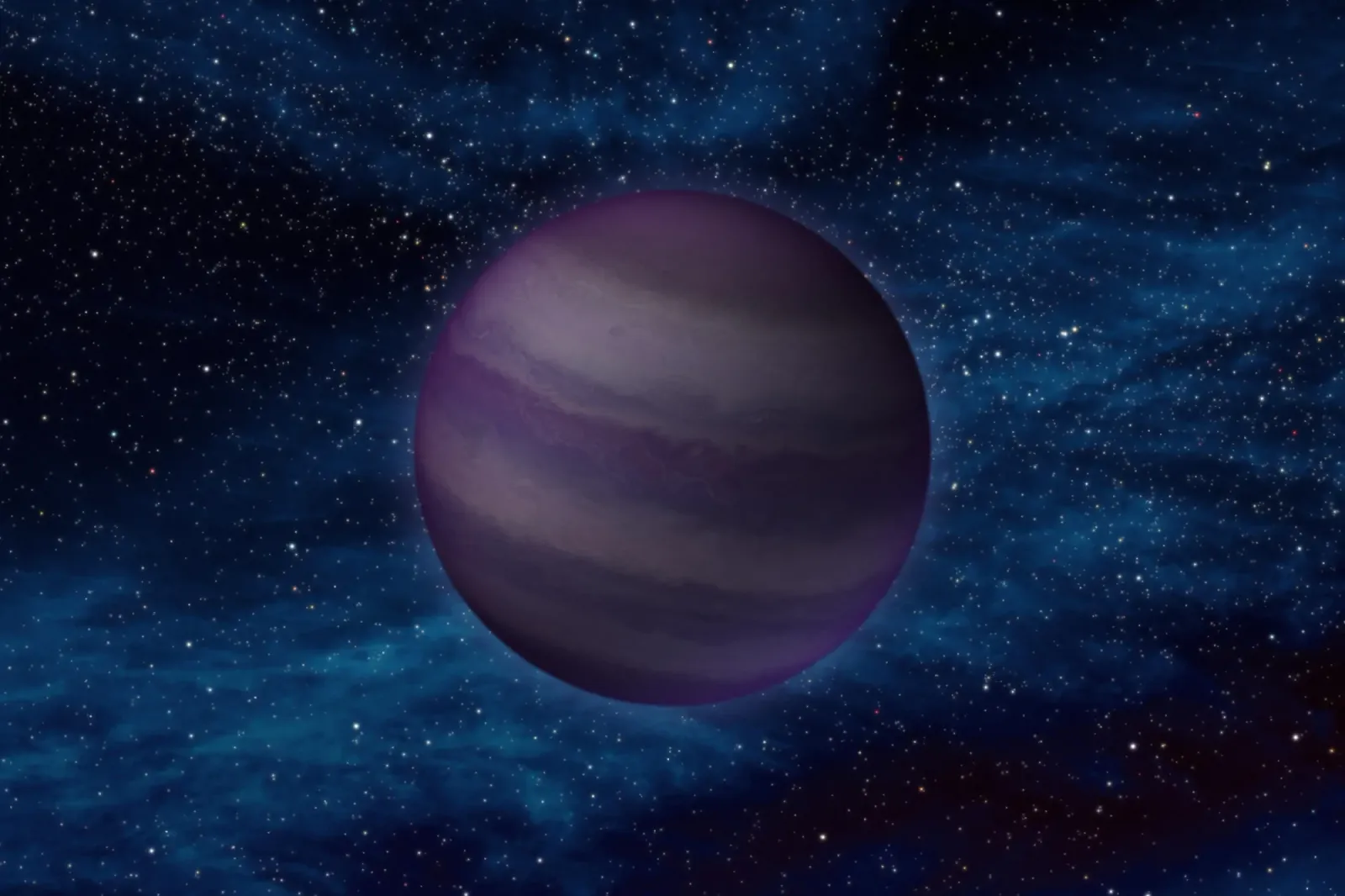
WISE 0855 represents an extreme example of this cooling process, existing as the coldest known brown dwarf.1 The object has an atmospheric temperature of approximately 265 kelvins, equivalent to 17 degrees Fahrenheit, measured across its observable envelope.1 In physical scale, WISE 0855 is roughly the size of Jupiter while possessing approximately twice the mass of Jupiter.1 Because the body does not orbit a stellar host, its faint luminosity originates entirely from residual heat preserved within its interior.
To describe how thermal energy escapes through this atmospheric layer, Mark Marley, director and department head of the Lunar and Planetary Laboratory at the University of Arizona and a study co-author, compared the atmosphere to a screen door.1 Outgoing photons generated by internal warmth travel upward through gaseous layers before escaping into space.1 The intervening atmospheric particles act like the wire mesh of a screen, absorbing and filtering specific frequencies of light.1 By analyzing the filtered light that emerges, researchers can learn about physical conditions on both sides of the barrier while determining the composition of the filtering layer itself.1
What distinguishes upper clouds from deep atmospheric gases?
Upper water clouds and deep atmospheric gases produce contrasting signals because they reside at different altitudes and move through distinct physical mechanisms.1 Earlier observations of WISE 0855 established that the overall brightness of the object changed over time, but those studies relied on broad photometric data.1 Photometry records total luminous intensity without separating light into narrow wavelength bands, blending the simultaneous effects of cloud cover, temperature shifts, and chemical reactions into an unresolved signal.1 Brittany Miles, an astronomer and postdoctoral researcher at Steward Observatory at the University of Arizona, noted that previous instruments could not separate those overlapping factors.1
Spectroscopic measurements from the James Webb Space Telescope resolved that ambiguity by breaking the faint infrared glow of the object into detailed wavelength channels.1 Across an unbroken observation window of 11 hours, the space telescope recorded spectral data every 15 minutes as WISE 0855 rotated.1 These periodic measurements allowed the research team to monitor how different molecules and cloud layers altered the escaping light over the course of the rotational cycle.1
The resulting spectra showed two dynamical patterns operating simultaneously in the atmosphere of WISE 0855.1 High-altitude patches of water clouds varied in thickness as rotation carried them across the observable hemisphere.1 At the same time, volatile gases including carbon monoxide and phosphine varied in an entirely different pattern.1 Convective currents transport these chemical species upward from hot, deep layers toward the surface.1 Because the cloud variations did not track the gas variations, the researchers concluded that the changing cloud signal originates high in the atmosphere, while the chemical fluctuations reflect convective motion churning deeper down.1
What can the current measurements leave unresolved?
Current observations provide a brief snapshot of atmospheric activity that cannot capture long-term seasonal cycles or map the complete three-dimensional circulation of WISE 0855. The data reflect an 11-hour observation window, which documents short-term meteorological variability during a single observing sequence rather than extended climate trends.1 In addition, the findings represent physical conditions inferred from changing spectra without providing direct resolved images of clouds drifting across a planetary disc. The paper has been accepted for publication in The Astrophysical Journal and is posted as a preprint on arXiv, reflecting research that has concluded peer review but awaits formal inclusion in the journal.1
What do shifting clouds on a brown dwarf mean for exoplanets?
Weather patterns on cold brown dwarfs offer a clear observational model for studying giant exoplanet atmospheres without the blinding interference of stellar glare.1 Although WISE 0855 drifts freely through space without orbiting a star, its atmospheric activity closely resembles the dynamical weather seen on giant planets such as Jupiter.1 Both types of worlds experience vertical convection and cloud formation shaped by common thermodynamic laws.1
Studying these processes on a free-floating body provides a practical advantage over observing planets that circle stars.1 A giant exoplanet orbiting a bright star is bathed in intense starlight that obscures faint atmospheric signals.1 Because WISE 0855 emits its own faint glow in isolation, astronomical instruments can record its emissions directly without needing to subtract light from a parent star.1 If identical physical mechanisms govern cloud condensation and chemical mixing across both brown dwarfs and giant exoplanets, observations of nearby failed stars will help astronomers interpret data collected from distant exoplanetary atmospheres.1
Additional observations will be needed to measure the full atmospheric rotation of WISE 0855 and determine how its weather circulates in three dimensions.1 Miles noted that observing water clouds thicken and thin alongside rising and falling gases allows astronomers to watch alien weather change in real time.1 The research group stated that future observations using the James Webb Space Telescope could help pin down the precise rotation of the brown dwarf and provide clearer insight into how its atmospheric currents move through space.1
The record
39 sentences trace to 1 source.
-
1
JS
Jordan Strickler Document · zmescience.com · 16 Oct 2026 A Nearby Failed Star Has Water Clouds and a Churning Atmosphere, and NASA’s Webb Telescope Just Watched Its Weather Change See the source