A polymer foot membrane lets miniature robots draw electrical power from metal floors
By turning ordinary metal floors into an open chemical cell, crawling microrobots can shed heavy onboard batteries and generate electricity at each footstep.

Robots built at the scale of insects have long faced a physical barrier that prevents them from moving freely outside laboratory benches. Their mechanical frames are light enough to squeeze through tight cracks and ductwork, yet storing electrical energy inside something that weighs less than a coin requires packaging that quickly overwhelms the machine. As battery cells shrink below a single gram, the casing, protective seals, and current collectors take up almost all available volume, leaving almost no active chemical material to drive electric motors. The result is that miniature crawlers either carry heavy power packs that drain in a matter of minutes or remain tethered to stationary electrical cables.
A study published in National Science Review outlines a method that circumvents onboard storage by turning the surrounding terrain into an open battery.12 A research team led by Yue Gao at Fudan University in Shanghai designed an electrochemical polymer membrane applied directly to the feet of miniature crawling machines.12 Whenever a foot steps onto an active metal surface such as zinc or aluminum, it completes a circuit with ambient moisture and oxygen from the air, producing electrical power on contact without carrying a sealed power pack.12
Why do tiny machines run out of energy so quickly?
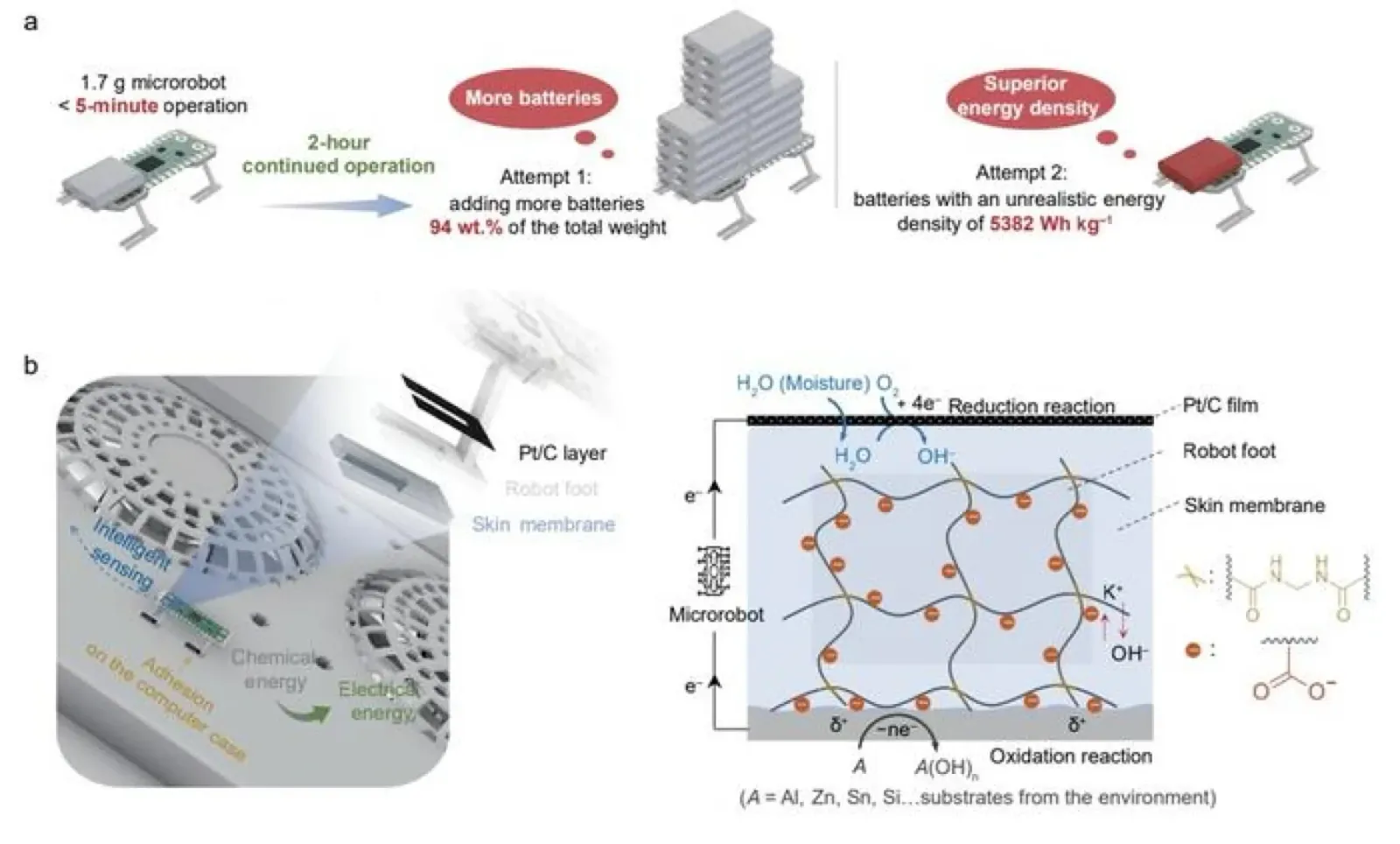
Commercial microbatteries become dramatically inefficient as their dimensions shrink, creating a severe trade-off between weight and operational endurance.21 Yue Gao and colleagues report that a 1.7-gram microrobot operating on commercial lithium batteries can crawl for only about two minutes before its power supply is exhausted.12 Extending that crawl time to two hours would require an onboard power cell that accounts for 94 percent of the machine's total mass, operating at an energy density of 5,382 watt-hours per kilogram of battery weight.1 Existing commercial lithium-ion chemistry cannot approach such energy densities, particularly when fabricated at volumes smaller than one cubic centimeter, where inactive casing components dominate the overall footprint.21
Engineers envision miniature walking machines inspecting narrow ventilation conduits, exploring industrial pipe networks, assessing telecommunication equipment, and navigating collapsed infrastructure after disasters. These environments contain abundant structural materials that can serve as chemical energy donors. Piping, server racks, building frames, and industrial machinery frequently feature exposed surfaces of aluminum, zinc, silicon, tin, or lead.12 By treating those structures as external fuel sources, crawling devices can avoid the need to carry their own chemical reserves.
How does a footstep generate electricity?
Electric current flows when an active metal loses electrons while another substance at the opposing side of a chemical cell absorbs them. In conventional metal-air batteries, such as the zinc-air cells that power hearing aids, atmospheric oxygen enters through small perforations in a protective case to react with an internal zinc anode.1 The Fudan University researchers adapted this chemistry into an open system by leaving the metal anode in the external environment and placing the electrolyte and cathode on the underside of the robot's foot.12
The sequence occurs in several distinct steps each time the robot steps forward. When the foot descends onto an exposed metal plate, the polymer membrane touches the surface and establishes an electrochemical junction.21 The external metal acts as an electron donor, giving up electrons at the contact interface.23 At the top of the foot membrane, a flexible film composed of platinum and carbon acts as the reaction site where water vapor and oxygen molecules from ambient air receive those migrating electrons, generating hydroxide ions.1 This movement of charge produces a steady electrical current that powers the robot's onboard actuators. When the foot lifts into the air, the physical contact breaks, which halts the chemical reaction within roughly 0.1 milliseconds.12
Because the chemical reaction ceases during the swing phase of each step, reaction byproducts remain deposited on the walked-on surface.21 The system thereby avoids the internal clogging and progressive electrode decay that degrade sealed batteries over repeated discharge cycles.12 The researchers synthesized this foot membrane in a single fabrication step, polymerizing acrylic acid monomer, an initiator, a chemical crosslinker, and potassium hydroxide directly onto the foot structure.21 The resulting crosslinked potassium polyacrylate gel layer measures 135 micrometers in thickness, comparable to the diameter of a coarse human hair, and operates on foot pads as small as one square millimeter.23
Laboratory measurements show that the membrane delivers a power density of 133 milliwatts per square centimeter on zinc surfaces and 103 milliwatts per square centimeter on aluminum plates.1 The researchers observed that this electrical output represents approximately an order of magnitude higher power density than conventional microbatteries achieve at comparable scales.21 The current delivery held steady when the active membrane volume was scaled down to 0.0004 cubic centimeters.21 In endurance trials, a three-dimensional printed test robot measuring 6.7 by 5.7 centimeters completed 10,000 steps with consistent electrical voltage, and the mechanism sustained one million continuous steps while consuming approximately two grams of the underlying aluminum plate.31
What allows the material to climb and sense the ground?
The polymer formulation balances electrical generation with mechanical traction by altering how its chemical bonds interact with smooth metal surfaces. Carboxylate groups, which are negatively charged chemical clusters along the polymer chain, create electrostatic adhesion against the conductive substrate.23 When the foot moves horizontally during forward propulsion, high shear adhesion prevents slipping, yet the material exhibits low detachment resistance when lifted straight up.21 This directional adhesive behavior enabled the experimental robot to climb up an inclined aluminum surface without losing traction or draining energy to detach its feet.214
The same ionic movements provide tactile perception across different surfaces. When the foot touches different materials, variations in chemical reactivity and hydroxide consumption alter the migration speed of potassium ions through the gel, generating recognizable electrical voltage signatures.21 Chemically distinct materials produce stable square-wave electrical signals, while physical surface roughness deforms the flexible gel and generates short electrical spikes measured in millivolts.21 By decoupling these two electrical signals across a grid of integrated electrodes, the robot can detect contact coordinates and distinguish between materials, allowing autonomous navigation algorithms to steer the device toward surfaces that provide higher electrical energy.21
The crosslinked electrolyte structure also maintains conductivity under extreme environmental fluctuations. Potassium and hydroxide ions within the polymer network disrupt the rigid hydrogen-bond lattice of water, preserving ionic mobility at low temperatures.1 At minus 20 degrees Celsius, the operating voltage dropped by only 0.2 volts compared with baseline measurements recorded at room temperature.21 The material also functioned at 80 degrees Celsius and continued generating power after 48 hours in an atmosphere with 20 percent relative humidity, roughly matching the dryness of the Sahara Desert. If liquid water evaporates entirely during extended dry exposure, applying additional moisture restores original discharge capacity.21
What environments remain out of reach?
The reported mechanism is an experimental demonstration under controlled laboratory conditions, and it cannot supply power on chemically inert materials. Surfaces made of common construction materials like plastic, glass, masonry, dry wood, and biological tissue cannot donate electrons, meaning the foot generates no electrical power across non-metallic terrain.31 To navigate brief gaps between compatible surfaces, the research team installed an onboard supercapacitor, an electrical component that rapidly charges while walking over reactive metals and discharges stored energy when traversing inert floors.3
Long-term operational longevity also introduces chemical maintenance hurdles that the current design does not automate. The internal potassium hydroxide electrolyte undergoes gradual degradation when exposed to airborne carbon dioxide, and corrosion slowly depletes the active solution over extended operations.3 During prolonged durability tests, the researchers had to replenish potassium hydroxide manually to maintain performance.3 Furthermore, real-world industrial conduits and structural beams often carry layers of protective paint, industrial grease, dust, or oxidized corrosion crusts, and the published experiments do not determine how effectively the polymer skin functions when encountering such insulated coatings.13
Future development will determine whether self-replenishing chemical reservoirs or automated cleaning mechanisms can make these polymer skins practical for autonomous deployment. For now, Yue Gao and colleagues have shown that the physical boundaries of robotic endurance can shift when machines stop carrying their power supplies and instead consume energy directly from the structures they inspect.
The record
36 sentences trace to 4 sources.
-
1
S
scientificinquirer Document · scientificinquirer.com · 18 Oct 2026 No Battery Needed: A Polymer ‘Skin’ Lets Tiny Robots Draw Power From the Metal They Walk On See the source
-
2
E
eurekalert.org Third-party reporting · eurekalert.org No battery needed: Robot skin harvests power as it walks See the source
-
3
EC
El Confidencial Third-party reporting · elconfidencial.com · 7 Oct 2026 Este robot no necesita baterías: se recarga solo mientras anda gracias a la piel de sus pies See the source
-
4
KN
Kernel News Third-party reporting · kernel-news.com · 7 Oct 2026 Una piel para microrrobots les permite generar electricidad mientras caminan See the source