Russian military satellite stalks US commercial spacecraft in orbit
Orbital tracking data recorded an unsanctioned approach closing within meters of an imaging platform used by Ukrainian forces.
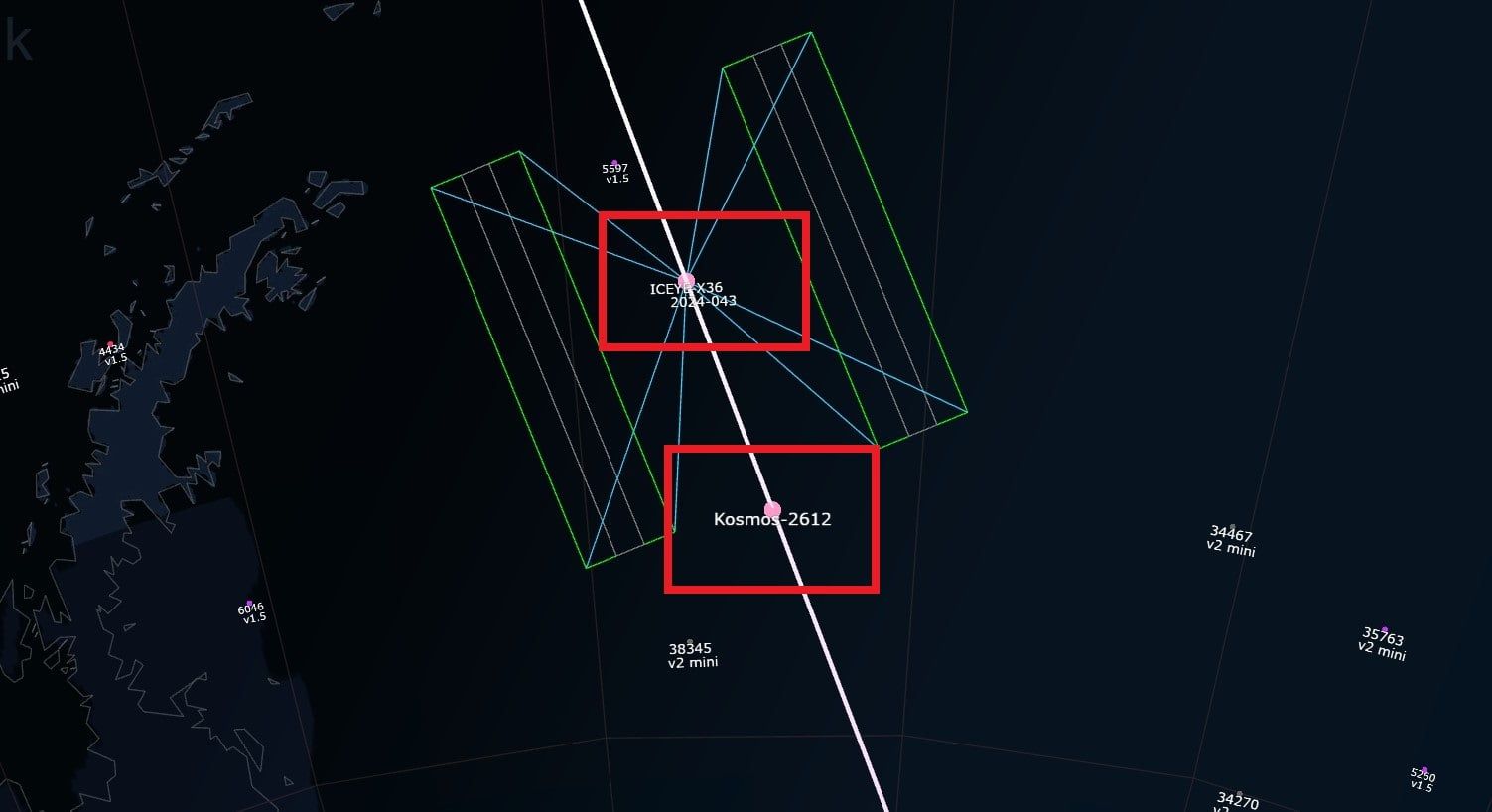
A Russian military satellite executed an unsanctioned rendezvous with a commercial radar spacecraft in low-Earth orbit, closing to extreme proximity before beginning a slow retreat.12 The maneuver targeted ICEYE-X36, a spacecraft owned by the American subsidiary of Finnish radar imaging provider ICEYE.12 The incident marks the first documented case of an unsanctioned rendezvous between two active spacecraft in low-Earth orbit where the operator of the target satellite gave no consent.1
The Russian spacecraft, designated Kosmos 2612, launched in April on a Soyuz rocket from a spaceport in northern Russia.1 US military officials and independent analysts tracked the vehicle alongside five other payloads deployed during the same launch.1 Within weeks of reaching orbit, at least four of the six satellites adjusted their flight paths to align with the orbital plane of ICEYE-X36.1
Orbital intelligence firm LeoLabs, which operates a global radar network capable of detecting objects as small as two centimeters, monitored the pursuit over several months.1 The situation shifted from passive tracking to active maneuvering in late September.2 According to a report from the Center for Strategic and International Studies, the Russian spacecraft conducted a sequence of orbital adjustments to match the altitude and path of the commercial satellite.2
On October 12, Kosmos 2612 executed a propulsion burn that changed its velocity by approximately 27.9 meters per second.2 That adjustment lifted its orbit to an altitude of roughly 555 kilometers, matching the working altitude of ICEYE-X36.2 Orbital tracking data compiled by satellite monitoring service satellitemap.space showed the Russian vehicle stationed at an altitude of about 547 kilometers, hovering two kilometers above ICEYE-X36 at 545 kilometers.2
A deliberate orbital rendezvous
By Friday, Kosmos 2612 was holding station two to three kilometers away from the commercial platform before shifting relative positions directly ahead of and behind the target.1 Over the weekend, the separation distance narrowed sharply.12 LeoLabs recorded the two satellites operating within 500 meters of each other, noting that the physical proximity occasionally made it difficult for ground radars to distinguish the two spacecraft independently.1
Tracking records from satellitemap.space indicated an even closer encounter.2 At 02:06 Coordinated Universal Time on October 19, Kosmos 2612 was positioned roughly 640 meters behind ICEYE-X36 and two kilometers above it.2 By 16:07 UTC that afternoon, the separation narrowed to 26 meters.2

The precision of the flight path ruled out an accidental conjunction. Orbital mechanics dictate that altering an orbital inclination requires significant fuel expenditure, while maneuvering within an established plane consumes far less propellant.2 The flight sequence demonstrated controlled proximity operations, characterized by an intentional approach, station keeping, and relative orbit adjustments.
"This was not a routine conjunction or 'fly by,'" LeoLabs said in a technical assessment.1 "The sequence included a controlled approach, changes in relative position, close-proximity loitering, additional small maneuvers, and a controlled departure. The behavior is consistent with sophisticated rendezvous and proximity operations (RPO)."1
Adam Marsh, vice president of technical solutions at LeoLabs, described the operation as unprecedented in low-Earth orbit.1 While similar rendezvous maneuvers have occurred in geosynchronous orbit, unconsented loitering at lower altitudes has previously been limited to tests involving a nation's own hardware.1 "As far as this kind of event, rendezvousing in, staying there for a few days, and getting very, very close in low-Earth orbit, this is the first time we’ve ever seen this without consent," Marsh said.1 "We’ve seen them test it with their own satellites before, but not like this."1
Jonathan McDowell, an astrophysicist who tracks orbital launches and cataloged space objects, noted the historic nature of the maneuver.1 "To my knowledge, this is the first LEO rendezvous of two active satellites where the owner of one of the sats (satellites) did not give approval," McDowell said in a public statement.1
Commercial synthetic aperture radar
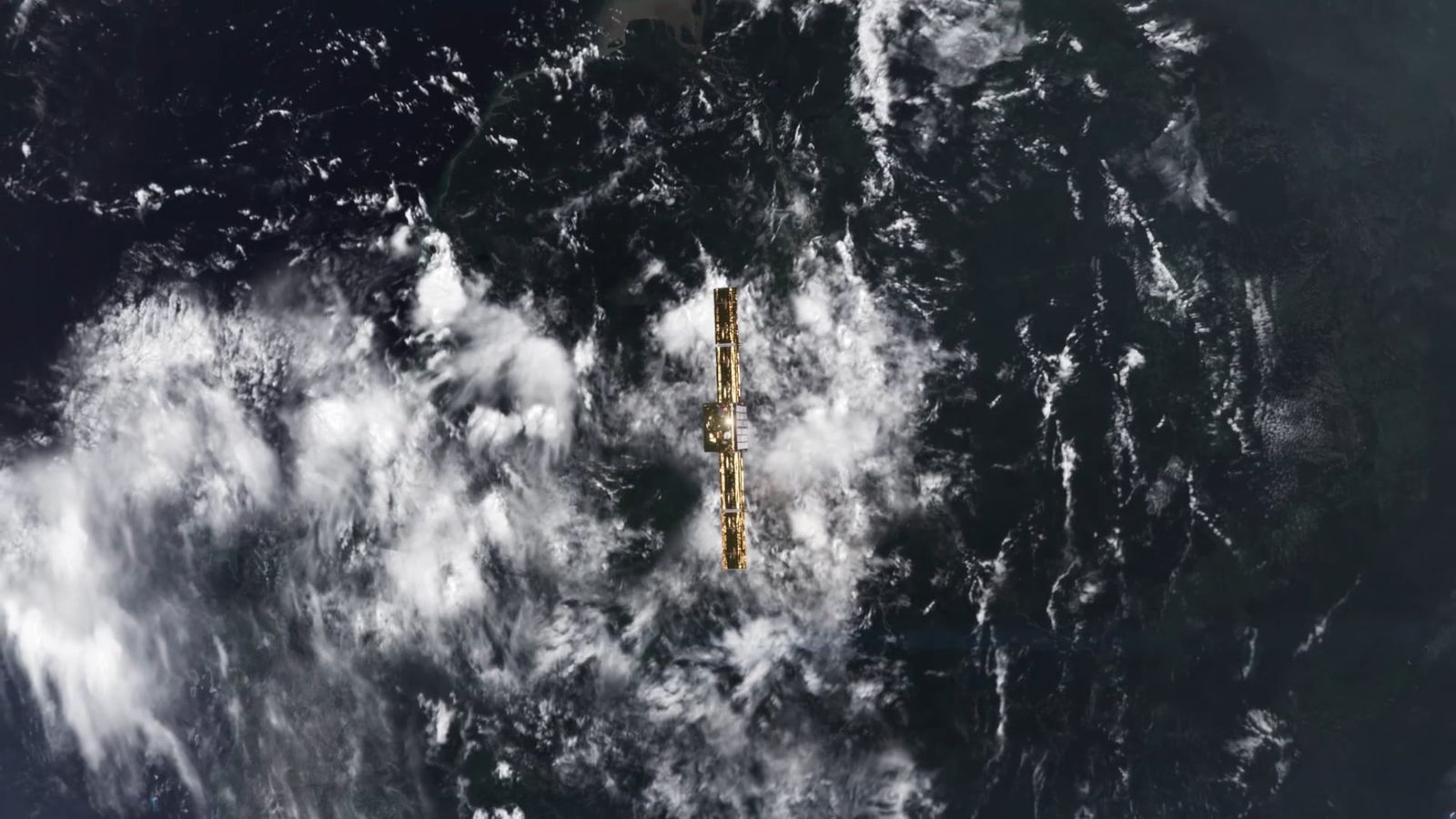
The target of the operation occupies a sensitive position in defense reconnaissance. ICEYE-X36 carries synthetic aperture radar, a sensor technology capable of penetrating cloud cover, smoke, and darkness to generate high-resolution imagery of the ground.12 Conventional optical reconnaissance platforms require daylight and clear skies to produce usable intelligence, constraints that radar systems bypass.1
ICEYE US owns and operates the satellite.1 The Finnish parent company has launched 80 satellites to date and maintains a commercial constellation supplying intelligence to multiple defense customers, including the US military and several European defense ministries.1 Ukraine has relied heavily on ICEYE's near-real-time space-based radar intelligence since the Russian invasion in 2022, using the data to direct battlefield operations and monitor logistical movements.12
That military utility made the commercial fleet a declared target in Moscow. In 2022, a Russian government official stated publicly that commercial satellites supporting Ukraine's military operations constituted legitimate military targets.1 Close proximity operations allow an approaching satellite to inspect an adversary's sensors, analyze antenna designs, and potentially conduct electronic interference or physical tampering.2
Operating near a commercial spacecraft also exploits legal and operational ambiguities in space defense. In April, Gen. Stephen Whiting, commander of US Space Command, warned that Russia is actively operationalizing anti-satellite capabilities.1 Government assessments have also indicated Russian interest in placing nuclear devices in orbit, while the US military disclosed that it has placed defensive systems in space without detailing their specifications.1
Retired Lt. Gen. John Shaw, a former deputy commander of US Space Command, characterized the close approach as calculated intimidation aimed at commercial providers.1 "So far, the best interpretation of the Russian activity is clear messaging that they will intentionally conduct aggressive activity near platforms they perceive as actual or potential threats to their interests," Shaw said.1 "A broader point is the acknowledgment this activity in the space domain is not at all different from what we often see Russia conduct in the other domains—close-in aggressive and provocative behavior."1
Shaw noted that Russian military aircraft routinely fly within air defense identification zones near American and Canadian airspace, and Russian fighters forced down an unmanned US surveillance drone over the Black Sea in 2023.1 "If the Russians were willing to do this to an unmanned US military platform, it would seem their threshold for attacking an 'unmanned' commercial space platform cannot be too different," Shaw said.1
Resilience and departure
By Monday, Kosmos 2612 had concluded its inspection and began drifting away from the American satellite at a relative speed of approximately 10 mph, or 17 kilometers per hour.1 Ground telemetry detected no physical damage to ICEYE-X36, and the spacecraft remained fully operational throughout the encounter.1
A spokesperson for ICEYE US confirmed that the company tracked the Russian maneuvers continuously.1 "We are aware of the situation and tracking it closely," the spokesperson said.1 "Our constellation architecture is designed for continuity and resilience."1
The loss of an individual platform would cause minimal operational disruption to the broader network.1 ICEYE maintains dozens of active spacecraft in orbit, with four additional radar satellites scheduled to launch on a SpaceX rideshare flight.1 That distributed architecture prevents an adversary from disabling tactical radar coverage by neutralizing a single orbital node, ensuring continuous intelligence flow even during active confrontation.
The record
49 sentences trace to 2 sources.
-
1
SC
Stephen Clark Document · arstechnica.com · 19 Oct 2026 Russian spacecraft maneuvers in "extreme proximity" to satellite used by Ukraine See the source
-
2
N
newsukraine.rbc.ua Third-party reporting · newsukraine.rbc.ua · 19 Oct 2026 Russia stages space provocation as its satellite comes dangerously close to Ukraine partner See the source