Medieval Russian bread shovel doubled as an eleventh century board game
Archaeologists in Staraya Russa uncovered a rare wooden baking paddle with an ancient logic game carved into its reverse side.
How did medieval bakers pass the hours beside hot ovens?
Baking bread in an eleventh-century wood oven required long periods of watchful waiting. A baker heated a masonry hearth with firewood, cleared out glowing embers, slid unbaked loaves inside on a broad flat paddle, and waited for the trapped heat to bake the dough. During those slow stretches between loading and unloading the hearth, workers needed simple ways to pass the time that required neither expensive equipment nor extra furniture.
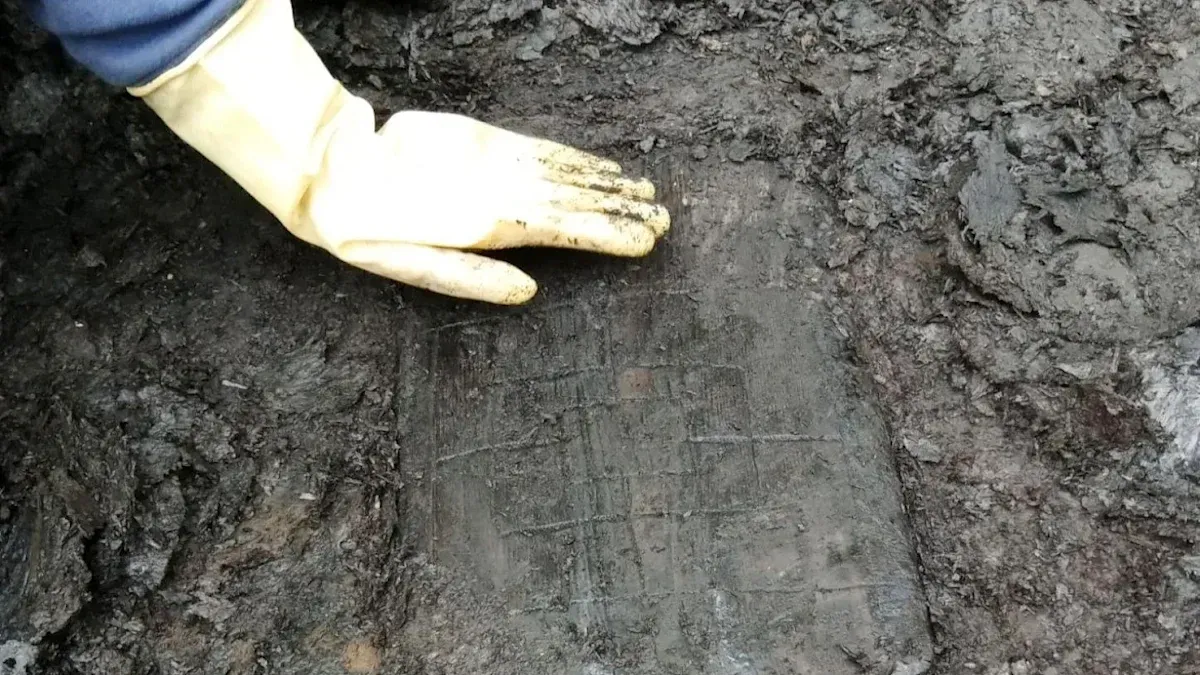
A discovery in western Russia reveals how ordinary townspeople solved that idle interval by transforming essential kitchen tools into leisure objects. During excavations at the medieval settlement of Staraya Russa, situated between Moscow and St. Petersburg, archaeologists uncovered a carved wooden baking paddle dating to the eleventh century.12 The tool features a smooth flat face designed to slide loaves across hot stones, while its reverse side carries a carefully incised board for merels, a strategic grid game popular across the ancient and medieval worlds.13
Organic domestic objects like wooden paddles rarely survive in the archaeological record, because soil microbes and moisture usually decompose timber within decades. At the Pyatnitsky excavation in central Staraya Russa, waterlogged clay layers preserved the oak implement along with the fine geometric grooves scored into its grain.14 The surviving fragment measures approximately 30 by 40 centimetres, or about 12 by 16 inches, along with the stump of its original handle.13
What kind of game is carved into the paddle?
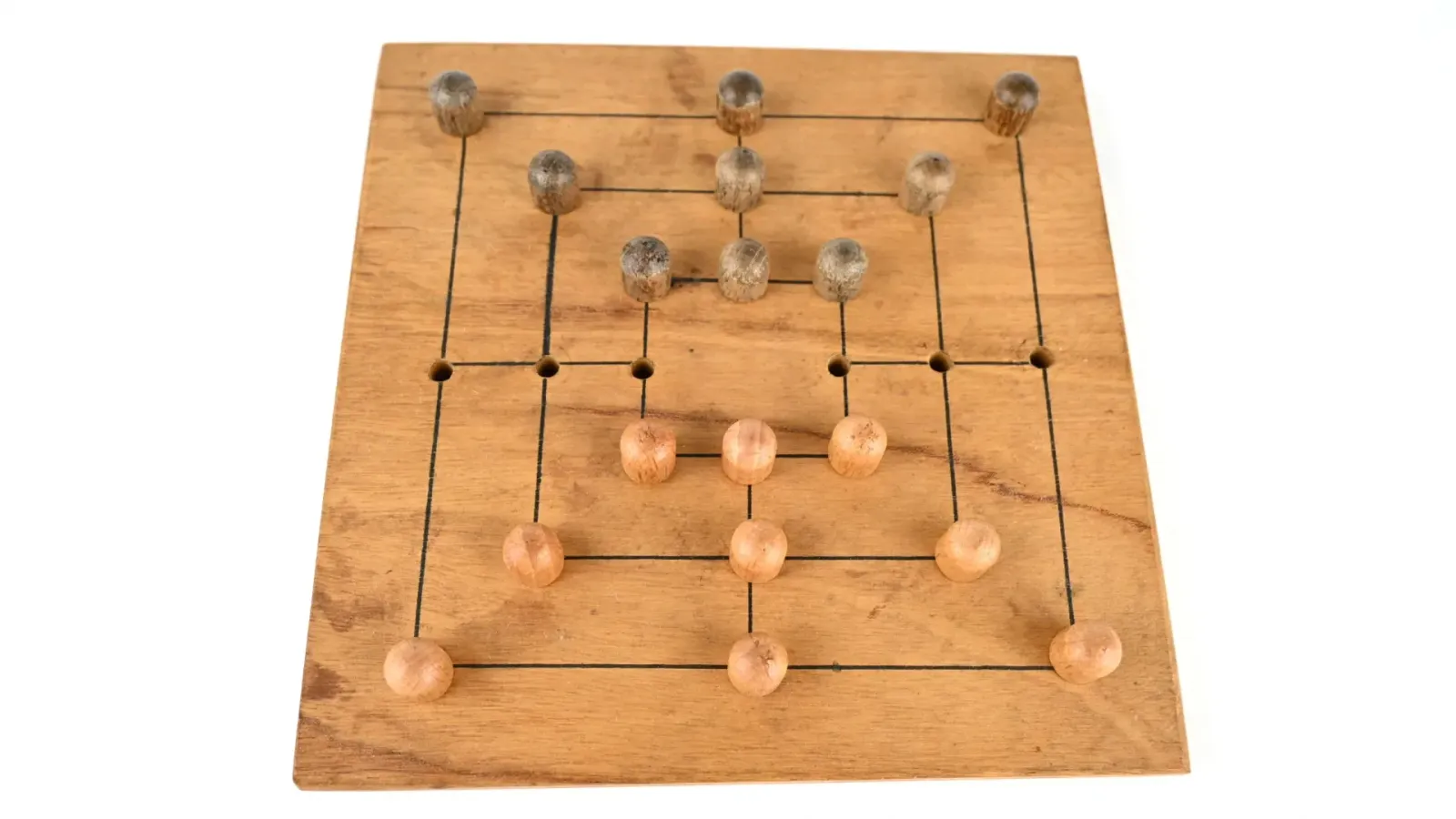
The carved pattern on the back of the paddle belongs to merels, an ancient game of alignment and capture also known as nine men's morris, mills, or cowboy checkers.12 The board consists of three concentric squares nested inside each other, connected by perpendicular lines running through the midpoints of their sides.13 Two competitors each control nine playing pieces, traditionally small stones, wooden pegs, or bone counters picked up from around the homestead.12
Players take turns placing their counters on the intersections of the grid, aiming to form straight rows of three along the lines.12 Each completed triplet allows a player to capture one of the opponent's pieces from the board.12 After all eighteen counters are placed, players slide their pieces along adjacent lines to form new triplets, and a participant wins by trapping their opponent or reducing them to two pieces.12 In medieval Rus', historical variants of the pastime were known colloquially as Nine Dancers.4
The rules rewarded foresight and spatial planning while requiring minimal setup. Historical records indicate that comparable grid games existed in ancient Rome two millennia ago, and related designs appear as far back as ancient Egypt.14 In medieval Rus', where Norse settlers known as the Rus' established trade networks from the eighth century onward, gaming boards and counters have been documented in ninth-century layers at Novgorod and Staraya Ladoga.14
Who carved the game into the baking shovel?
Sergey Toropov, director of the Center for Archaeological Research at Novgorod State University, reported that the paddle came from one of the earliest occupational levels of an eleventh-century urban estate.43 The tool was crafted from oak timber, a durable hardwood capable of withstanding the heat of domestic ovens.13 Toropov noted that while dedicated wooden gaming tables existed for wealthy elites in antiquity, ordinary folk routinely scratched boards into utilitarian household surfaces.13
Archaeologists cannot yet determine whether the implement served a dual purpose during daily kitchen routines or received its carved grid only after breaking.12 A baker may have flipped the tool over during long baking shifts to play a quick match on the bench. Alternatively, after the handle snapped or the blade cracked from oven heat, a household resident may have salvaged the flat oak timber as a durable game board rather than discarding it into the hearth.
What are the limits of the discovery?
The preserved shovel cannot resolve whether baking and gaming occurred concurrently or in two distinct phases of the object's life. The archaeological context establishes the century of deposition and the structure of the estate, but it cannot show who wielded the tool or carved the lines. Tool marks on waterlogged wood demonstrate intentional layout, yet they do not record which local rule variations the household followed during play.
Furthermore, isolated wooden artifacts cannot indicate how widespread this specific repurposing practice was across medieval towns. Wood survives only under exceptional anaerobic conditions where oxygen cannot penetrate the sediment. Most wooden peels from the period decayed centuries ago, meaning researchers cannot verify whether dual-purpose kitchen tools were common fixtures or rare improvisations.
What does the find tell us about medieval daily life?
The Staraya Russa paddle provides rare physical proof that intellectual pastimes were woven directly into the workspace of ordinary medieval households. Rather than being confined to tavern tables or aristocratic halls, strategic pastimes occupied the working corners of domestic compounds. The discovery underscores how medieval townspeople integrated problem-solving pastimes into the rhythm of domestic labor, using whatever flat surfaces and loose pebbles were close at hand.
The record
18 sentences trace to 4 sources.
-
1
KK
Kristina Killgrove Document · livescience.com · 19 Oct 2026 11th-century 'pizza peel' discovered in Russia doubled as a medieval game board See the source
-
2
РИ
Рамблер/развлечения и отдых Third-party reporting · weekend.rambler.ru · 19 Oct 2026 В Старой Руссе нашли хлебную лопату XI века с вырезанным игровым полем мереля See the source
-
3
N
Novgorod.ru Third-party reporting · news.novgorod.ru · 15 Oct 2026 Археологи НовГУ нашли лопату, на которой древние рушане играли в подобие «крестиков-ноликов» See the source
-
4
A
abnews.ru Third-party reporting · abnews.ru В Старой Руссе нашли лопату XI века - АБН 24 See the source