Tiny mineral deposits allow synthetic nanopores to read molecules autonomously
A nanoscale opening that repeatedly forms and dissolves mineral crystals can identify DNA bases and amino acids by retaining a chemical memory of recent interactions.
When an electric current pulls a molecule through a tiny channel, the shape and size of that molecule momentarily alter the flow.12 In conventional sensors, that physical bottleneck provides a single readout: the channel stays rigid, the ions rush around the obstruction, and the electrical circuit records an instantaneous dip before resetting. The channel retains no trace of what just moved across its opening, responding in the exact same manner whether it has met one particle or thousands in the preceding second.
Biological channels operate under very different physical rules. In living systems, molecular pores continuously interact with their surrounding chemical bath, changing shape, accumulating surface ions, and reacting to recent encounters. Designing synthetic versions that mimic this active responsiveness has remained a major challenge in nanoscale engineering. Most manufactured pores drilled into synthetic membranes behave like passive drainpipes, relying entirely on external computer processors and variable voltage controls to sort through biological samples.
A research collaboration led by the Institute of Scientific and Industrial Research at the University of Osaka has now created a synthetic pore that alters its own opening without external tuning.13 By allowing tiny mineral deposits to continuously precipitate and dissolve at the mouth of the channel, the device opens and closes autonomously under a constant electrical voltage.13 Because each passing molecule interferes with this continuous crystallization cycle, the resulting electrical pulses carry information about both the current molecule and the recent chemical history of the channel.13 The authors reported in the journal ACS Nano that machine learning models could analyze these history-dependent electrical waveforms to distinguish among all four individual DNA bases as well as seven amino acids.21
How do molecules leave distinct electrical traces in a changing channel?
Molecules register their presence by disrupting a self-sustaining cycle of mineral growth and dissolution that occurs at the narrowest constriction of the channel. To understand why this creates a measurable signal, consider the sequential physical steps required for autonomous detection. First, a steady electrical voltage is applied across a thin membrane separating two salt solutions.1 This applied voltage drives local electrochemical reactions that cause minerals to precipitate and form tiny deposits inside the nanoscale opening, which narrows the passageway until the current nearly shuts off. Next, the restricted flow alters the local chemical environment, causing those newly formed deposits to dissolve back into solution.12 Once the minerals dissolve, the channel briefly clears, allowing ions to surge through again before the precipitation cycle restarts.
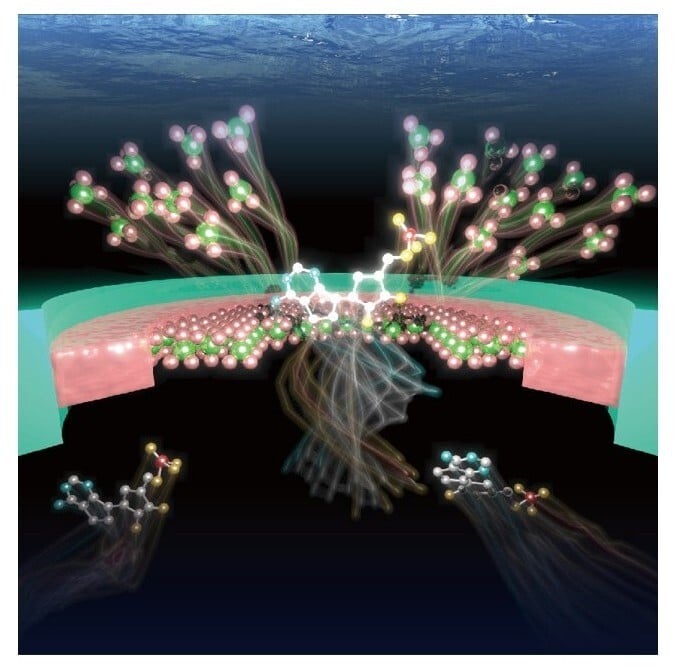
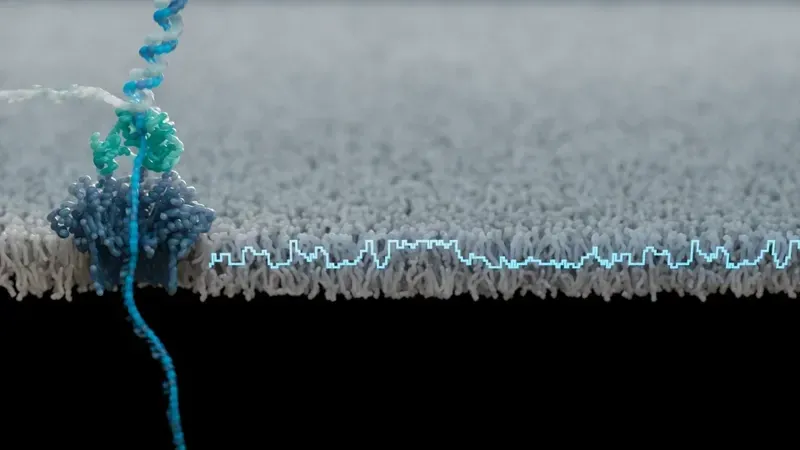
When an analyte enters this environment, it alters that cyclical rhythm. A passing nucleotide or amino acid does not simply obstruct ionic flow in a static aperture. Instead, the molecule physically and chemically interacts with the growing and dissolving mineral crystals, altering the exact rate at which precipitates form and disappear. Consequently, each passage shifts the amplitude, duration, and timing of the current bursts produced during the opening and closing cycles.12 Because the state of the mineral deposit at any given millisecond depends directly on how recently and how strongly earlier molecules altered the crystal growth, the device functions as a stateful sensor with short-term chemical memory.
The resulting electrical current displays complex, non-repeating fluctuations rather than uniform square-wave pulses. Associate Professor Makusu Tsutsui, the lead author of the study at the University of Osaka, noted that under a constant voltage supply, chemical reactions repeatedly build up and dissolve tiny mineral deposits, creating bursts of electrical signals without any external switching.31 Senior author Tomoji Kawai explained that different molecules change the size, duration, and timing of these electrical spikes in distinctive ways, leaving what he described as unique electrical signatures.13 Kawai stated that because each signal also depends on the nanopore recent memory, the device behaves as a remembering, chemically active sensor.13
Why does protein sequencing require a different kind of sensor?
Protein sequencing requires more adaptable sensors because the fundamental building blocks of proteins are vastly more diverse and chemically nuanced than those of nucleic acids. While genetic material is composed of only four distinct nucleotide bases, standard proteins are built from 20 different amino acids that share similar backbones and vary only in subtle side-chain structures.1 Standard sequencing techniques rely heavily on biological pores derived from bacterial toxins, which thread linearized strands through a fixed protein barrel. While these protein pores have successfully commercialized single-molecule DNA sequencing over the past decade, adapting them to the intricate geometry of folded or diverse peptide chains has proven considerably more difficult.1
Solid-state pores drilled into synthetic materials offer greater durability and thermal stability than fragile protein channels, but their rigid surfaces often lack the delicate molecular recognition needed to separate similar amino acids.1 In the Osaka experiments, the research group demonstrated that their autonomous mineral channel could distinguish seven distinct amino acids by processing the stateful electrical bursts through machine learning algorithms.23 The autonomous pore also identified mixtures containing multiple DNA nucleotides without requiring real-time external manipulation of the applied voltage.31
The ability to classify both nucleotides and amino acids on a single synthetic platform points toward practical applications in label-free molecular analysis. Conventional analytical methods frequently require tagging molecules with fluorescent dyes or chemical reagents before measurement, which can disrupt delicate biological samples and increase preparation times. A device capable of single-molecule identification through purely physical and electrochemical interactions avoids the need for chemical labeling, making it an attractive candidate for portable biomedical diagnostics.
What are the limits of the autonomous mineral channel?
The laboratory findings describe an experimental proof of concept measured in clean, controlled liquid solutions, which cannot yet tell observers how the sensor will perform in complex biological fluids such as blood plasma or cellular lysates. Real clinical samples contain thousands of competing proteins, lipids, and background salts that could coat the synthetic surface, foul the mineral crystallization cycle, or produce overlapping electrical signatures that machine learning models cannot accurately classify. Furthermore, the published paper does not report explicit numerical accuracy percentages for its amino acid classifications, leaving the precise operational error rate undetermined across extended sensing runs.1
The underlying mechanism also relies on an ongoing chemical reaction that forms and dissolves minerals, meaning the device operates in a dynamic regime that depends heavily on local solution chemistry, pH, and ion availability. Any century-old Coulter counter relies on a fixed geometry to count passing blood cells by momentary changes in resistance; here, by contrast, the geometry continuously shifts.1 If the delicate balance between precipitation and dissolution falters because of drift in reactant concentrations or temperature, the pore could permanently seal itself shut or remain stuck in an open state. The researchers have not yet disclosed the exact identity of the mineral deposits involved or demonstrated long-term mechanical endurance over continuous weeks of operation.1
Where does autonomous molecular sensing lead?
Beyond molecular diagnostics, the demonstration of an autonomous nanoscale channel contributes to the emerging discipline of iontronics, a branch of engineering that processes information using mobile ions in fluids rather than electrons in solid silicon.13 Biological nervous systems process information through ion currents crossing neural membranes, storing state through physical and chemical adaptations. By integrating molecular sensing, signal generation, and physical memory into a single nanoscale component, the autonomous pore mirrors the behavior of memristors, which are electrical components whose resistance changes according to the history of current that has previously passed through them.13
Tsutsui described the work as a shift in how nanopores are designed, stating that instead of serving as passive channels that simply let molecules through, nanopores can actively respond to their chemical environment.3 The collaborative team included researchers from the University of Osaka Institute of Scientific and Industrial Research, the University of Osaka Research Institute for Microbial Diseases, the University of Tokyo Graduate School of Engineering, the National Institute of Advanced Industrial Science and Technology, and the Italian Institute of Technology.2 Future research will need to determine whether the mineral precipitation cycle can remain stable when exposed to full-length protein chains, and whether the classification algorithms can maintain their discriminative accuracy when faced with all 20 standard amino acids.
The record
23 sentences trace to 3 sources.
-
1
S
scientificinquirer Document · scientificinquirer.com · 20 Oct 2026 A Nanopore That ‘Remembers’ Identifies DNA Bases and Amino Acids Without Being Steered See the source
-
2
T
t.u-tokyo.ac.jp Press release · t.u-tokyo.ac.jp Autonomous molecular sensing with a chemically stateful solid-state nanopore: Toward next-generation single-molecule sensors capable of distinguishing between DNA bases and amino acids See the source
-
3
R
resou.osaka-u.ac.jp Third-party reporting · resou.osaka-u.ac.jp New smart sensor identifies present molecules by remembering the past See the source