Engineered proteins could neutralize deadly scorpion venom without animal blood
Computational models designed small proteins that attach to four dangerous scorpion neurotoxins, offering an early step toward synthetic antivenoms that do not rely on horse ranches.
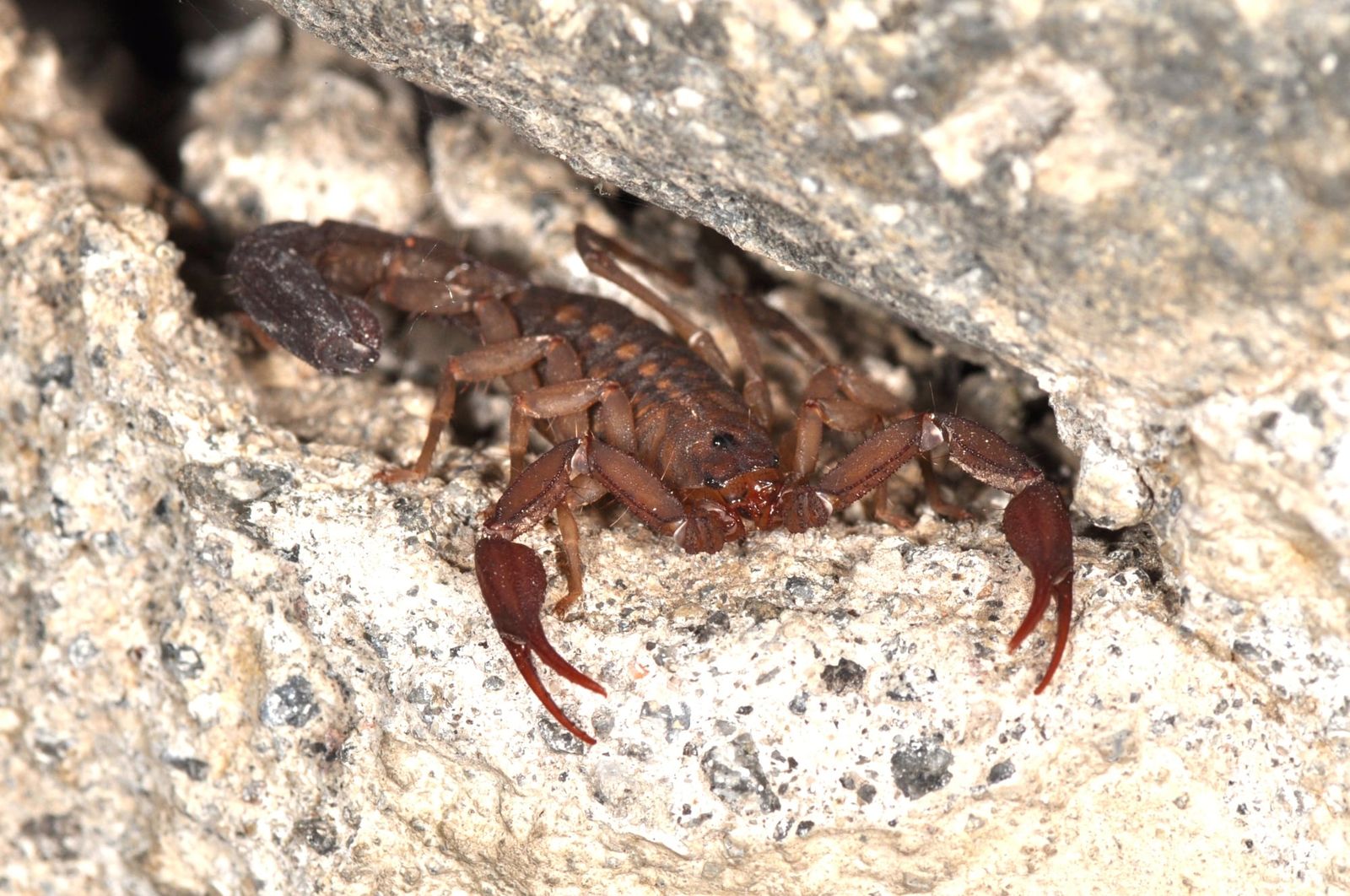
When a venomous scorpion strikes, it injects a complex cocktail of neurotoxins that turn the victim's own nervous system against itself.1 Nerve cells communicate by passing tiny electrical currents across their membranes through microscopic gateways known as sodium channels.1 Under ordinary conditions, these channels open briefly to let sodium ions surge inward, sending an electrical signal along the nerve, and then promptly snap shut so the cell can reset. Scorpion neurotoxins interfere with this precise cycle.1 By locking onto the channel's outer gate, the toxins jam the mechanism open or alter its timing, forcing nerves to fire uncontrollably. The resulting barrage floods the human body with stress hormones such as adrenaline, triggering rapid heartbeat, high blood pressure, fluid buildup in the lungs, and fatal heart failure.1
Scorpion stings represent an acute global health emergency, yet treatment options have remained largely unchanged for more than a century. Every year, roughly 1.2 million people suffer scorpion stings, resulting in more than 3,250 deaths, mostly among young children in rural regions with fragile medical infrastructure.12 The standard therapy relies on conventional antivenom serum produced by immunizing livestock. Technicians milk venom from thousands of live scorpions, inject tiny sublethal doses into horses or sheep over several months, and collect the animals' blood to harvest the resulting protective antibodies.1 This biological manufacturing cycle is slow, technically demanding, and vulnerable to supply shortages. Because horse antibodies are foreign proteins to the human immune system, animal-derived serums can also trigger severe allergic reactions, and each preparation typically neutralizes only the specific toxins found in a single geographic region.1
Neutralizing these venom molecules requires an agent that can latch onto the dangerous region of the neurotoxin before the toxin can reach a nerve cell. In molecular biology, a binder is any compound engineered to cling tightly to a specific molecular target.1 If an engineered protein binds directly to the specific groove on a neurotoxin that would otherwise plug into a nerve cell's sodium channel, it acts as a molecular shield.1 The toxin remains suspended in the bloodstream, physically blocked from engaging the nervous system until the body clears it safely.
Anthropic reported on October 20, 2026, that an internal artificial intelligence research model autonomously designed novel protein minibinders against four dangerous scorpion neurotoxin species.12 Working inside a computational environment called Claude Science, the model generated hundreds of thousands of candidate protein structures from scratch over a 64-hour run.13 In physical laboratory experiments conducted by two independent testing laboratories, Adaptyv Bio and Twist Bioscience, 17 of the synthetic designs met strict laboratory criteria for tight, targeted binding against lethal neurotoxins from Mexico, North Africa, and the Middle East.12
How did artificial intelligence generate viable protein binders from scratch?
Claude generated novel protein binders by orchestrating a pipeline of 12 specialized computational tools that mapped target surfaces, assembled amino acid backbones, and simulated physical docking.1 The automated design campaign was initiated after Citrini Research, an investment research firm, approached the life sciences team at Anthropic to explore whether advanced machine learning models could empower researchers to address neglected global health priorities.1 The team directed Claude using an initial prompt defining five target scorpion neurotoxins, accompanied by rules for biological novelty, computational filtering, and structural scoring.1
The study focused on five neurotoxin variants representing distinct geographic hazards: Cn2 from the Mexican scorpion Centruroides noxius, Ts1 from the Brazilian scorpion Tityus serrulatus, AaH I and AaH II from the North African scorpion Androctonus australis, and LqhIII from the Middle Eastern scorpion Leiurus quinquestriatus.1 These toxins present a notoriously difficult design challenge. While they share a similar overall three-dimensional protein fold, their amino acid sequences vary considerably, sharing only 26% to 62% sequence identity with one another.1 To find viable targets on each molecule, Claude examined structural repositories including the Protein Data Bank and the AlphaFold database, identifying five hotspot residues on each toxin that correspond to the critical site where the toxin binds to human sodium channels.1
Over the course of 64 hours, the model operated largely autonomously across roughly 10,000 graphics processing unit hours, producing 318,484 candidate protein designs.1 The system systematically filtered out any design that closely matched existing natural proteins or natural toxins to guarantee novelty.1 It co-folded and screened 553,052 design-toxin complexes in silico, evaluating how tightly the virtual surfaces packed against each target.1 The automated system selected 180 promising candidates, to which the research team added 31 additional designs chosen with Claude's assistance, yielding a final panel of 211 candidates for physical synthesis.
What did laboratory experiments reveal about the synthetic designs?
Physical laboratory testing confirmed that 17 of the 211 computational designs successfully bound to their target scorpion neurotoxins under rigorous experimental conditions.1 To validate the computer models in the physical world, Anthropic sent the digital amino acid sequences to two contract research organizations that produced the proteins using completely different laboratory systems. Adaptyv Bio synthesized the minibinders using a cell-free platform that extracts bacterial cellular machinery to construct proteins in test tubes without living cells.1 In parallel, Twist Bioscience manufactured the binders inside cultured human embryonic kidney cells, fusing each minibinder to the constant Fc stem of a human antibody to mimic therapeutic antibody formats.1
Both testing facilities measured binding interactions using surface plasmon resonance, an optical technique that flows a liquid solution of toxin molecules across a sensor chip coated with the candidate binder.1 By monitoring subtle changes in reflected light as molecules attach and detach in real time, the instruments generate an optical trace called a sensorgram. This trace yields the dissociation constant, known as KD, which quantifies binding affinity.1 A lower dissociation constant indicates that a binder grips its target with greater strength at lower concentrations.
Anthropic established a demanding threshold to define a successful binder: a candidate had to demonstrate binding in every test replicate at both testing facilities with a dissociation constant of 1 micromolar or tighter. In addition, the candidate had to show zero interaction with CLEC12A, an unrelated human protein tested as a negative control to ensure the synthetic molecules were not simply sticky, non-specific proteins that latch onto random cellular tissue.1 Out of 211 tested candidates, 17 met every criterion.1 Seven successful binders targeted the Mexican neurotoxin Cn2, four bound North African AaH I, four bound North African AaH II, and two bound Middle Eastern LqhIII.1 None of the designs successfully bound the Brazilian toxin Ts1.2
The strongest candidates, designated Cn2-B1 and Cn2-B2, bound the Mexican Cn2 neurotoxin with single-digit nanomolar affinity at both laboratories.1 To evaluate where these binders attach, researchers conducted competitive binding experiments against LR, a known laboratory antibody that protects mice from Cn2 envenomation by covering the toxin's sodium-channel binding site.1 The tests demonstrated that Cn2-B1 and Cn2-B2 compete with the LR antibody for the exact same physical docking site on the neurotoxin, indicating that the synthetic proteins target the precise functional region necessary to prevent the toxin from engaging nerve cells.1
What are the limits of the current laboratory findings?
The current laboratory results demonstrate physical attachment to synthetic toxin molecules but do not prove that the engineered proteins can neutralize live scorpion venom inside a living organism.1 Anthropic emphasized that the research team has not produced a functional antivenom drug.1 In the experimental evaluations, the binders were tested exclusively against recombinant toxins manufactured from isolated genetic sequences in a laboratory, rather than venom extracted directly from wild scorpions.1 Natural scorpion venom contains diverse chemical isomers, digestive enzymes, and complementary peptide toxins that could interact differently with synthetic binders.
Furthermore, none of the 17 confirmed binders has been evaluated in cellular electrophysiology assays or tested inside live animals.1 Confirming true therapeutic neutralization requires patch-clamp recordings on cultured neurons to measure whether a binder prevents toxins from altering electrical current through voltage-gated sodium channels.1 Following cellular assays, candidate molecules must prove safe and effective in animal survival studies, demonstrating that they protect mice injected with lethal venom doses without causing toxicity or adverse immune reactions.1
The campaign also revealed computational boundaries when attempting to target multiple neurotoxins simultaneously. Anthropic asked the model to design broad-spectrum binders capable of recognizing several related toxins at once, including 91 designs intended to bind all five neurotoxins.1 However, every single one of the 17 successful binders bound only one specific toxin; not a single cross-reactive candidate succeeded against multiple targets.1 In an earlier study released on August 18, 2026, Anthropic demonstrated that Claude Opus 4.8 and Mythos Preview achieved single-target binder success rates between 22% and 35% across benchmark proteins, whereas the single-toxin success rate in the scorpion campaign reached 18%, yielding 11 binders from 60 single-target attempts.41
What must happen before synthetic minibinders become treatments?
Transforming these initial binding hits into practical medical treatments will require resolving extensive pharmacological, formulation, and global distribution challenges. Outside experts reviewing the data noted both the technological achievement and the substantial clinical pipeline that remains ahead. Susana Vázquez Torres, a postdoctoral researcher in structural biology at the Spanish National Cancer Research Centre in Madrid, observed that computational tools have drastically accelerated early molecular discovery:1
Designing a binder against almost any target no longer seems unrealistic. We can now obtain very tight binders remarkably quickly, and binding itself is no longer the main bottleneck. For venomous animals such as snakes and scorpions, whose bites and stings kill or seriously injure large numbers of people, particularly in underserved regions, the real impact will come from tackling the parts of the therapeutic pipeline that go beyond binding. The challenge is to use these extraordinary tools to develop molecules that can become real drugs, ones that are safe, affordable, and widely accessible.1
Timothy P. Jenkins, an associate professor at the Technical University of Denmark, highlighted the potential of automated molecular design for underserved therapeutic areas, stating in Anthropic's technical release that agentic methods provide a significant speed-up in discovery and bring realistic therapeutic solutions much closer for neglected conditions that have historically lacked commercial research investment.1
To support continued research across the academic community, Anthropic released all 211 synthetic protein sequences, structural models, and raw physical assay data on Hugging Face under an open license.52 If synthetic minibinders prove capable of neutralizing native venoms in pre-clinical animal models, they could eventually form the foundation of recombinant, shelf-stable antivenom cocktails. Such formulations would bypass the need for animal immunization ranches entirely, allowing distributed bioreactors to produce low-cost treatments directly within the rural communities where scorpion stings remain an enduring threat.
The record
49 sentences trace to 5 sources.
-
1
A
Anthropic Document · anthropic.com · 20 Oct 2026 How Claude designed protein binders against scorpion neurotoxins See the source
-
2
X
x.com Third-party reporting · x.com Anthropic (@AnthropicAI) on X See the source
-
3
X
-
4
A
-
5
H
huggingface.co Third-party reporting · huggingface.co Anthropic/scorpion-toxin-binder-design · Datasets at Hugging Face See the source