Higher-page tori bring geometric order to irregular complex shapes
An algebraic filter called the Frölicher spectral sequence allows mathematicians to project non-Kähler manifolds onto orderly complex tori, exposing new metric restrictions on the six-dimensional sphere.
In geometry, the difficulty of understanding a high-dimensional space often depends on whether its internal directions can be cleanly separated.1 When a space is endowed with a complex structure, meaning its local coordinates behave like complex numbers with independent real and imaginary parts, the calculus of paths and surfaces gains rich algebraic rigidity.1 On the best-behaved of these shapes, known as Kähler manifolds, every closed geometric loop can be mapped through integration into a flat, donut-like grid known as a complex torus.1 This construction produces classical objects called the Jacobian and Albanese tori, which mathematicians use to project complicated multidimensional geometries onto simpler geometric fibrations.1
For decades, however, this bridge between shapes and tori has broken down whenever a space strays outside that well-behaved family.1 On more irregular, non-Kähler manifolds, the calculus that governs complex shapes ceases to balance, leaving mathematicians without a universal way to translate closed loops into orderly lattices of points.1 Without that translation, the broader landscape of complex geometries has remained resistant to the classification tools that work so effectively on symmetric spaces.
In a preprint posted to the arXiv mathematics repository on October 1, 2026, mathematicians Dan Popovici of Université Toulouse III - Paul Sabatier and Luis Ugarte of the Universidad de Zaragoza established a new theoretical machinery to bridge this divide.1 By climbing the successive stages of an algebraic filter known as the Frölicher spectral sequence, the authors proved that higher-order analogues of the Jacobian and Albanese tori exist for two substantial classes of non-Kähler shapes.1 The preprint showed that these higher-page structures preserve the holomorphic fibration properties of classical geometry and provide metrical constraints that rule out specific geometric structures on the six-dimensional sphere.
Why do geometric loops fail to form classical tori?
Classical constructions fail on irregular spaces because the measurement rulers used to evaluate paths do not split into balanced real and imaginary components.1 To build an Albanese torus from a complex manifold, a mathematician must first measure every possible path that wanders through the shape. This is done by integrating differential forms, which act as directional rulers, along paths connecting a fixed base point to any target location. When a path loops back on itself to form a closed circuit, the integral evaluates to a specific vector in a complex vector space. If the manifold possesses the right structural symmetry, the collection of all vectors produced by every closed loop forms a discrete, periodic grid known as an integral lattice.1
Dividing the full continuous vector space by this discrete grid wraps the flat space into a compact complex torus, where any two points differing by an entire loop integral are identified as the same position.1 For this construction to succeed, the underlying calculus requires the Hodge decomposition.1 In plain terms, any first-order measurement of direction must cleanly separate into a holomorphic component of type (1, 0) and an anti-holomorphic component of type (0, 1) that mirror each other across complex conjugation. That balance ensures that the real paths through the space fit precisely into the complex vector space without collapsing or drifting uncontrollably.1
On non-Kähler spaces, this balance breaks down at the very first step.1 The exterior derivative operator fails to decompose into tidy, independent operators, meaning forms that appear closed under one directional derivative are distorted by another.1 As a consequence, attempting to construct an Albanese or Jacobian torus directly from first-stage differential forms yields an incomplete or degenerate projection, preventing mathematicians from using the torus to fiber the original manifold into well-behaved geometric slices.1 Dan, a co-author of the preprint, told Primary that "The main obstruction was the lack of a standard Hodge decomposition of the de Rham cohomology of the given compact non-Kähler manifold as a direct sum of the Dolbeault cohomology groups of the same total degree."
How does a multi-stage algebraic filter restore geometric order?
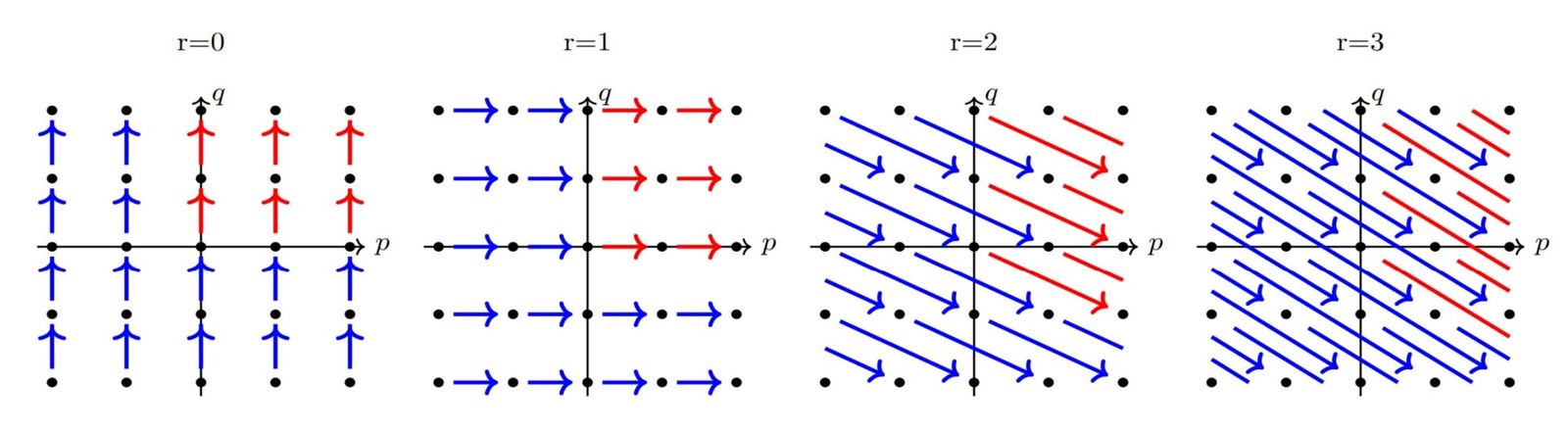
Mathematicians restore order to these unruly spaces by sorting the differential forms through a multi-tiered algebraic ledger known as the Frölicher spectral sequence.1 A spectral sequence functions like a book of successive approximations, indexed by positive integers called pages.1 On the initial page, labeled E 1, forms are grouped by their basic complex types, but they still carry the ambiguities caused by non-Kähler geometry.1 Moving to the second page, E 2, involves applying an algebraic differential that discards forms that fail to remain closed and cancels out exact boundaries.1 As one advances to higher pages E r, the remaining vector spaces E p,q r become smaller, progressively filtering away the geometric noise that prevented clean integration.
Dan Popovici and Luis Ugarte demonstrated that this filtering process reaches a point of structural balance on two specific families of manifolds.1 The first family consists of page-(r-1)-∂̄∂ manifolds, introduced in earlier joint work with Jonas Stelzig, where the analogue of the Hodge decomposition holds on the r-th page of the Frölicher spectral sequence.1 The second, broader family consists of E r -sGG manifolds, introduced by Popovici, where every Gauduchon metric on the space satisfies an E r -strongly Gauduchon condition.1 In their preprint, Popovici and Ugarte established that every page-(r-1)-∂̄∂ manifold is automatically an E r -sGG manifold, and that every E r -sGG manifold is an E r+1 -sGG manifold, providing an ascending stairway of structured geometric classes.1
Dan explained the underlying mechanics in comments to Primary: "The page-(r-1)-ddbar-manifolds, that we introduced and studied in our earlier joint work with J. Stelzig, have the analogue of the Hodge decomposition in which the usual Dolbeault cohomology (that forms the first page, E_1, of the Frölicher spectral sequence) is replaced by the cohomology on the r-th page of this spectral sequence. A key step in our new work was to prove that a weak version of the Hodge decomposition using the r-th page persists in the larger class of E_r-sGG manifolds. These are the compact complex manifolds on which every Gauduchon metric (these metrics always exist) is E_r-sG (a generalisation of the strongly Gauduchon metrics I introduced in 2013)."
By developing a dedicated Hodge theory for E r -sGG manifolds, Popovici and Ugarte proved that these spaces admit what they term a weak Hodge decomposition in degree one at the E r level. Under this condition, the canonical mapping from the first de Rham cohomology group into the direct sum of the spaces E 0,1 r and its conjugate is a well-defined bijection. This equivalence allowed the authors to prove that the dimension of the first Betti number is exactly twice the complex dimension of the space E 0,1 r, guaranteeing that the image of the first integral homology group forms a true, non-degenerate lattice inside the vector space.1
Using this lattice, Popovici and Ugarte defined the E r -Jacobian torus as the quotient of E 0,1 r by the lattice of first-degree integral cohomology, and the E r -Albanese torus as the quotient of E n-1,n r by the image of degree 2n-1 integral cohomology, where n represents the complex dimension of the manifold.1 They then constructed the E r -Albanese map, which sends each point of the manifold to the functional defined by integrating d-closed (0, 1)-type representatives along a path from a fixed base point. The authors proved that this mapping is holomorphic.1 Dan clarified how this property survives higher differentials, stating to Primary: "We study the local structure of the E_r-Albanese map. This map is expressible in terms of a finite set of d-closed (1,0)-forms. Every d-closed form is locally d-exact, so on a sufficiently small, simply connected, open subset U, each of these d-closed (1,0)-forms is of the shape df_j for some locally defined holomorphic function f_j. The holomorphicity of the E_r-Albanese map follows from the holomorphicity of the functions f_j."
When the underlying space is complex parallelisable, meaning its holomorphic tangent bundle is trivial, the preprint established that the E r -Albanese map is a surjective holomorphic submersion, and that the algebraic dimension of the original manifold is identical to the algebraic dimension of its E r -Albanese torus. This directly extends earlier results on nilmanifolds and solvmanifolds, proving that these geometric structures preserve their fibration properties under higher-page mappings.
What does the higher-page framework reveal about the six-dimensional sphere?
The six-dimensional sphere S 6 exhibits severe metric restrictions under hypothetical or claimed complex structures because its topological invariants force specific degeneration behavior in the Frölicher sequence.1 Whether the smooth six-dimensional sphere admits any integrable complex structure remains one of the longest-standing open problems in differential geometry.1 If an integrable complex structure exists, the resulting three-dimensional complex manifold must conform to the rigid topological bounds of the sphere, where the first, second, and fourth Betti numbers are zero.1
Applying their framework to this longstanding puzzle, Popovici and Ugarte examined S 6 under any hypothetical complex structure, as well as under the specific complex structures recently claimed by other researchers in the mathematical literature.1 The authors proved that if the six-dimensional sphere is endowed with any hypothetical complex structure J, the resulting manifold is necessarily a page-2-∂̄∂ manifold, which implies that it is also an E 3 -sGG manifold.1 Furthermore, the paper established that if such a hypothetical manifold supports a strong Kähler with torsion metric, abbreviated as an SKT metric, it must satisfy the stronger condition of being a page-1-∂̄∂ manifold.1
Dan detailed how these bounds restrict candidate geometries, telling Primary: "For standard topological reasons, it has long been known that any hypothetical complex structure on the 6-sphere cannot be dd-bar, i.e. cannot admit a classical Hodge decomposition. Our page-(r-1)-dd-bar theory enabled us to show that in this latest work that any hypothetical complex structure on S^6 must be at least page-2-dd-bar, hence also E_3-sGG. In other words, it admits a canonical Hodge decomposition on the third page, E_3, of the Frölicher spectral sequence. Moreover, we were able to prove that the newly claimed, AI-constructed, complex structure on S^6 has an even better property: it is page-1-dd-bar, hence also E_2-sGG. This last property means that every Gauduchon metric is E_2-sG. However, we also showed that this metric property in bidegree (n-1, n-1) = (2, 2) is optimal since no strongly Gauduchon (=E_1-sG) metric exists on S^6. This naturally throws up the question of what happens for metric conditions in bidegree (1, 1), such as the SKT metrics. These are metrics \omega such that \partial\bar\partial\omega = 0. What we showed is that, for any hypothetical complex structure on S^6, if an SKT metric exists, then S^6 is a page-1-dd-bar manifold. Since we showed that this last property is satisfied by the complex structure claimed by AI, it is natural to ask whether the SKT property is satisfied as well by this complex structure."
Turning to the complex structure claimed in 2026 by Alpöge and Claude, the authors showed that the resulting manifold Y is a page-1-∂̄∂ manifold.1 Because this space admits a surjective holomorphic map onto the complex projective line P 1, Popovici and Ugarte proved that it cannot support any strongly Gauduchon metric, which in turn rules out the existence of balanced Hermitian metrics.1 Explaining why this projection eliminates strongly Gauduchon metrics, Dan told Primary: "Gauduchon metrics always exist on any compact complex manifold. On the other hand, the recently claimed surjective holomorphic map onto the complex projective line enables us to pull back the Fubini-Study metric and to notice that the integral of the product of this pullback form and \omega^2, for any Hermitian metric \omega on Y, is positive. On the other hand, if \omega were strongly Gauduchon, this integral would have to be zero, as one can see after two applications of the Stokes theorem. This provides a contradiction."
The authors noted that recently claimed families of complex structures on S 6 constructed by other research teams also admit surjective holomorphic mappings to P 1, extending this metric non-existence theorem across all such examples. However, Dan observed that some metric flexibility remains, pointing out that "We already have the E_2-sG metrics and, actually, every Gauduchon metric is E_2-sG. So, we do have some special Hermitian metrics."
The results presented in the preprint are rigorous mathematical theorems, but their physical or broad geometric interpretation is constrained by the nature of the underlying spaces.1 The paper does not claim to resolve whether an integrable complex structure on the six-dimensional sphere genuinely exists, nor does it confirm the validity of external claims regarding complex structures on S 6.1 Instead, the theorems describe the precise structural consequences that must follow if such structures or metrics are present.1 Furthermore, the work is currently available as a preprint on arXiv and has not yet completed formal peer review.1
These structural findings raise immediate open questions for complex geometers studying non-Kähler spaces. In particular, Popovici and Ugarte formulated an explicit question regarding the manifold Y arising from the Alpöge-Claude construction: does that compact complex space admit an SKT metric?1 Because the authors proved that being a page-1-∂̄∂ manifold is a necessary requirement for an SKT metric on S 6, and demonstrated that the Alpöge-Claude space satisfies that requirement, determining whether the metric exists has emerged as a central test for the classification of higher-dimensional spheres.1
The record
65 sentences trace to 1 source and 1 contributor.
-
1
DP
Dan Popovici, Luis Ugarte Paper · arxiv.org · 2 Oct 2026 Higher-Page Jacobian and Albanese Tori Preprint · may not have been peer reviewed See the source
- 2 Contribution — Dan Popovici 25 statements added to this article
Other consulted pages1 page
Article history
-
Published 21 Oct 2026, 18:56Assembled by the Primary desk from 1 source · 1 contributor · 65 cited sentences
-
Dan Popovici
- Go to the sentence: For decades, however, this bridge between shapes and tori has broken down whenever a space strays outside that well-behaved family.
- Go to the sentence: On more irregular, non-Kähler manifolds, the calculus that governs complex shapes ceases to balance, leaving mathematicians without a universal way to translate closed loops into orderly lattices of points.
- Go to the sentence: By climbing the successive stages of an algebraic filter known as the Frölicher spectral sequence, the authors proved that higher-order analogues of the Jacobian and Albanese tori exist for two substantial classes of non-Kähler shapes.
- Go to the sentence: Classical constructions fail on irregular spaces because the measurement rulers used to evaluate paths do not split into balanced real and imaginary components.
- Go to the sentence: For this construction to succeed, the underlying calculus requires the Hodge decomposition.
- Go to the sentence: On non-Kähler spaces, this balance breaks down at the very first step.
- Go to the sentence: Dan, a co-author of the preprint, told Primary that "The main obstruction was the lack of a standard Hodge decomposition of the de Rham cohomology of the given compact non-Kähler manifold as a direct sum of the Dolbeault cohomology groups of the same total degree."
- Go to the sentence: On the initial page, labeled E 1, forms are grouped by their basic complex types, but they still carry the ambiguities caused by non-Kähler geometry.
- Go to the sentence: The first family consists of page-(r-1)-∂̄∂ manifolds, introduced in earlier joint work with Jonas Stelzig, where the analogue of the Hodge decomposition holds on the r-th page of the Frölicher spectral sequence.
- Go to the sentence: The second, broader family consists of E r -sGG manifolds, introduced by Popovici, where every Gauduchon metric on the space satisfies an E r -strongly Gauduchon condition.
- Go to the sentence: Dan explained the underlying mechanics in comments to Primary: "The page-(r-1)-ddbar-manifolds, that we introduced and studied in our earlier joint work with J. Stelzig, have the analogue of the Hodge decomposition in which the usual Dolbeault cohomology (that forms the first page, E_1, of the Frölicher spectral sequence) is replaced by the cohomology on the r-th page of this spectral sequence. A key step in our new work was to prove that a weak version of the Hodge decomposition using the r-th page persists in the larger class of E_r-sGG manifolds. These are the compact complex manifolds on which every Gauduchon metric (these metrics always exist) is E_r-sG (a generalisation of the strongly Gauduchon metrics I introduced in 2013)."
- Go to the sentence: By developing a dedicated Hodge theory for E r -sGG manifolds, Popovici and Ugarte proved that these spaces admit what they term a weak Hodge decomposition in degree one at the E r level.
- Go to the sentence: This equivalence allowed the authors to prove that the dimension of the first Betti number is exactly twice the complex dimension of the space E 0,1 r, guaranteeing that the image of the first integral homology group forms a true, non-degenerate lattice inside the vector space.
- Go to the sentence: The authors proved that this mapping is holomorphic.
- Go to the sentence: Dan clarified how this property survives higher differentials, stating to Primary: "We study the local structure of the E_r-Albanese map. This map is expressible in terms of a finite set of d-closed (1,0)-forms. Every d-closed form is locally d-exact, so on a sufficiently small, simply connected, open subset U, each of these d-closed (1,0)-forms is of the shape df_j for some locally defined holomorphic function f_j. The holomorphicity of the E_r-Albanese map follows from the holomorphicity of the functions f_j."
- Go to the sentence: The six-dimensional sphere S 6 exhibits severe metric restrictions under hypothetical or claimed complex structures because its topological invariants force specific degeneration behavior in the Frölicher sequence.
- Go to the sentence: The authors proved that if the six-dimensional sphere is endowed with any hypothetical complex structure J, the resulting manifold is necessarily a page-2-∂̄∂ manifold, which implies that it is also an E 3 -sGG manifold.
- Go to the sentence: Furthermore, the paper established that if such a hypothetical manifold supports a strong Kähler with torsion metric, abbreviated as an SKT metric, it must satisfy the stronger condition of being a page-1-∂̄∂ manifold.
- Go to the sentence: Dan detailed how these bounds restrict candidate geometries, telling Primary: "For standard topological reasons, it has long been known that any hypothetical complex structure on the 6-sphere cannot be dd-bar, i.e. cannot admit a classical Hodge decomposition. Our page-(r-1)-dd-bar theory enabled us to show that in this latest work that any hypothetical complex structure on S^6 must be at least page-2-dd-bar, hence also E_3-sGG. In other words, it admits a canonical Hodge decomposition on the third page, E_3, of the Frölicher spectral sequence. Moreover, we were able to prove that the newly claimed, AI-constructed, complex structure on S^6 has an even better property: it is page-1-dd-bar, hence also E_2-sGG. This last property means that every Gauduchon metric is E_2-sG. However, we also showed that this metric property in bidegree (n-1, n-1) = (2, 2) is optimal since no strongly Gauduchon (=E_1-sG) metric exists on S^6. This naturally throws up the question of what happens for metric conditions in bidegree (1, 1), such as the SKT metrics. These are metrics \omega such that \partial\bar\partial\omega = 0. What we showed is that, for any hypothetical complex structure on S^6, if an SKT metric exists, then S^6 is a page-1-dd-bar manifold. Since we showed that this last property is satisfied by the complex structure claimed by AI, it is natural to ask whether the SKT property is satisfied as well by this complex structure."
- Go to the sentence: Turning to the complex structure claimed in 2026 by Alpöge and Claude, the authors showed that the resulting manifold Y is a page-1-∂̄∂ manifold.
- Go to the sentence: Because this space admits a surjective holomorphic map onto the complex projective line P 1, Popovici and Ugarte proved that it cannot support any strongly Gauduchon metric, which in turn rules out the existence of balanced Hermitian metrics.
- Go to the sentence: Explaining why this projection eliminates strongly Gauduchon metrics, Dan told Primary: "Gauduchon metrics always exist on any compact complex manifold. On the other hand, the recently claimed surjective holomorphic map onto the complex projective line enables us to pull back the Fubini-Study metric and to notice that the integral of the product of this pullback form and \omega^2, for any Hermitian metric \omega on Y, is positive. On the other hand, if \omega were strongly Gauduchon, this integral would have to be zero, as one can see after two applications of the Stokes theorem. This provides a contradiction."
- Go to the sentence: However, Dan observed that some metric flexibility remains, pointing out that "We already have the E_2-sG metrics and, actually, every Gauduchon metric is E_2-sG. So, we do have some special Hermitian metrics."
- Go to the sentence: In particular, Popovici and Ugarte formulated an explicit question regarding the manifold Y arising from the Alpöge-Claude construction: does that compact complex space admit an SKT metric?
- Go to the sentence: Because the authors proved that being a page-1-∂̄∂ manifold is a necessary requirement for an SKT metric on S 6, and demonstrated that the Alpöge-Claude space satisfies that requirement, determining whether the metric exists has emerged as a central test for the classification of higher-dimensional spheres.