Oil beetle larvae smell like plum and cherry blossoms to hitch rides on bees
European blister beetles synthesize floral scents from scratch to lure solitary bees and hitch a ride into their subterranean nests, according to a new chemical ecology study.
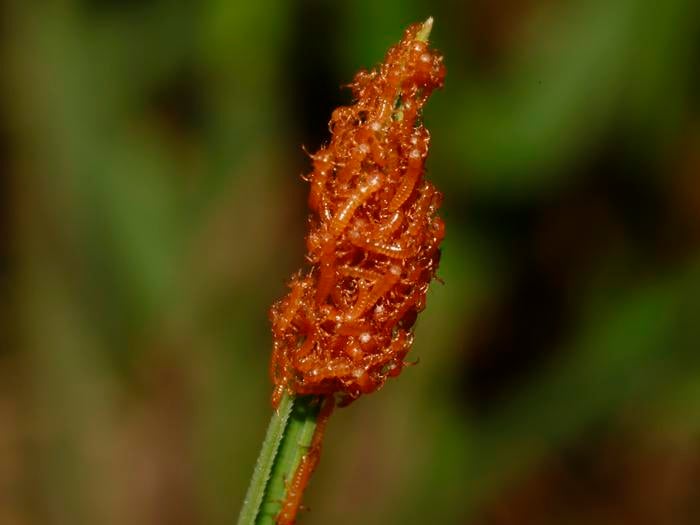
A flightless insect hatched on the forest floor faces staggering odds if its only source of nourishment lies hidden inside the underground burrow of a wild bee. For the newborn young of the European oil beetle, the search for food requires an extraordinary sequence of events. First, the tiny larva must crawl up a stalk of vegetation and wait where passing insects might land.12 Next, a solitary bee must approach close enough for the larva to latch onto its hairs. That bee must then return to its subterranean burrow, inadvertently delivering the parasite directly into its brood chamber. Once inside, the beetle feeds on the bee's egg and the pollen and nectar stockpiled for the young bee.2
Because solitary bees do not form sprawling colonies and their nests are concealed beneath the soil, discovering an entrance by foot is nearly impossible for a larva measuring only a millimeter or two across. If the young beetle fails to secure transport during its brief window of vitality, it starves. To compensate for this hazardous lifecycle, a female blister beetle deposits thousands of eggs at a time, betting that a tiny fraction will successfully infiltrate a host burrow.12 For decades, naturalists wondered how a passive hitchhiker perched on a leaf could reliably arrange its own transport.
Researchers at the Max Planck Institute for Chemical Ecology in Jena, Germany, have now resolved that puzzle by demonstrating that the larvae actively manipulate the senses of their hosts. According to an experimental study published in the Proceedings of the National Academy of Sciences, the larvae of the European oil beetle, Meloe proscarabaeus, release a complex fragrance that mimics the sweet scent of flowering trees.12 By replicating the perfume of plum and cherry blossoms, the beetles turn their own bodies into counterfeit feeding stations, prompting unsuspecting solitary bees to land within arm's reach.
How do beetle larvae convince bees to land?
European oil beetle larvae lure foraging bees by manufacturing a bouquet of 17 fragrant plant compounds that solitary bees mistake for fresh spring flowers.12 When researchers led by Ryan Alam and Tobias Köllner analyzed the volatile chemicals evaporating from three-week-old larvae, they identified a suite of monoterpenoids, a family of aromatic molecules widespread in botanical nectar and petals. Together, these 17 monoterpenoids generate an aroma remarkably similar to the spring blossoms of stone fruits, which bloom at the exact time beetle larvae emerge to wait for hosts.21
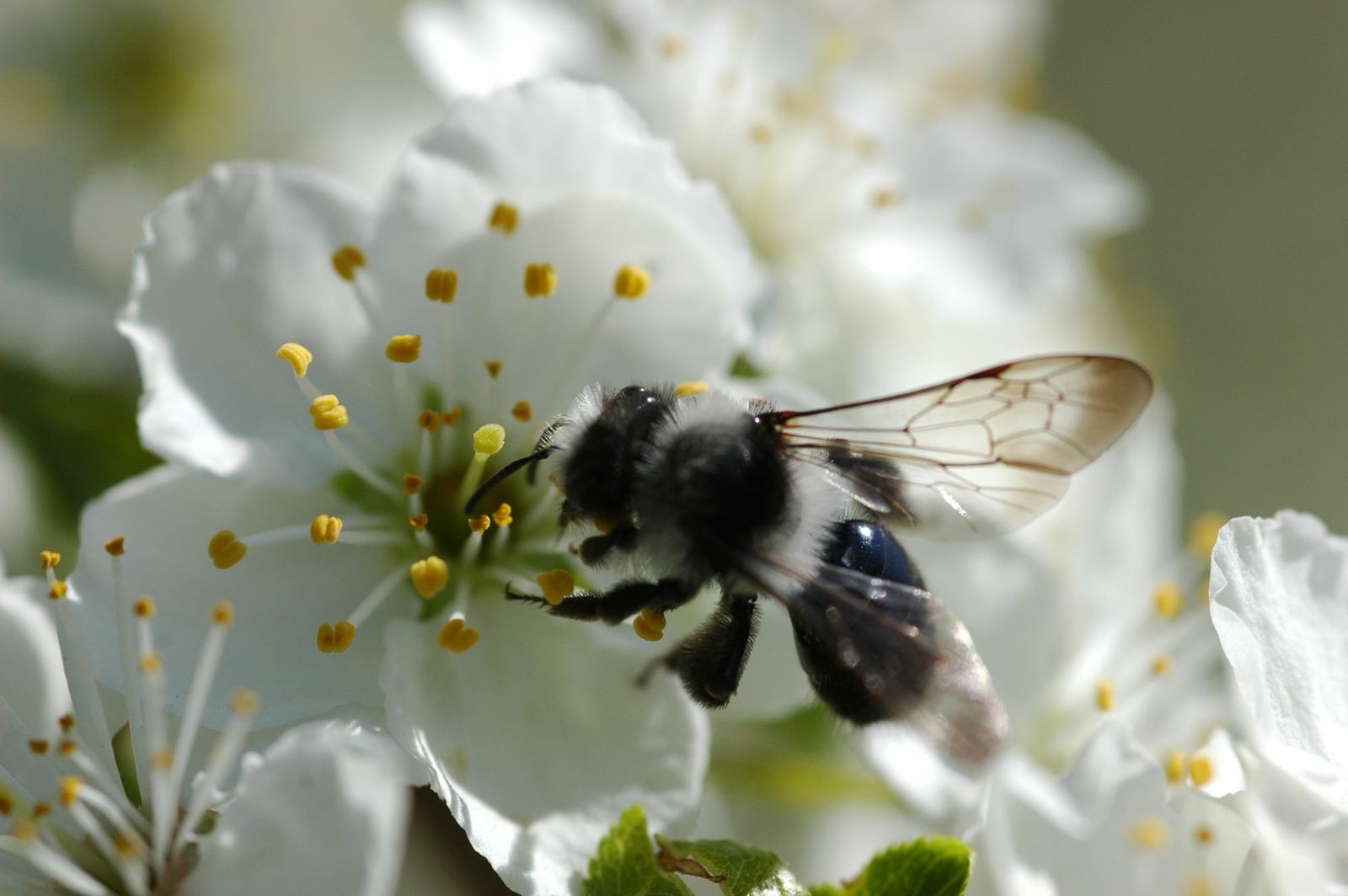
To confirm that bees respond directly to the scent rather than to visual cues, the research team conducted behavioral trials in an olfactometer, a specialized glass chamber designed to test insect olfactory preferences. In these controlled tests, solitary bees consistently favored the scent of the larvae over clean air or control odors, choosing the aroma even when the beetle larvae remained completely hidden from sight.21 Field trials reinforced the laboratory observations. When the investigators applied the isolated monoterpenoid mixture to cotton swabs placed in the wild, ground-nesting sand bees belonging to the genus Andrena flew directly toward the treated swabs.21
The floral strategy represents a stark departure from the chemical deceptions previously documented in closely related beetles. In California, larvae of the North American blister beetle Meloe franciscanus aggregate on vegetation to mimic the physical profile of a female solitary bee while synthesizing a facsimile of the female bee's mating pheromone.31 Male bees fly in attempting to mate with the counterfeit cluster, pick up the hitchhikers, and subsequently transfer them to female bees during genuine copulation.13 That specialized pheromone lure operates exclusively on a single host species, whereas a general floral aroma allows the European oil beetle to manipulate a broad spectrum of wild bee species searching for nectar and pollen.12
How does an insect produce the scent of a flower?
Larvae of the European oil beetle synthesize their floral perfume entirely on their own, using specialized metabolic enzymes rather than sequestering fragrant oils from surrounding flora.24 When the investigators examined adult beetles and unhatched eggs, they found no trace of the 17 monoterpenoids.21 The absence of the fragrance in earlier and later developmental phases indicated that the chemical machinery turns on exclusively during the mobile larval stage, known as the triungulin, when the insects must attract a host to survive.
Genetic sequencing revealed the molecular mechanism driving this cross-kingdom chemical mimicry. The researchers identified two distinct enzymes from the cytochrome P450 superfamily, designated CYP347BT1 and CYP345BZ1, that construct the chemical precursors necessary for generating the flower-like monoterpenoids.21 Cytochrome P450 enzymes perform diverse biochemical transformations across insects, including the detoxification of plant poisons and the assembly of species-specific pheromones. In the European oil beetle, evolutionary pressure has retooled these ubiquitous enzymes to mirror the metabolic pathways of angiosperms, marking the first documented case of an animal synthesizing floral volatile signals de novo to manipulate an ecological partner.42
“This discovery describes a previously unknown form of mimicry and expands our understanding of how parasites use chemical signals to manipulate other organisms,” said Ryan Alam, a researcher at the Max Planck Institute for Chemical Ecology.21 Because the larvae make the perfume inside their own tissues, they are not reliant on the presence of actual flowering trees nearby to acquire their deceptive odor.
What limits the scope of these findings?
Laboratory choice tests and artificial swab experiments demonstrate that solitary bees find the monoterpenoid blend attractive, but they cannot measure the precise hitchhiking success rate in wild environments. The study provides direct evidence that bees are drawn toward the larval scent in controlled olfactometers and on exposed cotton swabs, yet the data do not reveal how frequently a wild bee permits larvae to cling to its thorax during natural floral foraging.1 Furthermore, the findings cannot determine whether floral mimicry confers a higher net reproductive fitness than the sex-pheromone deception practiced by North American blister beetles.
The research is also limited by an incomplete map of the beetle's biochemical machinery. While the team successfully pinpointed two cytochrome P450 enzymes responsible for initiating the precursor molecules, the entire biosynthetic pathway required to assemble all 17 volatile compounds remains unmapped.12 Future biochemical analyses across related species will be required to confirm whether this floral mimicry represents a solitary evolutionary novelty or a widespread strategy shared across other blister beetles.
Why does beetle mimicry matter for wild bee conservation?
Understanding how blister beetles track their hosts provides vital perspective on the health of fragile temperate ecosystems, where both the parasites and their solitary bee hosts face mounting environmental pressures. Oil beetles are strict obligate parasites, meaning their populations cannot persist without stable numbers of solitary ground-nesting bees. In across Europe, both wild solitary bees and oil beetles have experienced noticeable regional declines caused by the loss of flower-rich meadows and undisturbed soil habitats.1
Because the larvae rely on generalized floral cues, their survival is intimately tied to the seasonal phenology of spring blossoms and the emergence schedules of multiple solitary bee species. Disruptions caused by shifting regional climates could knock these interconnected schedules out of alignment, stranding larvae on foliage before solitary bees begin their spring foraging runs. Investigating the molecular basis of host finding helps ecologists understand the intricate dependencies binding parasites to native pollinators.
For Sarah O'Connor, head of the Department of Natural Product Biosynthesis at the Max Planck Institute for Chemical Ecology, the immediate scientific challenge lies in dissecting the complete genetic assembly line. “Our next goal is to elucidate the entire biosynthetic pathway of these volatile compounds,” O'Connor said.21 Tracing how a tiny beetle larva evolved the identical aromatic vocabulary of a cherry blossom offers a compelling look at the boundless chemical ingenuity forged by natural selection.
The record
20 sentences trace to 4 sources.
-
1
S
scientificinquirer Document · scientificinquirer.com · 21 Oct 2026 Oil Beetle Larvae Smell Like Plum and Cherry Blossoms to Hitch a Ride on Bees See the source
-
2
E
eurekalert.org Third-party reporting · eurekalert.org Oil beetle larvae smell like flowers to manipulate bees See the source
-
3
UA
UC Agriculture and Natural Resources Third-party reporting · ucanr.edu · 16 Oct 2017 The Amazing Bee-Parasite Research of Leslie Saul-Gershenz | Bug Squad See the source
-
4
E