Arctic ice expanded for two millennia before greenhouse warming reversed it
Ancient plants emerging from beneath Canada's Barnes Ice Cap show that a natural cooling cycle had begun building toward a new glaciation before industrial emissions took over.
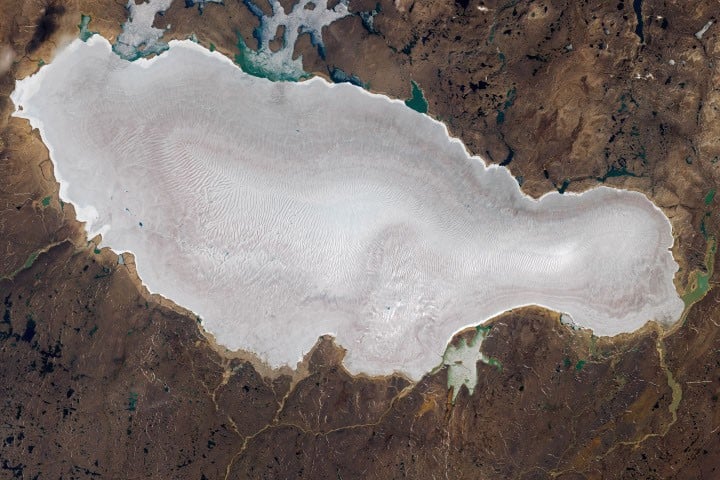
For thousands of years after the continental glaciers melted away, the high latitudes of the Northern Hemisphere grew quietly colder. The subtle tilt and wobble of Earth's orbit gradually reduced the amount of summer sunlight falling on the far north, allowing winter snow to linger into the warmer months. As that reflective white blanket survived each passing summer, it bounced more solar heat back into space, chilling the surrounding tundra and cooling the ocean waters. Given enough uninterrupted centuries, small lingering patches of snow slowly thicken into permanent ice caps, and ice caps eventually merge into continental sheets. That slow cooling cycle had driven the planet toward ice ages repeatedly across millions of years.
A modern descent into that kind of icy climate would reshape human geography across North America and Eurasia. Entire river systems would shift, agricultural belts would contract toward the equator, and growing glaciers would displace millions of people while locking up trillions of tonnes of fresh water. Yet across the twentieth century, that expected descent failed to materialize. Instead of expanding across northern valleys, glaciers across the globe began to melt at accelerating rates.
To understand why the planet broke with its long-term pattern, scientists trace a chain of linked physical steps. Earth's position relative to the sun sets the baseline energy reaching polar landmasses during the warm season. When summer sunlight diminishes, the seasonal snowline drops to lower elevations. If summer temperatures stay cold enough that annual snowfall exceeds summer melting, snow survives the thaw, compresses under its own weight into crystalline firn, and gradually forms dense glacial ice. Over decades, that expanding ice reflects more sunlight, cooling the local climate further and encouraging the ice margin to push outward across the tundra. But if heat-trapping gases in the atmosphere rise rapidly, the additional thermal energy warms the summer air, pushes the snowline back up the mountains, and forces the ice into retreat.
New research published in the journal Science indicates that this exact cooling cycle was actively advancing across the Canadian Arctic until human activity disrupted it.12 By examining preserved vegetation emerging from beneath the Barnes Ice Cap on Baffin Island in Nunavut, a research team led by paleoclimatologist Nicolás Young of Columbia University found that the ice cap had been expanding steadily for approximately 2,000 years.13 That two-millennium expansion came to a sudden halt around 1960, when industrial emissions of greenhouse gases drove summer temperatures high enough to overpower the cooling effects of Earth's orbital cycle.12

How did scientists determine when the ice began expanding?
Glaciers moving across bedrock typically obliterate the ancient landscape beneath them, grinding rocks and scraping away soil as they slide. The Barnes Ice Cap behaves differently because it remains frozen directly to its underlying bedrock across the study area.13 Instead of sliding and scouring the ground, the advancing ice moved like a slow, protective blanket over the tundra, suffocating and entombing small shrubs, mosses, and lichens exactly where they grew.31 When modern warming forced the margin of the glacier to melt backward, that entombed tundra vegetation emerged back into daylight, offering an intact calendar of past ice movements.32
A team including Young, Institute of Arctic and Alpine Research fellow Gifford Miller of the University of Colorado Boulder, and collaborators from the University of Münster gathered these emerging plant samples along the retreating ice edge.23 Using radiocarbon dating, which measures the steady decay of the radioactive carbon-14 isotope in dead organic matter, the researchers calculated a kill date for 88 plant samples collected along an 800-meter transect running from the modern ice boundary to its maximum modern extent.32 The samples grew systematically younger the farther they lay from the current ice margin, confirming that the glacier had pushed outward across the landscape over time.32
The oldest plants uncovered at this margin date to around the year 1000, indicating that the ice cap was already marching forward toward its mid-twentieth-century limit by that date.32 Roughly 70 percent of the collected plant specimens died around the year 1800, with an uncertainty of about 200 years, corresponding to the coldest phase of the Little Ice Age.3 To trace the history even further back, the scientists turned to measurements of beryllium-10, a rare isotope formed when cosmic rays strike minerals in exposed rocks.13 Rock surfaces and boulders around the margin showed that the ice cap had melted back behind its current footprint around 3,560 years ago.31
Radiocarbon records from 186 plant samples beneath smaller plateau ice caps on Baffin Island, none of which predate the start of the Common Era, confirmed that the regional snowline dropped low enough to generate permanent snow and ice across the 800-meter-high plateau roughly 2,000 years ago.3 Taken together, the evidence shows that the Laurentide Ice Sheet, which once stretched across Canada and into the northern United States, reached its smallest size between 3,000 and 2,000 years ago before rebounding into an extended growth phase.34
Why did the growth trend reverse in the twentieth century?
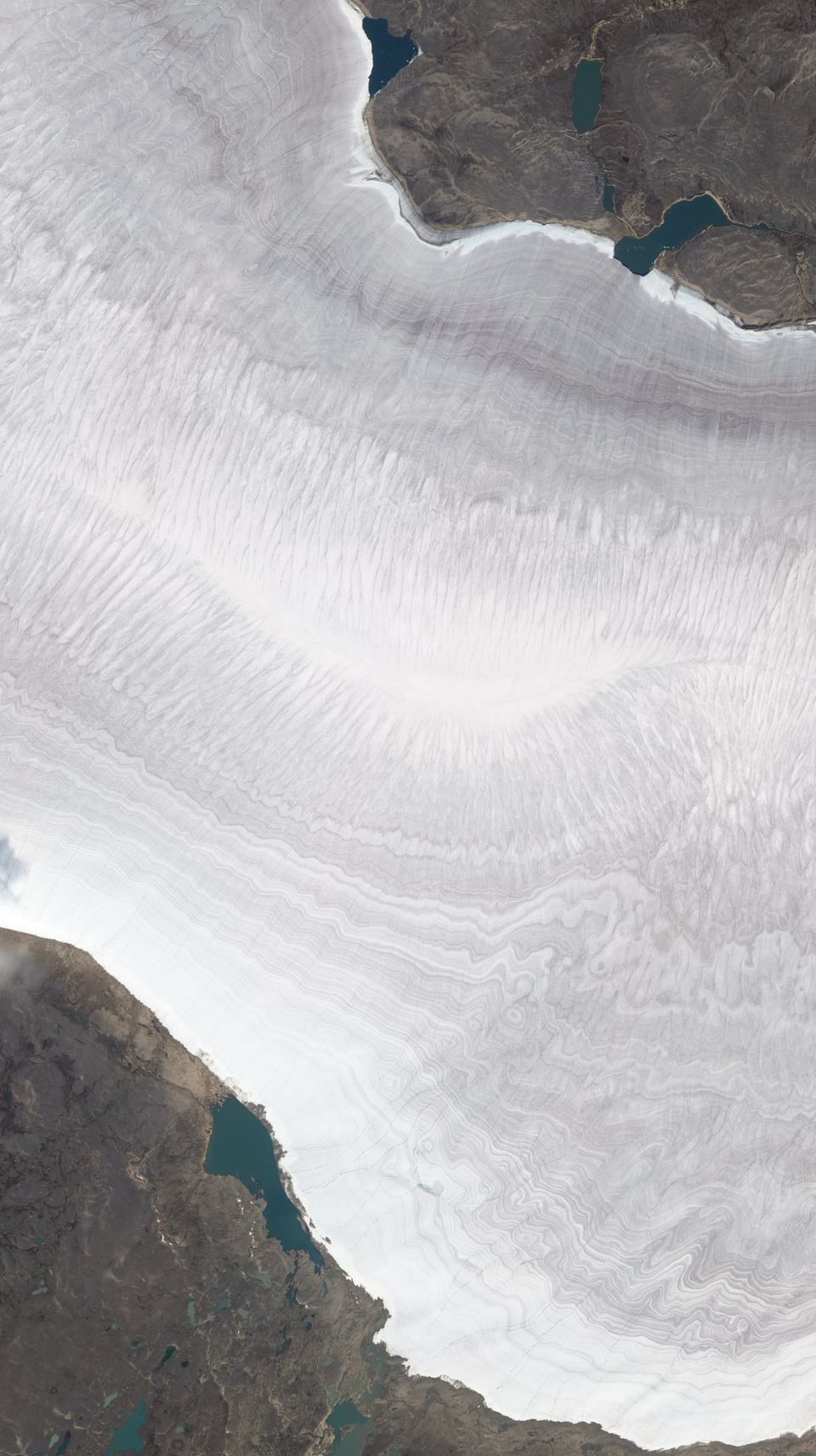
The steady advance of Arctic ice came to an abrupt stop around 1960. Photographic records and ground surveys show that the Barnes Ice Cap reached its maximum Holocene regrowth boundary around that year before reversing direction.32 Aerial photography reveals that the ice boundary has since pulled back between 200 and 800 meters from that sharp perimeter, retreating at an average rate of four meters per year since the 1980s.31 That modern retreat has undone roughly 2,000 years of net glacial expansion in just a few decades.13
The reversal coincides with a sharp surge in atmospheric greenhouse gases. Between 1750 and 1850, the concentration of heat-trapping gases in the atmosphere rose by roughly 12 parts per million in carbon dioxide equivalent.3 Between 1850 and 1960, concentrations rose by an additional 50 parts per million, followed by a jump of 138 parts per million between 1960 and 2024.3 A modest increase of about 20 parts per million between 8,000 and 2,000 years ago had failed to stop the natural orbital cooling trend, but the massive post-industrial surge produced enough summer warming to outstrip winter accumulation entirely.3
Because the Barnes Ice Cap sits on low terrain around 500 meters above sea level, it relies heavily on its own thickness to keep its upper surface in freezing conditions.3 Between 1960 and 1980, roughly 35 percent of the ice cap's surface stood above the summer snowline, where fresh winter snow could accumulate and turn to ice.3 By the early 2000s, that accumulation zone shrank to roughly 3 percent of its surface area, and after 2010 the ice cap lost its accumulation area entirely.3 The entire ice body now sits in a zone where summer melting exceeds winter snowfall, feeding meltwater channels and ponds across its surface every summer.342
What can these Arctic findings tell us about future glaciations?
The study provides physical confirmation that an ancient glacial remnant expanded for centuries before industrial emissions reversed the trend, but the result carries clear physical limitations. The data comes primarily from one geographic feature, a surviving five-thousand-square-kilometer ice cap in the eastern Canadian Arctic and adjacent plateau summits.41 While the Barnes Ice Cap represents the final surviving piece of the Laurentide Ice Sheet, its localized behavior does not constitute a direct observation of a fully formed global ice age. Glaciologists and paleoclimatologists note that under traditional definitions, an ice age begins when growing continental ice sheets lock up enough water to lower global sea levels by several meters, a transformation that Young estimated would take roughly 30,000 years of sustained growth.34
Furthermore, the oldest preserved plants under the main body of the Barnes Ice Cap remain sealed beneath hundreds of meters of frozen ice, meaning the estimated start date of 2,000 years ago relies partly on neighboring ice caps on higher plateaus.3 Recent paleoclimate temperature reconstructions also suggest that Holocene cooling was not uniform across all latitudes, though the authors note that those alternative temperature reconstructions cannot explain the widespread physical advance of ice recorded across the Arctic.3 The study is a historical reconstruction based on radioisotope measurements and glaciological records, not a computer simulation claiming to predict exact global temperature paths over the next thousand years.
For scientists studying the long-term climate system, the findings demonstrate that human emissions altered a geological cycle that had been operating for millions of years. Orbital forces are still pulling high-latitude solar radiation downward, but rising concentrations of greenhouse gases have overwhelmed that cooling push. The Barnes Ice Cap itself is projected in earlier modeling studies to melt entirely within three centuries if warming continues unabated, eliminating the glacial seed crystal from which future North American ice sheets historically grew.34 The immediate question facing researchers is how similarly situated glaciers in Greenland and the high Arctic responded during those same centuries, and whether the planet has deferred the next ice age for tens of thousands of years.
The record
29 sentences trace to 4 sources.
-
1
W
WIRED Document · wired.com · 22 Oct 2026 A New Ice Age Was Beginning. Then Humans Started Burning Fossil Fuels See the source
-
2
C
colorado.edu Third-party reporting · colorado.edu The failed ice age: Arctic ice was expanding for centuries before global warming stopped it See the source
-
3
FU
Forschung und Wissen Third-party reporting · forschung-und-wissen.de · 22 Oct 2026 Der Mensch hat die nächste Eiszeit im Keim erstickt See the source
-
4
S
scinexx.de Third-party reporting · scinexx.de · 22 Oct 2026 Globale Erwärmung könnte eine beginnende Eiszeit gestoppt haben See the source