A neglected heavy neutrino may explain why the universe contains matter
Altering how fast the young cosmos cooled could have protected the tiny surplus of particles needed to build stars and galaxies, according to calculations in Physical Review Letters.
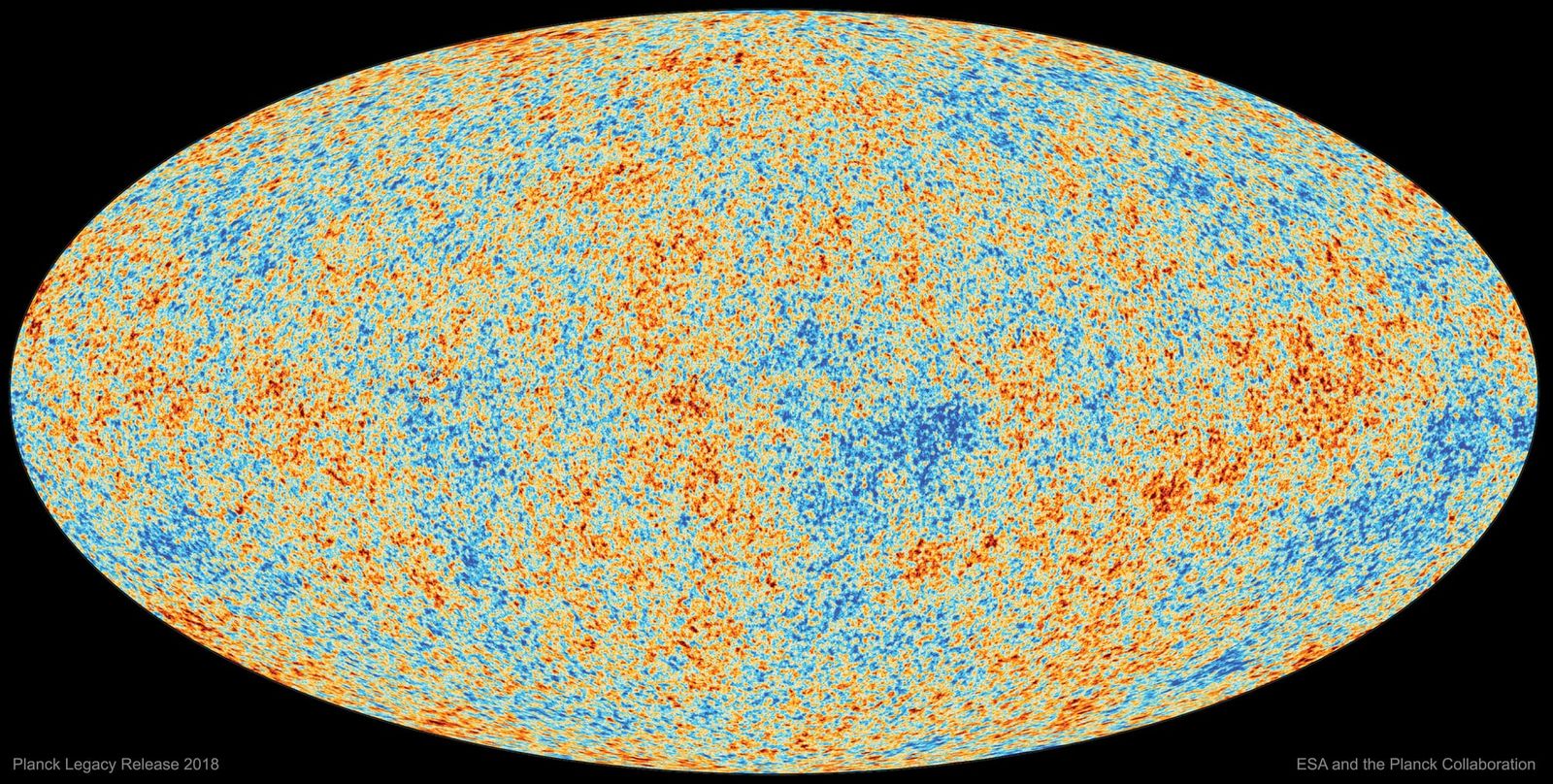
The early universe should have emptied itself of all physical substance. When matter encounters antimatter, both forms vanish on contact, converting their mass into pure radiation.12 Standard cosmological theories predict that the hot, dense conditions following the Big Bang generated identical quantities of particles and antiparticles.12 If that balance had remained perfect, the cosmos would have cooled into an expanding sea of light, leaving no atoms, no stars, and no planets.21
Physical reality exists because of a fractional remnant. For roughly every billion pairs of particles that annihilated each other, a single particle of matter endured.12 That thin surplus formed all the galaxies, dust clouds, and celestial bodies observed across astronomical history.12 Accounting for how that imbalance developed remains one of the fundamental puzzles in particle astrophysics.21
The survival of matter depends on a tight causal sequence during the earliest moments of cosmic cooling. First, the intense energy density after the Big Bang produces equal distributions of fundamental particles.1 Next, as the universe expands and cools, specific high-energy reactions decay into slightly unequal quantities of matter and antimatter before reaching thermal equilibrium.1 Finally, the rate of cosmic expansion outpaces competing reverse reactions that would otherwise wipe out the difference.12 If expansion proceeds too slowly, opposing interactions destroy the surplus; if it proceeds too quickly, the particles cannot interact enough to establish the shift.21
In a paper published on September 8, 2026, in Physical Review Letters, physicists Rishav Roshan of the University of Southampton and Sudipta Show of the Indian Institute of Technology Kanpur proposed that an overlooked particle altered that cosmic clock.21 They focused on an ultra-heavy relative of the neutrino, designated N3, which conventional particle models usually ignore as an inconsequential spectator.12 According to the authors, this particle could have survived long enough to dominate the energy density of the infant universe, changing its expansion rate and preserving the exact fraction of matter required to form physical structures.12
Why did matter survive the cosmic annihilation?
A slight excess of matter over antimatter endured because fundamental physical processes in the first split-second broke the symmetry between particles and antiparticles.12 In 1967, the Soviet physicist Andrei Sakharov established three necessary conditions for such an imbalance to form: reactions that violate baryon number conservation, differences in how particles and antiparticles interact, and a departure from thermal equilibrium.2 The Standard Model of particle physics contains all three elements, but its known differences between matter and antimatter are vastly too small to explain the observed universe.2
To bridge this gap, theorists frequently turn to neutrinos.2 Neutrinos are electrically neutral elementary particles that pass through normal matter with almost no interaction, lacking electric charge and interacting through only gravity and the weak nuclear force.13 In a human body, approximately 100 trillion neutrinos from natural sources pass through undetected every second.1 Although the Standard Model originally treated neutrinos as massless, oscillation experiments in the late 1990s confirmed that they possess tiny masses, leading to the 2015 Nobel Prize in Physics for Takaaki Kajita and Arthur McDonald.2
To explain why neutrino masses are so remarkably small compared with other fermions, physicists introduced the seesaw mechanism in the late 1970s.2 In this mathematical formulation, the tiny masses of known neutrinos balance against three hypothetical, exceedingly heavy neutrino partners.12 Two of these heavy neutrinos provide enough parameters to generate the observed masses and produce an excess of leptons, the particle family containing electrons and neutrinos.12 A framework formulated in 1986 by Masataka Fukugita and Tsutomu Yanagida, known as leptogenesis, describes how the decay of heavy neutrinos produces unequal quantities of leptons and antileptons, which later high-temperature processes convert into protons and neutrons.21
How could a neglected heavy particle alter cosmic history?
Rishav Roshan at the University of Southampton and Sudipta Show at the Indian Institute of Technology Kanpur calculated that an ultra-heavy neutrino could briefly account for most of the cosmos's energy density.12 While theorists commonly omitted the third heavy neutrino because its extremely weak interactions appeared to decouple it from other particles, Roshan and Show found that this isolation caused it to decay slowly.12 "This decoupled heavy neutrino has long been dismissed as an irrelevant background detail in particle physics," Roshan said.1
In the researchers' primary worked example, the decoupled neutrino N3 possesses a mass approximately 100 trillion times that of a proton.12 In the blazing temperatures after cosmic inflation, an abundance of these particles formed, traveling near the speed of light and behaving like radiation.2 As the cosmos expanded and cooled, the particles slowed and began behaving like matter.12 Because cosmic expansion stretches the wavelengths of radiation, radiation loses energy density more rapidly than matter.21 The energy density of the slow-moving heavy neutrinos diminished at a slower rate, allowing their collective mass to overtake radiation and briefly govern the expansion of the cosmos.12
This period of matter domination accelerated the expansion rate of the young universe, shifting the schedule of critical particle interactions.12 Under standard physics, charged leptons, including electrons, muons, and tau leptons, interact with the Higgs field, an energy field that provides fundamental particles with their masses.12 Each lepton type enters chemical equilibrium once its reaction rate matches the rate of cosmic expansion.2 Under the accelerated expansion induced by N3, the temperature at which tau leptons equilibrated fell between seven and 12 times lower than in standard models.21
This temperature shift delayed the equilibration of tau leptons, allowing a lighter heavy neutrino to produce the matter excess through simplified single-flavor interactions.2 "The fact that we are here at all proves that an asymmetry between matter and antimatter occurred," Roshan said.1 Roshan noted that the decoupled neutrino altered the temperature at which fundamental leptons interacted with their antiparticles through the Higgs boson, explaining that "This temperature acts like a switch that shapes how the matter-antimatter imbalance was built up."1
When N3 eventually decayed into lighter particles, it released a surge of energy that diluted the existing matter surplus.12 The authors demonstrated that by tuning two specific parameters, the production of the initial surplus and the subsequent dilution factor balanced out to match the matter density measured by the European Space Agency's Planck satellite.2 In a prior 2024 study in Physical Review Letters with co-authors Arghyajit Datta and Arunansu Sil, Roshan had demonstrated that prolonged cosmic reheating after inflation could also alter lepton equilibration temperatures; the new work established that an overlooked particle species could independently produce a similar developmental delay.41
What does the theoretical model leave unresolved?
The calculations describe a hypothetical scenario that currently lacks direct experimental confirmation or astronomical detection.12 The paper models physical relationships using mathematical assumptions without relying on laboratory measurements of captured particles.21 A primary assumption is that all three heavy neutrino species existed in huge quantities following cosmic inflation, an initial state for which no observational evidence exists.12
Testing the model requires measuring quantities that lie far beyond current experimental limits.12 The authors' formulation links the lifespan of N3 and the duration of the matter-dominated era to the mass of the lightest known neutrino, projecting that particle to weigh between a trillionth and a hundred-trillionth of an electronvolt.12 In contrast, the international Karlsruhe Tritium Neutrino experiment in Germany, which measures electron energies from tritium beta decays, published findings in Science in 2025 establishing an upper limit of 0.45 electronvolts based on 259 days of collected data.35 The mass range predicted by Roshan and Show is hundreds of billions of times smaller than the sensitivity threshold of any existing laboratory spectrometer.2
Cosmological observations offer a second possible testing ground through primordial gravitational waves.12 If a matter-dominated epoch interrupted the early radiation era, the transition would imprint distinctive spectral modifications on background gravitational radiation and ripples from hypothetical cosmic strings.2 "These gravitational wave signatures open up new avenues for us to unravel the evolution of the early universe after the Big Bang," Show said.1 However, astronomical observatories have not yet detected a background of primordial gravitational waves from that epoch.1
For now, the proposal provides a mathematically consistent mechanism showing how a neglected particle could resolve the survival of matter without introducing complex new forces. Future measurements of neutrino mass bounds from projects such as Project 8, alongside next-generation space-based gravitational wave detectors, will determine whether the third neutrino shaped cosmic history or remains an intriguing mathematical possibility.2
The record
53 sentences trace to 5 sources.
-
1
TP
Tibi Puiu Document · zmescience.com · 22 Oct 2026 Why Does Anything Exist at All? Physicists Think a Humble ‘Ghost Particle’ May Hold the Answer See the source
-
2
L
labrujulaverde.com Third-party reporting · labrujulaverde.com · 20 Oct 2026 The Universe Should Be Empty — A Particle Physicists Ignored for Decades May Explain Why It Isn’t See the source
-
3
E
energy.gov Official record · energy.gov · 7 Apr 2026 KATRIN Narrows Down the Range of Neutrinos’ Mass See the source
-
4
A
arxiv.org Paper · arxiv.org Effects of Reheating on Charged Lepton Yukawa Equilibration and Leptogenesis Preprint · may not have been peer reviewed See the source
-
5
K
kit.edu Third-party reporting · kit.edu KIT - KIT - Media - Press Releases - Archive Press Releases - PI 2025 - Astroparticle physics: Neutrinos weigh less than 0.45 electronvolts See the source