A rare Martian meteorite bridges a two-billion-year volcanic gap
A volcanic fragment found in Algeria formed 1.27 billion years ago, revealing that pockets of deep Martian rock survived undisturbed since the birth of the solar system.
Planets cool and quiet over cosmic time, but their internal volcanic engines leave records frozen in stone. On Mars, where spacecraft have never returned a sample directly from bedrock to terrestrial laboratories, the only physical pieces of the planet to reach Earth arrive by accidental cosmic delivery. Asteroid impacts strike the Martian surface with enough violence to blast fragments clean into interplanetary space, where they drift for thousands or millions of years before crossing Earth's path.12 Among the roughly 400 Martian meteorites collected across global deserts and polar ice sheets, nearly all tell a story of two extreme eras, either documenting ancient crust from billions of years ago or volcanic flows that crystallized relatively recently.12 A vast middle era of Martian geological history has remained an empty stretch in the planetary archive.
Volcanism provides the primary window into the thermal evolution and interior structure of a rocky world. Magma rising from deep mantle reservoirs delivers gases to the atmosphere, builds volcanic provinces, and sustains the subsurface thermal systems that planetary scientists study when assessing long-term planetary habitability. Without samples bridging the planet's middle life, geochemists could not tell whether Martian volcanism ground to a sudden halt, retreated to isolated plumes, or continued drawing from primitive interior sources that planetary processing had somehow left untouched.
When molten rock ascends from planetary depths, minerals crystallize in a specific sequence as the melt cools, trapping trace elements within rigid crystalline structures. Some of those elements include unstable radioactive parent atoms that decay spontaneously into stable daughter atoms at steady, measurable rates. Once minerals freeze solid, the daughter atoms accumulate within the crystal lattice like sand piling in an hourglass. If an asteroid impact later shatters the volcanic field and flings fragments outward, that shock can melt glassy patches without resetting the radioactive clock recorded in the bulk mineral grains. Measuring the ratio of parent to daughter isotopes within those minerals allows geochemists to calculate the precise moment the volcanic rock originally formed.
Why was a two-billion-year stretch of Martian history missing?
The gap existed because volcanic meteorites from Mars had previously clustered into two widely separated age brackets. The most common category of Martian meteorites, known as shergottites, are basaltic igneous rocks formed when molten magma cooled and solidified within the crust or near the surface.12 Previously dated shergottites were either younger than 600 million years old or roughly 2.4 billion years old.12 That distribution left an unexplained absence of approximately 1.8 billion years in which geochemists possessed no shergottite samples to trace how Martian magmatic activity progressed through the planet's intermediate history.12
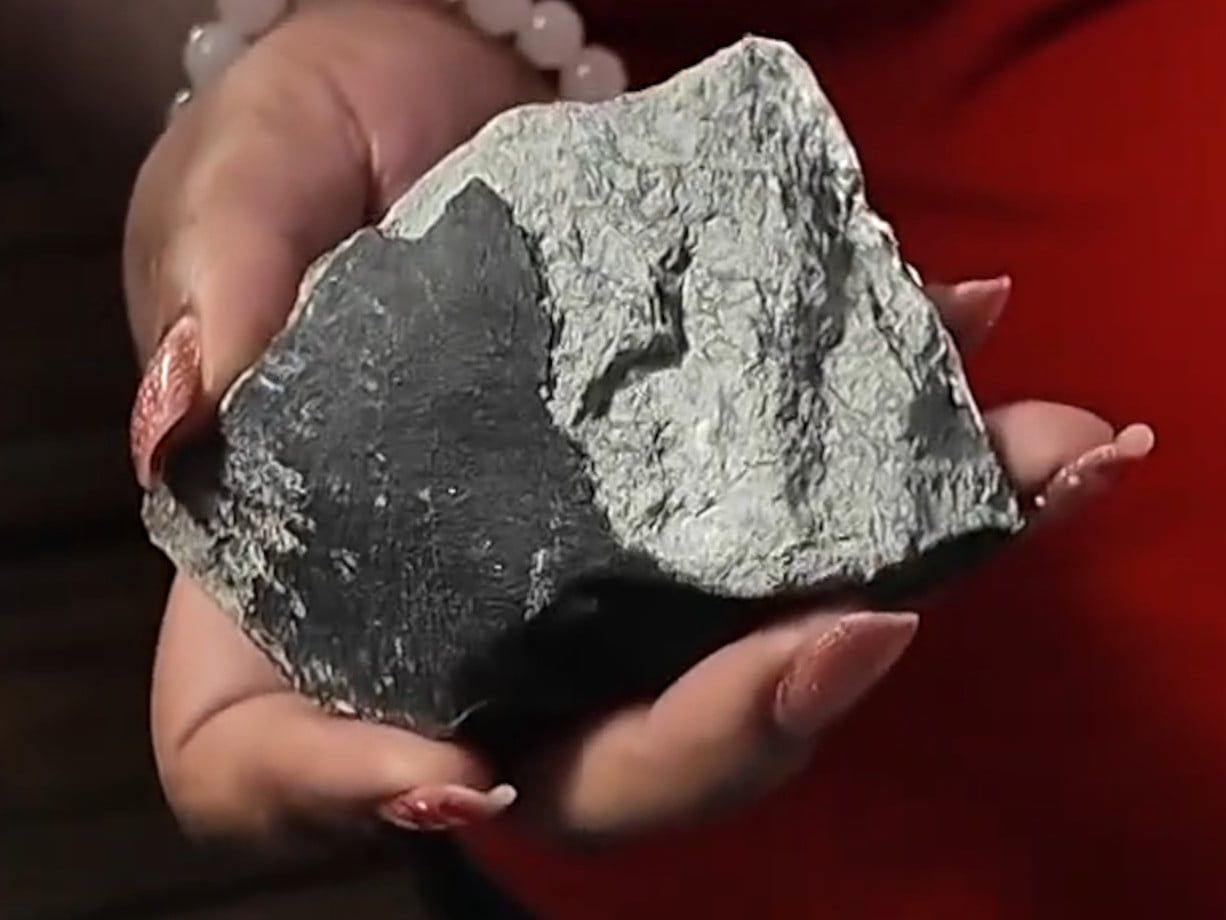
A newly characterized meteorite designated Northwest Africa 13441, or NWA 13441, has settled directly into that void.13 Found in Algeria in 2019, the specimen crystallized approximately 1.273 billion years ago, according to isotopic measurements conducted by researchers at Boston College.1 Lead author Dylan M. Seal, a doctoral candidate at Boston College, stated that "Martian meteorites of this type are either younger than 600 million years old, or approximately 2.4 billion years old."12 Seal noted that the finding bridges a roughly two-billion-year span that had previously lacked shergottite samples to illuminate volcanic processes on Mars.21 While two other rare families of Martian meteorites, called nakhlites and chassignites, date to between 1.3 billion and 1.4 billion years ago, their chemical compositions are distinctly different from shergottites and point to entirely separate magma sources.12
What does an ancient rock reveal about the deep mantle?
Initial neodymium isotope ratios inside the meteorite match the primitive chemical signature of the early solar system.14 Neodymium is a naturally occurring rare earth element whose isotopes act as a diagnostic fingerprint of the mantle source that melted to create magma. Geochemists call this primitive isotopic proportion chondritic, referring to chondrites, the primordial, unmelted stony meteorites that formed 4.56 billion years ago from solar nebula dust.21 Senior author Ethan Baxter, a professor of Earth and environmental sciences at Boston College, noted that this chondritic composition has never been observed in any other shergottite.21
That composition suggests that a reservoir within the Martian interior remained completely isolated and chemically unaltered for billions of years.12 Mars formed rapidly, accreting within roughly five million years after the birth of the solar system, and underwent early differentiation as iron separated into a dense central core beneath a silicate mantle and crust.12 On Earth, vigorous plate tectonics constantly subducts surface crust into the mantle, stirring and homogenizing the interior over geologic time and erasing primitive signatures. Mars lacks active plate tectonics, which permitted isolated mantle reservoirs to escape convective mixing and retain their primordial chemical identity across billions of years of volcanic history.12
How did scientists trace the meteorite back to Mars?
Researchers verified the meteorite's planetary origin through distinct mineral chemistry and oxygen isotope ratios. The investigation, led by Dylan M. Seal, Melody Z. Chen, Robert W. Nicklas, and Ethan Baxter at Boston College alongside collaborators at the Scripps Institution of Oceanography, The Open University, and Appalachian State University, determined that NWA 13441 is an olivine-phyric shergottite.1 The rock contains large, visible crystals of olivine embedded within a groundmass of pyroxene, olivine, and maskelynite, which is plagioclase feldspar transformed into glass by the violent pressure of impact shock.45 Accessory grains of chromite and merrillite fill out the mineral assembly.45
To confirm that the rock originated on Mars rather than on an asteroid, the authors measured the iron-to-manganese ratios in olivine and pyroxene minerals, yielding values characteristic of Martian rocks, along with bulk-rock oxygen isotope ratios of Δ17O equal to 0.270 parts per thousand.45 Titanium and aluminum barometry within pyroxene grains indicated that the initial crystals began forming deep near the boundary between the Martian crust and mantle.45 Hand-picked mineral separates and acid-cleaned leachates produced a samarium-neodymium radioactive decay isochron yielding an age of 1,273 million years, with an uncertainty of 21 million years, cementing its status as an intermediate benchmark.45
What remains unknown about the rock's journey?
The meteorite provides a chemical probe of the Martian interior, but it cannot reveal where on the planet it originated. Like all Martian meteorites collected on Earth, NWA 13441 is an unanchored sample, stripped of its local field geography and bedrock geological context.16 Planetary scientists know the fragment experienced intense shock metamorphism under pressures between 28 and 34 gigapascals and temperatures of 200 to 250 degrees Celsius when an impact blasted it into space, creating roughly 7 percent melt glass by volume throughout the sample.45 However, the exact volcanic province, fissure vent, or impact crater from which it was launched remains unidentified.
Geochemical interpretations of the rock's primitive signature also carry competing possibilities. While the chondritic neodymium ratio strongly indicates an ancient, undifferentiated mantle reservoir, the authors acknowledge that the same isotopic balance could theoretically result from the physical mixing of two previously known mantle sources, one chemically enriched and the other depleted.45 Confirming whether the reservoir was truly pristine will depend on studying additional isotopic systems across the sample. Baxter and his colleagues at the Boston College Center for Isotope Geochemistry plan to examine further isotopic markers to resolve whether NWA 13441 represents a widespread primitive layer or an isolated magmatic anomaly in the Red Planet's volcanic past.21
The record
26 sentences trace to 6 sources.
-
1
S
scientificinquirer Document · scientificinquirer.com · 22 Oct 2026 A 1.27-Billion-Year-Old Martian Meteorite Fills a Gap in the Red Planet’s Volcanic History See the source
-
2
B
bc.edu Third-party reporting · bc.edu Martian meteorite helps bridge nearly 2-billion-year knowledge gap See the source
-
3
L
lifeboat.com Third-party reporting · lifeboat.com “Entirely Surprising” — Scientists Have Found a Martian Meteorite Unlike Any Known Before – Lifeboat News: The Blog See the source
-
4
C
cosmochemistry-papers.com Third-party reporting · cosmochemistry-papers.com June 2026 – Cosmochemistry Papers See the source
-
5
C
-
6
C
Ciencias.uy Third-party reporting · ciencias.uy · 9 Aug 2026 Un meteorito marciano cubre un gran vacío geológico de Marte See the source