Interactive clothing turns woven fabric into a responsive touchscreen
Engineered electronic threads that merge light emission with touch sensitivity allow everyday clothing to run basic programs and display health readings without rigid glass screens.
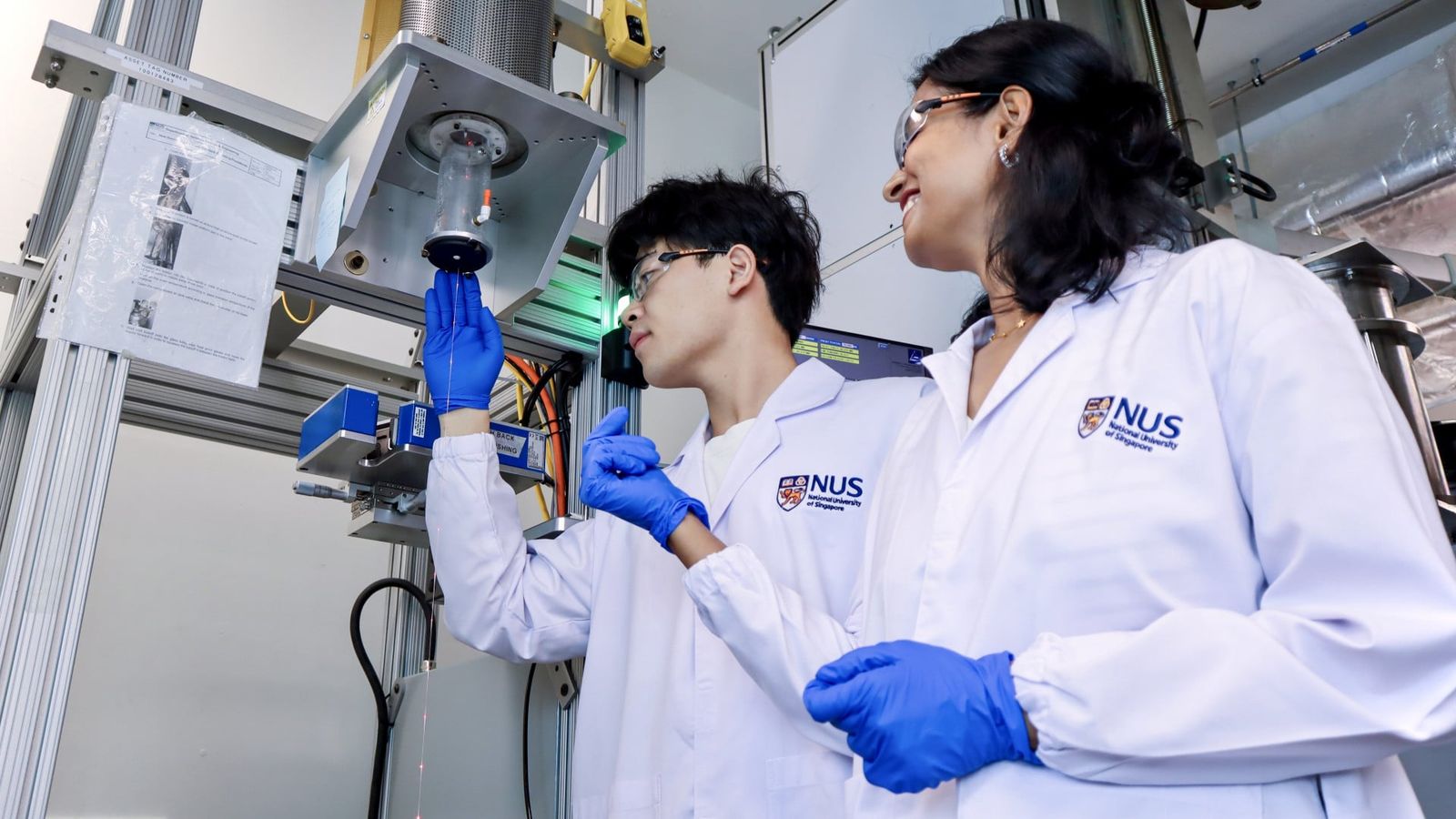
Everyday clothing is expected to bend, fold, soak in water, and allow air to reach the skin. Digital screens demand the opposite, relying on flat sheets of tempered glass, rigid backplanes, and delicate soldered connections that fracture when twisted. For decades, attempts to merge digital displays with wearable textiles have meant strapping plastic casings to wrists or affixing stiff, fragile electronic patches directly onto cloth.
A wearable display that preserves the natural feel of a garment requires an entirely different physical form. Instead of attaching a completed screen to the outside of a textile, the individual threads that compose the fabric must themselves generate light, detect physical interaction, and carry electrical power. Transforming flexible yarn into an interactive computing surface opens a path toward garments that monitor vital signs and control nearby digital devices without adding bulk.
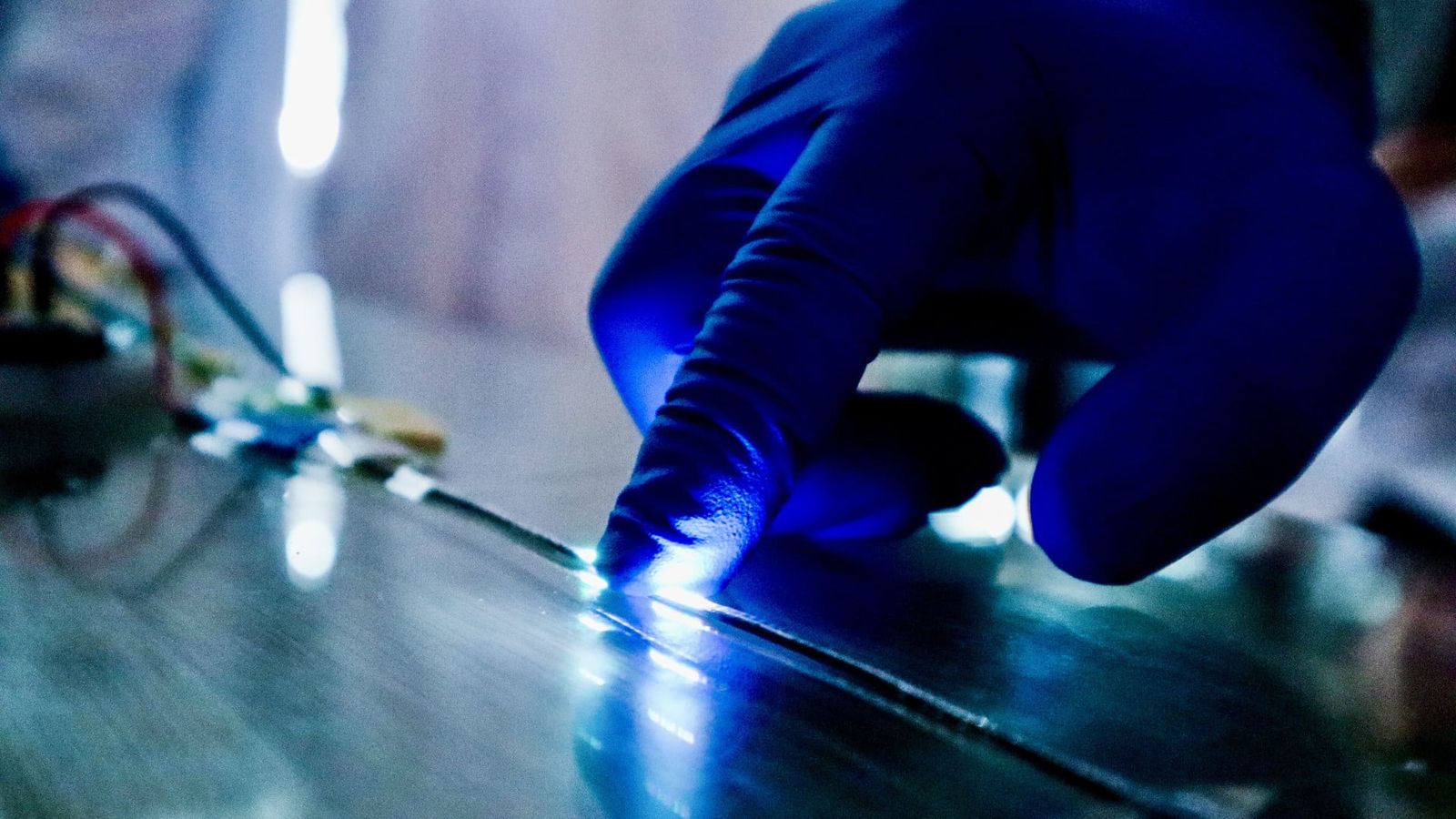
For a piece of cloth to respond to a human touch, an unbroken causal sequence must take place within the thickness of a thread. A person presses their finger against the fabric, compressing its flexible outer layers. This physical pressure forces two conductive layers inside the strand into direct contact, completing a low-voltage electrical circuit. The resulting electrical pulse travels along the wire to pinpoint the exact physical location of the contact. Electronic control systems register those coordinates and direct adjacent microscopic diodes to emit light in response. When dozens of these active strands are aligned side by side, individual illuminated points combine into a visible image that changes as fingers move across the surface.
Scientists have now woven that chain of events directly into a wearable garment. In a study published in Nature on October 21, 2026, researchers at the National University of Singapore integrated 54 specialized digital pixel fibers into the forearm of a sleeve, creating what the authors describe as the first full-fledged touchscreen built into clothing.12 The resulting display measures 168 millimeters by 105 millimeters and provides a resolution of 96 by 54 pixels.12 Operating with 8-bit color depth, the woven screen updates its display at 30 frames per second, matching the refresh speed needed for standard motion video.12
How can an interactive display fit inside a single strand of thread?
Circuits inside conventional consumer electronics are etched across wide, flat sheets of silicon and plastic, an arrangement that fails when applied to the cylindrical geometry of a thread. To solve this spatial challenge, the research team, led by Assistant Professor Tural Khudiyev of the Department of Materials Science and Engineering at the National University of Singapore College of Design and Engineering, devised a specialized interconnection architecture.12 Alongside Khudiyev, the work was carried out by researchers Swetika Chaturvedi, Heng Fu, and Ziang Li.32
The engineering process begins by cutting microscopic contact points into fine, insulated wires. A programmable laser strips away the insulation only at the exact locations where microchips must rest.12 The researchers then employ controlled surface wetting, a chemical technique that guides droplets of molten solder to adhere exclusively to those exposed metallic spots.12 Using this automated assembly method, the team mounted more than 5,000 tiny chips along the lines, establishing more than 20,000 discrete electrical connections without requiring manual soldering.12
The connected strand of light-emitting diodes is subsequently fed into a thermal drawing process, where heat and tension pull the components into a uniform, flexible fiber.12 The resulting multi-layer strand measures roughly one millimeter in diameter and stretches to a length of 10 meters.12 Inside this single filament, the illumination components sit directly above a pressure-sensitive conductive layer.12 Because each individual thread maintains its own independent electrical control channel, damage to one fiber does not disable adjacent threads, and the overall system can process several separate finger presses simultaneously.12
What tasks can an electronic sleeve perform?
The prototype sleeve operates as a self-contained interactive interface capable of running basic software applications. In tests conducted by the research group, the textile display played recorded video clips at 30 frames per second, and at 25 frames per second when synchronizing visuals with audio.12 Users could operate an interactive calculator, browse through a photo gallery, and view directional readings from an integrated magnetic compass.12 The sleeve also accepted wireless file transmissions and received image data over Bluetooth connections.12
Beyond visual pixels, the researchers threaded complementary sensory fibers into the fabric using the same thermal drawing technique. These auxiliary strands incorporate a microphone, a small speaker, motion tracking components, and an ambient light sensor that adjusts screen brightness to match environmental conditions.12 The textile can also detect orientation and rotate the visual display automatically when the wearer turns their arm.12 When the team positioned a specialized thermal sensing fiber under the arm, the garment gathered continuous body temperature readings and displayed the measurement directly on the sleeve.12
Can an electronic textile survive everyday wear and laundering?
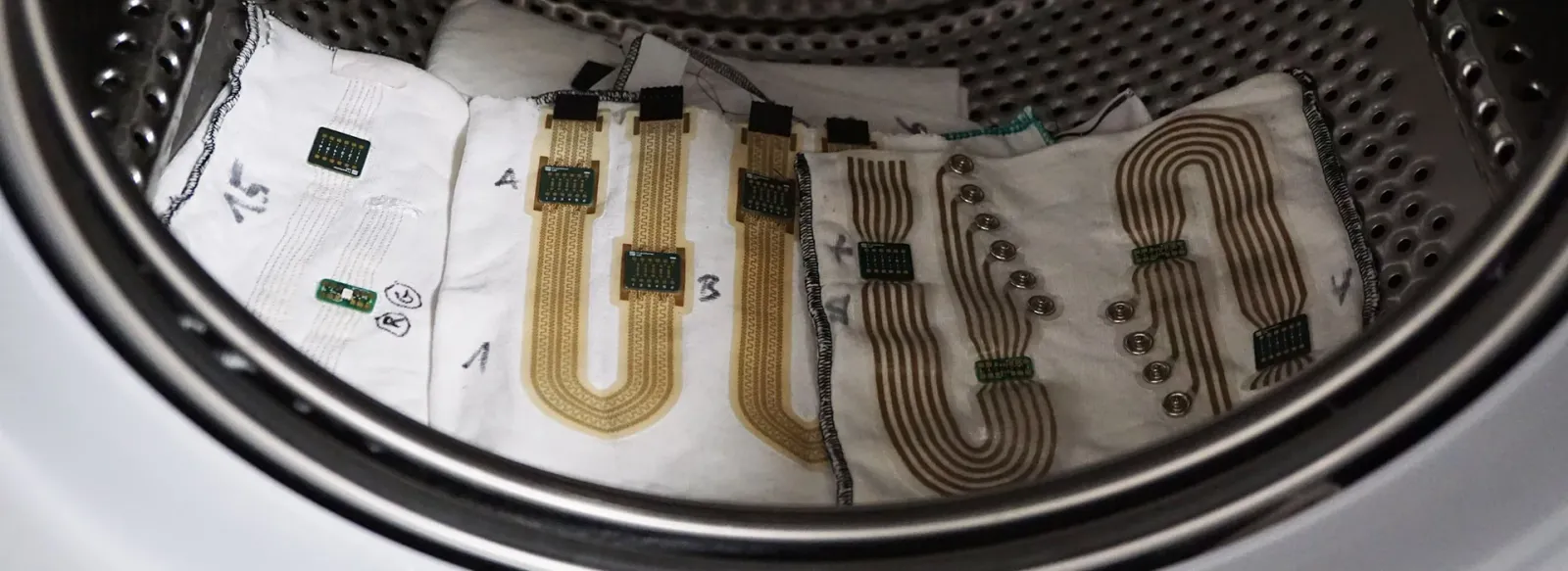
The main barrier facing electronic garments has long been mechanical durability, because ordinary clothing must withstand constant friction, sharp creasing, and repeated immersion in soapy water. In durability trials reported in the study, the interactive sleeve completed 50 full wash cycles inside a standard residential washing machine using liquid detergent.12 Following these washes, both the light emission from the pixel fibers and the responsiveness of the touch sensors remained virtually identical to their pre-wash baseline measurements.12
Physical flexibility showed similar resilience under mechanical strain. The researchers bent the fiber assembly 1,000 consecutive times around a tight curve with a radius of five millimeters, observing no breakdown in circuit continuity or touch sensitivity.12 Air permeability evaluations indicated that the finished display weave breathes as easily as common commercial fabrics, including cotton, polyester, and denim.12 Furthermore, the electrical and chemical composition of the outer fiber layers complies with established safety limits for continuous skin contact.12
What are the limits of the current prototype?
The experimental sleeve is a laboratory demonstration rather than a finished consumer product, and its technical characteristics reflect that early stage of development. The screen delivers a coarse resolution of 96 by 54 pixels across an area roughly the size of an adult hand, which suffices for simple icons, numeric displays, and basic video, but cannot reproduce fine text or sharp modern graphic interfaces. The report presents the output of experimental fiber lines prepared under controlled research conditions, meaning the findings cannot predict how the material would hold up over years of continuous friction, heavy perspiration, or commercial laundering environments.
Fabrication also remains tied to specialized laboratory drawing equipment. While the linear structure of the one-millimeter fibers is designed to be compatible with industrial knitting, weaving, and embroidery machinery, full-scale mass production has not yet been demonstrated.12 The authors note that transitioning the technology into everyday apparel will depend on producing much thinner threads and significantly smaller microelectronic chips. The Singapore research group is currently working toward higher display resolutions, richer onboard physiological sensors, and local artificial intelligence processing embedded directly into the textile weave.12
The record
25 sentences trace to 3 sources.
-
1
NU
National University of Singapore Document · futurity.org · 23 Oct 2026 Watch: Team weaves a touchscreen into clothing See the source
-
2
NU
National University of Singapore Third-party reporting · news.nus.edu.sg · 22 Oct 2026 NUS researchers thread the world’s first touchscreen into a garment See the source
-
3
IT
India Today Third-party reporting · indiatoday.in · 23 Oct 2026 A touchscreen you can wear? Indian researcher helps develop a washable smart sleeve See the source