Microplastics interact with water to generate damaging reactive chemicals
Tiny plastic fragments spontaneously produce tissue-damaging oxygen radicals in water, offering a chemical mechanism linking environmental plastic exposure to human cardiovascular and cellular injury.
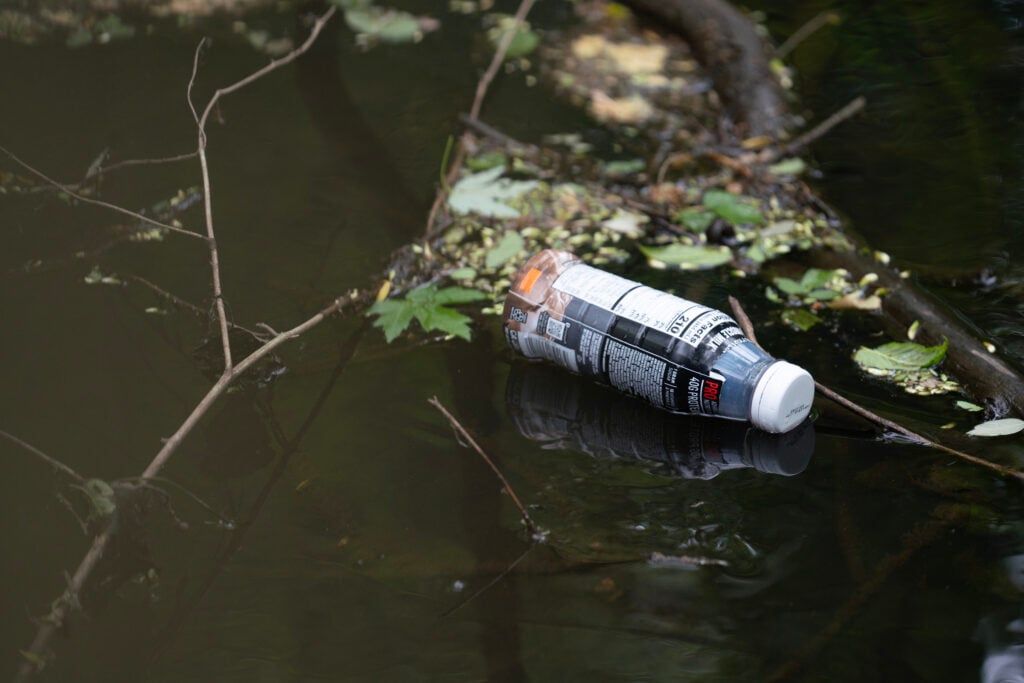
Plastics have spent nearly a century earning a reputation as stubborn, chemically inert materials. Manufacturers chose synthetic polymers for bottles, pipes, food wrappers, and medical tubing precisely because they resist biological breakdown and refuse to react with common household substances. That chemical indifference has long defined how scientists thought about plastic waste. While plastic objects slowly crumble into microscopic specks under weather and sunlight, the fragments themselves were assumed to remain chemically dormant.
A study published in Nature changes that picture.12 Researchers at Columbia University and the University of California, Berkeley, established that when microscopic plastic fragments touch water, their surfaces turn into chemically active zones.21 The boundary between water and the water-repellent synthetic material facilitates the spontaneous formation of reactive oxygen species, unstable molecules that can tear electrons from proteins, lipids, and DNA.12 Because human tissues and blood are mostly water, the finding suggests that ingested or inhaled plastic debris may continuously generate destructive chemical radicals inside living organs.23
Why does water become reactive around microscopic plastics?
Microscopic plastics trigger chemical reactions because their hydrophobic surfaces disrupt the normal molecular arrangements of surrounding water.12 Most plastics are composed of hydrocarbon backbones that actively repel water molecules.12 When liquid water encounters such a water-repellent barrier, the typical network of hydrogen bonds between water molecules cannot extend into the synthetic material. This sharp boundary alters the local electrical charges and forces water molecules and dissolved ions into unaccustomed arrangements right at the plastic surface.1
Within this crowded boundary layer, negatively charged hydroxide ions stripped from water molecules behave very differently than they do in bulk liquid.21 The partial lack of surrounding water cages makes it energetically easier for an interfacial hydroxide ion to shed an electron.13 Once that hydroxide ion loses its extra electron through interfacial electron transfer, it transforms into a hydroxyl radical.23 Hydroxyl radicals are among the most aggressive oxidants known in chemistry, capable of reacting instantly with almost any organic molecule they encounter.21
Particle fragmentation multiplies this surface effect to an extraordinary degree. When a solid plastic item breaks into microscopic and nanoscopic specks, its total volume remains the same while its exposed surface area increases exponentially.23 A bulk plastic container possesses relatively little exposed surface compared to its mass, keeping any edge reactions negligible. By dividing that same mass into billions of microscopic particles, the total surface area contacting the surrounding liquid expands thousands of times, converting passive debris into an active reactive field.12
How did researchers detect radical formation on plastic surfaces?
Researchers detected the production of reactive oxygen species by monitoring how plastic particles degraded sensitive organic tracer molecules in aqueous solutions.1 A team led by Wei Min, a professor of chemistry and biomedical engineering at Columbia University, and postdoctoral researcher Naixin Qian immersed polystyrene microplastics in water containing methyl orange, an azo dye known to break down only when attacked by reactive oxygen species.21 Over a period of 10 days of continuous stirring, the dye in the plastic-water mixture underwent approximately 90 percent degradation, turning from bright yellow to nearly colorless, whereas the dye remained entirely stable when dissolved in pure water or in organic solvents containing polystyrene.1

To confirm the chemical identity of the generated oxidants, the Columbia investigators used electron spin resonance spectroscopy with a chemical trapping agent called 5,5-dimethyl-1-pyrroline-N-oxide.1 The resulting spectral signal displayed the definitive signature of trapped hydroxyl radicals generated directly in the water.1 The investigators subsequently mapped the spatial origin of these oxidants using confocal fluorescence microscopy and aminophenyl fluorescein, a sensor that fluoresces green when cleaved by hydroxyl radicals.1 The green fluorescence concentrated directly on the outer surfaces of the polystyrene particles, verifying that the oxidation reactions originated precisely at the plastic-water interface.1
Theoretical physical chemists provided the mathematical explanation for why this reaction occurs spontaneously at room temperature. Calculations and molecular dynamics simulations conducted by Teresa Head-Gordon, a professor of chemistry, bioengineering, and chemical and biomolecular engineering at the University of California, Berkeley, and her colleagues showed that hydroxide oxidation becomes energetically favorable at hydrophobic plastic-water boundaries.13 The simulations demonstrated that the combination of partial solvation, where water molecules cannot fully surround the ion, and localized electrostatic fields removes the energetic barrier that normally prevents hydroxide from losing an electron in bulk water.12
How could surface radicals affect human health?
Surface-generated radicals could explain why epidemiological studies consistently link microscopic plastic exposure to chronic cardiovascular and cellular diseases.23 Exposure to microplastics and nanoplastics has been associated with elevated risks of stroke, heart attack, and tissue inflammation.21 A previous investigation led by Wei Min, Beizhan Yan of Columbia University Lamont-Doherty Earth Observatory, and their collaborators evaluated bottled water using stimulated Raman scattering microscopy and reported an average of roughly 240,000 detectable plastic fragments per liter of water, about 90 percent of which were nanoplastics smaller than one micrometer.42 Because particles below one micrometer can pass through intestinal linings and lung tissue directly into the bloodstream, they travel through an environment that is predominantly water.42
When chemically active particles lodge in vascular tissue or cell interiors, their continuous production of reactive oxygen species can overwhelm local antioxidant defenses.2 Human cells routinely produce small quantities of reactive oxygen species during normal energy production and neutralize them using enzymes and dietary antioxidants like glutathione and vitamins C and E. If foreign particles lodge permanently in arterial walls or organ tissues and steadily generate hydroxyl radicals, they can induce chronic localized oxidative stress.25 In laboratory evaluations conducted alongside the chemical measurements, the researchers observed that these interfacial reactions can cause biomolecular adsorption, protein aggregation, and the lysing of cellular membranes.15
What remains unknown about plastic reactivity in living tissue?
Laboratory measurements in clean water cannot predict the exact intensity of radical generation inside living human tissues.2 The experiments published in Nature relied on synthetic microplastics placed in purified water and controlled saline buffers, representing an artificial environment far simpler than living blood, mucus, or cellular cytoplasm.12 Once a plastic fragment enters a biological system, it is quickly enveloped by a corona of circulating proteins, lipids, and sugars that may partially shield the hydrophobic surface and dampen electron transfer.2
The study also evaluated a limited selection of commodity polymers under static conditions.21 Different plastics, including polyethylene, polypropylene, polyvinyl chloride, and polyethylene terephthalate, feature varying degrees of surface hydrophobicity, roughness, and manufacturing additives.1 Commercial plastic debris also carries plasticizers, flame retardants, and absorbed environmental contaminants that might either accelerate or suppress radical formation in ways that pure polymer standards do not capture.2
Future public health and engineering initiatives may use these chemical mechanisms to design polymers that avoid hazardous surface reactivity. The United States federal government launched a $144 million program in 2026 to study toxic microplastics in the human body, and the Environmental Protection Agency has placed microplastics on its list of candidate drinking water contaminants.23 Understanding that hydrophobicity drives radical creation gives materials scientists a direct target: by subtly altering the surface chemistry of future polymers to make their interfaces less prone to electron transfer, engineers could preserve the durability of plastics while eliminating their hidden chemical potency.35
The record
37 sentences trace to 5 sources.
-
1
P
pmc.ncbi.nlm.nih.gov Official record · pmc.ncbi.nlm.nih.gov Intrinsic physicochemical activity at microplastic–water interfaces - PMC See the source
-
2
S
scientificinquirer Document · scientificinquirer.com · 23 Oct 2026 Microplastics Are Not Inert: Their Surfaces Generate Reactive Chemicals in Water See the source
-
3
E
eurekalert.org Third-party reporting · eurekalert.org Microplastics are chemically active, and could cause biological harm See the source
-
4
SO
State of the Planet Third-party reporting · news.climate.columbia.edu · 8 Jan 2024 Bottled Water Can Contain Hundreds of Thousands of Previously Uncounted Tiny Plastic Bits, Study Finds See the source
-
5
C
chemistry.berkeley.edu Third-party reporting · chemistry.berkeley.edu Uncovering the hidden chemical activity of microplastics | College of Chemistry See the source