Heat can bend around complex objects without altering surrounding temperatures
A three-dimensional hybrid lattice guides heat around intricate objects from any direction, pointing toward improved thermal shielding for delicate computer chips and electronic components.
When heat moves through a solid material, any foreign obstacle placed in its path disrupts the smooth gradient of temperature. Thermal energy travels naturally from hotter zones toward colder ones, diffusing through matter along predictable lines. If an object conducts heat sluggishly compared with its surroundings, thermal energy backs up behind it and spreads outward around the edges. A thermal sensor or infrared camera viewing that surface detects the resulting hot spots and cold shadows, instantly exposing the presence, shape, and position of the hidden obstruction.
For engineers trying to shield sensitive components, this physical reality creates a difficult dilemma. Simply encasing an object in heavy thermal insulation protects the interior, but it blocks heat movement and leaves a conspicuous cold shadow downstream. Truly hiding the thermal disruption requires guiding the heat smoothly around the interior cavity, accelerating it along flanking paths, and then releasing it back into its original trajectory on the far side without leaving a trace.
Mechanical and materials engineers at the University of Illinois Urbana-Champaign and the Technical University of Denmark have manufactured a three-dimensional composite device that achieves this redirection around complex forms.12 In a paper published in the journal Nature Communications, civil and environmental engineering professor Shelly Zhang, postdoctoral researcher Weichen Li, graduate student Yibo Wang, and engineering professor Ole Sigmund describe a hybrid metallic framework that bends thermal currents around irregular cavities while leaving exterior temperature distributions undisturbed.23
Why did earlier thermal cloaks struggle in three dimensions?
Previous thermal cloaks operated reliably across two dimensions or along a single direction of incoming heat, causing the illusion to fail as soon as thermal currents shifted.12 When an incoming thermal gradient met an earlier cloaking structure from an uncalibrated angle, heat encountered the wrong conductivity profile, creating distortion patterns that an infrared camera could readily spot.45
The mathematical principles governing how heat can be bent around objects stem from transformation thermotics, an analytical theory establishing what conductive properties a material requires to steer temperature fields without external distortion.24 To prevent distortion, different points within a cloak must exhibit graded and anisotropic thermal conductivities, conducting heat rapidly in some coordinate directions while heavily resisting it in others.34 While researchers demonstrated two-dimensional thermal cloaks and heat rotators, manufacturing physical solids whose conductive properties vary smoothly across three dimensions proved exceptionally difficult.13
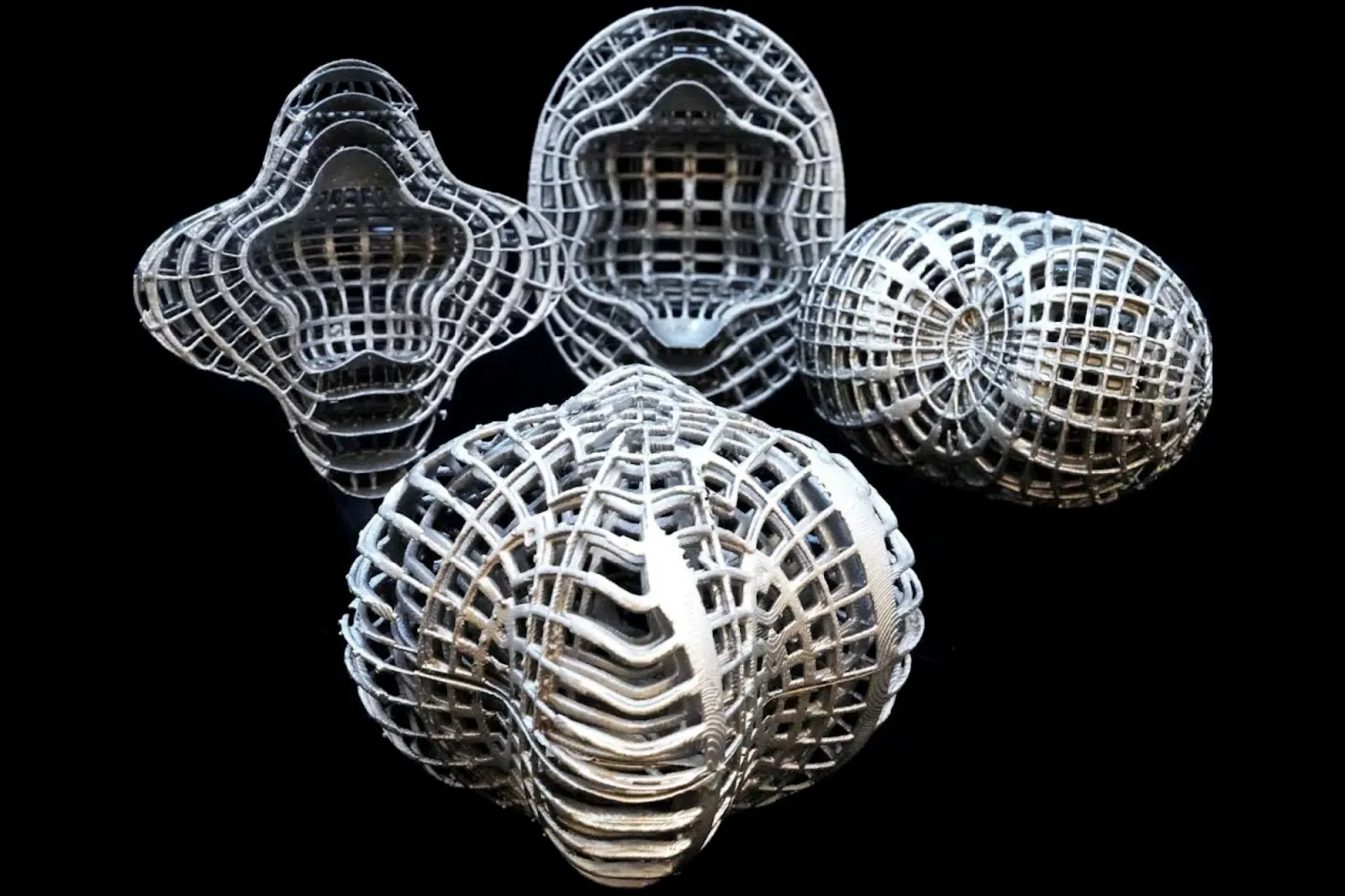
To solve that manufacturing obstacle, Zhang and her colleagues developed an optimization approach that mapped the necessary mathematical property distributions into a continuous, physically buildable lattice.13 By designing a repeating cellular framework whose individual struts can vary in thickness and orientation throughout three dimensions, the authors achieved the range of directional conductivities required by the underlying transformation theory.21
How does the hybrid lattice guide thermal energy?
The device steers thermal energy by pairing a highly conductive 3D-printed aluminum lattice with a surrounding low-conductivity silicone rubber.24 Aluminum conducts heat readily through its rigid network of interconnected metal bars, while the silicone polymer known as polydimethylsiloxane, cast into the remaining interior voids, conducts heat thousands of times more sluggishly.12
By tuning the thickness, spacing, and local orientation of the aluminum struts, the researchers created custom pathways through which heat travels at controlled speeds.14 Along designated routes surrounding the interior cavity, thickened aluminum channels accelerate thermal energy past the protected zone. In regions where heat must not cross into the concealed interior, narrower struts and thicker rubber barriers block thermal penetration. Thermal energy flowing into the structure follows the path of least resistance through the metallic grid, swings around the central chamber, and reconstitutes into an evenly spaced temperature field on the opposite side.
To evaluate the device, the researchers placed a fabricated specimen between two aluminum plates to generate an external temperature gradient.12 One aluminum plate was heated to 40 degrees Celsius, while the opposing plate was chilled with ice water.1 After allowing heat to diffuse through the assembly for one hour, the researchers used an infrared camera to record the resulting temperature field across the specimen.12
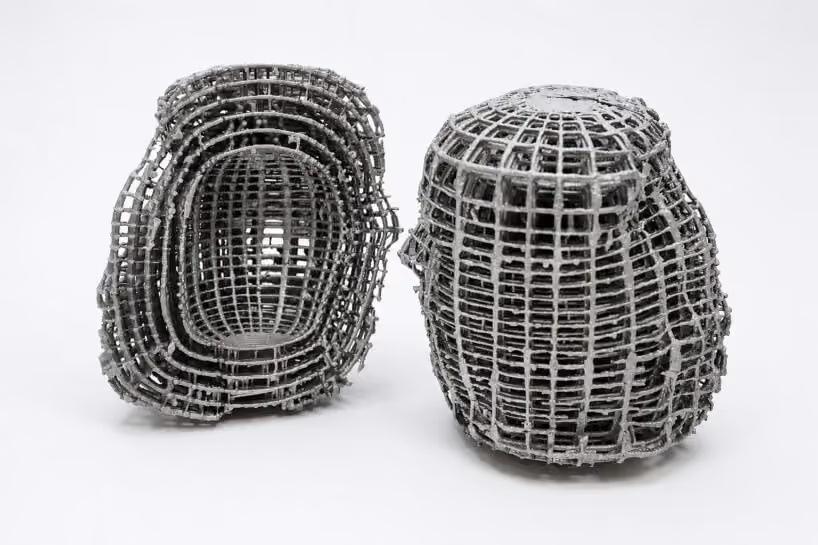
The test specimen contained an apple-shaped inner core concealed within a pear-shaped outer cloak shell.13 Outside the boundary of the cloak, the recorded temperature bands remained nearly straight and uniformly spaced, resembling the undisturbed gradient of an empty, uniform material.12 Meanwhile, temperature variations within the protected core remained small, confirming that minimal heat crossed into the hidden apple cavity.12 The authors observed similar thermal shielding behavior when testing a heart-shaped cloaking design under laboratory conditions.1
Numerical simulations also confirmed the cloaking effect across complex irregular geometries, including a detailed human face wearing glasses embedded inside a face-shaped exterior shell.12 According to the paper, the team quantified cloaking effectiveness using a thermal field disturbance index.5 Relative to an uncloaked baseline value of 1, adding the thermal cloak reduced the disturbance index to 0.037 under top heating and to 0.079 under side heating, confirming multi-directional performance.5
What can the thermal cloak accomplish today?
The current cloaking lattice can only redirect external heat traveling through solid structures and cannot conceal objects that generate their own thermal energy.14 Because living human beings and operating engines continuously produce metabolic or mechanical heat, that internal energy would accumulate within the shielded core, creating a hot pocket that eventually leaks into the surroundings and betrays its location to an infrared sensor.14
The physical laboratory experiments were conducted under steady-state conductive conditions between fixed metal boundary plates rather than in dynamic open environments subject to convection or wind. Furthermore, while the researchers successfully fabricated the intricate apple, pear, heart, and face geometries, the human-head experiment was evaluated through computer simulations rather than experimental thermal imaging of an actual printed face.13 The material configuration relies on specific manufacturing tolerances for 3D printing aluminum and casting silicone rubber, meaning structural damage or environmental wear could degrade the delicate directional pathways that make the effect work.
Even with these operating boundaries, the design provides an adaptable physical blueprint for routing heat around delicate components in extreme environments.21 Managing thermal currents is a recurring challenge in microelectronics, where densely packed processing cores generate intense localized heat that can degrade adjacent silicon elements. A structured material that bends surrounding thermal energy away from vulnerable circuits could prevent overheating without requiring bulky mechanical refrigeration or active cooling loops.
The research team plans to investigate active and multifunctional materials capable of managing heat generated inside the cloaked space.24 Developing cloaks that can dynamically route, disperse, or concentrate internal heat on demand would expand the technique from passive laboratory concealment toward responsive thermal regulation in computing hardware and aerospace equipment.24
The record
28 sentences trace to 5 sources.
-
1
TP
Tibi Puiu Document · zmescience.com · 23 Oct 2026 Scientists Built a 3D Cloak That Makes Objects Almost Invisible to Thermal Cameras See the source
-
2
C
cee.illinois.edu Third-party reporting · cee.illinois.edu New 3D thermal cloak hides objects from heat in any direction See the source
-
3
E
experts.illinois.edu Third-party reporting · experts.illinois.edu Free-form thermal cloaks in three dimensions See the source
-
4
TT
The Times Of India Third-party reporting · timesofindia.indiatimes.com · 24 Jul 2026 Scientists create the first 3D cloak that makes objects invisible to heat See the source
-
5
T
technews.tw Third-party reporting · technews.tw 全球首個 3D 熱隱形斗篷問世,紅外線相機也偵測不到 See the source