The moon is steadily shrinking as its interior cools down
Thousands of newly mapped surface faults indicate ongoing contraction across the lunar crust, pointing to widespread moonquakes as the interior loses its ancient heat.
A planetary body with a warm core surrounded by cold space will inevitably lose its heat. When rock and metal cool, they lose volume, drawing inward and pulling the surface along with them. If the outer layer is a brittle shell of solid rock, that shrinking interior removes the support beneath it. The rigid crust cannot simply compress smoothly to fit a smaller sphere. Stresses accumulate until the rock fractures, thrusting one section over another along newly broken scarps and ridges.
This progressive structural fracturing changes how planetary scientists view the moon. While popular imagination often treats the lunar surface as a static relic preserved unchanged since the era of heavy bombardment, the crust remains dynamic. Where the ground buckles under compressive strain, the slippage produces seismic shaking. Understanding where and why these fractures develop affects where future robotic landers or crewed outposts can operate without being disrupted by shallow moonquakes.
The sequence that drives this deformation follows a straightforward mechanical chain. As the moon's core and mantle lose their internal thermal energy to space, the interior volume decreases. That internal shrinkage exerts horizontal compression across the entire brittle outer shell. Eventually, the accumulated stress exceeds the physical strength of the lunar rock, causing the crust to crack and heave upward. These surface deformations leave visible geological scars where older terrain has been cut and pushed into stepped cliffs.
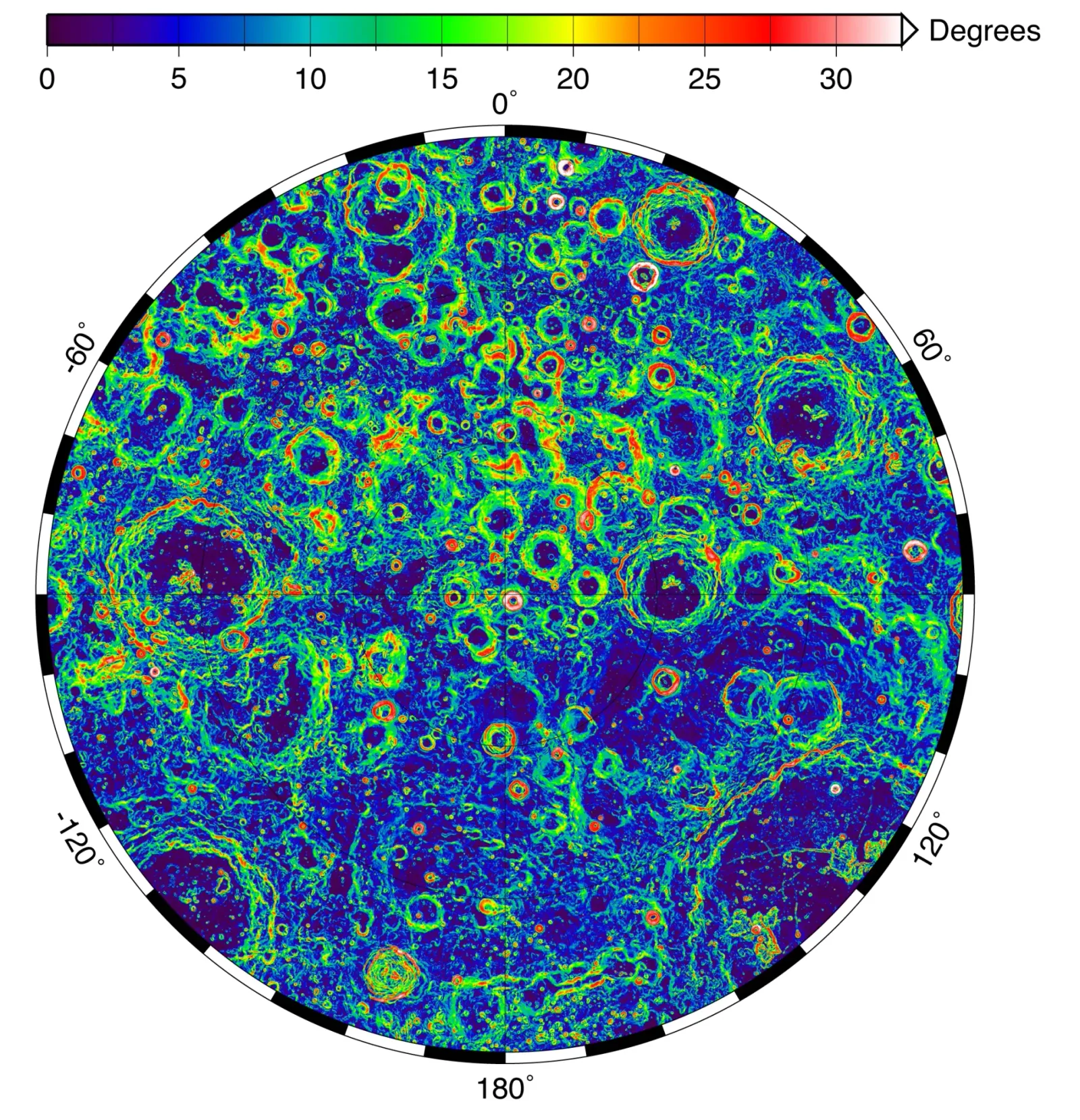
A study published on October 14, 2026, in The Planetary Science Journal establishes the scale of this structural contraction.1 A research team led by scientists examining the lunar surface reported that the moon's radius has decreased by approximately 45 meters, or 148 feet, over the past 400 million to 800 million years.1 That shrinkage has carved more than 10,000 young faults across both the rugged lunar highlands and the dark volcanic plains.1
How do surface fractures reveal lunar contraction?
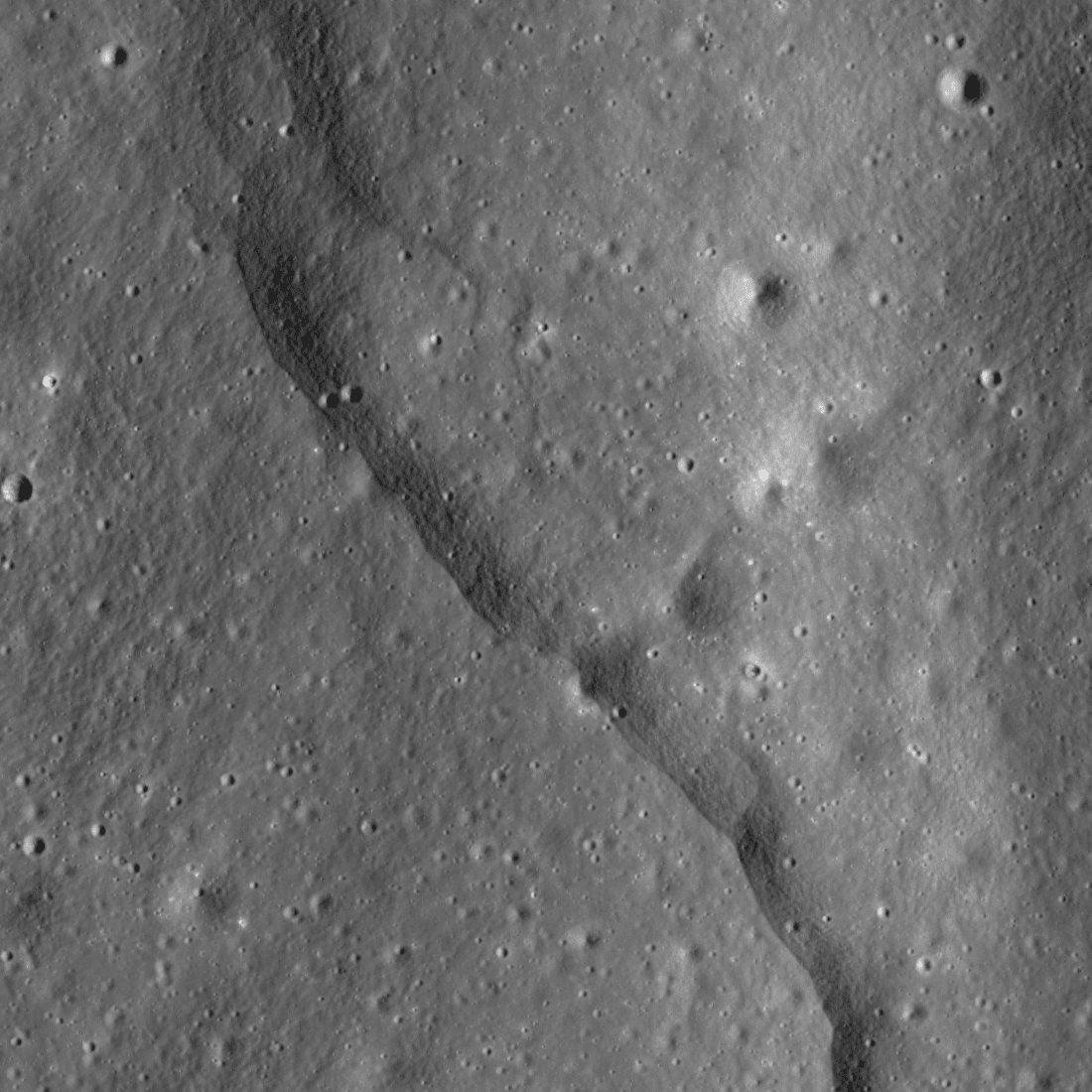
The newly identified landforms consist primarily of two distinct compression structures known as lobate scarps and small mare ridges.1 Lobate scarps resemble small curved cliffs where one block of the lunar crust has been thrust upward and over adjacent ground along a reverse fault. Small mare ridges represent similar compressive buckling across the hardened volcanic plains. Because both features crosscut relatively young impact craters and lack significant weathering from subsequent micro-meteorite strikes, geologists know they formed late in lunar history.
The paper calculated that if the moon's contraction rate has remained steady across that multi-hundred-million-year span, its radius has shrunk by around 6 to 11 centimeters every million years.1 That pace translates to a radial loss of roughly 0.1 micrometers per year.1 By contrast, tectonic plates on Earth slide past and collide with each other at an average speed of about 1.5 centimeters per year, which is roughly comparable to the growth rate of human fingernails.1
The mechanical difference between the two worlds alters where seismic hazards emerge. Earth distributes its internal tectonic motion across more than 15 independent plates, concentrating approximately 90% of its seismic activity along plate boundaries.1 The moon's crust functions as a single continuous shell without plate margins, meaning horizontal compression accumulates broadly across the sphere.1 Tectonic moonquakes generated by slipping faults can therefore happen throughout the global surface rather than along narrow boundary zones.1
Why did widespread faulting take hundreds of millions of years to appear?
A heavily fractured outer layer of pulverized rock appears to have insulated the lunar interior for billions of years before widespread faulting took hold. Scientists at the Smithsonian's National Air and Space Museum reported that the moon's outer crust is both thick and porous, pitted by billions of years of meteorite impacts.1 This porous crust acted like a thermal blanket, trapping internal heat and slowing the rate of cooling through earlier geological epochs.1 That heat retention delayed the rapid volumetric shrinkage that ultimately produced widespread fault scarps.
Geological mapping shows that regions with the thickest lunar crust consistently display the fewest surface faults.1 Those thicker zones resisted compressive strain or maintained superior thermal insulation, marking them as the most geologically stable expanses on the lunar surface. Where the crust is thinner, the cooling interior exerted immediate compressive force, forcing the rock to yield and fracture.

To detect these small, subtle structures, researchers analyzed high-resolution orbital imagery. The team identified the faults by examining data collected by NASA's Lunar Reconnaissance Orbiter Camera, an instrument that has orbited the moon for approximately 17 years.1 By viewing the surface under low-angle sunlight, long shadows cast by the scarps revealed thousands of low cliffs that earlier missions had overlooked.
“The number of these young faults revealed in LROC images is much greater than I ever imagined,” Thomas R. Watters, scientist emeritus in the Center for Earth and Planetary Studies at the Smithsonian's National Air and Space Museum, said in a statement accompanying the research.1
What do these geological measurements leave unresolved?
The estimated 45-meter radial loss represents a long-term model projection averaged across hundreds of millions of years, not an active real-time measurement of ongoing daily deformation. Researchers infer the total shrinkage from the physical dimensions, depths, and counts of observed surface scarps rather than direct orbital laser ranging of the lunar radius. Furthermore, the calculated rate assumes a relatively uniform contraction over time, even though thermal loss and crustal resistance could fluctuate over long planetary cycles.
Nevertheless, the sheer volume of crisp, unweathered fault scarps suggests the cooling process remains dynamic. Because the core has not reached complete thermal equilibrium with space, the interior continues to contract. As long as internal volume drops, mechanical stresses will continue to build within the single-plate crust.
“As the interior of the moon continues to cool and contract, it is expected that the growth of existing faults and formation of new faults continues today,” Watters said.1
The record
16 sentences trace to 1 source.
-
1
MA
Melissa Ait Lounis Document · dailygalaxy.com · 25 Oct 2026 The Moon Has Shrunk by 148 Feet, and Scientists Have Found More Than 10,000 Faults That Explain Why See the source