Camera sensors could capture three times more light by steering photons instead of filtering them
Engineers designed microscopic polymer pillars that sort incoming red, green, and blue light across image pixels, cutting exposure times without the heavy absorption losses of standard filters.
When a digital camera takes a photograph in dim lighting, most of the light that strikes the lens never makes it into the final picture. Photographers know the familiar consequences: grainy textures, smeared movement, and muted shades where vibrant details ought to stand out. The fundamental issue is not that sensors cannot register faint signals, but that modern camera hardware discards the vast majority of incoming photons before they can be counted.
Standard digital cameras produce colour pictures by breaking light apart into red, green, and blue components.12 Because a silicon photodiode measures only the quantity of light that hits it rather than its colour, camera makers place a coloured mosaic over the pixel grid. The arrangement, known as a Bayer filter array, covers individual pixels with microscopic dyed tiles.12 A red tile lets red wavelengths pass through to the pixel below while absorbing green and blue.12 A green tile lets green light pass while absorbing blue and red, and a blue tile absorbs red and green. Because two out of three primary colour bands are absorbed at every single pixel, the filter mosaic throws away roughly two-thirds of the available light across the sensor.12
For a photograph taken in full midday sun, losing two-thirds of the incoming photons is an acceptable cost. Daylight provides plenty of illumination, allowing cameras to expose clean images in tiny fractions of a second. The equation breaks down as soon as twilight arrives, an indoor scene is dimly lit, or a microscope attempts to image living tissue under low-intensity light. To gather enough photons when light is scarce, a camera must keep its shutter open longer, which introduces hand shake and motion blur. Alternatively, the camera software can boost the electrical amplification of the pixel signals, but this boosts electronic background noise alongside the true image, producing heavy speckled noise.
Solving this dilemma requires changing how sensors split light into distinct colours. In an ideal system, incoming red, green, and blue light waves would not be stopped by pigment barriers. Instead, every photon arriving at the sensor surface would be bent and guided to the exact pixel assigned to record its specific wavelength. A red photon heading toward a green pixel would be redirected into the neighbouring red pixel, preserving its energy while maintaining correct colour separation across the entire array.
A research team from Singapore, China, and Japan reports a practical way to achieve this redirection.12 Led by Professor Joel Yang of the Singapore University of Technology and Design, the researchers created microscopic arrays of 3D-printed polymer pillars that sort visible wavelengths into their corresponding sensing regions.12 By routing photons rather than absorbing them, the experimental device allows an image sensor to harvest up to three times more light, producing sharper and cleaner images at one-third the exposure time required by a conventional filter setup.12
Why do conventional cameras discard incoming light?
Conventional digital image sensors discard incoming light because their colour filters rely strictly on selective optical absorption.13 When ambient light strikes a sensor pixel beneath a red dye filter, the green and blue wavelengths cannot pass and are converted into wasted heat within the filter layer. Commercial Bayer filter arrays typically transmit only 20 to 35 percent of the total incident visible light to the underlying photodetectors, according to the researchers.12
Optical engineers have explored alternative devices known as colour routers for several years to redirect light instead of blocking it. Earlier designs relied on high-refractive-index materials, such as titanium dioxide or gallium nitride, which bend light sharply at nanoscale boundaries.12 While those materials route wavelengths effectively, their fabrication demands complex, costly, multi-step lithography and etching processes that are difficult to adapt to high-volume commercial manufacturing.12
The team at the Singapore University of Technology and Design took a different route by testing whether low-refractive-index materials could perform the same sorting role.12 Everyday optical polymers and glasses are inexpensive, abundant, and compatible with large-scale manufacturing methods.12 The physical obstacle is that these substances interact with light much more weakly, which previously prevented researchers from achieving sharp wavelength redirection within tight pixel boundaries.12
How can transparent pillars steer different colours?
Transparent microscopic pillars steer different colours by scattering incoming light waves so that they interfere constructively toward specific target pixels. Rather than treating each pillar as a standalone coloured lens, the researchers designed a coordinated unit cell of four cylindrical nanopillars printed onto a flat base.12 In a standard Bayer arrangement, pixels sit in a two-by-two repeating grid containing one red, two green, and one blue detector.12 The four polymer pillars sit directly above this quadrant and act as a coupled optical system.12
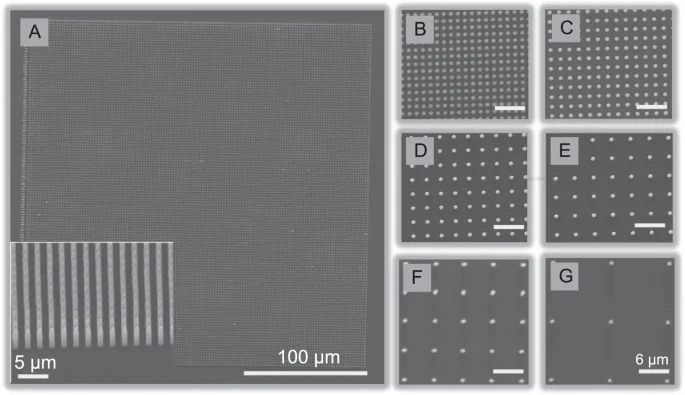
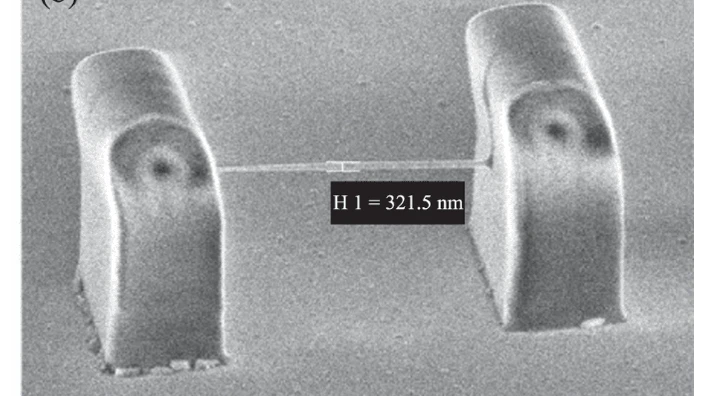
To fabricate the structures, the researchers used two-photon polymerisation, a nanoscale 3D-printing technique where a tightly focused laser beam solidifies liquid resin only at the point of maximum intensity.12 The system achieved spatial features as small as 150 nanometres, well below the width of a human hair and smaller than the wavelengths of visible light.12 The resulting pillars rise to differing heights and widths, creating a surface texture without any overhanging ledges or internal cavities, a layout the researchers call a 2.5D geometry.12
Finding the right pillar shapes required computational exploration. The team implemented particle swarm optimisation, an algorithm patterned after the collective motion of flocking birds, to navigate thousands of structural permutations.12 The algorithm tested candidate geometries in digital simulations, evaluating how effectively each variation routed light across the spectrum. Crucially, the researchers programmed the optimisation process to adjust its choices based on whichever colour channel performed worst in a given simulation, preventing the design from improving red transmission by degrading green or blue.12
In computational models, the optimised polymer nanopillar design achieved routing efficiencies of nearly 90 percent across the visible spectrum.12 To test the concept physically, the team printed prototype devices featuring 250,000 unit cells across an area measuring one square millimetre.12 In laboratory measurements, these physical devices achieved approximately 70 percent routing efficiency.12 The authors attributed the difference between the 90 percent simulation mark and the 70 percent experimental result to minor physical deviations introduced during the 3D-printing process.12

What can the colour router do in practice?
In photographic testing, the 3D-printed colour router allowed a monochrome sensor to reconstruct full-colour images with improved colour fidelity while using one-third the exposure time of a conventional filter system.12 Because the router directs red, green, and blue wavelengths to predictable pixel positions, a monochrome camera sensor, which records only brightness levels without native colour awareness, can supply the raw data needed to assemble an accurate colour picture.12
The threefold increase in collected light addresses the central engineering compromise of low-light photography. By capturing more photons at the start of an exposure, a camera can freeze motion at faster shutter speeds while avoiding the heavy digital amplification that introduces speckles and noise into dark frames.
The simplified 2.5D pillar structure also changes the economic equation for manufacturing. Because the pillars sit upright on a flat base without undercut cavities or suspended bridges, identical arrays could potentially be stamped or moulded using roll-to-roll or nanoimprint lithography, sidestepping the slow speed of laser printing each unit individually.
What are the limits of the current technology?
The current prototypes remain laboratory proofs of concept and are not yet ready to drop into commercial consumer devices.12 The experimental tests evaluated the optical routers placed alongside monochrome sensors rather than integrated directly onto mass-produced camera microchips.12 Moving the structures into mass production will require translating the designs into materials and processes compatible with commercial semiconductor foundries.12
Two physical constraints also require further engineering before the technology can operate inside a phone or handheld camera. First, light striking the edges of a camera sensor arrives at much steeper angles than light hitting the centre, an effect known as chief ray angle variation.12 The current nanopillars were optimised primarily for perpendicular light, meaning routing efficiency and colour balance may degrade near the edges of an image frame. Second, imperfect routing causes a fraction of incoming light to spill into adjacent pixels, creating channel cross-talk that can distort subtle colour boundaries if not corrected.12
If engineers can address angular sensitivity and channel leakage, the underlying principle could extend well past consumer photography. The researchers note that the approach could enable compact multispectral sensors that divide light into more than three distinct wavelength bands.12 Such capabilities are especially valuable in fluorescence microscopy, where scientists illuminate living cells with delicate excitation light to observe biological processes.12 In those experiments, capturing three times more emitted signal would allow researchers to record living cellular activity with dimmer light and shorter exposures, preventing phototoxic damage to living samples.12
What happens next?
The next stage of research will focus on fabricating colour routers directly atop functioning image sensor wafers to measure performance gains under real-world operating conditions. Professor Yang and his colleagues plan to refine the pillar profiles to maintain uniform optical sorting across wide angles of incidence and reduce stray light between neighbouring channels.12 Demonstrating that the polymer arrays can be reliably stamped at high volume will decide whether colour routing transitions from an elegant laboratory demonstration into standard camera hardware.
The record
37 sentences trace to 3 sources.
-
1
S
scientificinquirer Document · scientificinquirer.com · 26 Oct 2026 Tiny 3D-Printed Colour Routers Could Let Cameras Use Three Times More Light See the source
-
2
E
eurekalert.org Third-party reporting · eurekalert.org Routing the way to sharper and brighter low light photography with tiny 3D printed colour routers See the source
-
3
O
opg.optica.org Third-party reporting · opg.optica.org 2.5D Low Refractive Index Designer Color Router for High-Transmission Image Sensor See the source