Early snakes took to burrows and ground long before modern forms appeared
A newly identified fossil from Brazil shows that ancient snakes branched into underground and surface habitats during the age of dinosaurs rather than following a single evolutionary path.
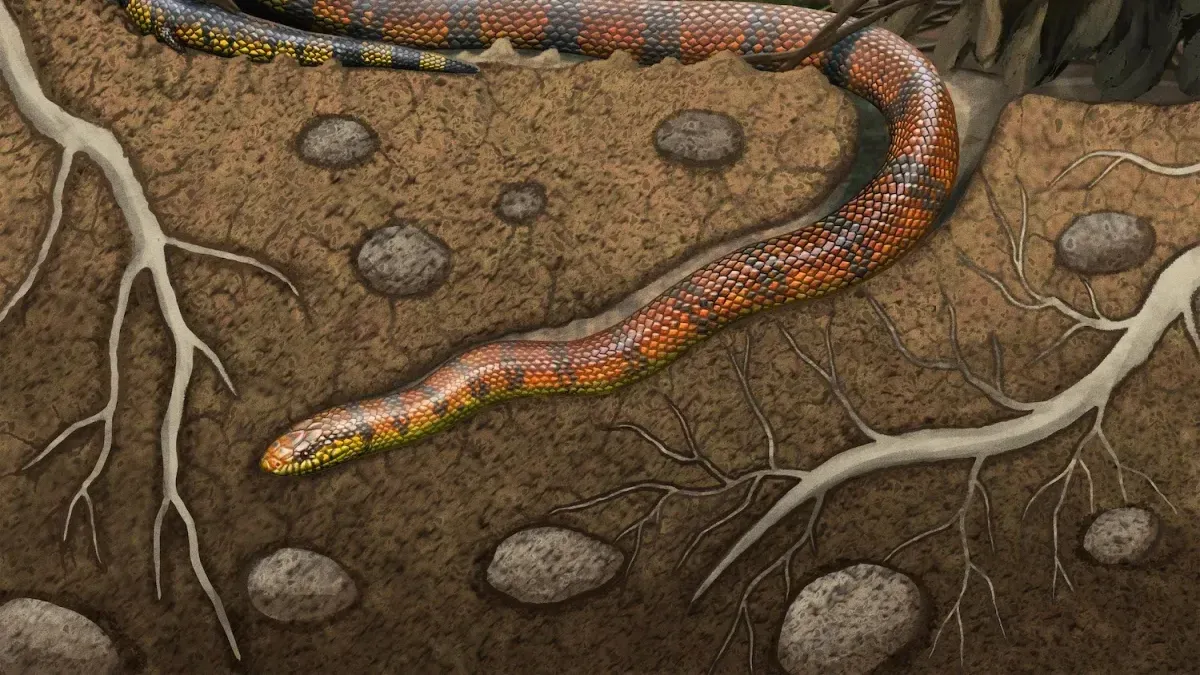
Snakes possess one of the most specialised body designs in the animal kingdom, having lost limbs, elongated their spines, and reorganised their internal organs.12 For decades, evolutionary biologists debated whether this radical transformation began underground as a burrowing adaptation or in ancient waterways as an adaptation for swimming.12 A newly analysed Cretaceous reptile from Brazil indicates that the living world explored both paths simultaneously. Rather than moving sequentially through a single transitional stage, the earliest snakes radiated into remarkably different lifestyles side by side.
Understanding this evolutionary flexibility matters because modern snakes comprise more than 4,000 living species, occupying nearly every ecological role on land, in trees, beneath the soil, and in the open ocean.13 If the foundational anatomy of snakes evolved within a single habitat, every modern variation would represent a departure from that ancestral mould. If early snakes split rapidly across contrasting environments, then adaptability itself was the original hallmark of the lineage.
The sequence of changes leading to burrowing or surface life follows clear physical constraints. An animal living in loose soil requires a reinforced skull to push through sediment, reduced eyes that avoid abrasion, and a balance system that does not rely on open spatial cues. Conversely, a reptile roaming above ground depends on acute vision to locate prey, lighter bone architecture to permit rapid locomotion, and sensitive semicircular canals in the inner ear to track agile head turns. These physical demands leave distinct traces inside the skull, long after soft tissue decomposes.
A study published in Nature reveals that two contemporary snake species living roughly 80 million years ago occupied completely different worlds.13 An international team of researchers described Tametara mirim, an ancient snake discovered in southeastern Brazil whose fossilised anatomy matches the profile of a committed burrower.13 When compared with Dinilysia patagonica, a contemporary fossil snake unearthed in Argentina, the two species revealed entirely distinct skull and brain adaptations.14 While Tametara dug into sediment, Dinilysia roamed open land.14
How did two ancient reptiles split their territory?
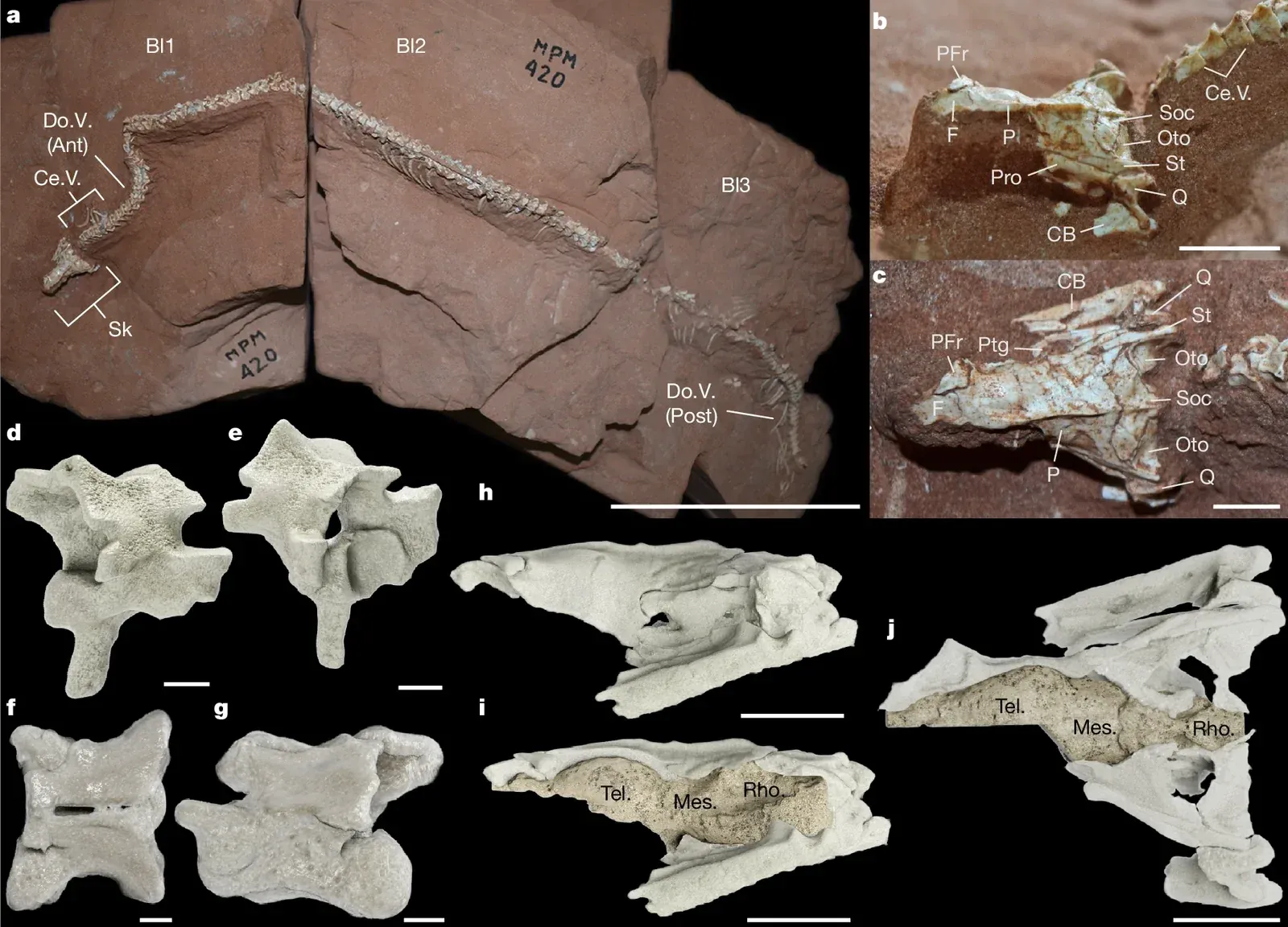
The physical specimen of Tametara mirim consists of an articulated partial skeleton measuring about 42 centimetres in length, excavated from rocks in the state of São Paulo, Brazil.3 Paleontologists William Nava and Giovanna Paixão discovered the fossil in 2020 at William's Quarry 2 within the José Martin Suárez paleontological site in Presidente Prudente.3 The surrounding sedimentary layer, designated the Adamantina Formation within the Bauru Group, dates to between 85 million and 75 million years ago, a late Cretaceous interval that also preserved sauropod dinosaurs and primitive birds.13 Unlike previous snake discoveries from Brazil, which consisted solely of isolated vertebrae, this individual preserved its skull, lower jaws, and 103 presacral vertebrae in anatomical connection.3
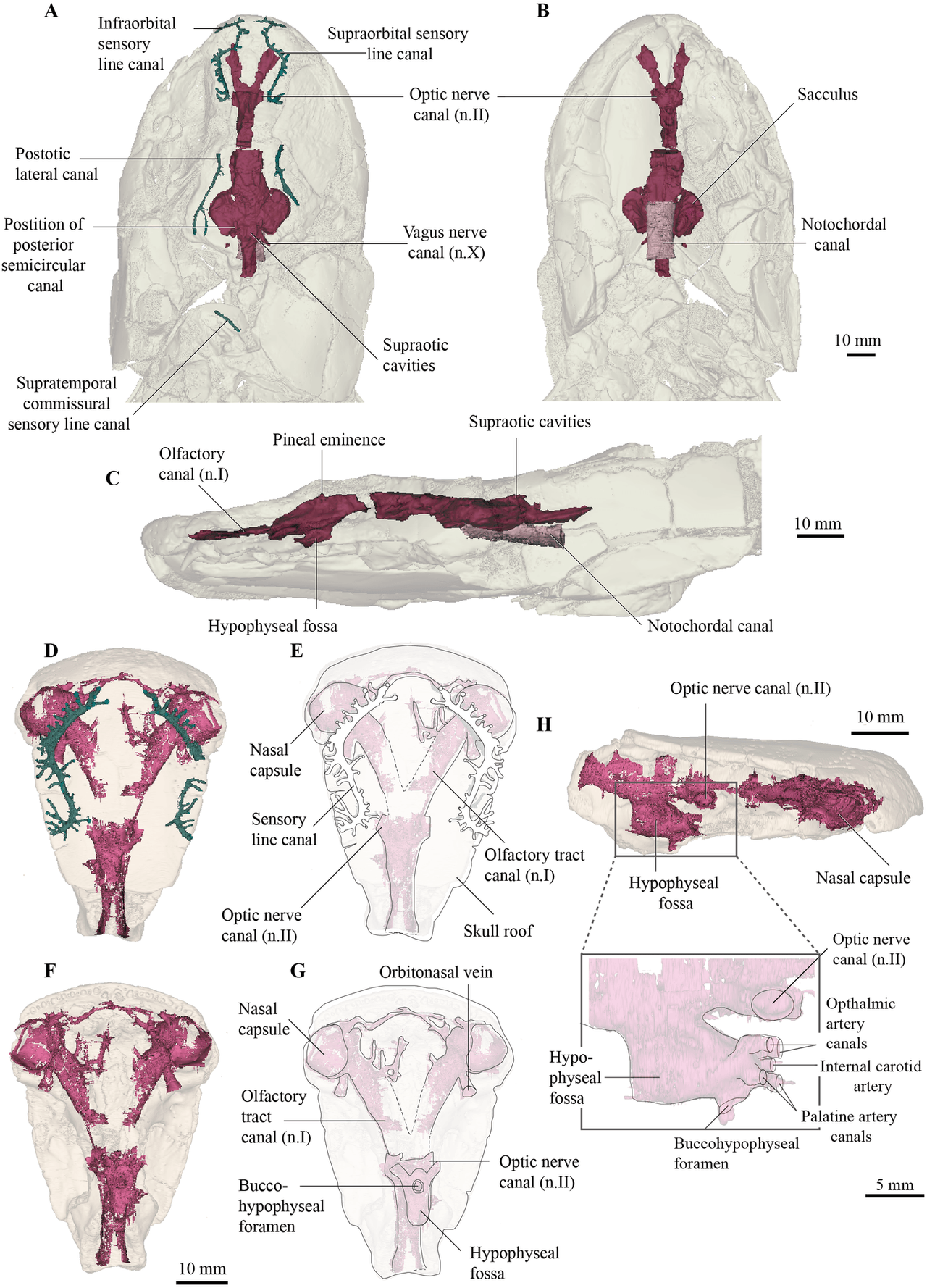
To inspect the animal without destroying delicate bones, an investigation led by Tiago Simões of Princeton University, Nicolas Di-Poï of the University of Helsinki, and Annie Hsiou of the University of São Paulo deployed computed microtomography.3 Gabriela Sobral, a researcher at the Natural History Museum in Stuttgart and the University of Brasília, digitally segmented the resulting three-dimensional X-ray scans.3 This process separated individual cranial bones and generated a high-resolution cast of the empty space inside the braincase, known as an endocast.14
The digital endocast of Tametara demonstrated direct physical evidence of subterranean habits.34 The roof of its skull displayed thickened, tightly overlapping bones suited to resist mechanical strain when burrowing through dirt.43 Inside its inner ear, the semicircular canals were thin and reduced, indicating that agile, three-dimensional orientation was unnecessary underground.43 By contrast, the inner ear vestibule was large and rounded, an arrangement that facilitates the reception of low-frequency vibrations travelling through solid ground.43 The brain endocast also revealed that the optic roof, the neural structure responsible for visual processing, was reduced to a narrow band, showing that vision had atrophied as the animal adapted to darkness.4
Why do their brain shapes tell different stories?
The researchers observed an entirely different anatomical pattern when evaluating Dinilysia patagonica, which lived approximately 85 million years ago in what is now Argentina.14 While Tametara possessed compact olfactory structures and an atrophied optic roof, Dinilysia exhibited cranial features and brain dimensions suited for an animal hunting on the surface.34 Earlier scientific assessments had debated whether Dinilysia burrowed, swam, or walked.13 The digital endocast and bone tissue examinations confirmed that it was a terrestrial ground-dweller rather than a burrower.13
Bone microstructure, the microscopic architecture of mineralised tissue visible under magnification, reinforced what the digital brain models indicated.13 Animals that live underground develop characteristic bone densities and cortical arrangements that contrast sharply with the bone geometry of surface-dwelling or aquatic animals.14 Quantitative shape analysis of the telencephalon, the forward region of the brain housing the olfactory bulbs, matched the physical bone structure in both species, grouping Tametara squarely among specialized burrowers and separating it from Dinilysia.43
“Brain shape and bone microstructure pointed to the same conclusion: Tametara was adapted to burrowing, Dinilysia to life on the ground,” said Di-Poï, a research director at the University of Helsinki's HiLIFE Institute.12 By demonstrating that two stem snakes from the Late Cretaceous possessed radically different neurological configurations, the study showed that ancient lineages were developing divergent sensory systems suited to local niches.3
What can these ancient fossils leave unexplained?
These fossil interpretations reflect the physical geometry of preserved cavities rather than the soft cellular anatomy of the brain itself. As Sobral noted, an endocast reflects the composite interior volume enclosed by the skull bones during life, which does not always mirror the exact boundaries of every neural fold.4 Furthermore, while the skull and upper spine of Tametara are exceptionally preserved, the fossil specimen MPM 420 does not preserve the pelvic region near the cloaca.43 Consequently, researchers cannot determine whether Tametara possessed tiny vestigial hind limbs like its Argentine contemporary Najash rionegrina, or whether it had completed full limb loss.14
The discovery also cannot identify where the very first stem snakes arose. The earliest known snake remains date back to the Middle Jurassic, more than 160 million years ago, although those older specimens consist mostly of fragmentary bones.13 Because Tametara and Dinilysia lived roughly 80 million years after the origin of the lineage, their differences demonstrate evolutionary diversification that was already well underway, rather than capturing the singular moment when snakes split from other lizards.14
Where does the evolutionary tree branch next?
Fossils recovered from ancient marine sediments had already proven that early Cretaceous snakes frequented coastal waters and shallow seas.12 Integrating Tametara and Dinilysia into that broader picture reveals that stem snakes switched repeatedly between subterranean, surface, and marine environments.12 Instead of progressing along a single uniform pipeline from lizard to burrower and finally to modern generalist, snake evolution was deeply bush-like from an early stage.
Fewer than 10 articulated snake skeletons survive from the entire Mesozoic era, which ended 66 million years ago, and only four are preserved in full three dimensions.34 As teams prospect deeper into the Adamantina Formation and other Cretaceous and Jurassic horizons, the anatomy of early snakes will continue to clarify how bodily elongation opened up varied ways of living. The ancient record shows that long before modern vipers, pythons, and blind snakes emerged, their distant forebears were already carving out lives beneath the ground and across the prehistoric landscape.
The record
36 sentences trace to 4 sources.
-
1
S
scientificinquirer Document · scientificinquirer.com · 26 Oct 2026 An 80-Million-Year-Old Burrowing Snake Shows Early Snakes Explored Many Lifestyles See the source
-
2
S
sciencedaily.com Third-party reporting · sciencedaily.com 80-million-year-old snake brain reveals a surprising evolutionary secret See the source
-
3
P
pmc.ncbi.nlm.nih.gov Official record · pmc.ncbi.nlm.nih.gov Exceptional brain and ecological diversity in the earliest snakes - PMC See the source
-
4
E
eurekalert.org Third-party reporting · eurekalert.org Fossil discovered in São Paulo reveals new clues about the origin of snakes See the source