Elite infant tomb in Peru reveals inherited power in Moche society
A newly excavated burial at Huaca de la Luna filled with warrior ceramics suggests aristocratic status passed through birth rather than battlefield achievements in ancient northern Peru.
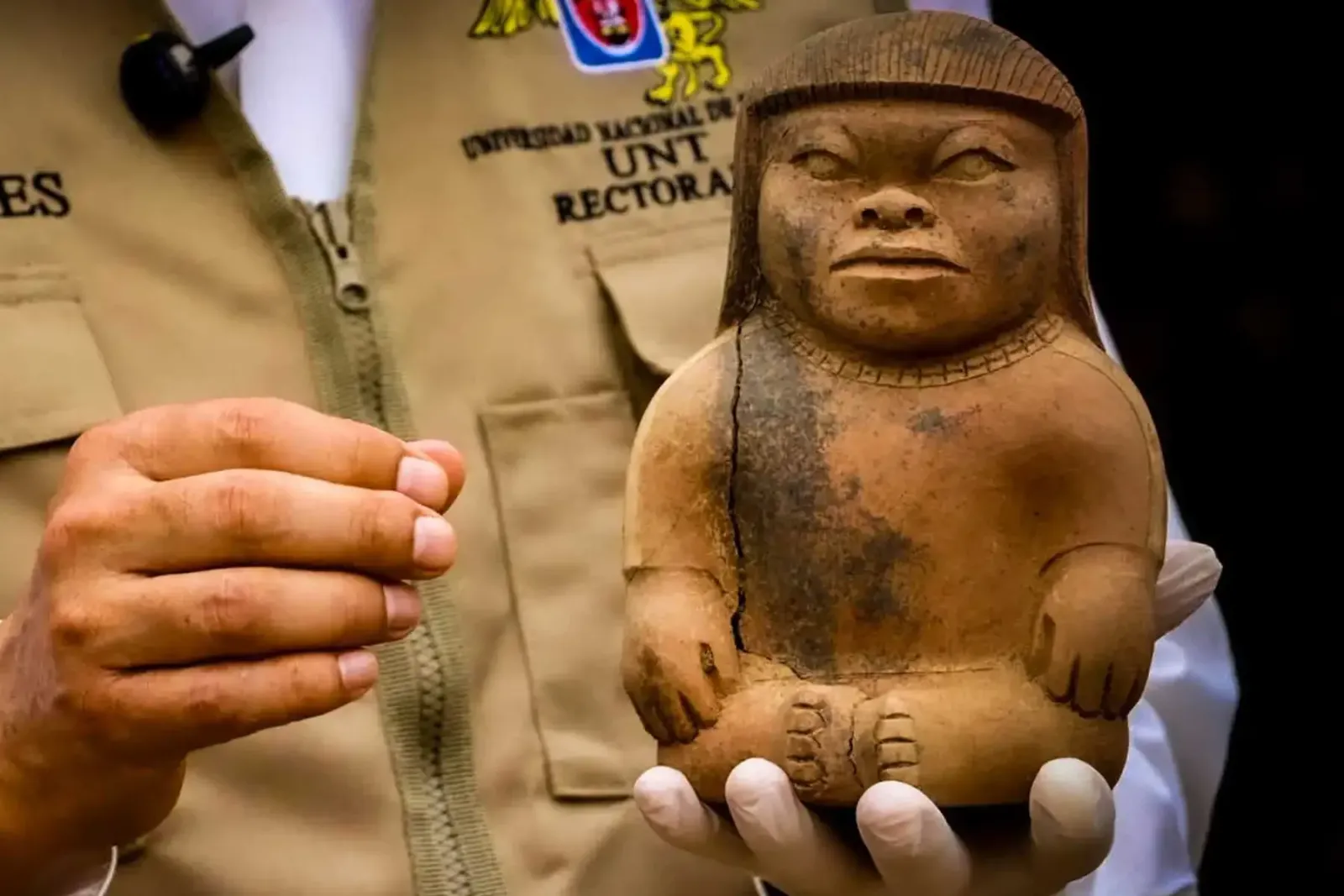
In stratified societies that leave no written histories, the archaeological traces of childhood provide the clearest test of how social power actually worked. When an adult is buried with weapons, elaborate metalwork, and depictions of defeated enemies, those grave goods can be interpreted as honors earned across a lifetime of physical combat, political negotiation, or ceremonial duty. When the same martial symbols accompany the skeletal remains of a toddler who never held a weapon or walked onto a battlefield, the interpretation must change. The presence of combat regalia in an infant grave shows that social rank did not begin with personal accomplishments. It was assigned at birth through an inherited aristocratic lineage.
That distinction lies at the center of a discovery on the arid northern coast of modern Peru, where researchers excavating an ancient ceremonial complex have uncovered the intact tomb of a child buried with thirty-two ceramic vessels and funerary metalwork.12 The child was interred inside the Uhle Platform, a mausoleum connected to the monumental adobe temple known as Huaca de la Luna in the Moche River valley.13 Dating to roughly 1,500 years ago during the sixth or seventh century, the burial belonged to the Moche civilization, an urban society that flourished in coastal river valleys between the third and ninth centuries.1 While dozens of elite adult burials have been documented in the same platform, the newly discovered sepulcher represents the only known young child found with such an elaborate assemblage at the site.13
To understand the significance of the burial, one must trace how the Moche conceived the relationship between physical warfare and cosmological order. In Moche society, elite warriors engaged in ritualized hand-to-hand combat to capture opposing noble combatants.14 The defeated combatants were stripped of their clothing, bound around their necks with ropes, and presented before priests and rulers to be offered as human sacrifices to sustain the religious order.13 The entire sequence of victory, subjugation, and sacrificial offering was recorded across thousands of realistic ceramic vessels that were buried alongside deceased nobility.13 Because participating in this ritual combat was an exclusively adult enterprise, artifacts depicting captive warriors had previously appeared almost exclusively alongside the remains of adults who could have taken part in those ceremonies during their lifetimes.15
What did excavators find inside the Uhle Platform tomb?
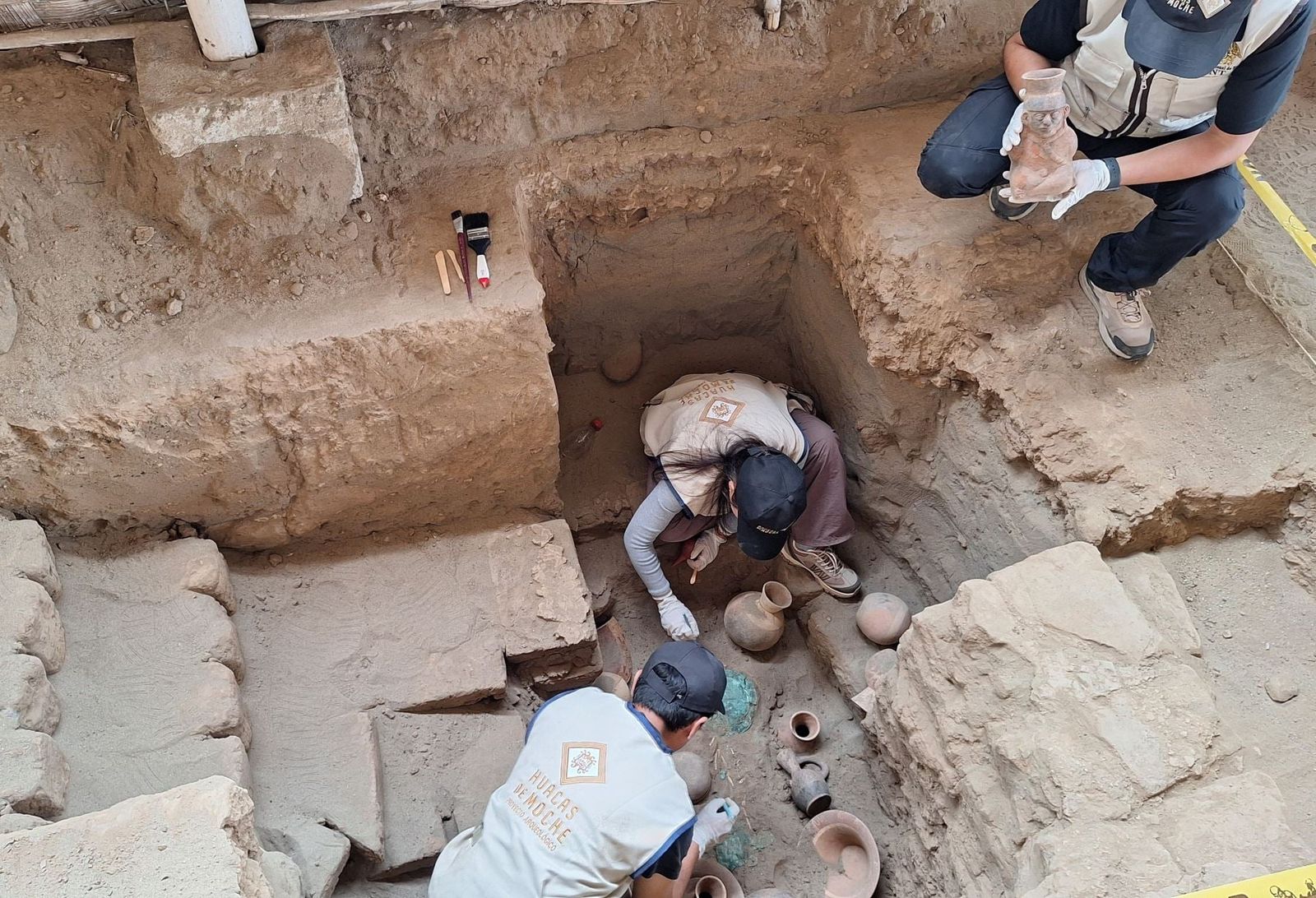
Excavations revealed an enclosed tomb containing the skeleton of a child who died at no more than two years old, surrounded by an unusually dense collection of prestige grave offerings.13 Carlos Rengifo-Chunga, director of the Huacas de Moche Archaeological Project from the National University of Trujillo, reported that the burial chamber was constructed using an enclosed brick structure typical of Moche funerary architecture.31 The chamber measured 1.20 meters long, 70 centimeters wide, and 1.20 meters deep, dimensions that could have accommodated a fully grown adult rather than a toddler whose biological sex remains undetermined.3
The funerary goods placed alongside the child included two specific metal artifacts and thirty-two distinct ceramic vessels.15 Carlos Rengifo-Chunga explained that excavators found a copper mask-like disk covering the child's face, alongside a crescent-shaped copper object resting against the bones of the feet.13 Enrique Zavaleta, the resident archaeologist on the project, noted that the ceramic assemblage encompassed both utilitarian vessels, such as jars, vases, and bottles, and elaborately decorated presentation pieces.36 Among these ceramic objects were vessels depicting human-animal deities, combat scenes, sacrificial rituals, and captive warriors bound with ropes around their necks.31
Two vessels in particular stand out for their unusual craftsmanship and symbolic themes. One ceramic piece represents a coastal lagoon separated from the ocean by a strip of sand, decorated with birds, fish, and two frogs that represented fertility and seasonal rainfall.35 Another bottle takes the form of a bound prisoner, yet the artifact was itself an original ceramic mold that artisans used to cast identical figures.35 Enrique Zavaleta explained that artisans typically discarded production molds after casting figures of heroic warriors, making the deliberate decoration and burial of a manufacturing mold an exceptional practice in Moche mortuary records.35
How do the burial goods illuminate Moche religious belief?
The iconography of the ceramic vessels connects the child directly to complex supernatural entities and elite ritual life. One prominent vessel recovered from the tomb depicts a human-bodied deity sporting bird wings and a bird tail, flanked on both sides by avian assistants dressed in ceremonial clothing.14 Carlos Rengifo-Chunga reported that the winged figure holds a square battle shield in one hand and a ceremonial goblet in the other, reflecting recurring themes of warfare and ritual consumption found in elite Moche art.12
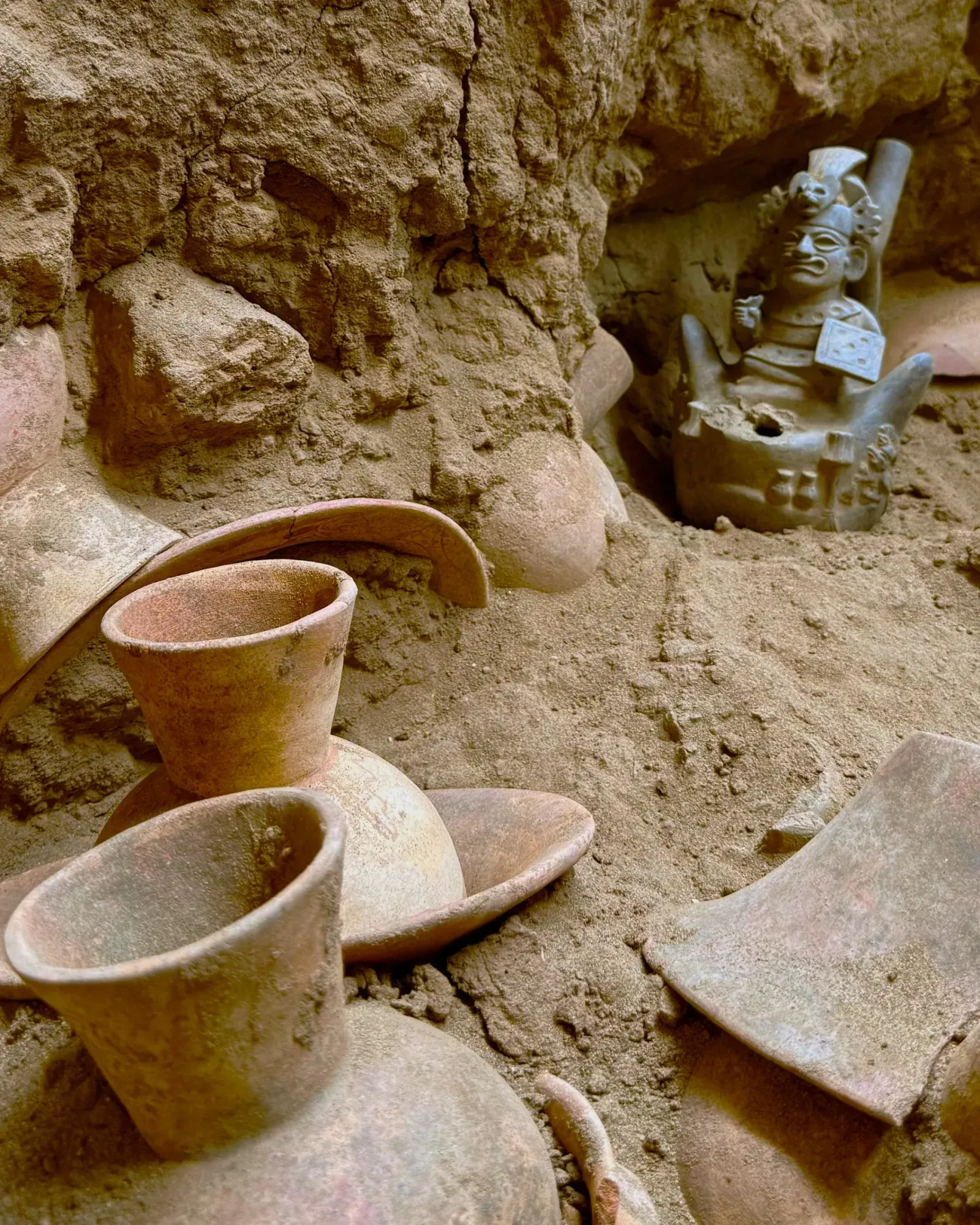
Researchers face an interpretive question over whether this hybrid creature represents a distinct supernatural figure or a known divinity captured mid-transformation. Carlos Rengifo-Chunga observed that the carving connects to an enduring scholarly debate regarding whether the Moche religious pantheon contained dozens of distinct gods or a compact group of deities capable of changing physical forms.14 A third vessel combines molding and manual modeling to portray a feline face embedded within an elaborate feather headdress, complete with protruding claws and a warrior shield integrated into the handle.35 The pairing of military equipment with divine avian and feline symbolism shows that the funerary ritual drew on the highest artistic traditions of the religious capital.
The inclusion of adult combat imagery in an infant tomb transforms our understanding of how Moche rulers communicated prestige. Under ordinary assumptions, grave goods reflect activities and roles performed by the individual during their life, such as metal tools buried with a smith or captive vessels buried with an accomplished warrior. Because a child under two years old could not have participated in military raids or ritual sacrifices, Carlos Rengifo-Chunga explained that the grave goods served as an expression of ascribed aristocratic lineage.5 The family or dynasty that prepared the burial projected their own political power and ritual prerogatives through the child, ensuring that sacred symbols of warrior dominance accompanied their descendant into the afterlife.
What are the boundaries of the archaeological evidence?
The conclusions drawn from the tomb remain bounded by the physical state of the remains and the specialized nature of elite funerary architecture. The skeletal remains were found in an early developmental stage, meaning that physical anthropologists cannot establish the child's biological sex without destructive biochemical testing that has not yet taken place.14 Furthermore, the burial represents a single elite context within the Uhle Platform, meaning that scholars cannot assume that non-elite Moche families buried their deceased children with comparable ritual complexity or inherited ceremonial goods.
Archaeological evidence also reflects intended ritual presentation rather than everyday social life. Grave offerings show the idealized status that surviving relatives chose to assign to the deceased child, which can magnify family standing beyond their day-to-day administrative authority. While the presence of thirty-two ceramic vessels and copper ornaments confirms exceptional wealth relative to eighty other burials examined on the platform, broader historical reconstructions must await further physical analysis.12 The recovered artifacts have been transferred to the conservation laboratories of the Santiago Uceda Castillo Museum, where conservators will clean and stabilize the painted ceramics and fragile copper pieces before displaying them to the public.13
The record
26 sentences trace to 6 sources.
-
1
MB
Margherita Bassi Document · livescience.com · 26 Oct 2026 Rare burial of elite toddler from pre-Inca culture discovered in Peru See the source
-
2
I
infobae.com Third-party reporting · infobae.com · 7 Oct 2026 Descubren tumba infantil con 32 ofrendas que podría estar vinculada a la élite Mochica por su alto estatus social en Huacas de Moche See the source
-
3
AA
Agencia Andina Third-party reporting · andina.pe · 13 Oct 2026 Peru: Elite Moche infant's tomb discovered at Huaca de la Luna in Trujillo See the source
-
4
A
arkeofili.com Third-party reporting · arkeofili.com · 27 Oct 2026 Peru’da Moche Kültürüne Ait Elit Çocuk Mezarı Bulundu - Arkeofili See the source
-
5
I
-
6
A