Early cosmic dawn reshaped the universe through two separate waves of radiation
A vast simulation tracking how radiation from the earliest stars and supermassive black holes transformed intergalactic hydrogen and helium offers a benchmark for interpreting distant galaxy observations.
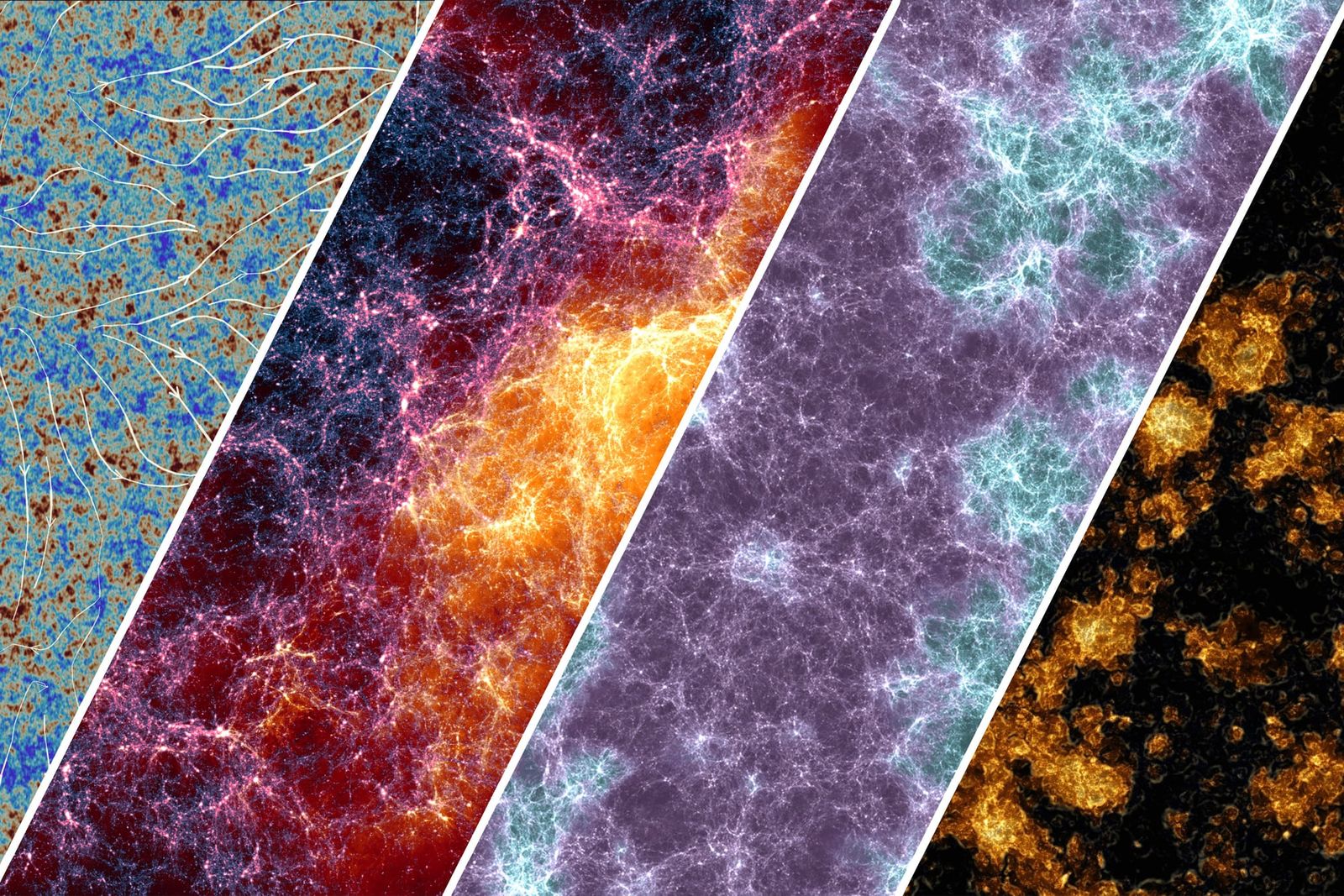
For hundreds of millions of years after the initial expansion of the cosmos, the universe remained dark, cold, and filled with neutral gas. As the primordial fireball cooled, electrons bonded with protons to form neutral hydrogen and helium atoms, leaving space transparent to ancient light yet devoid of stars. That quiet era ended when gravity pulled gas into the first clumps, igniting the earliest stars and assembling infant galaxies. Energetic light pouring out of those fledgling structures began stripping electrons away from surrounding atoms, gradually carving transparent bubbles out of the cosmic fog until the gas between galaxies was completely transformed into an ionized plasma.
Understanding this ancient transformation matters because it determined the physical conditions under which all later cosmic structures formed. When high-energy radiation ionizes intergalactic gas, it also heats that gas, raising its pressure and regulating how easily matter can fall into galaxies to fuel new stars.1 Today, space observatories like the James Webb Space Telescope capture infrared light from galaxies that shone during this transitional era.12 Yet detecting faint, distant points of light cannot by itself reveal how radiation moved through the vast voids between them or how quickly the surrounding intergalactic medium changed state.
For the cosmos to emerge from its dark phase, several physical processes had to operate in a specific sequence. Primordial gas had to fall into dark matter structures and cool enough to collapse into stars. Those newborn stars had to produce copious ultraviolet radiation, and a portion of those energetic photons had to escape the dense local gas of their parent galaxies. Once out in the wider cosmos, that light collided with neutral hydrogen atoms, knocking their solitary electrons free. As successive generations of stars ignited, individual pockets of ionized gas expanded, overlapped, and eventually joined together across millions of light-years. Later, when supermassive black holes gathered matter and blazed as active galactic nuclei, their harsher radiation drove a second wave of transformation by stripping electrons from helium.
Now researchers have simulated both of these widespread phase changes together across a vast, continuous digital volume. The project, named Lumina, tracks how radiation and matter coevolved from the earliest cosmic dawn down to the era when star formation reached its historical peak.23 Led by Oliver Zier, an ITC fellow at the Center for Astrophysics | Harvard & Smithsonian, the collaboration modeled the physical processes governing the first 2 billion years of cosmic history, following the gas, dark matter, and light until redshift 3, which corresponds to roughly 2.1 billion years after the Big Bang.12
How did early light reshape the intergalactic gas?
Radiation from the earliest stars dismantled the neutral hydrogen filling the young universe over hundreds of millions of years. According to research accepted for publication in Monthly Notices of the Royal Astronomical Society by Oliver Zier, Aaron Smith, Xuejian Shen, Rongrong Liu, Rahul Kannan, and colleagues, hydrogen reionization was driven predominantly by stellar radiation from galaxies.34 The simulation shows that the median sub-volume of the universe was fully ionized by redshift 5.2, while residual patches of neutral hydrogen persisted until redshift 4.75.3
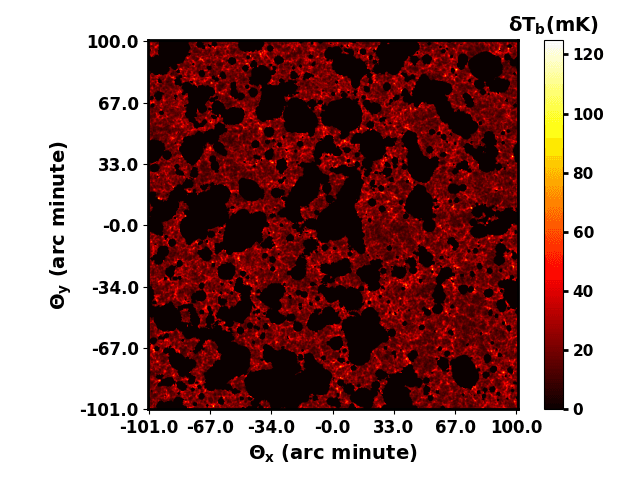
Because hydrogen possesses only a single electron bound to a single proton, lower-energy ultraviolet photons from star-forming dwarf galaxies carried sufficient energy to ionize it.2 As these small galaxies multiplied, expanding ionized regions spread through intergalactic space.1 The simulation demonstrates that dense regions attracted matter and formed luminous structures rapidly, while emptier voids lagged behind in darkness until light from neighboring structures penetrated the gas.1
Helium followed a markedly different timeline because of its atomic structure. Helium atoms hold two electrons, and stripping both requires considerably more energy than ionizing hydrogen. While the first electron can be removed by stellar radiation, ionizing singly ionized helium into doubly ionized helium demands hard, high-energy radiation.1 The authors report that this second ionization stage was driven by active galactic nuclei powered by accreting supermassive black holes rather than ordinary stars.23
According to the paper, helium reionization began around redshift 6, reached its midpoint at redshift 4, and approached completion near redshift 3, leaving a residual volume filling fraction of singly ionized helium below 1%.2 This delayed transformation produced a distinct late-time thermal boost in the intergalactic medium, altering its temperature and pressure just as cosmic star formation was reaching its peak.3
What makes tracking helium reionization so demanding?
Simulating the full duration of helium reionization requires evolving cosmic structure across an additional billion years while computing how energetic light travels through increasingly clumped matter. To follow both hydrogen and helium transitions down to redshift 3, the researchers had to compute interactions across an epoch where gravity had already pulled matter into dense filaments, clusters, and voids.2
To capture these extended processes, the team conducted the calculation across a comoving cube measuring 500 megaparsecs on each side, which corresponds to approximately 1.5 billion light-years per side.31 This spatial coverage represents a volume more than 100 times larger than those used in previous comparable calculations, allowing the model to encompass rare objects like bright quasars alongside common dwarf galaxies.13
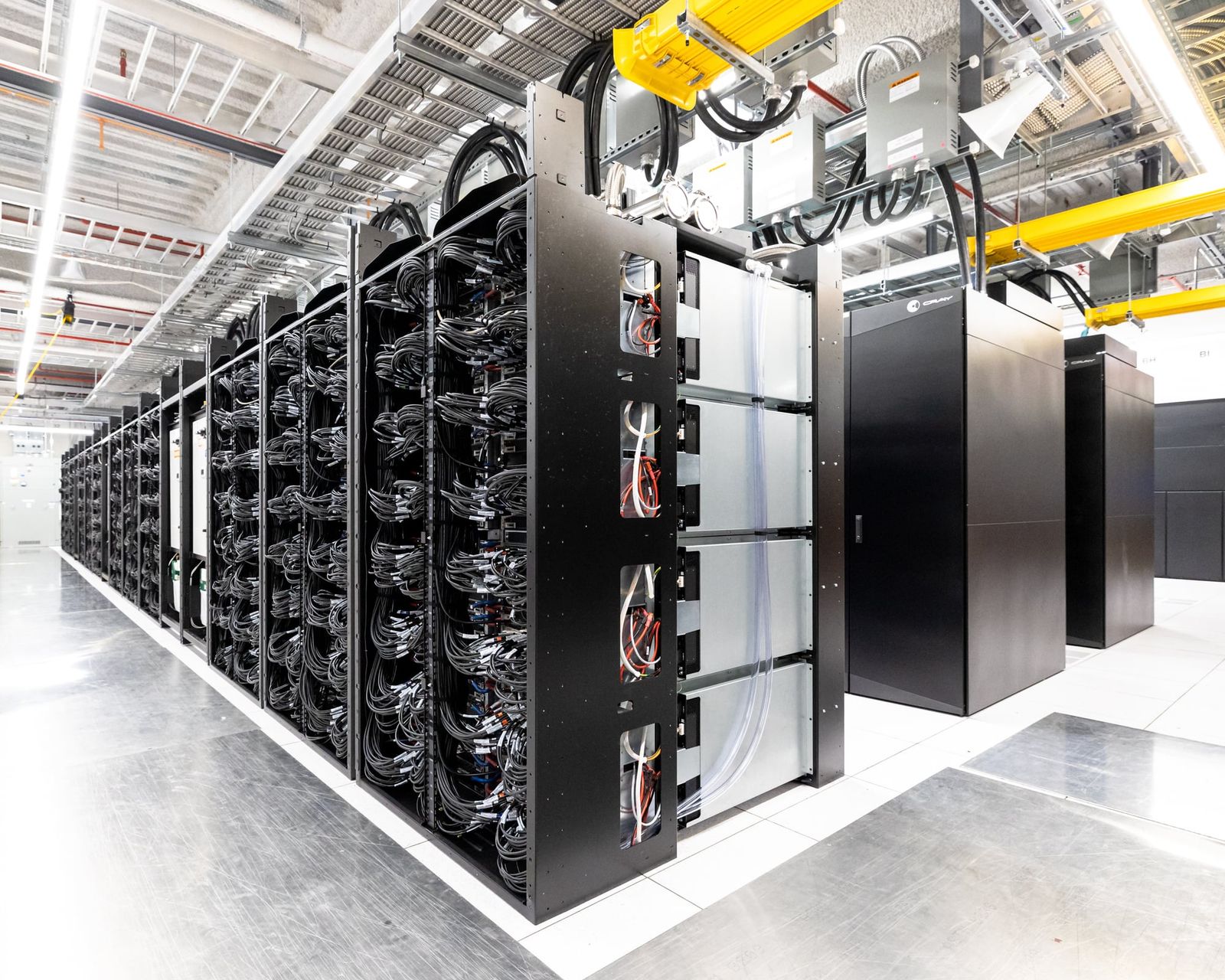
The calculation ran on the Frontier supercomputer at Oak Ridge National Laboratory, utilizing more than 15,000 graphics processing units.2 Using the moving-mesh code AREPO, the researchers combined the IllustrisTNG galaxy-formation model with a radiation-transport solver operating across six frequency bins.3 The simulation followed 2 times 6000 cubed resolution elements, achieving a baryonic mass resolution of 3.6 million solar masses and a dark matter mass resolution of 19 million solar masses.3
Tracking radiation across such large expanses also changes how scientists understand recombination, the process where free electrons rejoin ionized atomic nuclei. In a related study published in The Open Journal of Astrophysics, a research group led by Ali Sadain, Aaron Smith, Oliver Zier, Hyunbae Park, Teodora-Elena Bulichi, and co-authors analyzed clumping in Lumina. They found that standard density-only calculations overpredict the instantaneous recombination rate by a factor of 1.34 at redshift 8 and a factor of 2.02 at redshift 5, and overestimate cumulative recombinations by a factor of 1.53 by redshift 5, because heating from ionizing radiation suppresses recombination in warm gas.5
“For the first time, we can follow along as both hydrogen and helium changed into their modern form across such an enormous volume of the universe, while still resolving the galaxies and other luminous objects driving that transformation,” said Aaron Smith, an assistant professor of physics at the University of Texas at Dallas and an author on the research.12
What can a virtual universe leave unanswered?
Cosmological simulations are theoretical models that approximate physical laws rather than direct observations of the ancient sky. Lumina solves equations on a discrete numerical grid and relies on specific sub-grid rules to approximate star formation, black hole growth, and radiation escape fractions that occur below its resolution limit. The results show how the intergalactic medium behaves under these specific physical assumptions, but they do not prove that every early galaxy formed or radiated in precisely this manner. In addition, the primary reference paper describing the project was posted to the arXiv preprint server and accepted for publication in Monthly Notices of the Royal Astronomical Society, providing a computational framework whose predictions must now be checked against ongoing surveys.34
Telescopes observing the early cosmos also collect light that has traveled across billions of light-years, creating complementary challenges. Instruments on the James Webb Space Telescope detect early stellar populations, but interpreting whether an observed galaxy sits in an ionized bubble or a neutral environment requires theoretical modeling. When simulated predictions diverge from telescope data, the discrepancy does not automatically invalidate cosmic theories. Instead, it can reveal where models need to refine their representations of dust obscuration, radiative feedback, or galaxy selection effects.
“To understand what we are seeing with this telescope, we need to translate our theories into detailed predictions,” said lead author Oliver Zier, an ITC fellow at the Center for Astrophysics | Harvard & Smithsonian.12 “After several years of work, with plenty of ups and downs, it is incredibly rewarding to see the simulation results and watch our predictions come to life in video.”12
Connecting the growth of individual galaxies to the shifting state of intergalactic gas provides a new benchmark for interpreting data from space observatories. By comparing telescope surveys with a virtual cosmos that spans both hydrogen and helium transitions, astronomers can examine whether early black holes were as common as recent findings suggest, refine the timeline of the first billion years, and clarify how the universe ended its dark era.
The record
24 sentences trace to 5 sources.
-
1
KR
Kouceila Rekik Document · dailygalaxy.com · 26 Oct 2026 Scientists Just Recreated the First 2 Billion Years of the Universe on a Staggering Scale See the source
-
2
U
universetoday.com Third-party reporting · universetoday.com A Huge and Powerful New Simulation Helps Explain the Universe's Reionization See the source
-
3
A
arxiv.org Paper · arxiv.org Introducing the Lumina project: large-volume radiation-hydrodynamic simulations of the epochs of hydrogen and helium reionization Preprint · may not have been peer reviewed See the source
-
4
L
lumina-simulation.com Third-party reporting · lumina-simulation.com Publications - Lumina Simulation See the source
-
5
A
astro.theoj.org Third-party reporting · astro.theoj.org · 15 Oct 2026 The Lumina Project: Intergalactic Clumping and Recombination Sinks | Published in The Open Journal of Astrophysics See the source