Internal magnetic alignment awakens hidden spin channels in nanoscale ribbons
Nanoscale ribbons carved from zero-magnetization altermagnets can yield strongly spin-polarized electrical transport once relativistic effects tie electron spins to the crystal lattice, according to new theoretical modelling.
For decades, physicists sorting magnetic materials into neat categories recognized only two fundamental arrangements of electron spins. Ferromagnets, like iron, align their atomic spins in parallel, producing a powerful net magnetic field that easily controls spin-polarized currents but generates unwanted magnetic interference in microscopic circuits. Antiferromagnets, on the other hand, arrange alternating spins in strictly antiparallel pairs, cancelling external magnetic fields completely, yet traditionally leaving electron energy levels identical for both spin orientations. Recent discoveries revealed a third fundamental phase called altermagnetism, where materials carry zero net magnetization like antiferromagnets, but possess crystal rotation symmetries that naturally split spin-up and spin-down electron energies without requiring external fields.12
This unconventional behavior offers a foundation for spintronics, an electronic technology that processes data using the spin of electrons alongside their electrical charge. When engineers attempt to shrink components toward the atomic scale, however, crystal geometry faces extreme constraints. In particular, squeezing an altermagnet down to a one-dimensional ribbon or nanowire has long been thought to extinguish its defining talent. Under such narrow spatial confinement, the momentum of moving electrons is restricted to a single pathway, causing the distinct energy bands of opposite spins to merge together and masking the material's altermagnetic identity behind the appearance of an ordinary antiferromagnet.13
According to a study posted to the preprint server arXiv by Xin Chen, a researcher at the Thermal Science Research Center at the Shandong Institute of Advanced Technology, and Duo Wang, a researcher at the Faculty of Applied Sciences at Macao Polytechnic University, that disappearance is an illusion.13 The authors report that the missing spin splitting can be recovered by taking advantage of relativistic interactions between an electron's spin and the surrounding atomic lattice, known as spin-orbit coupling.13 By controlling the spatial orientation of the material's internal staggered magnetization, known as the Néel vector, nanoscale ribbons can generate strongly spin-polarized electrical transport while preserving their compensated, zero-magnetization character.13
Why does one-dimensional confinement hide magnetic spin splitting?
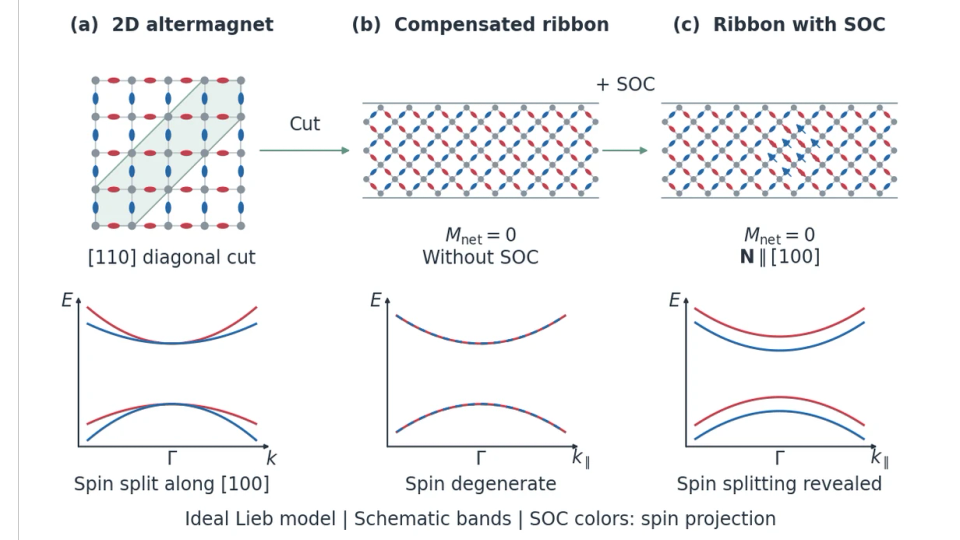
Restricting electron motion to a single spatial axis can force the energy states of opposite spins to coincide whenever the ribbon preserves specific crystal symmetries. To understand how this cancellation occurs, consider the step-by-step path an electron travels through an altermagnetic crystal. First, the electron moves through a lattice composed of two interleaved atomic sublattices with opposite magnetic moments. Second, because the two sublattices are linked by a spatial rotation rather than a simple spatial inversion, an electron traveling along a particular crystallographic direction interacts differently with up spins and down spins. Third, in two dimensions, this geometric arrangement creates a d-wave spin splitting, where spin separation reaches a maximum along the primary coordinate axes but drops to zero along diagonal directions.14 Fourth, when researchers carve a thin ribbon along that diagonal direction, the only remaining direction for electron momentum is along the ribbon's length. Fifth, an operation that exchanges the opposite-spin sublattices also swaps the top and bottom edges of the ribbon while leaving the longitudinal momentum unchanged.1 Consequently, in nonrelativistic physics where spin does not couple directly to orbital paths, spin-up and spin-down energy bands are mathematically forced to overlap at every available momentum.
Chen and Wang analyzed this geometric cancellation using a theoretical Lieb-lattice model, which represents an idealized square network of magnetic sites.1 In a two-dimensional sheet cut from an AA-stacked Lieb crystal, the nonrelativistic energy splitting between spins is proportional to the difference between the squares of the momentum components along the principal axes.1 When the crystal is reduced to a ribbon running diagonally along the [110] direction, the projected nonrelativistic spin splitting completely cancels out.13 Even though the real-space pattern of alternating magnetic moments remains intact across the width of the ribbon, the electronic band structure in the absence of spin-orbit coupling looks identical to that of a conventional, spin-degenerate antiferromagnet.
The underlying cancellation depends directly on the independence of spatial coordinates and spin directions in nonrelativistic quantum mechanics. Xin, the lead author, said in response to questions from Primary that "Without spin–orbit coupling, spin rotations and spatial transformations can be treated independently." Xin explained that "In our ideal diagonal ribbon, a spatial operation exchanges the two magnetic sublattices while leaving the momentum along the ribbon unchanged." Under those nonrelativistic conditions, combining that spatial mapping with a half-turn rotation in spin space forces the energy bands of opposite spins to match across the entire one-dimensional pathway.
How does the orientation of internal magnetism restore spin splitting?
Spin-orbit coupling ties the electron's spin directly to the physical geometry of the crystal lattice, allowing the spatial direction of the Néel vector to govern electronic symmetry. Without spin-orbit coupling, rotating the electron spins in abstract space has no connection to spatial operations on the atomic lattice. Once relativistic spin-orbit interactions enter the picture, any symmetry operation that swaps the opposite-spin sublattices must also physically reverse the orientation of their magnetic moments.1 If the internal magnetic axis points in a direction that is incompatible with the symmetry operations protecting the band degeneracy, the magnetic line group of the one-dimensional ribbon changes, lifting the overlap between spin bands.
Xin explained the physical mechanism behind this recovery in comments to Primary: "Spin–orbit coupling removes that independence. A spatial operation must now transform the magnetic moments consistently with their orientation relative to the lattice. Rotating the Néel vector can therefore remove a symmetry that previously protected degeneracy, allowing spin-split bands without requiring a net magnetization. The important point is that the magnetic orientation changes the symmetry of the electronic problem, even when the atomic positions remain unchanged."
This mechanism differs fundamentally from traditional antiferromagnetic wires, where an antiunitary symmetry combining space inversion and time reversal protects Kramers double degeneracy regardless of which way the magnetic moments point. In their study, Chen and Wang constructed a tight-binding wire with that combined symmetry as a control, verifying that its spin bands remain strictly degenerate for every magnetic orientation. In the diagonal altermagnetic ribbon, however, rotating the Néel vector from an out-of-plane direction to an in-plane direction removes the symmetry enforcing equal-energy pairs.1 As a result, the relativistic spectrum splits into distinct energy branches carrying opposite spin character, activating intrinsic spin properties without altering the zero net magnetization of the wire.
What did calculations reveal in tantalum nanoribbons?
First-principles calculations on nanoribbons composed of tantalum, tellurium, selenium, and oxygen revealed pronounced relativistic spin splitting under realistic material conditions. The researchers modeled a prototype nanoribbon cut from a single layer of Ta2TeSeO, a Janus monolayer where a square network of tantalum atoms is decorated on opposite faces by tellurium, selenium, and oxygen.1 In its two-dimensional form, the monolayer functions as an altermagnetic Weyl semimetal with magnetic easy axes lying naturally along the in-plane [100] and [010] directions. Chen and Wang constructed a prototype ribbon running along the diagonal [110] direction, measuring 11.64 nanometers in width and containing 197 atoms per axial period, with 40 tantalum sites in each magnetic sublattice.1
The choice of this specific material was driven by existing computational modeling rather than unique structural chemistry. Xin said to Primary that "Our choice was motivated primarily by a recent, separate study in which we had developed an accurate Wannier representation of Ta₂TeSeO’s electronic structure." Xin added that "The mechanism applies to Ta₂TeSeO, but its out-of-plane asymmetry does introduce additional variables into the symmetry analysis and the interpretation of the spin-resolved bands." The physical effect itself is governed by magnetic symmetries rather than chemical asymmetry between the two faces of the sheet.
When modeled without spin-orbit coupling, the electronic bands of the Ta2TeSeO nanoribbon were completely spin-degenerate across the one-dimensional Brillouin zone, confirming the theoretical cancellation predicted by the symmetry model.1 Once spin-orbit coupling was incorporated into the Wannier representation, the electronic bands split cleanly according to the orientation of the Néel vector. For the natural easy-axis domain where the Néel vector aligns with the [100] direction, the energy branches separated into states with opposite spin projections along the magnetic axis.1 Because the parent monolayer naturally favors this alignment, the resulting spin splitting represents a stable equilibrium property for sufficiently wide ribbons, requiring no external magnetic fields to maintain.13
Regarding the dimensions of the model, Xin noted that "There is nothing special about 11.64 nanometers." Xin told Primary that "We simply chose it as a representative ribbon width, not because it corresponds to a critical length or an optimized response." Xin added that "establishing the crossover would require relaxed ribbons with different widths and edge terminations, followed by comparisons of their magnetic anisotropy energies," framing the preservation of the parent easy axis as an expectation for wide ribbons rather than a calculated phase boundary.
The authors evaluated the transport performance of this easy-axis ribbon in a simulated two-terminal device with a fixed spin-analysis axis aligned along the ribbon length.1 For perfectly transmitting quantum channels, the easy-axis [100] domain achieved a right-moving-mode spin polarization of approximately 35 percent near an energy of 16 millielectronvolts relative to the reference energy, while sustaining an ideal conductance of approximately 4.47 conductance quanta.13 Transverse diagonal orientations reached a polarization of about 12.8 percent along the detector axis, whereas out-of-plane and longitudinal alignments produced negligible signals of about 1.9 percent and 1.7 percent, respectively.1
The small out-of-plane signal of 1.9 percent presented an intriguing anomaly, given that theoretical symmetry rules predict zero longitudinal spin polarization. Xin told Primary that "In the ideal symmetry-preserving ribbon, the longitudinal spin polarization should vanish for this magnetic orientation." Xin explained that "We therefore interpret the reported 1.9 percent cautiously, rather than as an established intrinsic response," attributing the residual fraction to numerical precision limits in the model rather than physical behavior.
What questions remain before these channels can be built?
These findings stem from computational models and first-principles electronic structure simulations of ideal crystals rather than laboratory measurements of fabricated devices. The paper by Chen and Wang was posted to a preprint server on September 10, 2026, and has not yet undergone peer review.13 Realizing these effects in practical hardware will depend on fabricating nanoribbons with atomically precise, mirror-symmetric edges, as atomic roughness or chemical contamination could alter the delicate boundary symmetries that govern the nonrelativistic degeneracy. Furthermore, the calculations assume ballistic quantum transport at low temperatures, leaving open the question of how thermal fluctuations, edge reconstruction, and substrate interactions might affect the stability of the Néel vector and the magnitude of the spin polarization.
When asked how an experiment could definitively test the predictions, Xin told Primary that "A clear test would be to prepare a ribbon with the predicted structure and magnetic order, set its Néel orientation, and tune the chemical potential into an energy window where we predict polarized transport." Xin stated that if an experiment under those conditions finds no polarization along the specified detector axis after accounting for contact and spin relaxation, that outcome would contradict the transport prediction. Xin noted that spin-resolved spectroscopy would provide a direct check of the underlying band splitting itself.
Chen and Wang also presented an independent calculation on a chromium trichloride chain, showing that the same symmetry diagnostic applies to naturally one-dimensional molecular chains that are not sliced from two-dimensional sheets. If experimental teams confirm these predictions using spin-resolved photoemission spectroscopy or transport measurements on gated nanoribbons, the discovery will broaden the search for spintronic materials. Nanoscale wires previously set aside as unpromising, spin-degenerate antiferromagnets may turn out to possess highly functional, switchable spin channels hidden in plain sight.
The record
35 sentences trace to 4 sources and 1 contributor.
-
1
XC
 Xin Chen, Duo Wang
Paper
· arxiv.org · 11 Sep 2026
Néel-Vector-Dependent Altermagnetic Spin Splitting in the One-Dimensional Limit
Preprint · may not have been peer reviewed
See the source
-
2
A
arxiv.org
Paper
· arxiv.org
Emerging research landscape of altermagnetism
Preprint · may not have been peer reviewed
See the source
-
3
A
arxiv.org
Paper
· arxiv.org
Néel-Vector-Dependent Altermagnetic Spin Splitting in the One-Dimensional Limit
Preprint · may not have been peer reviewed
See the source
- 4 Physical Review X - Browse by Subject See the source
- 5 Contribution — Xin Chen 11 statements added to this article
Other consulted pages1 page
Article history
-
Published 28 Oct 2026, 21:34Assembled by the Primary desk from 4 sources · 1 contributor · 35 cited sentences
-
Xin Chen, a researcher at the Thermal Science Research Center at the Shandong Institute of Advanced Technology
- Go to the sentence: Xin, the lead author, said in response to questions from Primary that "Without spin–orbit coupling, spin rotations and spatial transformations can be treated independently."
- Go to the sentence: Xin explained that "In our ideal diagonal ribbon, a spatial operation exchanges the two magnetic sublattices while leaving the momentum along the ribbon unchanged."
- Go to the sentence: Xin explained the physical mechanism behind this recovery in comments to Primary: "Spin–orbit coupling removes that independence. A spatial operation must now transform the magnetic moments consistently with their orientation relative to the lattice. Rotating the Néel vector can therefore remove a symmetry that previously protected degeneracy, allowing spin-split bands without requiring a net magnetization. The important point is that the magnetic orientation changes the symmetry of the electronic problem, even when the atomic positions remain unchanged."
- Go to the sentence: Xin said to Primary that "Our choice was motivated primarily by a recent, separate study in which we had developed an accurate Wannier representation of Ta₂TeSeO’s electronic structure."
- Go to the sentence: Xin added that "The mechanism applies to Ta₂TeSeO, but its out-of-plane asymmetry does introduce additional variables into the symmetry analysis and the interpretation of the spin-resolved bands."
- Go to the sentence: Regarding the dimensions of the model, Xin noted that "There is nothing special about 11.64 nanometers."
- Go to the sentence: Xin told Primary that "We simply chose it as a representative ribbon width, not because it corresponds to a critical length or an optimized response."
- Go to the sentence: Xin added that "establishing the crossover would require relaxed ribbons with different widths and edge terminations, followed by comparisons of their magnetic anisotropy energies," framing the preservation of the parent easy axis as an expectation for wide ribbons rather than a calculated phase boundary.
- Go to the sentence: Xin told Primary that "In the ideal symmetry-preserving ribbon, the longitudinal spin polarization should vanish for this magnetic orientation."
- Go to the sentence: Xin explained that "We therefore interpret the reported 1.9 percent cautiously, rather than as an established intrinsic response," attributing the residual fraction to numerical precision limits in the model rather than physical behavior.
- Go to the sentence: When asked how an experiment could definitively test the predictions, Xin told Primary that "A clear test would be to prepare a ribbon with the predicted structure and magnetic order, set its Néel orientation, and tune the chemical potential into an energy window where we predict polarized transport."