A forgotten heavy neutrino may explain why the universe contains matter
A slow-decaying particle could have temporarily dominated cosmic energy density and delayed critical interactions, offering a testable explanation for how matter avoided total annihilation after the Big Bang.
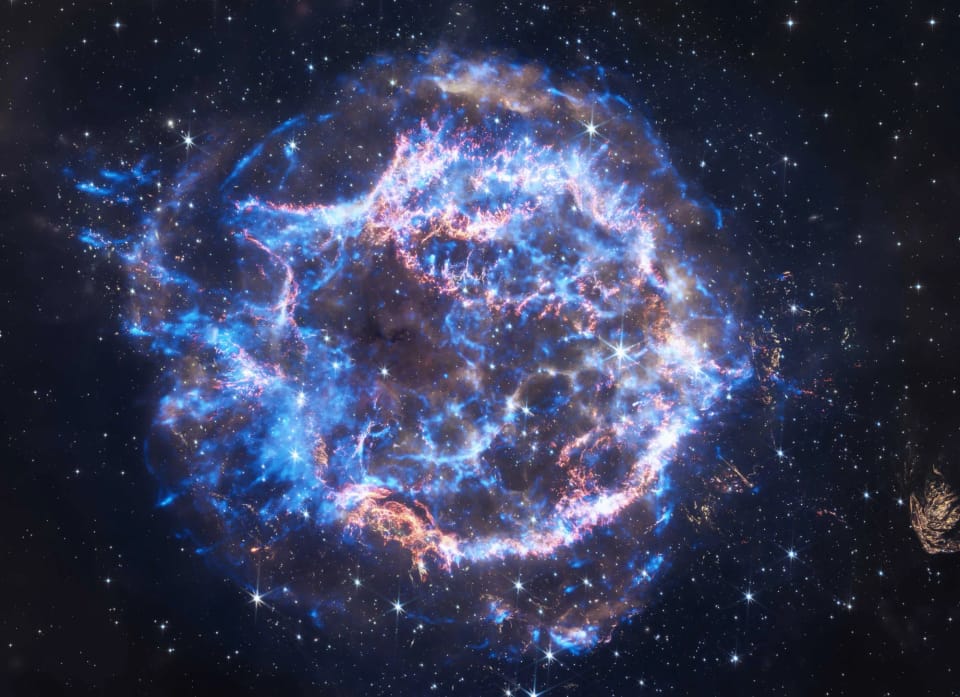
Every galaxy, star, planet and living organism in the observable universe exists because of a slight cosmic imbalance. When the universe formed in the Big Bang, the fundamental laws of particle physics dictate that matter and antimatter should have emerged in exactly equal quantities. Because matter and antimatter destroy each other on contact, releasing pure energy in mutual annihilation, an exact match should have left nothing behind except a thin sea of radiation. The survival of physical structures demonstrates that an early mechanism tilted the scales in favour of matter before that total destruction could occur.
Understanding how that imbalance arose is one of the most persistent challenges in cosmology. For matter to survive, three physical conditions must align in sequence. First, reactions among newly formed particles must generate a slight surplus of matter over antimatter. Second, that excess must emerge while the surrounding plasma remains out of thermal equilibrium, preventing reverse reactions from erasing the advantage. Third, the surviving surplus must outlive the era of mutual annihilation as the cosmos cools, preserving a small residue of matter that eventually condenses into gas clouds, stars and galaxies. Identifying which particle interaction held the system away from equilibrium at the critical moment has remained unresolved.
A study published on September 8, 2026, in the peer-reviewed journal Physical Review Letters suggests that an overlooked particle may have governed this tipping point.12 Rishav Roshan, a physicist at the University of Southampton, and Sudipta Show, a physicist at the Indian Institute of Technology Kanpur, showed that a heavy neutrino variant, long ignored in theoretical calculations because of its extraordinarily faint interactions, could have altered the timing of early cosmic reactions.34 By persisting long after other energetic species decayed, this particle temporarily took control of cosmic expansion and delayed key particle interactions, allowing matter to prevail.32
Why did matter survive total annihilation after the Big Bang?
The survival of matter depends on how rapidly the universe expanded compared with the rates of particle collisions in its first moments. As space expands, its temperature drops, and the pace of expansion acts as an internal clock governing whether particles have enough time to interact and reach balance. If interaction rates outrun the expansion rate, particles reach equilibrium, meaning forward and reverse reactions balance out and wipe away any accumulated excess. If the universe expands fast enough, reactions freeze out before an asymmetry can be erased.
In standard cosmological models, physicists explore this imbalance through leptogenesis, an umbrella term for processes where heavy neutral particles decay unevenly to produce an initial surplus of leptons, the fundamental family that includes electrons and neutrinos. Sphaleron transitions, high-temperature electroweak processes that convert lepton excesses into baryon excesses like protons and neutrons, then translate that early leptonic difference into ordinary matter. Yet standard versions of this process struggle to explain why the asymmetry was not washed away by subsequent particle interactions as the hot plasma settled into equilibrium.
To explain why neutrinos possess such tiny masses compared with other fundamental particles, theorists rely on the seesaw mechanism.35 This framework balances observed, lightweight neutrinos against hypothetical, extremely heavy neutrino partners, where increasing the mass of the heavy partners drives down the mass of the light particles. Minimal iterations of this model include multiple heavy neutrinos.35 One of these states frequently decouples from normal mass generation, meaning it couples so weakly to ordinary particles that it has almost no influence on observable neutrino masses.53
Because this decoupled heavy neutrino interacts so feebly with the rest of the thermal bath, theorists historically dismissed it as a passive background component. Roshan and Show demonstrated that this weak coupling produces the opposite effect. In particle physics, a particle that interacts feebly must also decay feebly, meaning its lifespan is substantially extended. While other heavy species decayed rapidly in the extreme heat of the early cosmos, this decoupled state persisted as a stable population of heavy matter.
How could an ignored particle delay cosmic equilibrium?
The lingering presence of a long-lived heavy particle alters how the cosmic energy pool behaves as the universe expands. Radiation and relativistic particles lose energy rapidly in expanding space because expansion dilutes their volume and stretches their wavelengths. Matter particles lose energy only through volume dilution because their rest mass remains constant. A population of massive particles that survives while radiation thins naturally gains a larger share of the total energy density, eventually overtaking radiation to trigger an early matter-dominated era.
“This decoupled heavy neutrino has long been dismissed as an irrelevant background detail in particle physics,” Roshan said in an account published by Scientific Inquirer.34 “However, it decays incredibly slowly. As the cosmos cooled after the Big Bang, the particle lived long enough that it temporarily took over the energy density of the universe and triggered a matter-dominated period.”34
This temporary period of matter domination accelerated the expansion rate of the universe during a pivotal temperature window. The specific consequence identified by Roshan and Show concerns charged lepton Yukawa interactions, the couplings through which electrons, muons and taus interact with the Higgs field to acquire mass and equilibrate with their antiparticles. Under standard thermal history, these interactions reach thermal equilibrium at defined temperatures, washing out specific asymmetries or splitting lepton flavours into distinct regimes.
By forcing the early universe to expand more rapidly, the decoupled neutrino postponed that balance. “The decoupled neutrino shifted the temperature in the early universe at which fundamental particles – like electrons and other leptons – interacted with their anti-particles with the help of Standard Model Higgs boson,” Roshan said.3 “This temperature acts like a switch that shapes how the matter-antimatter imbalance was built up.”34
The paper, titled “Delayed Charged Lepton Yukawa Equilibration in Minimal Seesaw,” demonstrates that delaying this equilibration shifts the conditions under which leptogenesis operates.3 When Yukawa interactions are delayed, an asymmetry generated by the decay of a lighter partner state can remain in an unflavoured regime longer, protecting the emergent matter surplus from destructive washout processes that would otherwise destroy it. “It offers us a new explanation for how matter won,” Show said.34
Can gravitational waves confirm this early era?
Direct observations of this early matter-dominated epoch cannot rely on ancient starlight or the cosmic microwave background, because the universe remained an opaque plasma for hundreds of thousands of years after the Big Bang. Instead, the authors point to primordial gravitational waves, ripples in spacetime that travel unobstructed across cosmic history from the earliest fractions of a second. Unlike electromagnetic radiation, gravitational waves do not scatter against free electrons in hot plasma.
In models that incorporate gauged symmetries such as the difference between baryon number and lepton number, known as B minus L, the spontaneous breaking of symmetry at high energy scales forms cosmic strings. These microscopic filaments of concentrated energy oscillate and emit a background of gravitational waves. If the early universe remained dominated by radiation throughout, this background spectrum would appear flat across a broad band of observational frequencies.
An intervening era of matter domination driven by a decoupled heavy neutrino disrupts that flat plateau, creating a characteristic break in the spectrum where the signal drops at higher frequencies.3 “The dramatic shift in the early expansion of the cosmos leaves distinct but detectable imprints of changes, for example on primordial gravitational waves,” Show said.3 “These gravitational wave signatures open up new avenues for us to unravel the evolution of the early universe after the Big Bang.”34
These predictions face severe practical limits that depend on future observational capabilities. Primordial gravitational waves from the earliest fractions of a second have never been detected directly by any operational observatory. The frequency range where the spectral break would appear depends on the mass of the decoupled neutrino and the absolute mass of the lightest active neutrino, potentially placing the signature beyond the reach of existing instruments.
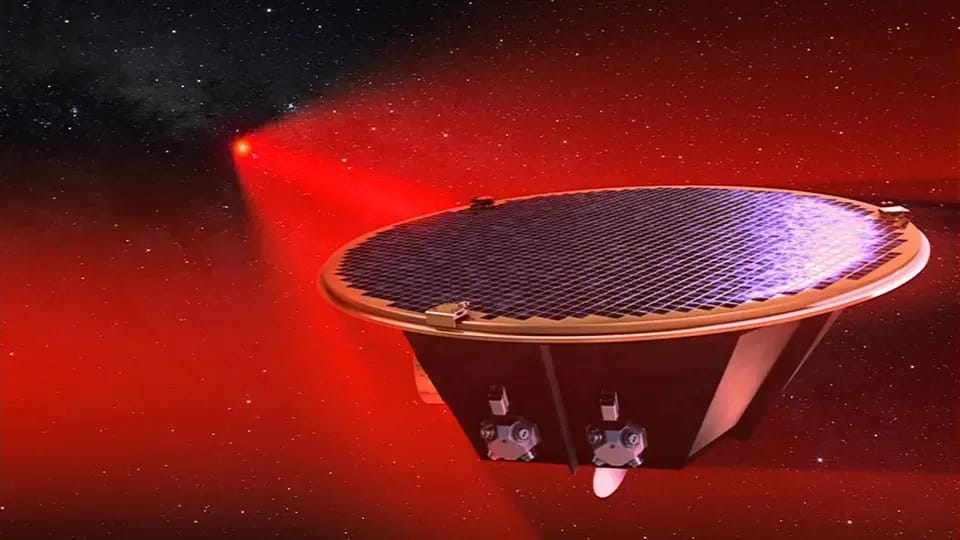
The mathematical framework is also a model of early cosmic history rather than a direct measurement of physical particles. While the seesaw mechanism is widely regarded as an elegant solution to neutrino masses, neither heavy right-handed neutrinos nor cosmic strings have been observed in physical experiments. The proposal shows how existing equations permit matter to survive without inventing arbitrary ingredients, but confirming whether the universe followed this path requires data from proposed gravitational wave observatories such as the Laser Interferometer Space Antenna, the Einstein Telescope, or the Square Kilometre Array.
The record
16 sentences trace to 5 sources.
- 1 Labtrace See the source
- 2 Delayed Charged Lepton Yukawa Equilibration in Minimal Seesaw See the source
-
3
S
 scientificinquirer
Document
· scientificinquirer.com · 29 Oct 2026
A Particle Physicists Had Written Off May Explain Why Anything Exists at All
See the source
-
4
E
 eurekalert.org
Third-party reporting
· eurekalert.org
Forgotten particle could answer mystery of why we exist, say physicists
See the source
-
5
A
 arxiv.org
Paper
· arxiv.org
Cosmological Consequences of a Highly Decoupled Right-handed Neutrino
Preprint · may not have been peer reviewed
See the source