Coronal magnetic fields reveal their three-dimensional structure without new instruments
Decoded plasma waves and polarized infrared light allow astronomers to reconstruct the unseen magnetic architecture of the outer solar atmosphere, opening clearer views of drivers behind destructive space weather.
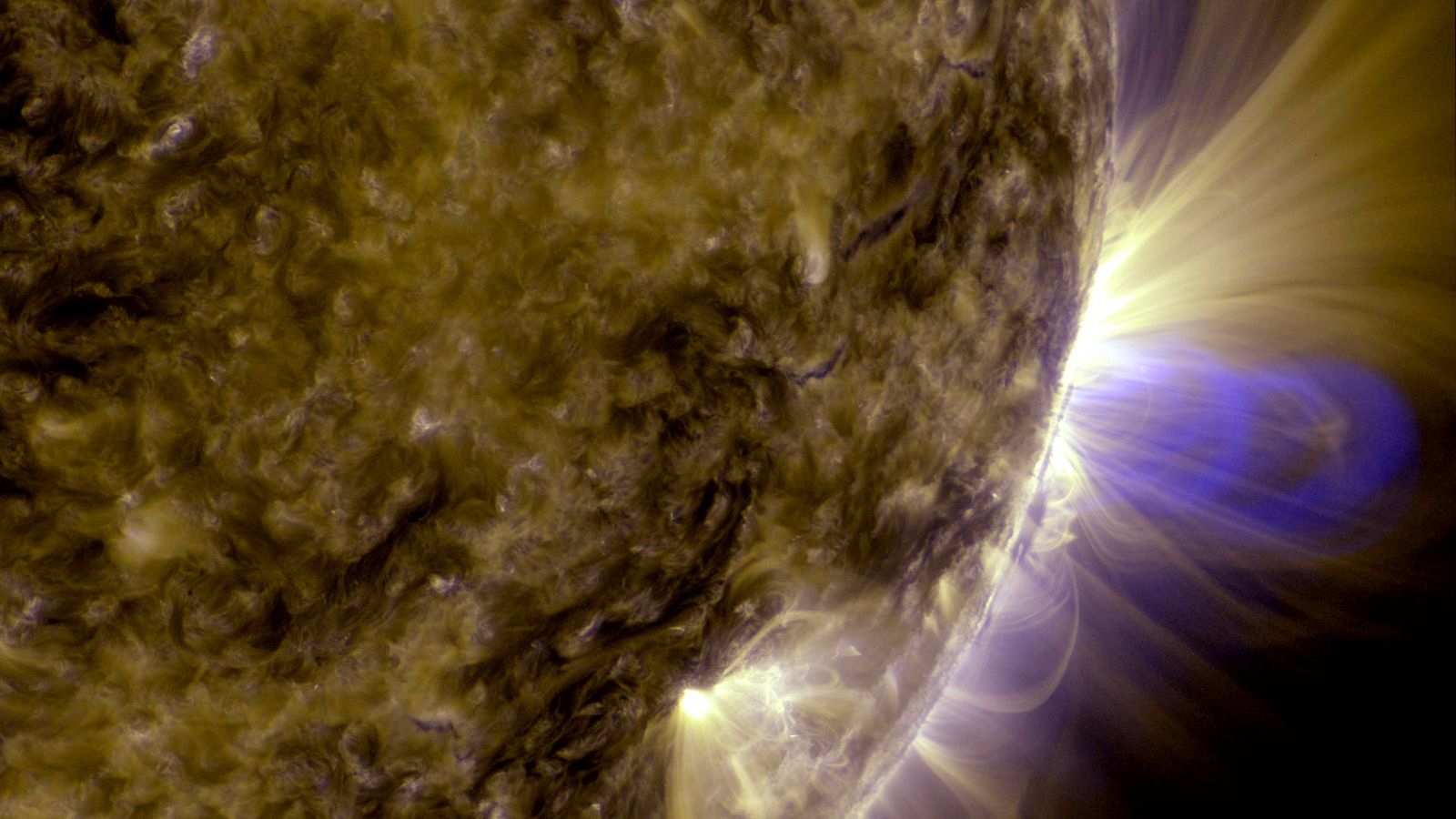
Above the glowing surface of the Sun, a superheated haze of thin gas called the corona stretches millions of kilometers into space.12 This outer atmosphere defies ordinary physics by burning hundreds of times hotter than the solar surface beneath it, defying intuitive expectations about how heat flows outward from a furnace. The invisible scaffolding holding this fiery halo together is the solar magnetic field. Huge loops and arches of magnetism trap charged particles, store vast reserves of energy, and periodically snap, hurling billions of tons of electrified gas across the solar system toward Earth.12
Understanding where and when these violent space weather eruptions will strike requires knowing the exact geometry of that magnetic scaffolding. For decades, solar physicists have observed the glowing loops of the corona in vivid detail, yet measuring the actual three-dimensional strength and direction of the invisible magnetic forces within them has remained an elusive target.12 Traditional techniques that calculate magnetism on the visible solar surface break down in the corona, where the plasma is extremely thin and the polarization signals that reveal magnetic fields are faint and difficult to isolate.
A magnetic field in a hot, ionized gas acts like a set of taut cosmic strings. When disturbance shakes the Sun, mechanical waves ripple outward along these magnetic lines of force. The speed at which these ripples travel depends on two primary properties: the local density of the electrified gas and the tension of the magnetic field itself. Denser gas slows the ripples down, while a stronger magnetic field accelerates them. If astronomers can measure both the density of the gas and the speed of the ripples rippling across the sky, they can deduce the strength and transverse tilt of the magnetic field directing the waves.
Now, a research team has demonstrated that existing ground-based observations can be decoded to infer the full three-dimensional vector of the Sun's coronal magnetic field across broad swaths of the outer atmosphere.31 The breakthrough combines measurements of wave motions across the plane of the sky with the subtle linear polarization of infrared emission lines emitted by highly ionized iron.41 Published in The Astrophysical Journal Letters, the study demonstrates that researchers can reconstruct the strength and spatial orientation of the coronal field without needing to construct new ground or space telescopes.1
How can astronomers measure magnetic fields they cannot touch?
Astronomers decipher the invisible forces of the corona by combining two distinct physical signatures carried in sunlight.1 The first signature comes from coronal seismology, which tracks subtle Doppler shifts caused by incompressible ripples known as Alfvenic waves propagating through the corona.45 By measuring how fast these waves travel across the plane of the sky and pairing that motion with electron density diagnostics, researchers can determine the strength and direction of the magnetic field projected flat against the sky.4

The second signature relies on the quantum mechanics of forbidden atomic transitions in highly ionized iron atoms. In the hot coronal plasma, iron atoms that have lost twelve electrons emit specific infrared light at wavelengths of 1074.7 nanometers and 1079.8 nanometers.53 When these ions absorb and scatter light rising from the solar surface below, the emitted infrared photons become linearly polarized.4 This linear polarization, captured through the standard mathematical components known as Stokes I, Q, and U parameters, records the inclination and orientation of the magnetic field relative to the Sun's vertical axis.5
Historically, converting these two-dimensional polarization measurements into a true three-dimensional magnetic vector required detecting circular polarization, known as the Stokes V parameter. Circular polarization signals from the Zeeman effect scale quadratically with field strength in the corona and are exceptionally faint.5 Measuring Stokes V requires massive telescopes with meters of light-collecting aperture, leaving smaller solar coronagraphs unable to isolate the third magnetic dimension directly along the line of sight.5
What did the new inversion technique discover in existing data?
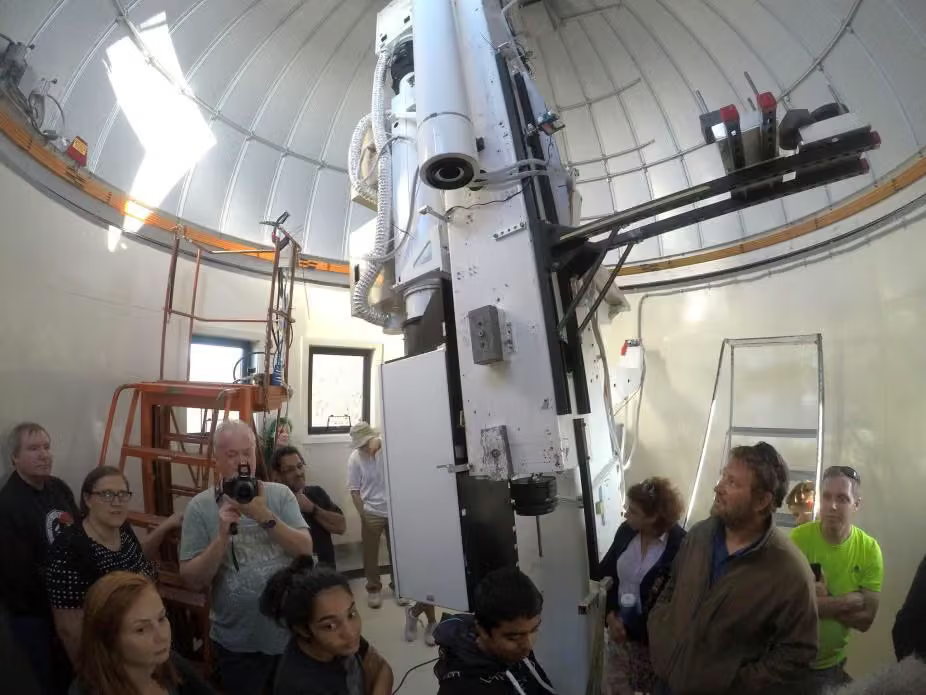
Researchers applied an inversion framework called IQUD, which substitutes wave-based velocity measurements for circular polarization, to archival observations from two instruments at the Mauna Loa Solar Observatory in Hawaii.1 The analysis examined data gathered on October 14, 2016, by the original Coronal Multi-channel Polarimeter, alongside observations recorded on June 1, 2022, by its successor, the Upgraded Coronal Multi-channel Polarimeter.1 Both instruments operate with modest 0.2 meter apertures, demonstrating that global vector magnetic fields can be inferred using modest operational telescopes.45
Lead author Alin Razvan Paraschiv of the National Solar Observatory, alongside co-authors Zihao Yang and Daniela Adriana Lacatus of the High Altitude Observatory at the NSF National Center for Atmospheric Research and Momchil Molnar of the Southwest Research Institute, found that this mathematical synthesis reliably recovered vector magnetic field components across the observable off-limb corona. By localizing the dominant emitting structures along the line of sight using atomic alignment calculations, the inversion successfully reconstructed the complex geometry of active regions rotating around the solar limbs.
The reconstructed field maps revealed dramatic magnetic variations that match physical expectations from coronal physics.43 In the June 1, 2022, dataset, the team observed a decaying active region named AR13006 that exhibited a strongly twisted core with substantial magnetic contributions along both the line of sight and the plane of the sky.3 Just south of this core, the field exhibited a sharp directional reversal, showing a sudden perpendicular shift in polarization that points to the presence of a large-scale magnetic current sheet, an energetic structure where opposing magnetic fields can cross and trigger explosive eruptions.43
The methodology also resolved magnetic field strengths across active regions that aligned closely with theoretical potential-field models extrapolated from the solar surface.43 While older analytical inversions were forced to assume that the magnetic field lay entirely flat against the plane of the sky, the new approach accurately separated the line-of-sight component from the transverse components, providing complete three-dimensional direction vectors.43
What are the limits of the reconstructed solar maps?
These reconstructed coronal maps are mathematical inferences rather than direct, in-place measurements of the solar atmosphere.1 The inversion algorithm operates under the single-point approximation, which assumes that the light collected along a given line of sight is dominated by a single, coherent coronal structure rather than a complicated blend of overlapping features.5 In diffuse or low-density environments, such as polar coronal holes, this assumption breaks down due to low signal strength and line-of-sight cancellation, preventing the technique from returning reliable magnetograms near the solar poles.43
The mathematical equations governing the linear polarization and wave motions also produce an intrinsic fourfold directional ambiguity.3 The method returns four degenerate candidate solutions representing opposite directional signs along the line of sight and vertical axes.43 To select a single candidate for visual mapping, the authors used an iterative statistical optimization algorithm that favors spatial coherence among neighboring pixels, though this selection remains a qualitative step that does not impose fundamental physical laws.43
The physical reach of the reconstruction is constrained by observational sensitivity and solar cycle activity. In the 2016 dataset from the earlier instrument, valid magnetic field reconstructions reached apparent heights between 1.15 and 1.25 solar radii above the photosphere. With the upgraded instrument in 2022, improved sensitivity extended that reach to apparent heights between 1.20 and 1.45 solar radii above active regions. Beyond these altitudes, infrared signals drop off and become too faint for reliable inversion.
How will this change forecasting for extreme space weather?
Coronal mass ejections and high-energy solar flares are initiated by magnetic instabilities in the corona, releasing energy stored within twisted magnetic fields.21 When directed toward Earth, these eruptions can deform our planet's magnetic shield, induce damaging currents across electric power grids, disrupt high-frequency radio communications, and destroy satellite electronics in orbit.12 Space weather forecasters have long been hampered by a lack of operational data regarding the magnetic forces that destabilize these active regions before they erupt.12
Because the datasets from the Mauna Loa observatory are publicly available, researchers can theoretically apply this technique to years of recorded observations to study how magnetic structures evolve across solar cycles.12 Tom Berger, director of the Mauna Loa Solar Observatory, noted that demonstrating this diagnostic capability provides a foundation for the planned COronal Solar Magnetism Observatory, a 1.5 meter facility designed to measure global coronal fields on a continuous operational schedule.14
Before the technique can be incorporated into daily space weather warning centers, researchers must test the inversion across a wider range of solar conditions and refine automated methods to resolve the directional ambiguities.12 As the scientific community tests the publicly released software against varying atmospheric conditions, the ability to reconstruct the Sun's coronal architecture without constructing specialized hardware provides a new window into the primary engine of solar eruptions.12
The record
35 sentences trace to 5 sources.
-
1
MA
Melissa Ait Lounis Document · dailygalaxy.com · 29 Oct 2026 After Decades of Failure, Researchers Finally Reveal the Sun’s Magnetic Structure in 3D Without Building a See the source
-
2
U
udaipurkiran.com Third-party reporting · udaipurkiran.com · 29 Oct 2026 Scientists Create First 3D Map of the Sun’s Magnetic Field | Udaipur Kiran See the source
-
3
I
iopscience.iop.org Third-party reporting · iopscience.iop.org A First Global Full-vector Coronal Magnetic Field Inference Using MLSO CoMP and UCoMP Observations - IOPscience See the source
-
4
A
arxiv.org Paper · arxiv.org A First Global Full-Vector Coronal Magnetic Field Inference Using MLSO CoMP and UCoMP Observations Preprint · may not have been peer reviewed See the source
-
5
A