Cosmic sound speeds could distinguish lookalike theories of dark energy
A two-dimensional diagnostic space maps internal pressure ripples against cosmic expansion, separating models of accelerated expansion that otherwise produce identical distance measurements across the universe.
Astronomers mapping the universe face a persistent puzzle when observing the acceleration of cosmic expansion. A uniform cosmological constant, a rolling scalar field, and an exotic fluid can all stretch the fabric of space at identical rates across billions of years. When telescopes measure only the distances to exploding stars and the background geometry of the universe, these radically different physical theories produce the same observable expansion history. Cosmologists refer to this problem as a theoretical degeneracy, where multiple distinct physical descriptions predict identical outcomes for standard geometric tests.
Understanding what drives the accelerated expansion of the universe requires probing deeper than the background expansion rate. Matter across the cosmos gathers under gravity to build galaxies, vast clusters, and elongated filaments. For dark energy to influence this structural growth, its own internal density fluctuations must interact with the surrounding gravitational landscape. If dark energy remains completely uniform, it affects matter clumping solely by speeding up cosmic expansion and pulling structures apart. If dark energy instead develops subtle ripples of its own, those fluctuations alter the growth of cosmic structure in measurable patterns.
A newly proposed framework published on the arXiv preprint server introduces a diagnostic method designed to break these observational stalemates.12 Oem Trivedi, Robert J. Scherrer, and Alfredo Gurrola, physicists at Vanderbilt University, developed a two-dimensional classification space called the w-c_s^2 plane.12 Their approach tracks both the cosmic equation of state and the speed at which pressure perturbations travel through dark energy, providing a complete description of the substance at linear order.12
Why can cosmic expansion alone fail to identify dark energy?
Standard cosmological tests focus almost entirely on the dark energy equation of state, which measures the ratio of pressure to energy density.13 This parameter, denoted by the letter w, determines how the overall energy density of dark energy evolves as the volume of the universe expands. Previous graphical tools classified models by tracking w alongside its derivative with respect to cosmic scale, or by computing geometrical parameters known as statefinder diagnostics.45 While these earlier methods distinguished broad classes of models such as cosmological constants from rolling quintessence fields, they remained fundamentally restricted to background expansion histories.12
Background expansion tests rely on the Hubble parameter and its direct derivatives over cosmic time.1 Two models with identical equations of state can possess fundamentally different kinetic structures beneath the surface. When dark energy experiences a localized fluctuation in density, its internal pressure responds by sending out acoustic ripples.1 The effective speed of these acoustic waves, denoted as the squared sound speed c_s^2, governs whether the ripples disperse smoothly across space or allow the substance to clump on astronomical scales.1
The physical chain of events connects cosmic expansion directly to the growth of large structures. First, slight density variations appear across the cosmological fluid. Second, if internal pressure waves travel through that fluid at the speed of light, pressure gradients smooth away localized clumps before gravity can amplify them. Third, if those pressure ripples travel much more slowly, density fluctuations survive and pool within expanding gravitational wells. Finally, the survival of these ripples modifies how matter condenses into galaxies. Measuring the expansion rate alone reveals only how fast the volume expands, leaving the speed of those internal pressure waves completely hidden.
Traditional observations have struggled to measure this sound speed with precision. Existing constraints on dark energy sound speed depend primarily on late-time integrated observables such as the integrated Sachs-Wolfe effect, which integrates evolving gravitational potentials along the line of sight.1 Because these measurements pool gravitational effects over immense cosmic distances, they provide only indirect sensitivity to the underlying perturbation dynamics. Consequently, vast regions of the theoretical parameter space governing dark energy perturbations have remained weakly constrained by observational surveys.1

How does the sound speed map out different cosmic fluids?
The w-c_s^2 plane organizes dark energy models into distinct physical regimes defined by their background acceleration and perturbative stability.12 The boundary where the equation of state equals negative one separates conventional non-phantom dark energy from phantom models, while the boundary where the squared sound speed equals zero divides stable acoustic propagation from catastrophic gradient instabilities.1 In their preprint, Trivedi, Scherrer, and Gurrola split the phase space into four primary quadrants, allowing researchers to track the theoretical properties of various cosmological models.1
In the primary stable quadrant, where the equation of state is greater than negative one and the squared sound speed is positive, dark energy satisfies the null energy condition while remaining perturbatively stable. When the sound speed is close to the speed of light, pressure gradients efficiently damp out any density perturbations on scales smaller than the cosmic horizon.1 Canonical quintessence models, which describe dark energy as a slowly rolling scalar field, naturally inhabit this region because their theoretical construction fixes the sound speed identically to the speed of light.1 In these models, dark energy remains effectively smooth and homogeneous throughout cosmic history.1
A different physical regime emerges when the equation of state stays near negative one while the sound speed drops well below the speed of light.1 Under these low sound speed conditions, dark energy generates weak internal pressure support, permitting perturbations to survive and cluster across large cosmological scales.1 Such clustering behavior characterizes non-canonical scalar field models, k-essence theories, and generalized Chaplygin gas models.12 Even when their background expansion histories mimic a cosmological constant, these clustering models alter the time evolution of large-scale gravitational potentials.1
Robert, a contributor to the study, clarified how this mimicry operates when models hover near the cosmological constant threshold. Robert said in response to questions from Primary that "if a model perfectly mimics cosmological constant, then w=-1 for it, and as the gravitational potential contribution in that case is through a factor of (1+w), it means the contribution vanishes." Robert noted that theories that are not strictly set at negative one can yield distinct signatures, adding that "models which are not exactly w=-1 but close to it or hovering around it, like Quintessence or other scalar field models, can give small contributions which could perhaps be measurable in eventual surveys."
The remaining quadrants of the w-c_s^2 plane identify theoretical regimes with exotic or pathological behavior. When the equation of state drops below negative one with a positive sound speed, the dark energy density increases as the universe expands, representing a perturbatively stable phantom fluid.1 When the squared sound speed drops below zero, pressure perturbations cease to propagate as stabilizing waves and instead cause fluctuations to grow exponentially.1 This gradient instability signals that a given effective fluid description has broken down or requires additional stabilizing degrees of freedom.1
What does the microphysical flow parameter reveal about dark energy?
The microphysical flow parameter reveals how internal perturbation dynamics change as the cosmic background expands across time.12 To quantify how perturbation dynamics evolve alongside cosmic expansion, Trivedi, Scherrer, and Gurrola defined a diagnostic quantity termed the microphysical flow parameter.12 Represented mathematically as F = dc_s^2/dw, this parameter captures the rate of change of the squared sound speed relative to the equation of state.12 The authors demonstrated that the present-day value of this parameter connects directly to two central cosmological benchmarks: the Hubble constant H_0 and the matter fluctuation amplitude parameter sigma_8.12
Modern cosmology faces notable tensions between local observations and early-universe measurements of both the cosmic expansion rate and the growth rate of large-scale structure.1 By linking the microphysical flow parameter to H_0 and sigma_8, the Vanderbilt researchers showed that consistency tests can rule out theoretical models that fail to reconcile both background expansion and structure growth simultaneously.12 The flow parameter serves as a compact mathematical bridge between microscopic kinetic properties and macroscopic astronomical observations.12
Robert explained to Primary that this connection arises from the analytical equations governing growth and background rates. According to Robert, "for a given shift in H_0, the corresponding shift in Sigma_8 is not fixed solely by the background equation of state, but also it depends on F." In canonical quintessence where the sound speed remains locked at unity, the flow parameter is zero and preserves standard background-driven coupling. When the parameter deviates from zero, Robert stated that "the growth response is modified, which ends up allowing for a decoupling between the background and perturbative sectors," meaning that "the evolution of both Sigma_8 and H_0 is in a way, moderated by the evolution of F."
Reflecting on the development of the tool, Robert said that "our initial focus was to just find out what would happen if w and cs^2 are plotted together for fun." The broader utility emerged when tracking trajectories across the phase space. Robert noted that once sound speed data across redshifts becomes available, mapping observations to the plane will make it possible to "rule out whole class of theories of dark energy," helping in "clearing a lot of the dark energy zoo in one sweep."
How could future observatories detect these subtle fluctuations?
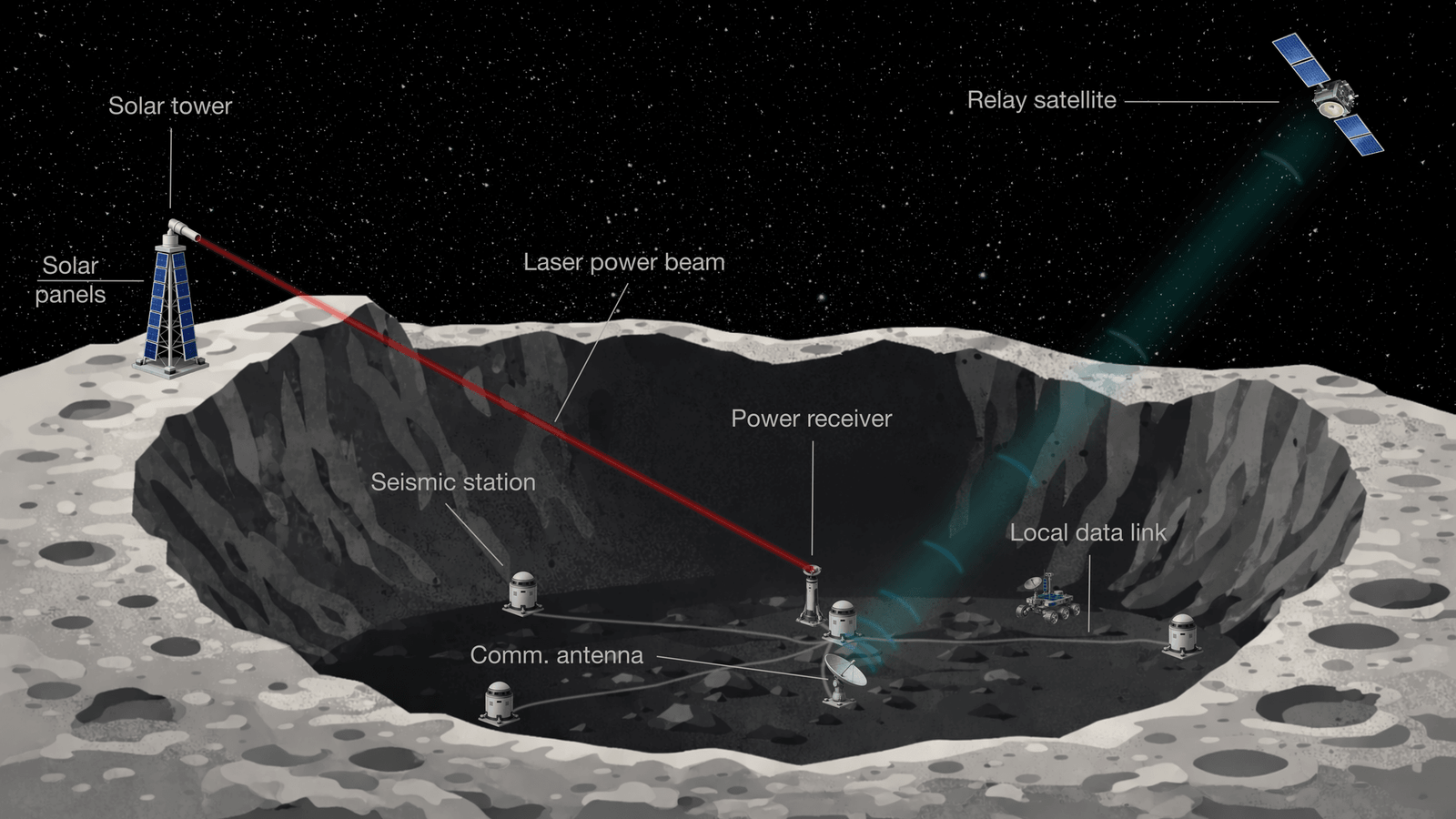
Future space-based and lunar observatories could detect dark energy perturbations by monitoring real-time variations in large-scale gravitational potentials.1 Testing these theoretical trajectories will require new observational techniques capable of measuring dark energy perturbations directly.1 The authors pointed to proposed space-based and lunar-based gravitational instruments, such as the Lunar Interferometer for Laser Astronomy, known as LILA.1 By measuring ultra-low frequency gravitational signals associated with horizon-scale scalar potentials, such interferometers could capture real-time variations in large-scale gravitational fields and measure the dark energy sound speed independently of distance-redshift surveys.1
Robert explained that lunar interferometry provides a clean observational test of these mechanisms. In response to questions from Primary, Robert stated that "a lunar laser interferometer could test dark energy clustering and see if there is a sizeable or noticeable variation in the sound speed." If detectors observe a spectrum consistent with smooth propagation where the squared sound speed is fixed at one, models predicting significant clustering variations would be falsified. Robert indicated that such measurements would target an "ultra low frequency band for this, of roughly 10^-7 to 10-3 Hz range," though exact instrument sensitivity thresholds remain undefined while detector hardware configurations are being established.
The diagnostic framework is an analytical tool built on linear perturbation theory, not an observational dataset or an empirical discovery of new physics. The curves mapped across the w-c_s^2 plane represent phenomenological effective fluid trajectories rather than exact solutions to fully non-linear field equations.1 In addition, the paper posted by Trivedi, Scherrer, and Gurrola to the arXiv preprint server has not yet undergone formal peer review.12 Future observational constraints will determine whether real cosmic data populates specific quadrants of this newly defined parameter plane.
The reach of the plane also encounters natural physical boundaries where fluid descriptions become complicated. Robert explained that "the beauty of the w-cs^2 plane is, that any model of dark energy will give you some sort of prediction for the sound speed from its action/Lagrangian itself." However, Robert cautioned that "genuinely nonlinear clustering, strong mode coupling, screening effects and theories requiring additional details such as significant anisotropic stress cannot in general be fully characterized by only w and cs^2." While these complex theories still fit into the plane, researchers will need to evaluate supplementary variables when nonlinear interactions dominate.
Astronomers expect upcoming cosmological surveys to place increasingly tight bounds on the evolution of cosmic structure over the coming decade. As wide-field telescopes measure the cosmic web with unprecedented fidelity, multi-dimensional diagnostics like the w-c_s^2 plane will help theorists evaluate which dark energy models remain mathematically viable. By incorporating both expansion dynamics and internal sound speeds into a single framework, cosmologists can systematically test whether the engine driving cosmic acceleration is a simple cosmological constant or a dynamic physical field.
30 Oct 2026, 18:30 UTC — This article was updated to reflect revised text and images.
The record
47 sentences trace to 5 sources and 1 contributor.
-
1
OT
Oem Trivedi, Robert J. Scherrer, Alfredo Gurrola Paper · arxiv.org · 2 Sep 2026 Dark Energy in the $w-c_s^2$ Plane Preprint · may not have been peer reviewed See the source
-
2
A
-
3
A
ar5iv.labs.arxiv.org Paper · ar5iv.labs.arxiv.org Constraints on the solid dark universe model Preprint · may not have been peer reviewed See the source
-
4
A
-
5
A
- 6 Contribution — Robert 14 statements added to this article
Other consulted pages1 page
Article history
-
Update 30 Oct 2026, 18:30
This article was updated to reflect revised text and images.
-
Published 30 Oct 2026, 18:28Assembled by the Primary desk from 5 sources · 1 contributor · 47 cited sentences
-
Robert, a contributor to the study
- Go to the sentence: Even when their background expansion histories mimic a cosmological constant, these clustering models alter the time evolution of large-scale gravitational potentials.
- Go to the sentence: Robert said in response to questions from Primary that "if a model perfectly mimics cosmological constant, then w=-1 for it, and as the gravitational potential contribution in that case is through a factor of (1+w), it means the contribution vanishes."
- Go to the sentence: Robert noted that theories that are not strictly set at negative one can yield distinct signatures, adding that "models which are not exactly w=-1 but close to it or hovering around it, like Quintessence or other scalar field models, can give small contributions which could perhaps be measurable in eventual surveys."
- Go to the sentence: According to Robert, "for a given shift in H_0, the corresponding shift in Sigma_8 is not fixed solely by the background equation of state, but also it depends on F."
- Go to the sentence: When the parameter deviates from zero, Robert stated that "the growth response is modified, which ends up allowing for a decoupling between the background and perturbative sectors," meaning that "the evolution of both Sigma_8 and H_0 is in a way, moderated by the evolution of F."
- Go to the sentence: Reflecting on the development of the tool, Robert said that "our initial focus was to just find out what would happen if w and cs^2 are plotted together for fun."
- Go to the sentence: Robert noted that once sound speed data across redshifts becomes available, mapping observations to the plane will make it possible to "rule out whole class of theories of dark energy," helping in "clearing a lot of the dark energy zoo in one sweep."
- Go to the sentence: The authors pointed to proposed space-based and lunar-based gravitational instruments, such as the Lunar Interferometer for Laser Astronomy, known as LILA.
- Go to the sentence: By measuring ultra-low frequency gravitational signals associated with horizon-scale scalar potentials, such interferometers could capture real-time variations in large-scale gravitational fields and measure the dark energy sound speed independently of distance-redshift surveys.
- Go to the sentence: In response to questions from Primary, Robert stated that "a lunar laser interferometer could test dark energy clustering and see if there is a sizeable or noticeable variation in the sound speed."
- Go to the sentence: Robert indicated that such measurements would target an "ultra low frequency band for this, of roughly 10^-7 to 10-3 Hz range," though exact instrument sensitivity thresholds remain undefined while detector hardware configurations are being established.
- Go to the sentence: The curves mapped across the w-c_s^2 plane represent phenomenological effective fluid trajectories rather than exact solutions to fully non-linear field equations.
- Go to the sentence: Robert explained that "the beauty of the w-cs^2 plane is, that any model of dark energy will give you some sort of prediction for the sound speed from its action/Lagrangian itself."
- Go to the sentence: However, Robert cautioned that "genuinely nonlinear clustering, strong mode coupling, screening effects and theories requiring additional details such as significant anisotropic stress cannot in general be fully characterized by only w and cs^2."