Complex gravitational waves lose energy faster when passing through matter
Higher harmonic ripples in spacetime face stronger damping and generate localized heat as they traverse viscous stellar debris, according to new theoretical derivations.
Gravitational waves are often described as pristine cosmic messengers that traverse the universe almost entirely unimpeded.1 Unlike light, which readily scatters off clouds of gas and interstellar dust, ripples in spacetime interact very weakly with ordinary substances.12 Yet weakly does not mean never. When gravitational radiation passes through a dense or viscous medium, such as the matter ejected during an explosive astrophysical event, the rhythmic stretching and squeezing of spacetime forces the material to move, generating friction that robs the wave of energy and turns that lost power into heat.32
For decades, theoretical studies examining this interaction have focused almost entirely on the simplest and dominant shape of gravitational radiation, known as the quadrupole mode.34 In a new preprint posted to the arXiv server, theoretical physicists Ulrich K. Beckering Vinckers and Nigel T. Bishop have extended the mathematical analysis beyond this baseline to examine how higher-order angular harmonics behave when passing through matter.43 Their findings reveal that these higher-order wave modes suffer greater damping and generate stronger localized heating than the standard quadrupole mode, suggesting that observing subtle higher harmonics from violent cosmic collisions may prove even harder than astronomers anticipated.3
This dissipation process alters how energy flows through the remnants of cataclysmic cosmic explosions. When two neutron stars collide or a massive stellar core collapses in a supernova, the dense debris surrounding the central engine interacts with the newly forged gravitational waves.3 If those passing waves undergo damping, the signal recorded by detectors on Earth could carry subtle modifications, and the surrounding stellar matter might experience significant shock-free heating that alters how the debris expands and glows across the electromagnetic spectrum.32 Theoretical research into gravitational wave interactions with matter also extends to quantum settings, where researchers study energy transfers in ultra-cold gases and Bose-Einstein condensates, as well as macroscopic plasma environments where wave propagation alters the underlying medium.12
What happens when spacetime ripples move through matter?
Ripples in spacetime force physical particles to alter their relative separations, driving internal friction whenever the surrounding medium resists deformation.31 The causal chain begins when an energetic gravitational wave reaches a layer of material. As the wave propagates, spacetime stretches along one spatial direction while contracting along another. Physical matter situated in that region is compelled to follow the changing geometry along paths known as timelike geodesics, which are the natural trajectories followed by freely falling particles through curved coordinates.3 If the medium is an idealized frictionless fluid, the particles oscillate and return their motion to the gravitational field without net loss. When the matter possesses internal shear viscosity, however, neighboring layers of fluid drag against one another during each oscillation cycle.3 That viscous friction extracts mechanical energy directly from the passing gravitational wave, gradually damping its amplitude while converting the absorbed energy into thermal heat within the shell of material.3
Understanding this transfer of energy matters because astronomers rely on gravitational wave observations to peer directly into extreme environments that telescopes cannot penetrate. Earlier work by various researchers established the framework for studying linearized gravitational wave interactions with matter using the Bondi-Sachs metric on a flat Minkowski background, but those analyses restricted the perturbations strictly to the ℓ equal to 2 quadrupolar mode.34 In the new study, Beckering Vinckers and Bishop, working at Rhodes University and the National Institute for Theoretical and Computational Sciences in South Africa, generalized that framework to accommodate arbitrary values of ℓ greater than or equal to 2. The angular harmonic index ℓ denotes the spatial complexity of the wave pattern, where higher values correspond to multipole moments that ripple with finer structure across the sky.3
By solving the linearized Einstein vacuum field equations using an angular calculus known as the eth formalism, the authors obtained general metric variables for any chosen angular mode, imposing the physical condition that no incoming gravitational waves enter the system from infinity. The mathematical derivations show that the metric components depend on radial coordinate expansions whose coefficients terminate cleanly at orders dictated by ℓ.3 In response to questions from Primary about whether the series closure required special handling, Nigel confirmed that "All the radial expansions terminate cleanly" across the calculations.
How do higher harmonic modes change the equations?
Higher harmonic modes introduce more intricate geometric ripples across the wave surface, which intensifies the velocity gradients and shear forces within the medium. To describe gravitational radiation mathematically, physicists decompose the angular shape of the wave into spherical harmonics indexed by the mode number denoted by the Greek letter ℓ. A value of ℓ equal to 2 corresponds to a quadrupolar wave, the fundamental shape produced by an orbiting binary system or a rotating asymmetric mass.34 Higher integer values of ℓ describe octupolar and higher-multipole patterns, where the distortions in spacetime vary more rapidly from one patch of the sky to another.3
From these metric components, the authors calculated the perturbed four-velocity field of particles moving through a spherical, viscous test shell of matter.3 Because the shell is treated as a test body with negligible back-reaction on the surrounding spacetime, the particles follow geodesics whose motion is determined directly by the wave field.3 Analyzing the resulting congruence of timelike geodesics allowed Beckering Vinckers and Bishop to compute the shear tensor, which quantifies how much neighboring elements of the fluid slide past each other.3 The expansion of the congruence vanishes entirely, leaving the shear tensor as the sole driver of viscous dissipation.3 The authors found that the shear tensor components scale with mode-dependent combinatorial factors that grow significantly as the value of ℓ increases.3
Explaining the physical mechanism driving this growth, Nigel told Primary that "Variations in velocity in the angular directions become larger as l increases, and fluid shear is produced by velocity variation" across the fluid. When velocity fluctuates more rapidly across small angular distances, adjacent fluid elements experience steeper velocity differences, magnifying the internal friction. By calculating the energy loss per unit volume, which is proportional to the shear viscosity and the square of the shear tensor, the authors integrated the dissipation rate over a spherical shell of radius r and thickness δr, then averaged the result across a complete wave period of 2π divided by the wave frequency.3 Comparing this integrated dissipation against the rate of gravitational energy radiated outward, determined from the Bondi news function, confirmed that damping and heating effects are generally enhanced for higher ℓ values.
Why does mode damping complicate future astrophysical detections?
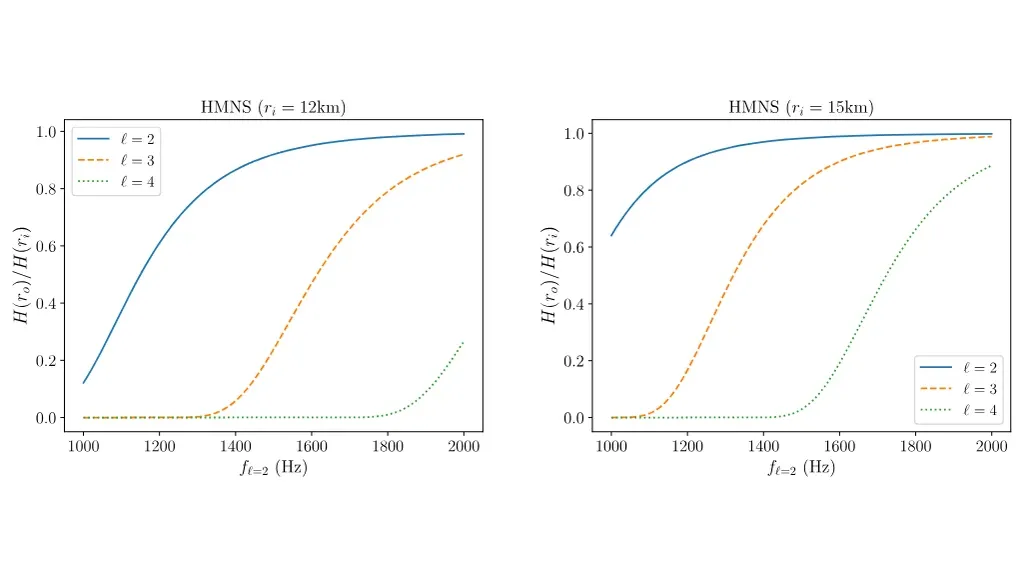
Gravitational wave damping increases for higher ℓ modes because the tighter spatial oscillations of higher multipoles create steeper velocity shears, driving faster viscous energy dissipation. Beckering Vinckers and Bishop evaluated their general algebraic expressions explicitly for the ℓ equal to 2, ℓ equal to 3, and ℓ equal to 4 modes. In the ℓ equal to 2 case, their formulas reproduced previously established analytical results, providing a direct consistency check on the broader formulation.3 When evaluating the ℓ equal to 3 octupolar and ℓ equal to 4 hexadecapolar modes, the energy dissipation per unit volume emerged systematically larger relative to the energy carried by the wave.3 Because higher multipole modes already carry far less intrinsic energy than the dominant quadrupole mode at the point of emission, experiencing disproportionately stronger damping within the dense matter of an exploding star or a merger remnant further suppresses their surviving amplitudes.3
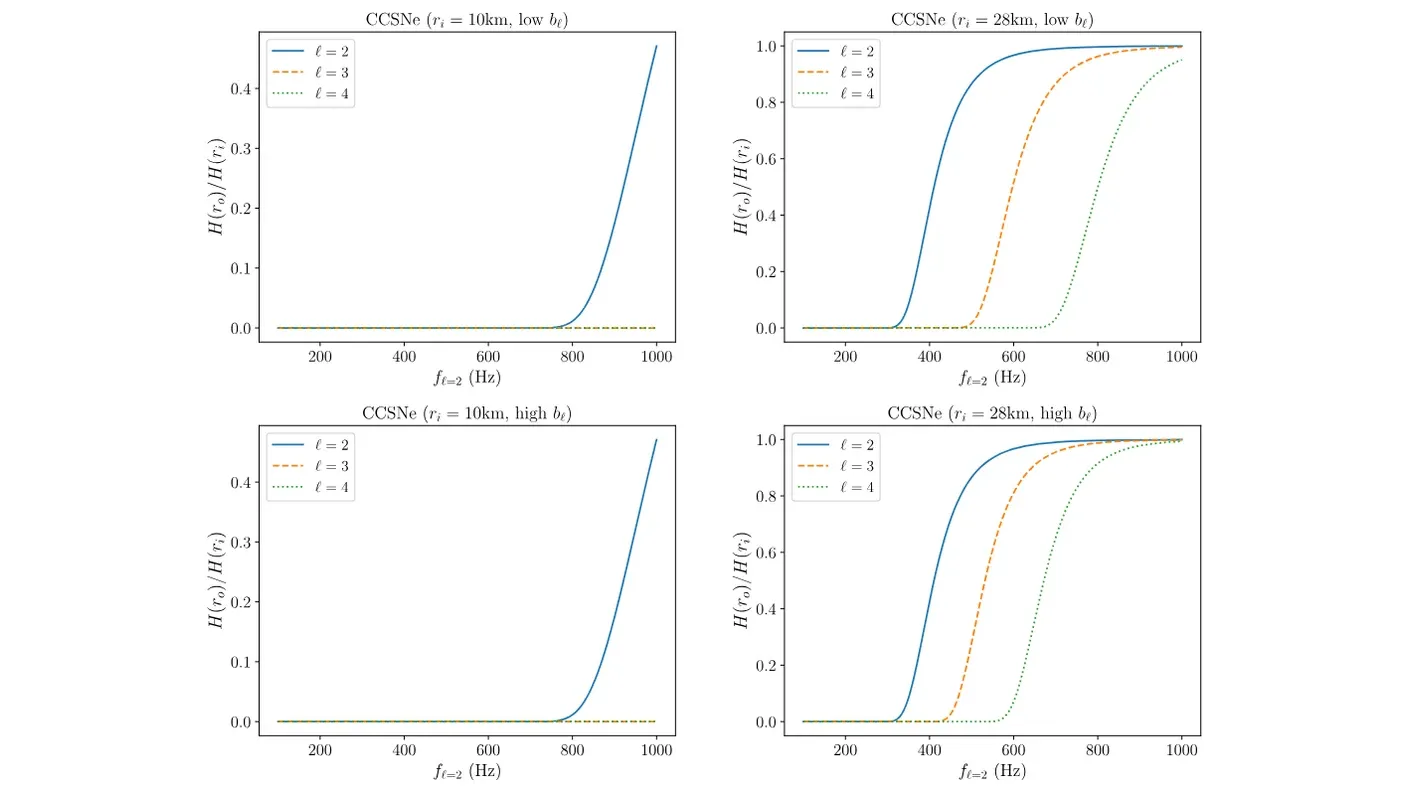
This heightened attenuation carries direct consequences for gravitational wave observatories such as the Laser Interferometer Gravitational-Wave Observatory and the Virgo detector. When two neutron stars coalesce, the messy post-merger remnant oscillates violently, theoretically emitting gravitational radiation across a spectrum of frequencies and multipole modes.3 Detecting those subleading ℓ equal to 3 or ℓ equal to 4 modes would provide crucial details about the state of ultra-dense nuclear matter. The findings by Beckering Vinckers and Bishop suggest that encountering these higher modes in observations of binary neutron star mergers or core-collapse supernovae is unlikely, because the dense, viscous material surrounding the source damps them with particular efficiency before they can escape into open space.3
Regarding how matter viscosity behaves across different astrophysical environments, Nigel said that "Values used for viscosity are determined by astrophysical modeling independent of this work. The damping can vary between being almost complete to negligible, both extremes being physically realistic." Asked what could change this suppression, Nigel noted that "The damping is reduced at higher frequencies. However, such frequencies are outside the detection sensitivity band of current gravitational wave detectors (which have an upper limit of about 2kHz)."
What the mathematical framework cannot yet reveal
The mathematical results derived in the study describe an idealized theoretical configuration and do not constitute a full numerical simulation of a real astrophysical explosion. Beckering Vinckers and Bishop conducted their calculations on a flat Minkowski background rather than on the curved spacetime of a strong gravitational field.3 While this assumption allows for closed-form analytical solutions that clarify the underlying physical mechanisms, real merger remnants and collapsing stellar cores generate intense local gravitational fields that deform spacetime much more severely than flat geometry can represent. Commenting on the influence of background gravity, Nigel said, "Probably, using a more physically appropriate background would increase the dissipation effect significantly. In previous work, it was shown that for the l=2 case the dissipation becomes larger by a factor of order 10 when allowance is made for the curvature near a compact object."
Furthermore, the matter shell in the model is treated as a passive test shell that experiences the wave without exerting any back-reaction on the metric itself.3 In an actual compact binary collision, the mass of the surrounding ejecta and the dynamic reaction of the matter could alter the propagating spacetime metric. The research was posted as a preprint on the arXiv repository in September 2026 and has not yet undergone formal peer review.34 When asked what findings could falsify the predicted suppression, Nigel pointed to both numerical and observational milestones: "Numerical: Simulation of a binary neutron star merger and its gravitational wave output in which the effect of shear viscosity is properly modeled - to date, this has not been done. Observational: Detection of higher-order gravitational wave harmonics in the post-merger signal of a binary neutron star merger or a core collapse supernova.."
Subsequent research will need to extend these general ℓ solutions to curved backgrounds, such as the Schwarzschild geometry around a non-rotating compact object, and incorporate realistic equation-of-state parameters before astronomers can definitively quantify the suppression of higher modes in specific observational targets. As theoretical models bridge the gap between idealized perturbation calculations and comprehensive viscous hydrodynamics, future observations of cosmic collisions will determine whether higher multipole whispers can ever be heard.
This piece was prepared from the paper on the arXiv preprint server and public records together with answers from Nigel to six questions from the Primary news team, completed September 2026.
30 Oct 2026, 16:41 UTC — This article was updated to reflect revised text and images.
30 Oct 2026, 16:40 UTC — This article was updated to reflect revised text and images.
The record
42 sentences trace to 4 sources and 1 contributor.
-
1
A
ar5iv.labs.arxiv.org Paper · ar5iv.labs.arxiv.org Energy transfer between gravitational waves and quantum matter Preprint · may not have been peer reviewed See the source
-
2
O
osti.gov Official record · osti.gov https://www.osti.gov/pages/servlets/purl/2217300 See the source
-
3
UK
Ulrich K. Beckering Vinckers, Nigel T. Bishop Paper · arxiv.org · 9 Sep 2026 Gravitational wave interactions with matter: beyond quadrupolar perturbations Preprint · may not have been peer reviewed See the source
-
4
A
- 5 Contribution — Nigel T. Bishop 18 statements added to this article
Other consulted pages1 page
Article history
-
Update 30 Oct 2026, 16:41
This article was updated to reflect revised text and images.
-
Update 30 Oct 2026, 16:40
This article was updated to reflect revised text and images.
-
Published 30 Oct 2026, 16:39Assembled by the Primary desk from 4 sources · 1 contributor · 42 cited sentences
-
Nigel T. Bishop, working at Rhodes University and the National Institute for Theoretical and Computational Sciences in South Africa
- Go to the sentence: Their findings reveal that these higher-order wave modes suffer greater damping and generate stronger localized heating than the standard quadrupole mode, suggesting that observing subtle higher harmonics from violent cosmic collisions may prove even harder than astronomers anticipated.
- Go to the sentence: When two neutron stars collide or a massive stellar core collapses in a supernova, the dense debris surrounding the central engine interacts with the newly forged gravitational waves.
- Go to the sentence: When the matter possesses internal shear viscosity, however, neighboring layers of fluid drag against one another during each oscillation cycle.
- Go to the sentence: That viscous friction extracts mechanical energy directly from the passing gravitational wave, gradually damping its amplitude while converting the absorbed energy into thermal heat within the shell of material.
- Go to the sentence: The angular harmonic index ℓ denotes the spatial complexity of the wave pattern, where higher values correspond to multipole moments that ripple with finer structure across the sky.
- Go to the sentence: The mathematical derivations show that the metric components depend on radial coordinate expansions whose coefficients terminate cleanly at orders dictated by ℓ.
- Go to the sentence: In response to questions from Primary about whether the series closure required special handling, Nigel confirmed that "All the radial expansions terminate cleanly" across the calculations.
- Go to the sentence: Higher integer values of ℓ describe octupolar and higher-multipole patterns, where the distortions in spacetime vary more rapidly from one patch of the sky to another.
- Go to the sentence: The authors found that the shear tensor components scale with mode-dependent combinatorial factors that grow significantly as the value of ℓ increases.
- Go to the sentence: Explaining the physical mechanism driving this growth, Nigel told Primary that "Variations in velocity in the angular directions become larger as l increases, and fluid shear is produced by velocity variation" across the fluid.
- Go to the sentence: By calculating the energy loss per unit volume, which is proportional to the shear viscosity and the square of the shear tensor, the authors integrated the dissipation rate over a spherical shell of radius r and thickness δr, then averaged the result across a complete wave period of 2π divided by the wave frequency.
- Go to the sentence: When two neutron stars coalesce, the messy post-merger remnant oscillates violently, theoretically emitting gravitational radiation across a spectrum of frequencies and multipole modes.
- Go to the sentence: The findings by Beckering Vinckers and Bishop suggest that encountering these higher modes in observations of binary neutron star mergers or core-collapse supernovae is unlikely, because the dense, viscous material surrounding the source damps them with particular efficiency before they can escape into open space.
- Go to the sentence: Regarding how matter viscosity behaves across different astrophysical environments, Nigel said that "Values used for viscosity are determined by astrophysical modeling independent of this work. The damping can vary between being almost complete to negligible, both extremes being physically realistic."
- Go to the sentence: Asked what could change this suppression, Nigel noted that "The damping is reduced at higher frequencies. However, such frequencies are outside the detection sensitivity band of current gravitational wave detectors (which have an upper limit of about 2kHz)."
- Go to the sentence: Beckering Vinckers and Bishop conducted their calculations on a flat Minkowski background rather than on the curved spacetime of a strong gravitational field.
- Go to the sentence: Commenting on the influence of background gravity, Nigel said, "Probably, using a more physically appropriate background would increase the dissipation effect significantly. In previous work, it was shown that for the l=2 case the dissipation becomes larger by a factor of order 10 when allowance is made for the curvature near a compact object."
- Go to the sentence: When asked what findings could falsify the predicted suppression, Nigel pointed to both numerical and observational milestones: "Numerical: Simulation of a binary neutron star merger and its gravitational wave output in which the effect of shear viscosity is properly modeled - to date, this has not been done. Observational: Detection of higher-order gravitational wave harmonics in the post-merger signal of a binary neutron star merger or a core collapse supernova.."