A gravity-driven seesaw turns dripping water into solar tracking
A passive mechanical frame tilts photovoltaic panels alongside the sun for under $25, avoiding the power draw and mechanical complexity of motorized systems.
A photovoltaic panel produces its highest electrical output when sunlight strikes its silicon surface at a perpendicular angle. Because the Earth rotates from west to east, the sun appears to travel across the sky in a continuous arc, changing the angle of incoming radiation every minute. A stationary panel bolted in place receives direct overhead rays only during a brief window near midday.12 During the early morning and late afternoon, sunlight strikes the glass at a low, oblique angle, which spreads the incoming photon flux across a larger surface area and reflects a substantial portion of the light away before it can release electrons. As a consequence of this geometry, stationary solar arrays routinely fail to capture up to 20 percent of the potential energy available in their location over the course of a day.12
Keeping a solar surface aligned with the sun throughout the day solves this geometric problem, but doing so has historically introduced a difficult engineering compromise. Commercial solar installations typically rotate panels using single-axis or dual-axis tracking rigs.13 These industrial assemblies rely on electronic optical sensors, automated digital microcontrollers, and electric motors to mechanically reposition arrays as the day progresses. While these automated platforms keep panels perpendicular to the sun, the motorized equipment adds between $500 and more than $1,000 per panel to total installation costs.31 The motors also create an ongoing parasitic electrical load, consuming a portion of the clean electricity that the photovoltaic cells generate simply to operate their own gears.13 In dusty or remote outdoor environments, the motors, bearings, and circuit boards remain susceptible to mechanical breakdown, making motorized tracking uneconomical for small residential arrays, emergency shelters, and isolated off-grid homesteads.
How does a mechanical water drip tilt a solar array?
A balanced mechanical pivot moves a solar panel across the sky by shifting liquid weight from one side of a frame to the other at a calibrated speed. The operational sequence follows a simple physical chain. When water escapes a raised container through a narrow aperture, it drains under the steady pull of gravity at a predictable, controlled rate. By directing that draining liquid into a secondary vessel suspended from the opposite end of an equilibrium lever, the system progressively adds gravitational mass to one side of the pivot. As the receiving container becomes heavier, the lever gradually dips downward, steadily tilting any mounted solar panel toward the west to mirror the sun’s natural progression across the horizon.
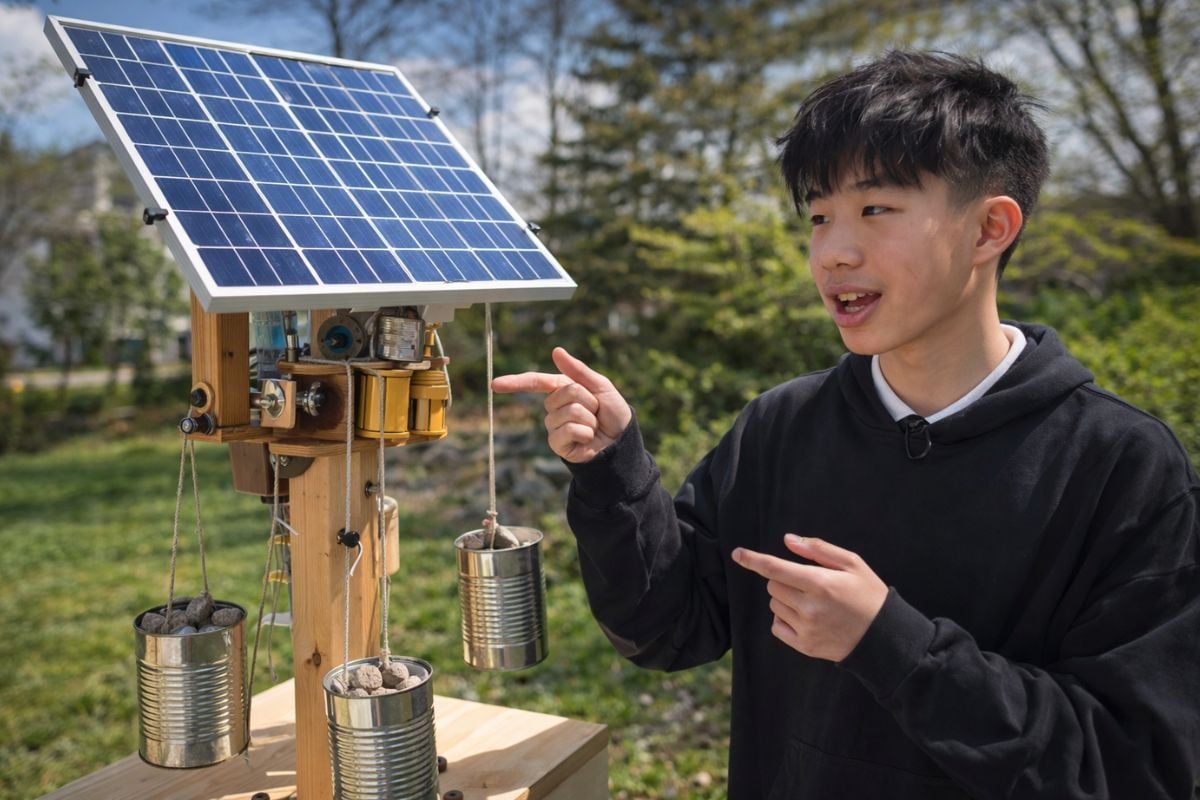
Thirteen-year-old student Jason Chang, a seventh grader attending Worcester Academy in Massachusetts, turned this gravitational principle into a functional, motor-free solar tracker.21 Chang initially set out to resolve an everyday family chore after his mother repeatedly sent him into freezing winter weather to manually reposition their solar-powered outdoor holiday lights.12 Rather than accepting the daily chore or adding an electric motor that would drain power, Chang designed a mechanical tracking frame that operates entirely without electrical current, optical sensors, or gearboxes.
The tracker operates on an equilibrium frame that functions like a seesaw, constructed from recycled and inexpensive hardware with a total component cost of less than $25.12 Operation begins at sunrise when an operator pulls a simple stopper plug from an elevated reservoir container.12 Gravity causes the water to begin dripping at a steady, tightly calibrated pace into a collection bucket hanging on the opposing side of the pivoting assembly.12 As the bucket fills, the accumulating liquid steadily pulls that end of the seesaw downward, rotating the mounted photovoltaic panel across the day in synchrony with the sun. Chang noted that developing the fluid-control frame was the most challenging stage of the process, requiring more than a year of trial, error, and meticulous notebook documentation to ensure that the drip rate matched the rotational speed of the Earth without stalling or tilting too rapidly.21
What did outdoor testing reveal about the passive design?
Direct outdoor testing revealed that the passive water-driven tracking system generated roughly 20 percent more voltage than an identical stationary panel over the course of a daily evaluation cycle.12 Chang positioned his working prototype side by side with a standard stationary panel, exposing both units to the same ambient weather and solar conditions. Throughout the testing run, the continuously tilted surface sustained a more perpendicular orientation to the sun during morning and afternoon hours, yielding an approximate 20 percent increase in measured voltage output.
This performance gain was recorded strictly as a differential in voltage output under outdoor experimental conditions.21 The measurement serves as an indicator of improved panel orientation, but it does not represent a verified 20 percent increase in overall electrical energy generation or total wattage delivered to an electrical load over time. Standard commercial single-axis motorized trackers typically boost energy production by 25 to 35 percent, while dual-axis motorized systems can deliver gains of up to roughly 40 percent.3 However, those motorized systems cost hundreds of dollars more per panel and require external electricity to function, whereas the mechanical seesaw tracker produced its 20 percent voltage increase using passive fluid movement that consumes no electricity.
What are the physical limits of a liquid-based tracker?
The current liquid-driven tracking system is an early functional prototype evaluated in localized outdoor tests, and it cannot demonstrate long-term mechanical reliability across diverse climates. Because the movement depends entirely on the flow of liquid water, freezing temperatures solidify the reservoir and bring the tilting seesaw to a complete halt.12 In high-temperature arid environments, evaporation from the open containers could alter the fluid volume and disrupt the calibrated drip rate.3 Furthermore, manual intervention is required at the start of each morning to pull the stopper plug and return the water from the lower bucket back to the upper reservoir, meaning the system does not reset itself autonomously.
The experimental results show that a passive fluid counterbalance can reliably track the sun under moderate ambient conditions, but they do not prove that such an assembly can withstand severe weather, strong wind gusts, or years of continuous outdoor exposure. Chang has acknowledged these environmental constraints and has begun designing a secondary, all-weather mechanical variant intended to function continuously throughout the year in sub-zero winter temperatures.12 That cold-weather iteration remains an active development project rather than a finished or independently verified mechanism.
Where could passive solar tracking be deployed?
Passive solar tracking could provide immediate utility in off-grid communities, developing rural regions, and disaster relief operations where electricity is scarce and capital is severely constrained. In many remote areas, families and medical clinics rely on a solitary solar panel to charge communications devices, operate basic lighting, or run small refrigeration units for essential vaccines.12 In these constrained environments, purchasing additional solar panels or expensive motorized trackers is financially impossible. A passive mechanical tracking rig built for less than $25 from local or scrap parts could allow existing panels to generate higher daily output without demanding electrical power from the battery.
The system also offers advantages in natural disaster zones where hurricanes, floods, or earthquakes have disabled centralized electrical grids. Emergency workers and displaced communities require rugged, field-repairable charging platforms that do not depend on delicate computer microcontrollers or fragile motorized parts. A gravity-powered seesaw frame can be assembled and serviced with basic tools anywhere water is available, ensuring that emergency responders can maximize solar power generation under harsh conditions.
Chang was named one of 55 National STEM Champions for 2026, earning an invitation to present his gravity-driven tracker at the National STEM Festival in Washington, D.C.1 Jenny Buccos, co-founder of the festival, cited the young inventor as an example of practical problem-solving that addresses real-world energy constraints.12 While the prototype remains an uncommercialized project, its demonstration indicates that fundamental fluid mechanics and simple gravitational levers can solve persistent efficiency challenges in renewable energy without costly electronics.
The record
20 sentences trace to 3 sources.
-
1
TP
Tibi Puiu Document · zmescience.com · 29 Oct 2026 Tired of a Household Chore, This 13-Year-Old Built a $25 Solar Tracker That Boosts Output by 20% — Without Using Electricity See the source
-
2
TT
The Times Of India Third-party reporting · timesofindia.indiatimes.com · 25 Oct 2026 Meet Jason Chang, the 13-year-old Massachusetts student who built a solar tracker for under $25 and increased voltage output by about 20% without motors or electricity See the source
-
3
N
now.solar Third-party reporting · now.solar This 13 Year Old's $25 Invention Solves A Big Limitation For Solar Panels – BGR See the source