Riemann prime formula falls apart when summed directly across zeros
A classic equation for counting primes diverges into infinite oscillations when evaluated over the zeta zeros alone, showing the exact order of summation cannot be switched.
For more than a century and a half, mathematicians have studied the irregular distribution of prime numbers by translating them into the harmonics of complex functions. Whole numbers greater than one that cannot be divided evenly by any positive integer other than one and themselves appear along the number line in an erratic, unpredictable pattern. In 1859, the German mathematician Bernhard Riemann discovered an exact mathematical bridge connecting this irregular sequence to the zeros of a complex function now known as the Riemann zeta function.1 In standard expositions of number theory, this bridge is often written as a compact equation known as the Riemann–von Mangoldt explicit formula, which expresses the exact number of primes up to any chosen cutoff point as a smooth main term minus an infinite sum over all the zeros of the zeta function.12
That compact formulation has appeared in classic lecture notes, survey papers, and modern monographs. Yet in a preprint posted on September 2, 2026, to the arXiv preprint server, Harald Grobner demonstrates that this textbook summation does not work as written.21 Grobner proves that for every fixed point greater than one, the partial sums taken over the non-trivial zeros grow without bound as more zeros are included.12 Rather than settling closer and closer to the exact prime count, the direct sum over the zeros fluctuates and diverges to infinity.12
The result clarifies a long-standing technical subtlety in analytic number theory, the mathematical discipline that applies continuous calculus and complex analysis to solve problems about discrete integers. While Riemann and Hans Carl Friedrich von Mangoldt established a rigorously true explicit formula, their valid identity requires carrying out an outer sum over integers before taking the limit over the zeros. Grobner's proof establishes that mathematicians cannot interchange those two summation operations to produce a well-defined, convergent series over the zeros alone.
Why does an explicit formula for primes matter?
An exact count of primes up to a given number allows mathematicians to understand the precise distribution of arithmetic's fundamental building blocks. Prime numbers act as the multiplicative atoms of the number system, because every integer greater than one factors uniquely into a product of primes. Because there is no simple repeating pattern predicting where the next prime will appear, mathematicians track them using the prime-counting function, traditionally denoted by the Greek letter pi. For any positive value, this function counts how many prime numbers are less than or equal to that value.
To compute the prime-counting function smoothly, Riemann introduced a related continuous function built from exponential integrals and the Möbius function, an arithmetic function that tracks whether an integer has repeated prime factors.1 In an explicit formula, this smooth approximation supplies the leading term. The remaining error, which accounts for every individual jump whenever the counting line crosses a prime number, is represented as a corrective sum running across the zeros of the Riemann zeta function.
The zeros of the zeta function are the complex numbers where the zeta function evaluates to zero.1 They come in two families: the trivial zeros, which sit at negative even integers along the real axis, and the non-trivial zeros, which reside within a vertical region called the critical strip, where the real part of the complex coordinate lies between zero and one. In 1977, Don Zagier recorded the prime-counting identity in a widely cited note by writing the prime-counting function as the smooth approximation minus a direct sum over all zeros of the zeta function, pairing the non-trivial zeros by increasing height of their imaginary coordinates.1
If that direct series converged, it would provide an immediate, self-contained decomposition of the prime count into independent wave-like components, with each zero of the zeta function contributing a distinct oscillatory note. However, because the terms in the series do not decrease rapidly enough to ensure absolute convergence, the validity of the expression depended entirely on whether the symmetric partial sums settled down to a finite value as the height cutoff increased.
The realization that this standard expression lacked a rigorous foundation began with an ordinary teaching assignment. Harald told Primary that he initially assigned a master's student the topic of explicit formulas for the prime-counting function. When the student could not supply a proof for the isolated sum over the zeros, Harald looked into the literature and found that no proof had ever been published. Harald said he initially assumed a proof was possible, but attempting to execute a contour integral suggested in online discussions made it apparent that the strategy would fail.
How do the zeros create unbounded growth?
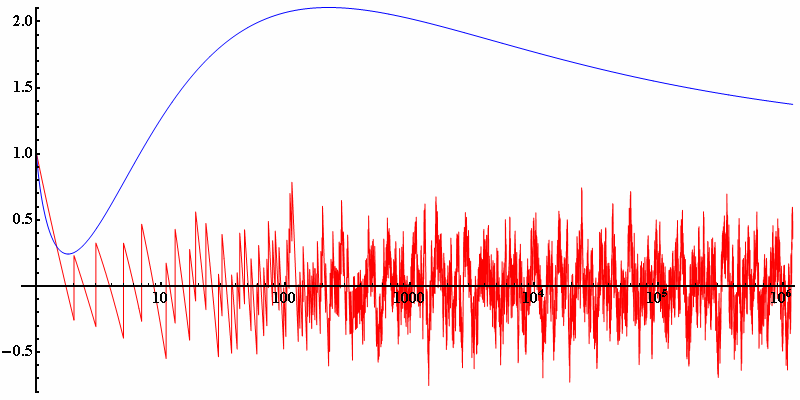
The partial sums over the non-trivial zeros grow uncontrollably because the individual terms do not cancel each other quickly enough when ordered purely by vertical height.1 To prove this divergence, Harald Grobner established that for any fixed evaluation point greater than one, the size of the partial sums up to height cutoff T cannot be bounded by any power of T that is strictly less than what is known as Riemann's constant, denoted by the Greek letter capital theta.12 Riemann's constant is defined as the supremum, or least upper bound, of the real parts of all non-trivial zeros of the zeta function, a quantity known to lie between one half and one.12
Grobner's analysis shows that the limit superior of the absolute value of the partial sums is infinite.12 Consequently, the expression written as a direct sum over the zeros does not define a valid complex number.1 The failure occurs because the smooth building blocks of the formula, when evaluated at the non-trivial zeros, retain an underlying resonance that aligns with the poles of an associated transform.
Harald explained to Primary that this behavior reflects deep structural constraints rather than random noise. "I would be slightly cautious about thinking of this simply as many independent oscillations that happen not to cancel. The terms are highly structured and are tied together through the zeta-function," Harald said in response to questions from Primary. The non-trivial zeros reappear as poles in the continued transform, which act as certificates that too much cancellation is mathematically impossible.
The proof constructs a chain of analytic deductions starting from an integral representation of the entire function that defines the terms. By taking the real part of this function along a vertical line in the complex plane, Grobner expresses it as a Fourier cosine transform of an integrable kernel function.1 When this transform is studied through a truncated Mellin transform, an integral transform that extracts frequency and scaling information from a function, the resulting expression admits a meromorphic continuation across the entire complex plane.1 Crucially, this continuation inherits mathematical poles, or points where the function blows up to infinity, at precisely the locations corresponding to the non-trivial zeros of the Riemann zeta function.
Grobner proves that each pole translates into an unavoidable growth obstruction for a logarithmically weighted integral of the transformed function.1 Because the function possesses these poles, its integrated primitive cannot remain bounded by small power-law bounds. Harald noted that the mechanism relies on a converse Mellin principle, where any power bound on the primitive would force the transform to be holomorphic across a region containing a pole, generating a direct mathematical contradiction. The presence of even a single non-trivial zero with real part beta guarantees that the weighted primitive cannot be bounded by any power of the upper limit whose exponent is smaller than beta.1
When asked how this growth bound behaves under the Riemann hypothesis, where all non-trivial zeros have a real part of exactly one half, Harald told Primary that the theorem provides a lower growth obstruction rather than an exact asymptotic formula. Even under the best possible distribution of zeros on the critical line, the sharp partial sums cannot be bounded by any power strictly smaller than one half.
What does the contour integration reveal about the sums?
A rectangular contour integral across the critical strip directly connects the partial sum over the zeros to the growth of the auxiliary primitive function. Grobner integrates the product of the entire function and the logarithmic derivative of the zeta function around a closed rectangular box in the complex plane. The vertical sides of this rectangle are placed at a fixed coordinate to the right of one and a fixed negative coordinate to the left of zero, while the horizontal top and bottom boundaries are positioned at a chosen height avoiding the exact imaginary parts of any zeros.
By Cauchy's residue theorem, the total integral around the closed loop equals the sum of the residues at the enclosed poles, which produces the exact difference between the smooth leading term and the partial sum of the zeros up to height T.1 Grobner then calculates the contribution of each of the four sides of the rectangle individually.
Along the right vertical side, where the real part exceeds one, the integral evaluates to the averaged prime-counting function.1 Along the horizontal segments, Grobner uses classical results on the spacing of zeta zeros to choose good ordinates, heights that stay sufficiently far from the zeros so that the horizontal line integrals decay to zero as the height grows to infinity.1 Harald told Primary that the proof is not sensitive to deep zero-density estimates, requiring only standard heights that remain a controlled distance away from the ordinates of the zeros.
Along the left vertical side, applying the functional equation of the Riemann zeta function and Stirling's asymptotic formula for the gamma function isolates the logarithmically weighted primitive as the only term capable of unbounded growth.1 This balance equation forces the partial sum over the non-trivial zeros to equal a constant multiple of the growing primitive function plus a constant and an error term that vanishes in the limit. Because good ordinates can always be found within a bounded distance of any large height, any bound on the partial sums would directly restrict the growth of the primitive function, contradicting the existence of the poles. Using an adapted version of the same contour strategy, Grobner also proves that the partial sums over the trivial zeros along the negative real axis diverge to infinity.2
Harald noted that the divergence along the trivial zeros shares a common origin with the non-trivial zeros. While the technical proof for the trivial zeros avoids the rectangular contour, the non-trivial zeros once again encode the obstruction to convergence through the meromorphic continuation of the transform.
What can these mathematical results tell us?
The findings presented in the preprint represent a rigorous mathematical proof concerning the divergence of a specific infinite series, rather than an experimental measurement or an empirical model. The proof confirms that the equation expressing the prime-counting function as an isolated sum over the zeros does not hold when evaluated under ordinary symmetric summation.1 At the same time, the proof does not invalidate the original explicit formula established by Riemann and von Mangoldt, in which the summation over the Möbius integers is executed outside the summation over the zeros.
Grobner's preprint has been posted to the arXiv server for community inspection and has not yet completed formal peer review.2 The argument operates within the standard framework of analytic number theory, drawing on classical theorems regarding the distribution of prime numbers, properties of the Riemann zeta function, and the theory of Mellin transforms. The proof establishes that divergence occurs for every fixed point greater than one, meaning that no choice of numerical threshold avoids the breakdown when the series is summed directly.
The broader takeaway for number theorists is that order of summation is not merely a bookkeeping detail in explicit formulas, but a decisive factor that separates convergent representations from divergent ones. While the Riemann hypothesis remains the central open question concerning whether all non-trivial zeros lie precisely on the critical line with real part one half, Grobner's proof demonstrates that the divergence of the unconditioned explicit formula holds regardless of where the zeros sit within the critical strip.
Future work inspired by the preprint may examine whether sophisticated smoothing factors or alternative summation methods can restore convergence to the isolated zeros series. Harald told Primary that particular regularization procedures must be justified separately, emphasizing that the paper focuses strictly on the standard summation method used in conventional literature. For now, the paper provides a definitive boundary for how explicit formulas can be stated in advanced textbooks and analytic research.
This piece was prepared from the arXiv preprint and public records together with answers from Harald to 7 questions from the Primary news team, completed September 2026.
The record
27 sentences trace to 2 sources and 1 contributor.
-
1
HG
 Harald Grobner
Paper
· arxiv.org · 3 Sep 2026
On divergence related to Riemann--von Mangoldt's explicit formula of the prime-counting function
Preprint · may not have been peer reviewed
See the source
-
2
A
arxiv.org
Paper
· arxiv.org
On divergence related to Riemann--von Mangoldt's explicit formula of the prime-counting function
Preprint · may not have been peer reviewed
See the source
- 3 Contribution — Harald Grobner 8 statements added to this article
en.wikipedia.org1 page
arxiv.org2 pages
- An explicit formula for the prime counting function
- 1Conceptual shift and design space of Agent-Centric World Proxies. We shift from world models for physical state prediction to interactive world proxies for information transition prediction, enabling continual agent improvement through six proxy functions and three empowerment levels: L.1 inference-time guidance, L.2 training-time optimization, and L.3 Agent-Proxy co-evolution.
Article history
-
Published 30 Oct 2026, 14:20Assembled by the Primary desk from 2 sources · 1 contributor · 27 cited sentences
-
Harald Grobner
- Go to the sentence: Grobner's proof establishes that mathematicians cannot interchange those two summation operations to produce a well-defined, convergent series over the zeros alone.
- Go to the sentence: The partial sums over the non-trivial zeros grow uncontrollably because the individual terms do not cancel each other quickly enough when ordered purely by vertical height.
- Go to the sentence: "I would be slightly cautious about thinking of this simply as many independent oscillations that happen not to cancel. The terms are highly structured and are tied together through the zeta-function," Harald said in response to questions from Primary.
- Go to the sentence: Grobner proves that each pole translates into an unavoidable growth obstruction for a logarithmically weighted integral of the transformed function.
- Go to the sentence: The presence of even a single non-trivial zero with real part beta guarantees that the weighted primitive cannot be bounded by any power of the upper limit whose exponent is smaller than beta.
- Go to the sentence: Along the horizontal segments, Grobner uses classical results on the spacing of zeta zeros to choose good ordinates, heights that stay sufficiently far from the zeros so that the horizontal line integrals decay to zero as the height grows to infinity.
- Go to the sentence: Using an adapted version of the same contour strategy, Grobner also proves that the partial sums over the trivial zeros along the negative real axis diverge to infinity.
- Go to the sentence: The proof confirms that the equation expressing the prime-counting function as an isolated sum over the zeros does not hold when evaluated under ordinary symmetric summation.