Adolescent binge-watching links to distinct gaps in mental control
Streaming marathons among teenagers reflect specific breakdowns in cognitive control systems rather than simple entertainment choices, according to a network analysis of Spanish secondary students.
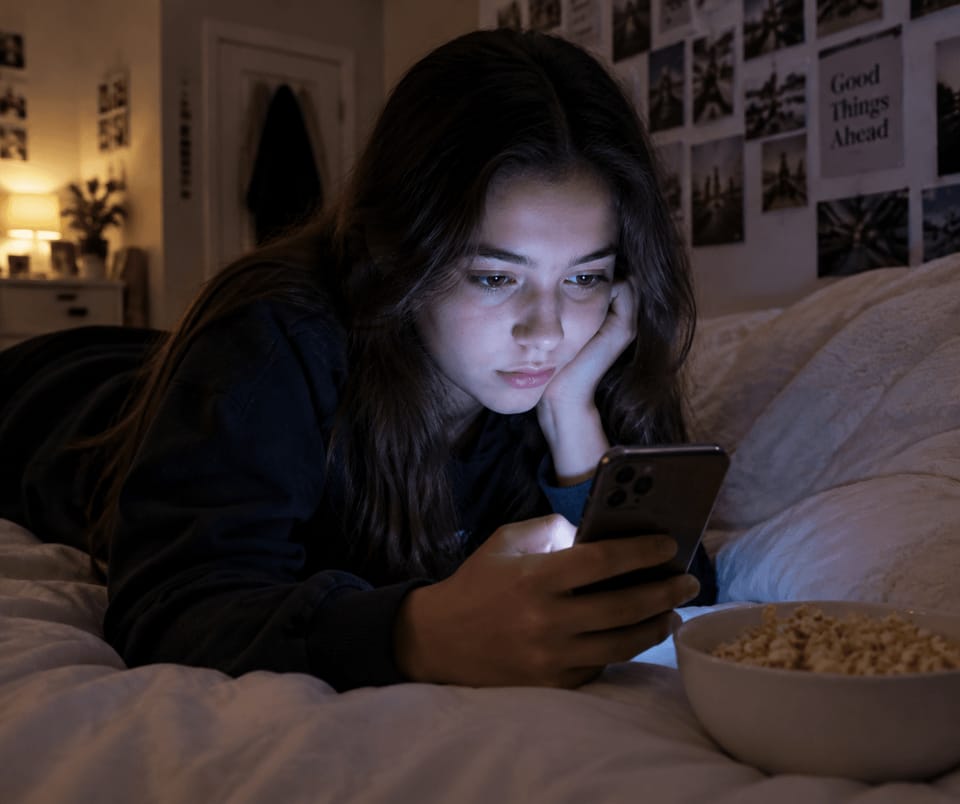
Television viewing among young people once followed fixed broadcast schedules with natural pauses. Digital streaming platforms have replaced those breaks with automated countdown timers that cue subsequent episodes in seconds. Screen time is no longer a matter of choosing a single broadcast, turning into an open-ended marathon that demands an active decision to stop.
Epidemiological estimates indicate that between 30% and 60% of teenagers engage in regular binge-watching, defined as viewing multiple episodes in a single sitting.1 In Spain, a national survey of more than 17,000 secondary school students found that 46.3% of surveyed adolescents access streaming platforms daily, while 40.8% of them do so several times each week.1 While frequent viewing does not always cause harm, constant access allows entertainment to displace sleep, academic responsibilities, and emotional stability.1
A study published in Frontiers in Public Health has examined how adolescent binge-watching connects directly to specific difficulties in cognitive self-regulation.1 Researchers investigating secondary schools in Spain evaluated 940 students aged 14 to 18 to explore how mental control systems relate to both harmless viewing pleasure and dysregulated screen habits.1 This interaction is especially relevant because adolescence is a period of rapid neurological maturation.1 Brain circuits that process emotional rewards and immediate gratification develop ahead of the prefrontal networks responsible for planning and impulse suppression.1
The mental challenge of turning off a video series follows a clear causal chain. An adolescent sits down to watch an episode for relaxation. As the credits roll, the platform immediately initiates the next chapter. To stop, the viewer must recognize the episode has ended, suppress the impulse to see what follows, and recall obligations like homework or sleep.1 If the capacity to inhibit impulses is weak, or if working memory fails to hold future responsibilities in mind, immediate gratification wins, and viewing continues.1
Why do some teenagers struggle to stop watching video streams?
Adolescent viewers often struggle to halt a video marathon because self-regulation requires the brain to suppress automatic impulses while holding longer-term responsibilities in active thought.1 When an entertainment platform removes structural pauses between episodes, the burden of stopping shifts entirely onto the viewer's internal cognitive control.1
Previous research characterizes binge-watching as a heterogeneous behavior that spans a spectrum from harmless recreation to compulsive media consumption.1 For many teenagers, watching consecutive episodes serves as an enjoyable social pastime linked to entertainment, relaxation, and emotional connection.1 Difficulties arise when viewing turns dysregulated, leading to dependency and the neglect of schoolwork.1
Two core elements of executive functioning govern this division, namely inhibitory control and working memory.1 Inhibitory control allows an individual to suppress automatic responses and resist tempting immediate distractions.1 Working memory provides the mental space to actively maintain and manipulate information, keeping goals and schedules prominent during decision-making.1 When either capacity falters, the immediate pleasure of continuing a story easily overrides bedtime routines.1
How did researchers trace the connections between mind and screen?
Cognitive control systems connect to streaming habits through an interdependent web of influences, where poor working memory and weak response inhibition link directly to feelings of dependency and a loss of personal control.1 Moving beyond isolated predictors, the researchers mapped these interactions as a connected network of cognitive and behavioral dimensions.1 The recruited group initially numbered 950 eligible students who completed in-person sessions lasting roughly 60 minutes, with 10 students excluded from the initial cohort because of missing sociodemographic information.1 Public school students accounted for 68% of the sample, totaling 639 adolescents, while 32%, or 301 students, attended private schools.1
The instrument measures seven distinct dimensions, covering general engagement, positive emotions, desire savoring, pleasure preservation, binge-watching frequency, dependency, and loss of control. In this sample, the questionnaire demonstrated high internal consistency, showing a general reliability coefficient of 0.948 for Cronbach's alpha and 0.960 for McDonald's omega, with individual dimension alphas ranging from 0.800 to 0.930.1 The tool assesses two primary dimensions, comprising inhibition, reflecting difficulties suppressing automatic reactions, and working memory, capturing problems holding and manipulating active thoughts.1 Reliability for the general factor reached 0.949 for both alpha and omega, while the inhibition dimension scored 0.906 and working memory scored 0.916.1
Socioeconomic status was measured as a covariate using the Family Affluence Scale, a six-item index assessing household cars, computers, bathrooms, private bedrooms, vacations, and dishwashers.1 Participants were categorized into low affluence with scores of zero to six, medium affluence with scores of seven to nine, and high affluence with scores of 10 to 13.1 The scale recorded modest internal consistency, showing an alpha of 0.497 and an omega of 0.537, which the authors noted is common for formative measures composed of heterogeneous material assets.1
Asked about the modest reliability scores for the affluence measure, Nicolás, a contributor to the study, explained that the scale captures diverse material indicators rather than a single underlying trait. Nicolás said in response to questions from Primary that the observed coefficients "do not, by themselves, quantify measurement error or establish that socioeconomic adjustment is unreliable." Nicolás emphasized that the scale served as a covariate in partial correlations rather than forming network nodes, noting that "additional sensitivity analyses using complementary socioeconomic indicators would be needed to address that issue directly."
Unlike classical linear regressions that estimate individual predictors against a single outcome, this network approach maps regularized partial correlations across all variables simultaneously.1 The resulting network reveals central nodes and bridging connections that explain how cognitive difficulties interact with specific viewing behaviors.1
Why do boys and girls display different viewing networks?
Male and female adolescents organize the psychological connections between mental control and video consumption differently, even though both groups experience similar overall levels of network connectivity.1 A statistical comparison using the Network Comparison Test demonstrated that while global network strength did not differ between genders, the specific structural arrangement of the associations varied significantly between males and females.1
Female participants reported higher scores for engagement, positive emotions, and desire savoring, indicating greater emotional immersion and enjoyment during viewing.1 Females also reported slightly higher executive functioning difficulties.1 In the network models, affective and control-related viewing dimensions emerged as central elements, organizing the relationships between cognitive deficits and screen habits along gender-specific lines.1
Nicolás pointed out that higher immersion scores among female students did not translate into greater functional harm. Speaking to Primary, Nicolás highlighted that greater emotional engagement and slightly greater self-reported executive difficulties "were not accompanied by statistically significant differences in dependency or loss of control." Nicolás said that these findings "describe modest differences in average reported experiences, rather than sharply differentiated cognitive profiles," cautioning against equating emotional pleasure with problematic habits.
Explaining the divergence in network structure between genders, Nicolás told Primary that "desire savoring contributed to cross-community connectivity in the female network, which is compatible with a potential role for emotionally rewarding viewing experiences." However, Nicolás cautioned that "these networks represent conditional associations between questionnaire dimensions, not neurological wiring," adding that the observed patterns do not establish a proven causal mechanism.
Partial correlations controlling for age, gender, and family affluence confirmed that executive dysregulation correlated positively with problematic binge-watching dimensions.1 Deficits in inhibitory control and working memory showed positive associations with dependency and loss of control.1 A sensitivity power analysis showed that with 940 participants, the study possessed 80% statistical power to detect partial correlations as small as 0.091 at an alpha level of 0.05.1
What limits exist in the current evidence?
Observational surveys administered at a single point in time cannot determine whether underlying executive difficulties cause compulsive viewing or whether extensive screen time erodes cognitive control.1 The cross-sectional design captures how cognitive control and media habits align in secondary school students, but cannot rule out bidirectional relationships where late-night viewing causes sleep loss that impairs executive functioning the next day.1
Addressing what would be required to evaluate causation, Nicolás clarified that the cross-sectional data show concurrent associations while leaving the direction of influence open. Nicolás told Primary that evidence weakening a causal interpretation would include "replicated longitudinal findings showing that executive difficulties do not predict subsequent changes in dependency or loss of control after accounting for baseline viewing patterns and relevant confounders." Such prospective studies would need to track potential confounders, including anxiety and depression, while pairing surveys with cognitive tests.
Furthermore, data collection took place within 23 school clusters in Spain, meaning local educational structures and cultural viewing habits might limit how directly these findings apply to adolescents in other settings.1 Nicolás acknowledged that the findings reflect the educational and cultural environment of Spanish secondary schools. Nicolás said in response to questions from Primary that while the division between recreational and dysregulated viewing provides an effective basis for international studies, "the three-community structure and specific central or bridging dimensions should be tested rather than assumed to generalize."
These findings indicate that managing adolescent screen time requires attending to cognitive control alongside behavioral rules.1 Nicolás emphasized that the research should not be interpreted as establishing prescriptive screentime caps for families or schools. Nicolás told Primary that the study "did not assess total screen time, establish a threshold for harmful viewing or evaluate the effectiveness of restrictions," meaning it cannot justify a rigid daily limit. Instead, Nicolás suggested that environmental changes, such as disabling automatic playback countdowns, provide practical avenues to explore for supporting adolescent self-regulation.
Future research will need to follow adolescent cohorts across developmental transitions to observe how cognitive control and media consumption interact over time, clarifying whether modifying digital environments can protect adolescents with executive control vulnerabilities.1
The record
58 sentences trace to 1 source and 1 contributor.
-
1
F
 Frontiers
Document
· frontiersin.org · 29 Sep 2026
Executive functioning and binge-watching behaviors in adolescents: a network analysis
See the source
- 2 Contribution — Nicolás Ruiz-Robledillo 21 statements added to this article
Other consulted pages1 page
Article history
-
Published 30 Oct 2026, 14:16Assembled by the Primary desk from 1 source · 1 contributor · 58 cited sentences
-
Nicolás Ruiz-Robledillo
- Go to the sentence: The scale recorded modest internal consistency, showing an alpha of 0.497 and an omega of 0.537, which the authors noted is common for formative measures composed of heterogeneous material assets.
- Go to the sentence: Asked about the modest reliability scores for the affluence measure, Nicolás, a contributor to the study, explained that the scale captures diverse material indicators rather than a single underlying trait.
- Go to the sentence: Nicolás said in response to questions from Primary that the observed coefficients "do not, by themselves, quantify measurement error or establish that socioeconomic adjustment is unreliable."
- Go to the sentence: A statistical comparison using the Network Comparison Test demonstrated that while global network strength did not differ between genders, the specific structural arrangement of the associations varied significantly between males and females.
- Go to the sentence: Females also reported slightly higher executive functioning difficulties.
- Go to the sentence: Nicolás pointed out that higher immersion scores among female students did not translate into greater functional harm.
- Go to the sentence: Speaking to Primary, Nicolás highlighted that greater emotional engagement and slightly greater self-reported executive difficulties "were not accompanied by statistically significant differences in dependency or loss of control."
- Go to the sentence: Nicolás said that these findings "describe modest differences in average reported experiences, rather than sharply differentiated cognitive profiles," cautioning against equating emotional pleasure with problematic habits.
- Go to the sentence: Explaining the divergence in network structure between genders, Nicolás told Primary that "desire savoring contributed to cross-community connectivity in the female network, which is compatible with a potential role for emotionally rewarding viewing experiences."
- Go to the sentence: However, Nicolás cautioned that "these networks represent conditional associations between questionnaire dimensions, not neurological wiring," adding that the observed patterns do not establish a proven causal mechanism.
- Go to the sentence: Deficits in inhibitory control and working memory showed positive associations with dependency and loss of control.
- Go to the sentence: Addressing what would be required to evaluate causation, Nicolás clarified that the cross-sectional data show concurrent associations while leaving the direction of influence open.
- Go to the sentence: Nicolás told Primary that evidence weakening a causal interpretation would include "replicated longitudinal findings showing that executive difficulties do not predict subsequent changes in dependency or loss of control after accounting for baseline viewing patterns and relevant confounders."
- Go to the sentence: Such prospective studies would need to track potential confounders, including anxiety and depression, while pairing surveys with cognitive tests.
- Go to the sentence: Furthermore, data collection took place within 23 school clusters in Spain, meaning local educational structures and cultural viewing habits might limit how directly these findings apply to adolescents in other settings.
- Go to the sentence: Nicolás acknowledged that the findings reflect the educational and cultural environment of Spanish secondary schools.
- Go to the sentence: Nicolás said in response to questions from Primary that while the division between recreational and dysregulated viewing provides an effective basis for international studies, "the three-community structure and specific central or bridging dimensions should be tested rather than assumed to generalize."
- Go to the sentence: These findings indicate that managing adolescent screen time requires attending to cognitive control alongside behavioral rules.
- Go to the sentence: Nicolás emphasized that the research should not be interpreted as establishing prescriptive screentime caps for families or schools.
- Go to the sentence: Nicolás told Primary that the study "did not assess total screen time, establish a threshold for harmful viewing or evaluate the effectiveness of restrictions," meaning it cannot justify a rigid daily limit.
- Go to the sentence: Instead, Nicolás suggested that environmental changes, such as disabling automatic playback countdowns, provide practical avenues to explore for supporting adolescent self-regulation.