Intact Roman child sarcophagus reveals undisturbed toys and wooden coffin
Excavations in ancient Tomis uncover a sealed stone burial holding clay playthings, floral offerings, and preserved wood from the second or third century.
Organic materials buried beneath the soil rarely survive the passage of several centuries. Moisture, soil bacteria, fungi, and shifting ground water typically dissolve wood, fabrics, and delicate plant fibres within a matter of decades. In archaeological excavations of the Roman Empire, stone monuments, pottery, and metals frequently endure, whereas the timber containers, textiles, and botanical wreaths that formed essential elements of ancient funeral rites almost always vanish entirely from the earth.
When a tomb remains completely isolated from air and moisture, this natural decay slows to an abrupt crawl. For nearly eighteen centuries, a small stone sarcophagus lay concealed beneath modern Constanța on the western coast of the Black Sea, holding a snapshot of family grief from antiquity.12 Inside, shielded beneath a heavy lid, rested the intact wooden coffin of a young child, accompanied by painted clay toys, floral offerings, personal ornaments, and protective amulets.21
Archaeologists Constantin Băjenaru and Cătălin Nopcea, working on behalf of the Museum of National History and Archaeology in Constanța, uncovered the stone container during preventive salvage excavations on October 22, 2026.23 The grave dates to the second or third century AD, when the ancient city of Tomis flourished as a major urban and maritime trade hub within the Roman province of Moesia Inferior.21
What keeps an ancient wooden coffin intact for eighteen centuries?
Structural isolation from the surrounding environment explains why the timber coffin and its contents survived in such pristine condition.13 For biological decay to break down timber and plant matter, oxygen and moisture must continuously feed microbial activity. If a container prevents water filtration and halts air circulation, the enclosed organic materials can endure across millennia without decomposing into dust.
In the Constanța burial, the funerary team achieved this long preservation by locking the stone lid with two lead clamps and sealing the entire exterior perimeter joint with dense mortar.2 That barrier blocked groundwater, insects, and air from entering the chamber as sediment accumulated above it across the centuries.2 It also prevented grave robbery, a disruption that compromised the vast majority of antique burials across the region long before modern researchers arrived.13
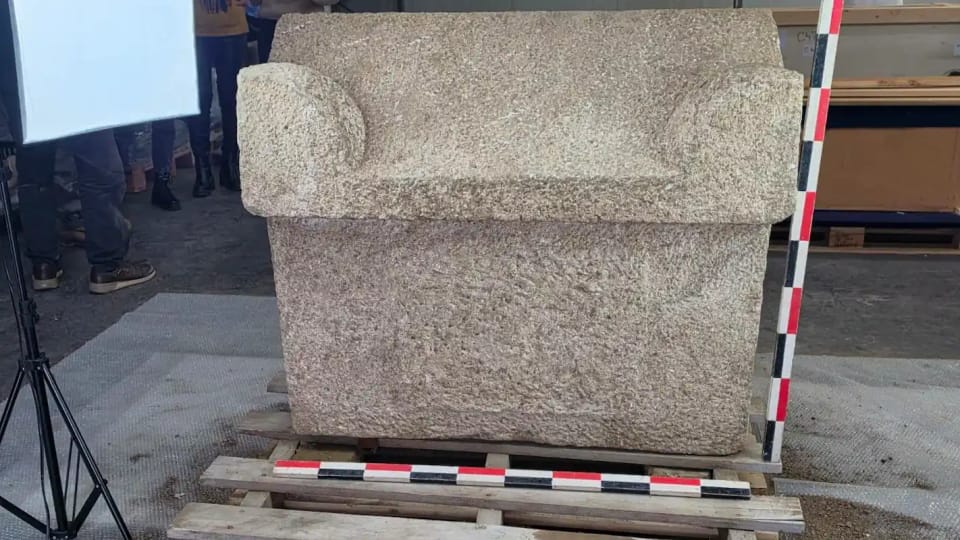
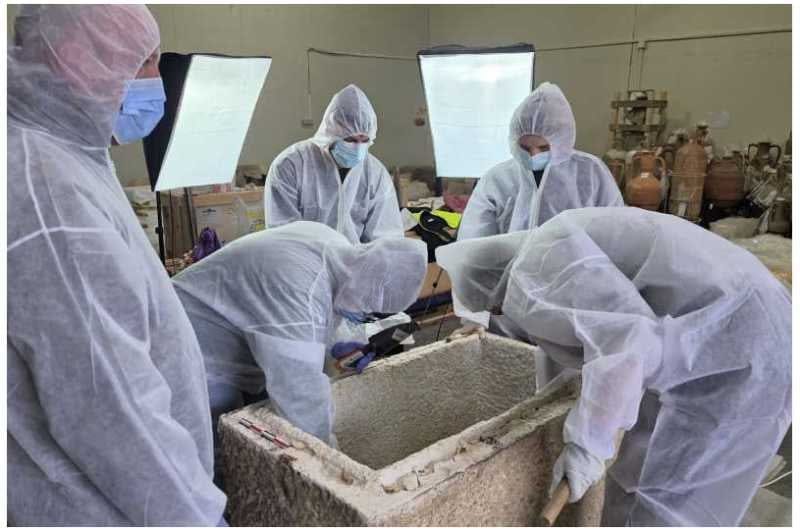
When specialists from the Museum of National History and Archaeology in Constanța transported the sarcophagus to a research facility and opened it on October 27, 2026, they discovered that the inner wooden coffin remained structurally sound.14 Its side panels remained intact, held together by carefully carved dovetail joints that demonstrate the carpentry methods used by provincial Roman woodworkers.21 Portions of a woven burial shroud that wrapped the child also survived inside the frame.2
What objects did Roman parents choose for a child's burial?
Two painted clay toys formed the focal point of the objects placed inside the child's wooden coffin.21 One piece is a terracotta rattle moulded in the shape of a rooster, containing internal pellets that still emit a distinct rattling noise when specialists move the object.21 The second toy is a small clay horse fitted with working wheels, designed to be rolled across flat surfaces. Traces of ancient paint survive on both items, outlining facial features and eyes on the figurines.2
In classical Mediterranean societies, rattles served both as soothing nursery instruments for infants and as protective items associated with the earliest stages of life.1 The presence of the rooster rattle prompted the research team to reconsider the initial chronological estimate of the deceased child.2 While the exterior measurements of the stone sarcophagus suggested a child of approximately four or five years, toys of this type frequently point to infancy or early toddlerhood.21
Beside the toys lay two rounded bronze amulets known as bullae, which Roman families hung around the necks of freeborn children to ward off malevolent influences and signal civic status.12 The burial also contained several bronze dress fittings, bronze bracelets, and a single coin deposited with the child.123 Botanical remains were arranged throughout the interior, including flower garlands and carefully folded leaves rolled into small bundles, offering physical evidence of the floral arrangements that accompanied Roman burial ceremonies.24
Where does the tomb sit in the ancient landscape of Tomis?
The sarcophagus occupied a prominent position on the northern margin of the Tomis necropolis, situated roughly 1.5 kilometers outside the defensive perimeter of the ancient city.21 Roman civic law strictly prohibited human burials within municipal city walls, leading urban communities to construct cemeteries that stretched alongside the principal outbound transit highways.32 This child's tomb lay beside the primary regional thoroughfare running north toward the coastal fortress city of Histria.1
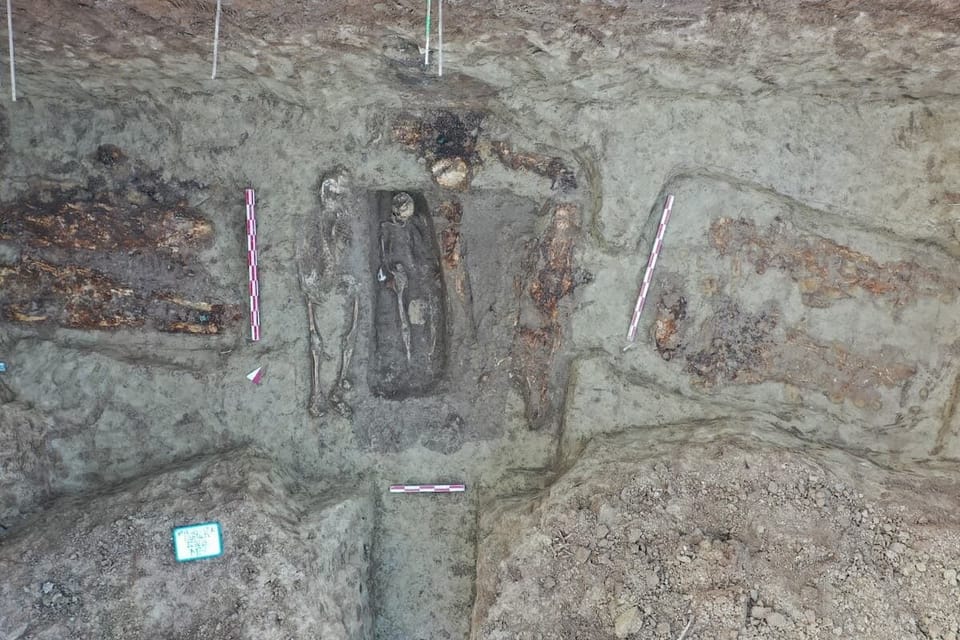
Constantin Băjenaru reported that the child's sarcophagus marks the northernmost known point of the Roman cemetery of Tomis documented to date.2 The site sits directly opposite several other graves previously investigated by the museum team, including an unusual brick tomb discovered four or five years earlier that had suffered damage from interwar trenching.1 Constantin Băjenaru noted that the concentration of elaborate burials along this arterial road indicates the parcel was reserved for an influential, wealthy local family.42
Tomis began in the sixth century BC as a Milesian Greek trading colony before falling under Roman administration in 29 BC.2 The settlement became famous across the empire as the remote destination where Emperor Augustus banished the poet Ovid in AD 8.31 By the second and third centuries AD, the community had developed into an affluent cosmopolitan centre where Greek traditions merged with Roman administrative institutions and civic customs.23
What questions remain unanswered about the child's life?
The initial findings represent field observations rather than a finished laboratory analysis.43 While the discovery of bulla pendants traditionally aligns with male Roman children, the biological sex of the young individual remains unverified until physical anthropologists complete a full osteological examination of the skeletal remains.2 That skeletal analysis will also establish a conclusive age at death, replacing the initial physical estimates derived from the coffin dimensions.2
The chemical profile of the wooden coffin and botanical matter also demands comprehensive laboratory testing.2 Archaeologists have not yet determined whether preserving resins, embalming compounds, or specific tree resins were applied to the timber panels during the funeral rites to delay wood rot.2 Furthermore, the contents enclosed inside the sealed metal bulla lockets remain unknown pending non-invasive imaging, and the origin and minting date of the recovered bronze coin have not been formally reported.23
Over the next two years, conservators and scientists from the Museum of National History and Archaeology in Constanța will analyze the textile weaves, pollen, leaf bundles, and wood species recovered from the stone chamber.24 Museum director Delia Cornea announced that international specialists in Roman provincial archaeology will evaluate the findings during the Congress on the Danubian Provinces, scheduled to take place in Constanța. Following conservation and cataloguing, the museum intends to place the child's coffin and playthings on permanent public exhibition.1
The record
37 sentences trace to 4 sources.
- 1 Archaeologists Opened an Untouched 1,800-Year-Old Roman Coffin and Found a Child Buried With His Toys See the source
- 2 1,800-Year-Old Roman Child's Sarcophagus Found Intact with Toys Inside | Arkeonews See the source
- 3 Archaeologists Open a Sealed Roman Child's Sarcophagus in Romania, and the Toys Were Still Inside See the source
- 4 Rare intact Roman-era child's sarcophagus discovered in Romania's Constanta - AGERPRES See the source