Parasites redirect host movements through subtle biological nudges
Fungal networks and venomous stings seize muscles and sensory systems to steer insects toward reproduction or death.
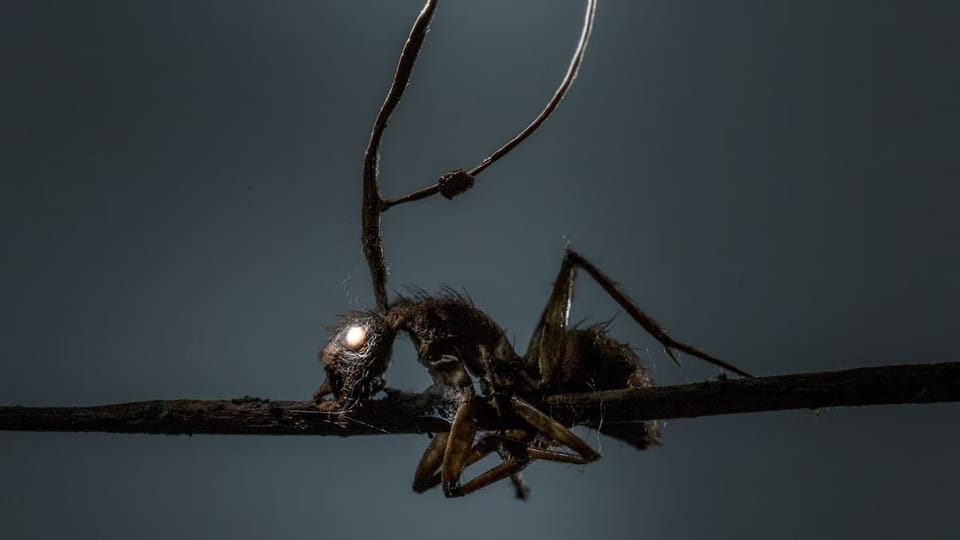
In fictional stories, zombies arise when dead tissue returns to life under supernatural curses or rogue pathogens. Natural biology operates in a manner that is quieter and far more precise. Across forests, fields, and freshwater edges, living organisms routinely find their movements, impulses, and choices commandeered by specialized parasites and fungi. The affected creatures remain alive while foreign invaders alter their everyday routines to serve a different reproductive cycle entirely.
Tara Deans, an Associate Professor of Biomedical Engineering at the Georgia Institute of Technology, pointed out that these biological invaders do not revive dead flesh.1 Instead, they interfere directly with physical mechanisms that govern locomotion, basic motivation, and animal decision-making.12 Studying how one living body takes control of another provides researchers with a practical window into the ways complex organisms process internal sensory signals and carry out behavior.
How do fungal spores seize control of an ant?
Infection begins on the forest floor when airborne spores of the parasitic fungus Ophiocordyceps land on a foraging ant.12 The microscopic spore adheres firmly to the outer surface of the insect and secretes enzymes that penetrate the hardened cuticle.12 Once inside the body cavity, the fungus proliferates throughout host tissues while the ant continues to walk, feed, and interact with its nestmates as if nothing were wrong.12 This internal colonization develops quietly over several weeks before any visible changes in habit emerge.12
When the reproductive phase approaches, the infected ant departs from its colony and begins to wander alone.12 The insect climbs surrounding vegetation, ascending to an elevated leaf or twig positioned above active colony trails.12 Near the end of this journey, the ant bites down with tremendous force onto a leaf vein or plant stem, anchoring itself in a posture that biologists call a death grip.12 The ant dies in this locked position, after which the fungal mycelium consumes the internal soft tissues, erupts as a slender fruiting stalk through the back of the insect's head, and showers infectious spores down onto new hosts below.12
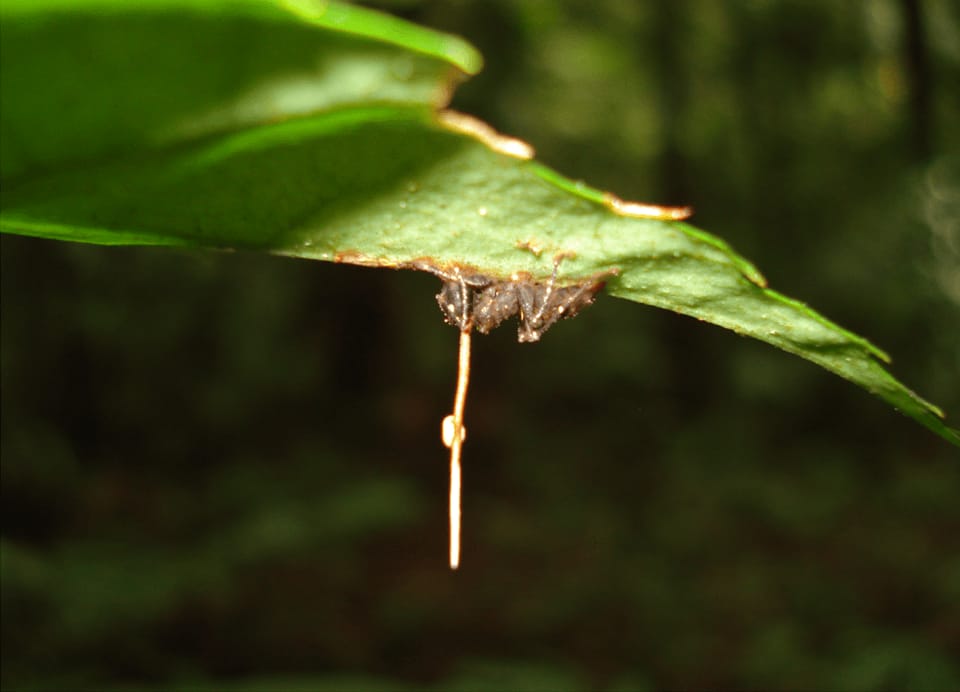
Why does the fungus spare the ant brain?
Microscopic examinations of infected ants demonstrate that fungal cells do not invade the central brain tissue to execute behavioral control.12 Tara Deans reported that investigators looking at infected insects before death detected pervasive fungal growth surrounding individual muscle fibers throughout the body, while the brain remained largely unpenetrated.12 The fungal cells organize into dense networks that wrap directly around the structural machinery of the host musculature.12
This anatomical pattern indicates that the parasite manipulates physical posture through local tissue interactions. The powerful jaw muscles responsible for the terminal death grip become heavily colonized by fungal growth and enter a state of severe, persistent contraction.12 While the fungus appears to release specialized bioactive molecules directly adjacent to these muscle cells, the underlying motor neurons and nerve connections remain intact.12 Rather than destroying the motor control apparatus, the fungus appears to modify the chemical environment that regulates cellular contraction in the jaw.12
Which other parasites hijack animal decisions?
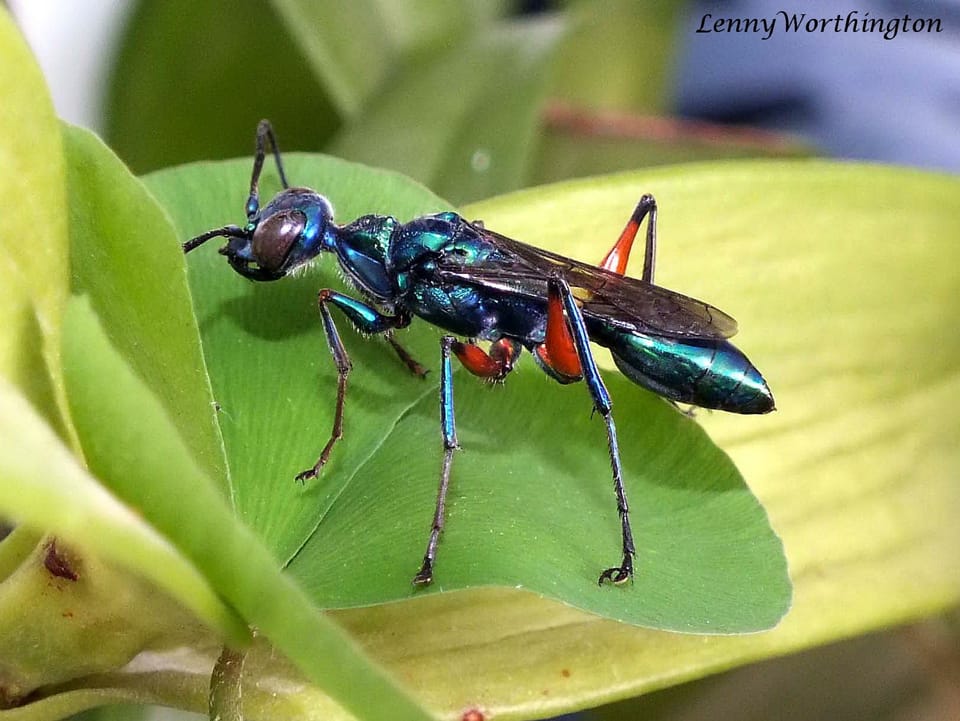
Venomous insects achieve behavioral redirection through direct chemical intervention in the nervous system.12 The emerald jewel wasp, known scientifically as Ampulex compressa, hunts cockroaches to provide living food stores for its offspring. When attacking, the female wasp delivers a measured sting directly into the central nervous system of the cockroach.12 The venom does not paralyze the insect's legs, but it sharply suppresses the specific neural circuits responsible for initiating voluntary walking. The cockroach retains normal physical capacity to run, yet it loses the internal drive to flee, allowing the much smaller wasp to lead it by its antennae into an underground burrow where an egg is deposited.
Aquatic hairworms employ sensory manipulation to compel terrestrial hosts to drown themselves.12 These parasitic worms infect crickets and praying mantises, feeding and growing inside the insect host until they reach adult reproductive maturity.12 When ready to enter open water to mate, the hairworm alters the host's behavioral response to ambient light, creating an intense attraction to illuminated surfaces that frequently directs the insect straight toward the reflective sheen of open ponds or streams.12 The cricket or mantis plunges into the water, allowing the mature worm to burst through the body wall into the aquatic environment while the terrestrial host drowns.12
Mammalian behavior can likewise be altered by single-celled protozoans seeking specific reproductive environments.12 Toxoplasma gondii can infect a wide range of warm-blooded creatures, including mice, rats, livestock, and humans, but it can reproduce sexually only within the digestive tract of felids.12 Rodents carry a natural, evolved dread of feline urine and predatory scents, which preserves them from predation.12 When infected by Toxoplasma gondii, rodents display a targeted loss of this protective aversion and can become actively attracted to cat scents, significantly increasing the probability that an infected rodent is captured and eaten by a feline host.12
What does host manipulation reveal about animal behavior?
These biological case studies demonstrate that an invading organism does not require complete control of an animal mind to achieve its reproductive aims.12 Parasites rarely rewrite an entire behavioural repertoire; they typically alter a single crucial choice, such as whether to ascend a stem, whether to initiate a walking step, whether to dive into a stream, or whether to flee an odor.12 By applying precise biochemical pressure at vulnerable nodes in sensory or muscular processing, the parasite redirects the animal toward a designated ecological trap.
Current research into these interactions represents an evolving field of descriptive biology and molecular sampling rather than a complete biochemical explanation. Tara Deans emphasized that while researchers have catalogued fungal genes linked to toxins, structural proteins, and signaling compounds, the exact molecular chains of custody causing an ant to wander, climb, and bite remain unproven.12 Genetic correlations do not demonstrate direct biochemical causation in living tissues.12 Scientists also rely on specific laboratory models and field observations that cannot account for every environmental variable shaping how parasitic infections unfold across diverse wild populations.
Unraveling the mechanisms of host manipulation provides practical insights for researchers working in synthetic biology and neurobiology. Behavior in animals does not stem from a single centralized switch, but arises from continuous physiological communication between nerves, peripheral muscle groups, and circulating hormones.12 Investigating how natural parasites disrupt these integrated systems helps researchers map the chemical pathways that generate voluntary movement and sensory awareness in healthy organisms.12
The record
32 sentences trace to 2 sources.
-
1
S2
 Science 2.0
Document
· science20.com · 31 Oct 2026
How To Create A Real Zombie, The Organic Way
See the source
- 2 Zombies are real – just ask the parasites taking over the bodies and brains of insects and rodents, leading them to their doom See the source