Electrical brain stimulation can alter how viewers perceive sexualized bodies
A mild current applied to the scalp temporarily eliminated a well-documented visual quirk that treats sexualized female bodies like inanimate objects, according to a new cognitive experiment.

When a photograph of an everyday building is turned upside down, the human brain still recognises it without much trouble. The windows, doors, and roof remain readily identifiable pieces of a mechanical structure. A human body, by contrast, is normally processed as an integrated whole, with spatial relationships between limbs, torso, and face bound tightly together. Inverting a person disrupts that automatic coordination, causing visual recognition to stumble. Yet when viewers look at images of sexualized women, this standard visual processing breaks down, and the figures are identified piece by piece, exactly like inanimate objects.
This perceptual difference has provided cognitive psychologists with an objective ruler to gauge sexual objectification. In visual psychology, perceiving an individual as an assembly of isolated parts rather than a unified person is not merely a social attitude. It represents a measurable mode of visual perception that alters how the visual cortex encodes human bodies.
Understanding this visual habit requires tracing how the brain handles shapes. An observer first glances at a human form and detects basic visual signals like edges, contours, and surface patterns. In typical human encounters, the visual system binds those components into an integrated arrangement, relying on spatial relationships between body parts. Turning the figure upside down breaks that binding process, forcing the viewer to inspect individual components in isolation. But when an observer views an object, the brain never attempts that unified binding in the first place, relying on isolated features whether the item is upright or inverted.
In a study published in the journal Social Neuroscience, researchers Ciro Civile and Arwen Stephens investigated whether this perceptual pattern could be interrupted using non-invasive brain stimulation.1 By applying transcranial direct current stimulation, a technique that delivers a gentle electrical current through electrodes placed on the scalp, the authors found that they could temporarily eliminate the recognition gap that typically separates sexualized female bodies from male figures.1
Why does turning an image upside down reveal visual objectification?
Visual recognition of human beings normally stumbles when an image is turned upside down, whereas recognition of inanimate objects remains relatively stable. Cognitive psychologists refer to this divide as an inversion effect. When participants view right-side human figures, the paper reports that about 80 percent of people recognize them correctly, compared with a success rate of 55 percent when the same bodies are displayed upside down.1 When observers view inanimate objects such as buildings, that performance gap is substantially smaller.1
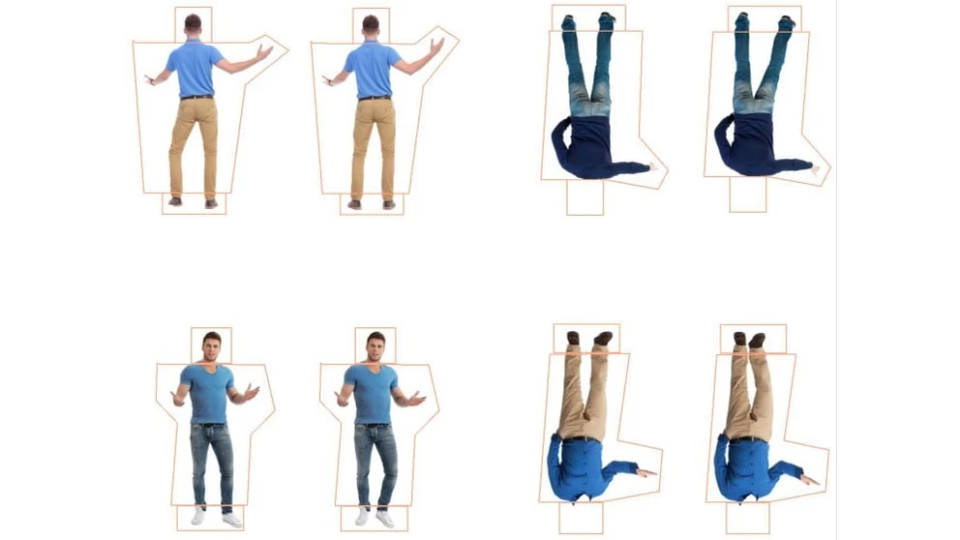
Earlier research established that sexualized imagery alters this standard pattern. In a 2012 experiment described in the paper, volunteers viewed an image and then completed a rapid-choice task, identifying the original photograph against a mirror image.1 Both male and female participants recognized photographs of men in underwear significantly better when the images were presented upright.1 When viewing women posed in comparable attire, however, participants performed just as accurately when the images were presented upside down, processing them with the part-based ease typically reserved for physical objects.1
Contextual changes can shift this perceptual pattern back toward standard human recognition. The paper notes that in a 2015 experiment, researchers blurred the chest and groin regions of sexualized photographs or informed participants that the women depicted were raising money for cancer research.1 Under those altered framing conditions, participants once again displayed the usual upright recognition advantage for female bodies, recognizing them in the same unified manner observed for male figures.1
Replicating these cognitive patterns across independent laboratories has posed persistent challenges within social psychology. To assess the consistency of the inversion effect across the wider scientific literature, the authors note that a 2022 meta-analysis examined findings across 41 individual papers.1 That synthesis determined that while the upright recognition advantage remained smaller for sexualized female figures than for male figures, the disparity was less pronounced than initial single-study trials had reported.1
How did electrical stimulation alter recognition patterns in the experiment?
Delivering a mild electrical current to the scalp eliminated the perceptual gap between male and female figures during the image recognition trials. Civile and Stephens tested their hypothesis by dividing participants into two experimental conditions, comparing active transcranial direct current stimulation against a control procedure.1
In the control condition, participants received a sham stimulation designed to mimic the physical sensation of the procedure. The sham apparatus delivered a brief electrical tingle that switched off automatically after 30 seconds, leaving the brain unstimulated for the remainder of the testing session.1 Participants in this placebo group retained the conventional perceptual pattern, continuing to recognize inverted sexualized female bodies without the typical performance penalty observed for male figures.1
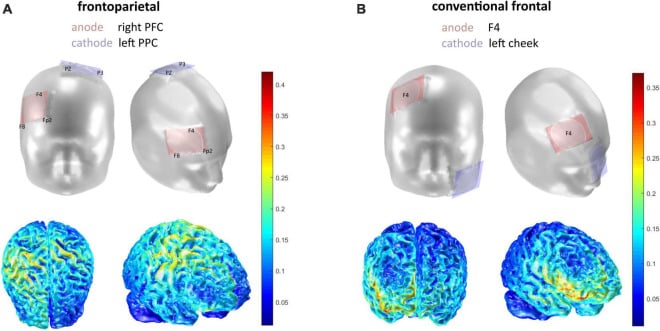
Participants who received active electrical stimulation displayed a pronounced shift in cognitive performance. In that group, the authors report that the recognition disparity between male and female images vanished entirely.1 Furthermore, participants receiving the stimulation showed improved recognition accuracy when viewing sexualized women in upright photographs, restoring the normal perceptual advantage associated with whole-body human processing.1
The authors suggest that this shift occurs because electrical current disrupts the cognitive mechanisms that draw disproportionate visual attention to localized bodily features. They compare this dynamic to the Thatcher illusion, a classic perceptual demonstration in which the eyes and mouth of former British Prime Minister Margaret Thatcher were inverted on an upright photograph of her face.1 While the altered features appear grotesque only when the face is viewed right-side up, the isolated features dominate attention. Civile and Stephens propose that sexualized bodily features capture attention in a similar piecemeal fashion, and the electrical current temporarily weakens that attentional pull.1
What does the electrical shift mean for social perception?
Modifying visual recognition with electrical stimulation indicates that objectification relies on basic attentional mechanisms rather than unchangeable social conditioning. In social science debates, critics often argue that visual objectification stems from cultural norms that demean women and foster tolerance for harm. However, cognitive findings point toward attentional and psychological mechanisms, including the distribution of interpersonal power.
Power dynamics appear to directly shape whether an observer engages in part-based visual processing. The paper highlights prior experiments where participants who wrote about personal experiences of feeling powerful adopted an object-like, piecemeal recognition style when viewing sexualized images of the opposite sex.1 By contrast, participants prompted to reflect on feelings of powerlessness retained the standard upright recognition advantage across all human figures, regardless of gender.1
The laboratory findings remain subject to important interpretative constraints. The results reflect an experimental simulation of cognitive perception conducted in a controlled setting, rather than a direct measurement of everyday interpersonal behaviour. The authors applied electrical current over brief periods to test immediate recognition accuracy, meaning the experiment cannot determine whether the perceptual changes persist over hours or days. The study also relied on two-dimensional laboratory photographs rather than real-world social encounters where vocal cues, movement, and emotional context actively shape how individuals perceive one another.
Civile and Stephens conclude that targeted electrical intervention can temporarily alter the brain networks governing feature-based attention. Future research will need to test how long the perceptual shift lasts and whether non-electrical interventions, such as cognitive training or attentional redirection, can replicate the same visual outcomes. For now, the experiment confirms that the tendency to view sexualized bodies as disconnected parts is an active cognitive process that physical interventions can disrupt.
The record
20 sentences trace to 1 source.
-
1
S2
 Science 2.0
Document
· science20.com · 31 Oct 2026
If You Want To Stop Objectifying Women, Try Electro-Shock
See the source