NASA schedules 2028 Dragonfly launch to Titan
The rotorcraft mission will carry public names on a microchip when it departs for Saturn's largest moon.
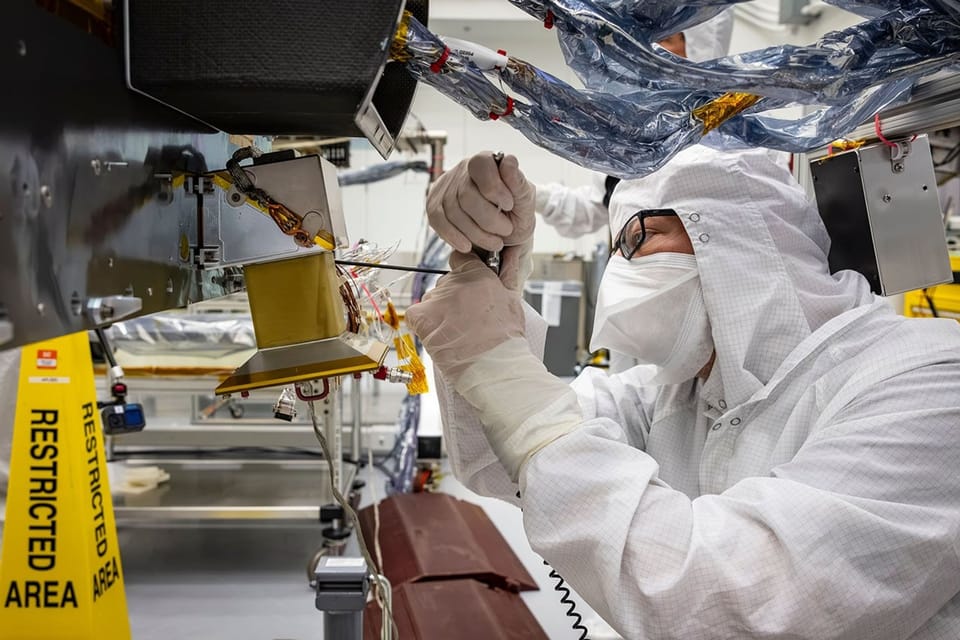
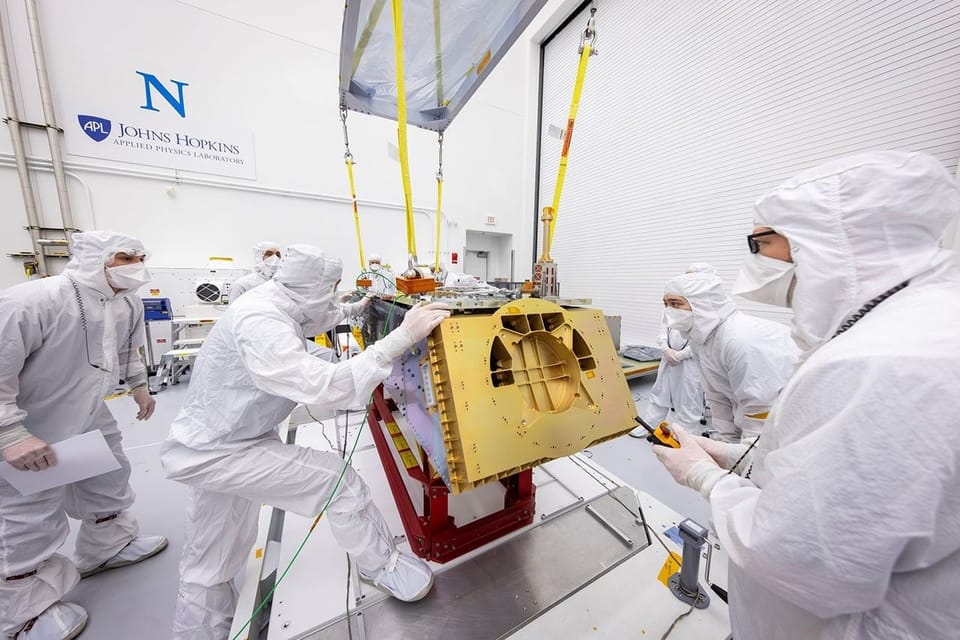
NASA will launch its Dragonfly rotorcraft mission to Saturn's largest moon in 2028, deploying an eight-rotor vehicle to investigate prebiotic chemical compounds across the alien surface.12 The flight system, currently undergoing assembly at the Johns Hopkins Applied Physics Laboratory in Laurel, Maryland, represents the agency's first science mission designed to perform powered atmospheric flight across another planetary body.23
Alongside technical preparations, the agency opened public registration for its Send Your Name to Titan initiative, also designated the Journey to Titan campaign.12 Names submitted before 11:59 p.m. EST on January 15, 2027, will be etched onto a digital microchip installed directly on the rotorcraft chassis.24 Participants receive a digital boarding pass marking their inclusion on the symbolic passenger manifest.21
Dragonfly will spend roughly six years in interplanetary transit before arriving at Titan in 2034.2 Once in the moon's atmosphere, the rotorcraft will decouple from its entry aeroshell to begin a multi-year exploration sequence across diverse geological zones.32
Atmospheric mechanics and rotorcraft architecture
Operating an aerial vehicle on Titan presents distinct aerodynamic conditions compared to Mars or Earth. Titan possesses a dense, nitrogen-rich atmosphere paired with surface gravity substantially weaker than Earth's.1 That combination creates high atmospheric density that makes rotor-driven lift far more efficient than on terrestrial terrain, enabling a heavier vehicle to travel distances between surface stations that would require months or years for wheeled surface rovers.1
The craft relies on eight rotors arranged in pairs.1 Structural components consist of ultra-lightweight honeycomb panels developed at the Applied Physics Laboratory to provide rigidity while minimizing structural mass.3 Engineers at the facility have installed internal cabling and instrumentation within clean-room environments to prepare the primary frame for mechanical integration.3
Thermal and structural protection represents another major development hurdle. Titan's upper atmosphere requires a dedicated heat shield to endure entry heating before atmospheric deceleration allows rotor deployment.3 Dragonfly flight systems completed thermal-structural evaluations in the New Mexico desert to confirm the heat shield can withstand high thermal loads during descent.3
Autonomous flight software controls guidance, hazard identification, and descent maneuvers. During simulated flight evaluations, test sequences demonstrated the vehicle's capability to scan ground topography autonomously, detect obstacles, alter course, and identify level touchdown sites across unfamiliar terrain.35
Power generation in deep space
At approximately one billion miles from the Sun, solar radiation on Titan is inadequate to power a high-performance science platform. The moon's thick atmospheric haze further scatters visible light, rendering conventional solar arrays ineffective for multi-year operations.
Engineers equipped Dragonfly with a radioisotope power system to supply continuous electrical power and operational heat.1 The system uses the natural decay heat of radioisotopes to generate electricity, maintaining stable temperatures for internal computers, sensors, and avionics against Titan's extreme external environment.
Surface temperatures on Titan hover around minus 290 degrees Fahrenheit, or minus 179 degrees Celsius.1 Under those thermal conditions, water ice freezes so hard that it behaves like solid bedrock.1 Liquid hydrocarbons take the place of water in Titan's active hydrologic cycle, where liquid methane and ethane condense into clouds, generate precipitation, and form surface rivers and expansive lakes.12
Prebiotic targets at Selk crater
Dragonfly is not engineered to search for extant biological life.1 The mission's scientific payload focuses on prebiotic chemistry, analyzing the chemical precursors that existed prior to biological emergence.24 Titan is considered a natural laboratory for understanding how organic molecules organize in complex environments.
The moon's nitrogen and methane atmosphere interacts with solar radiation to generate complex carbon-based molecules that precipitate onto the surface.1 Over geological time, these materials have formed wide equatorial sand dunes composed of solid organic grains.12
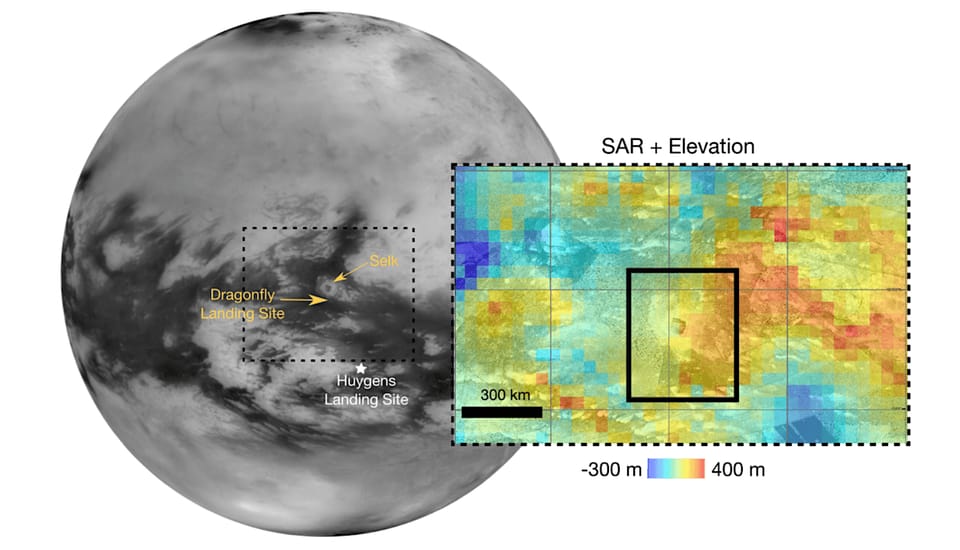
Flight plans target an operational corridor that includes these equatorial dunes as well as terrain surrounding the Selk impact crater.1 Scientists selected Selk because an ancient meteor impact melted Titan's subsurface water ice, creating a localized environment where liquid water mixed directly with organic surface sediments before refreezing.1 Instruments aboard Dragonfly will sample these frozen deposits to evaluate how far prebiotic synthesis advanced during that transient warm period.1
The science team will measure the exact elemental and molecular composition of surface samples across successive landing sites. By hopping multiple kilometers between flights, Dragonfly can study distinct geographical units rather than remaining constrained to a single landing basin.
Mission oversight and program lineage
Dragonfly forms the fourth mission under NASA's New Frontiers Program, a class of medium-scale planetary science investigations focused on high-priority solar system targets.24 NASA's Marshall Space Flight Center in Huntsville, Alabama, manages the New Frontiers Program on behalf of the agency's Science Mission Directorate.24
The Johns Hopkins Applied Physics Laboratory directs mission implementation and spacecraft development.24 Elizabeth Turtle of the laboratory serves as the mission's principal investigator, leading an international team of scientists and engineers.24
"By flying the first-ever rotorcraft science mission, NASA will explore Saturn's largest moon, Titan, as we search for signs of habitability on a distant world that is most similar to our own," Nicky Fox, associate administrator for the Science Mission Directorate at NASA Headquarters, said in an agency announcement.21
Testing will continue across NASA centers and partner facilities through 2027, focusing on system-level vibration, cold-temperature avionics performance, and flight communication protocols. After completing assembly and environmental screening in Maryland, the spacecraft will transfer to Florida for launch integration ahead of the 2028 launch window.
The record
31 sentences trace to 5 sources.
- 1 NASA Is Offering You a Chance to Travel 1 Billion Miles to a Mysterious Moon: Here’s How to Join the Mission See the source
-
2
N
 nasa.gov
Official record
· nasa.gov
Send Your Name to Titan Aboard NASA’s Dragonfly Mission - NASA
See the source
-
3
NS
 NASA Science
Official record
· science.nasa.gov · 4 Mar 2026
Dragonfly News
See the source
-
4
N
nasa.gov
Official record
· nasa.gov
Envía tu nombre a Titán a bordo de la misión Dragonfly de la NASA - NASA
See the source
-
5
NS
NASA Science
Official record
· science.nasa.gov · 13 Feb 2024
Astrobiology News - NASA Science
See the source