Symmetries give analog quantum simulators a path to error protection
By accepting controlled error, physical simulations could soon run robustly without losing continuous dynamics to heavy digital correction circuits.
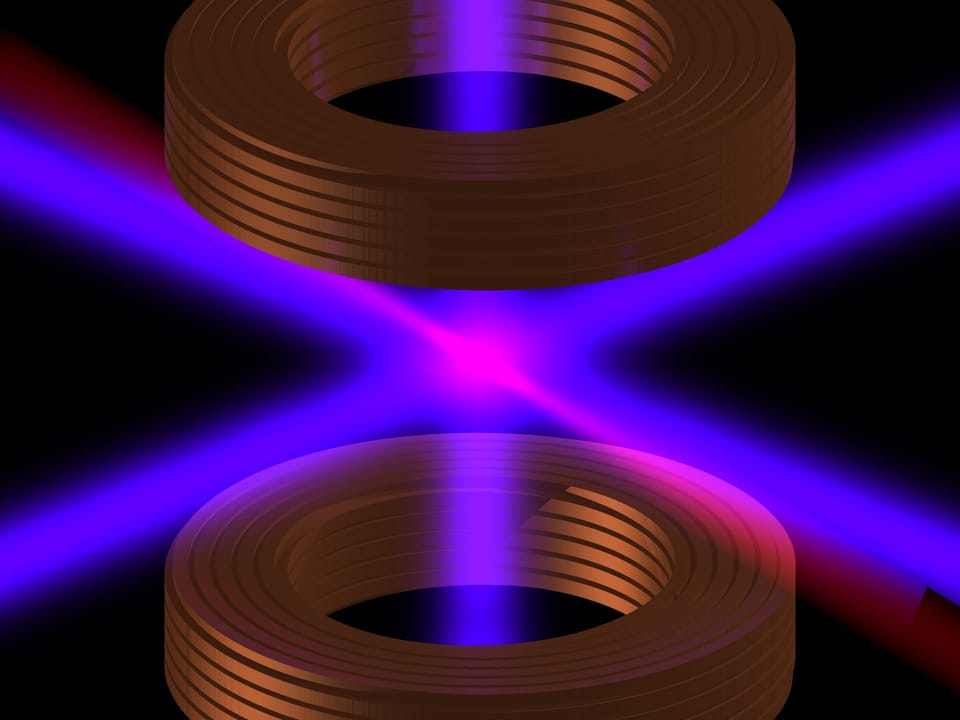
Quantum simulators work by mimicking the continuous laws of nature directly in hardware. Instead of breaking physical processes into millions of discrete digital logic gates, an analog quantum simulator tunes its own interactions so that its particles evolve under the exact continuous physical forces researchers want to study. This approach allows laboratory devices to reproduce complex magnetic materials, chemical reactions, and quantum materials in regimes that overwhelm standard supercomputers. Yet this continuous nature creates a severe dilemma whenever experimental noise interferes with the hardware.
When an ordinary digital quantum computer suffers an error, it can diagnose and fix the disturbance using quantum error correction codes that isolate discrete bit flips and phase flips. Digital systems correct errors by periodically pausing their routines, extracting diagnostic measurements, and applying discrete corrective pulses. Analog simulators cannot easily adopt this routine. If a simulator must constantly stop to perform digital error correction, the seamless continuous evolution that makes analog simulation natural and computationally direct is lost, replaced by large gate sequences and substantial mathematical overhead.
For years, physicists faced what appeared to be a mathematical barrier to protecting continuous analog evolution directly. A fundamental theorem in quantum information theory, proven by physicists Beverly Eastin and Emanuel Knill, establishes that no exact quantum error-correcting code can simultaneously correct local errors and support a continuous symmetry through simple, separate operations on each component.12 In an analog processor, the natural way to run a continuous physical simulation is to apply continuous physical operations across all components at once.1 Because exact codes cannot possess this continuous transversal symmetry while eliminating errors, protecting continuous analog evolution seemed to demand an impossible compromise.1
The underlying mechanism of continuous simulation relies on a clear physical chain of events. First, a researcher initializes an array of quantum particles, such as atoms or superconducting circuits, into an entangled collective state. Next, the experimenter turns on continuous physical interactions that generate collective rotations or energy shifts across the entire system. If a single particle in the array is lost or perturbed by stray electromagnetic noise, that local defect alters the global state. To keep the simulation running smoothly without halting the continuous dynamics, the collective quantum information must be stored so that no single particle holds enough information to ruin the global state if it drops out.
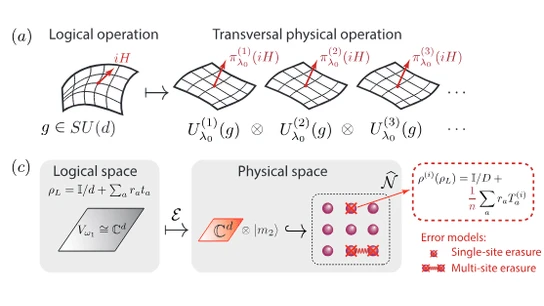
Mariia Elovenkova, Hong-Ye Hu, and Susanne F. Yelin, physicists at Harvard University, showed that this mathematical barrier can be circumvented by accepting a controlled error.1 In a theoretical preprint posted to the arXiv server, the researchers constructed explicit approximate quantum error-correcting codes that respect continuous non-Abelian symmetries while spreading logical information evenly across physical particles.1 By relaxing the demand for exact error correction to approximate error correction, the Harvard authors constructed codes that preserve continuous symmetries and protect against the loss of physical components.
Why do continuous symmetries clash with exact quantum codes?
Continuous symmetries clash with exact quantum error correction because the mathematical conditions required to eliminate local errors leave no room for continuous logical rotations.1 In standard error correction, the subspace that stores the protected information must be completely decoupled from any local probe. If an experimenter or the environment looks at a single physical component, the reduced physical state of that component must reveal zero information about the stored logical state. The Eastin-Knill theorem proves that if a code perfectly satisfies this condition for every local error, the group of logical transformations that can be executed by separate operations on each physical site is strictly restricted to a discrete set.1
To overcome this limitation, researchers study approximate quantum error-correcting codes, a general class of encodings where the error is not set to zero but instead shrinks systematically as more physical particles are added to the system. In their preprint, Elovenkova, Hu, and Yelin focused on special unitary symmetries, denoted mathematically as SU(d), which describe the continuous physical rotations of d-level quantum systems known as qudits.1 The authors showed that the conflict identified by the Eastin-Knill theorem can be managed if the code guarantees that the information leaked to any lost particle diminishes rapidly as the size of the processor grows.1
The practical goal of this work is to establish a systematic design principle for analog quantum processors. In digital computing, fault tolerance relies on active syndrome measurements and feed-forward operations that require massive hardware overhead. If analog quantum simulators can instead protect continuous dynamics robustly through the intrinsic symmetry of their encoding, they could run long, stable simulations of condensed matter systems and quantum field theories without needing full digital error correction architectures.
Beyond computational hardware, covariant approximate quantum error-correcting codes model fundamental questions across physics.1 They describe how quantum systems protect information carrying conserved physical symmetry charges, connect to quantum metrology where reference frames must maintain rotational orientation, and appear in toy models of quantum gravity where holographic boundaries reconstruct gravitational fields with approximate global symmetries.12
How does permutation symmetry distribute quantum information?
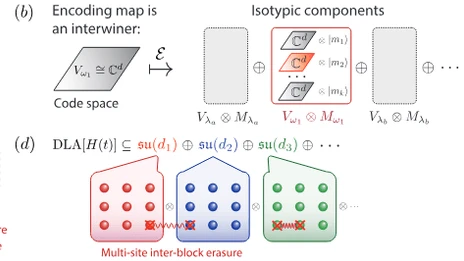
Permutation symmetry distributes quantum information by treating every physical component identically, ensuring that no individual site carries a privileged share of the encoded state. The Harvard team designed an encoding map that embeds a d-dimensional logical state into a larger physical space composed of n physical qudits.1 Because the continuous symmetry dictates how the global system transforms under rotations, it restricts the code to specific mathematical sectors called isotypic components.1 Within the allowed sector, there are multiple identical copies of the logical representation, leaving open the choice of which specific copy to use for the code.1
Elovenkova, Hu, and Yelin resolved this choice by enforcing permutation invariance across the physical qudits.1 By selecting a code space that remains invariant when physical sites are swapped, the researchers forced the logical information to be distributed across all n physical components. When an observer examines a single erased qudit, the reduced state seen by the environment consists of a completely random, maximally mixed state plus a small residual piece that depends on the logical information.1 The authors proved that this informative piece is suppressed by a factor of 1/n, meaning that as the total number of physical particles n increases, the environment learns almost nothing about the encoded data.1
Clarifying the physical mechanism behind this decay, Susanne explained in response to questions from Primary that the suppression does not eliminate underlying correlations across the processor. Susanne said, "The 1/n factor comes simply from distributing one unit of logical information evenly over n physical units; entanglement is what allows those units together to retain a complete quantum state." Susanne noted that covariance fixes the total amount of logical charge carried by the physical sites while permutation symmetry forces every site to carry the same share, adding that "the logical information becomes sufficiently nonlocal that no single subsystem contains more than an O(1/n) signature of it."
For single-qudit erasure at a known location, the researchers proved that the worst-case purified distance between the ideal logical channel and the recovered channel scales as O(1/n), matching theoretical lower bounds established in earlier approximate error correction literature up to constant factors.1 For the basic case of encoding a single two-level qubit into n physical spins, each carrying spin quantum number j, the paper established that the recovery error bound under single-spin erasure scales as 3 divided by 4 times the square root of 2j(j + 1), multiplied by 1/n, plus higher-order corrections in 1/n.1 Susanne told Primary that "the factor 3 ultimately reflects the three generators of SU(2), while j(j+1) is the quadratic Casimir of the physical spin representation." The authors also constructed an explicit near-optimal decoding procedure based on the Petz recovery map, an established mathematical tool for reversing quantum noise channels.1
When multiple physical particles are lost, exact permutation symmetry continues to protect the system up to a strict limit. The paper showed that for one-, two-, and three-qudit erasures at known locations, the worst-case purified distance maintains the same O(1/n) scaling.1 However, exact permutation symmetry cannot equalize all reduced states once more than three particles are erased, because there is no geometric permutation that can map every arbitrary set of four or more sites onto any other set.1 Susanne pointed out that "the deterministic construction requires a suitable k-transitive permutation subgroup under which a nontrivial covariant code can be invariant," which fails once k exceeds three because the classification of multiply transitive permutation groups restricts such symmetries to isolated system sizes.
To handle an arbitrary fixed number k of erased sites, the authors analyzed randomized encodings and showed that both Haar-random encodings and encodings generated from efficient short seeds achieve a worst-case purified distance scaling as O(sqrt(k)/n) with a probability exponentially close to one as the system size n grows.13 Susanne stated that "three erased sites are not a physical limit; three is simply where, in our construction, we don't have enough degrees of freedom; approximate randomized constructions allow us to go further."
What does this theoretical framework leave unresolved?
The theoretical framework leaves open several practical questions regarding experimental implementation and physical noise models. The primary mathematical guarantees derived in the preprint apply to flagged erasures, which are idealized scenarios where the hardware precisely detects which physical qudits have gone missing or suffered an error.1 When the authors extended their reduced-state analysis to general flagged local noise, their proof technique yielded a weaker error scaling of O(1/sqrt(n)) for single-site noise, reflecting the mathematical challenge of bounding arbitrary local noise channels via general trace-norm estimates.
Addressing this mathematical gap, Susanne explained that the weaker bound applies to arbitrary local noise acting on known, flagged locations rather than unflagged channels. Susanne noted that the authors suspect "the 1/sqrt(n) scaling may be an artifact of the proof rather than a fundamental physical penalty." Because the informative part of the local reduced state remains suppressed by 1/n, the drop in scaling occurs because a general trace-norm estimate loses a square root compared to direct fidelity calculations. Susanne said that "no proof better than 1/sqrt(n) exists to date for a general noise model," leaving the determination of sharp bounds as an open theoretical question.
The results describe asymptotic performance bounds and mathematical channel distances rather than experimental runtimes on existing laboratory platforms. Like any theoretical quantum coding analysis, the findings assume that the dominant noise source acts locally on individual subsystems and that the physical controls can implement global collective generators without introducing large correlated calibration drifts.1 The preprint was posted to the arXiv preprint server and has not yet undergone peer review.
Susanne clarified that the theoretical model explicitly includes an intrinsic drift Hamiltonian alongside time-dependent controls. When asked about experimental hazards, Susanne said, "The most dangerous imperfections would be correlated errors that affect multiple sites and, potentially, multiple times." Susanne added that uncontrolled symmetry breaking, such as spatial inhomogeneity across collective controls, represents a major concern because it can drive quantum states outside the protected algebra, though establishing exact laboratory tolerance thresholds remains an ongoing research goal.
How can these codes support universal analog simulation?
These codes support analog simulation by allowing the physically accessible Hamiltonians to act directly across the encoded blocks without decoding the quantum state. In an analog simulator, the set of reachable physical operations is determined by its dynamical Lie algebra, which is the algebraic closure of the system drift and control Hamiltonians. The Harvard authors showed that when the target simulation respects the underlying symmetry, the required interactions can be executed transversally, preserving the code space, meaning the simulator applies identical physical operations across its constituent qudits in parallel.1
To enable universal computation, where an analog device must reach states outside a single symmetry sector, the authors proposed using controlled symmetry-breaking Hamiltonians as non-transversal resources.1 In this architecture, the bulk of the continuous simulation remains protected within the symmetric code space, while weak or modulated symmetry-breaking interactions are introduced selectively to drive transitions between different sectors. The authors demonstrated that the 1/n error suppression persists even when multi-site erasures affect qudits located in different encoded blocks.1
Regarding the degree of protection during these non-transversal steps, Susanne said in response to questions from Primary that "we have not yet proved that the 1/n protection survives while the non-transversal symmetry-breaking operations are running; protecting those necessary steps remains an open problem." Susanne explained that while the symmetry-preserving dynamics remain transversal and protected, symmetry-breaking operations can disturb the protection, concluding that developing fault-tolerant implementations for these resource operations is a key step for future work.
These mathematical constructions provide a concrete bridge between symmetries and robust quantum hardware. By showing how approximate error correction accommodates the Eastin-Knill theorem, the research outlines a practical path toward building resilient analog quantum simulators for complex physics.
The record
30 sentences trace to 3 sources and 1 contributor.
-
1
ME
 Mariia Elovenkova, Hong-Ye Hu, Susanne F. Yelin
Paper
· arxiv.org · 2 Sep 2026
Covariant Approximate Quantum Codes for Protected Analog Computation
Preprint · may not have been peer reviewed
See the source
- 2 New perspectives on covariant quantum error correction See the source
-
3
A
arxiv.org
Paper
· arxiv.org
Covariant Approximate Quantum Codes for Protected Analog Computation
Preprint · may not have been peer reviewed
See the source
- 4 Contribution — Susanne 2 statements added to this article
Other consulted pages5 pages
errorcorrectionzoo.org1 page
journals.aps.org1 page
Article history
-
Published 2 Nov 2026, 20:53Assembled by the Primary desk from 3 sources · 1 contributor · 30 cited sentences
-
Susanne
- Go to the sentence: Susanne stated that "three erased sites are not a physical limit; three is simply where, in our construction, we don't have enough degrees of freedom; approximate randomized constructions allow us to go further."
- Go to the sentence: Susanne said, "The most dangerous imperfections would be correlated errors that affect multiple sites and, potentially, multiple times."