Ancient animal droppings helped drive the Cambrian explosion of life
Sinking parcels of organic waste carried vital carbon and minerals to the seafloor, opening dark ocean depths to an array of new burrowers and predators.
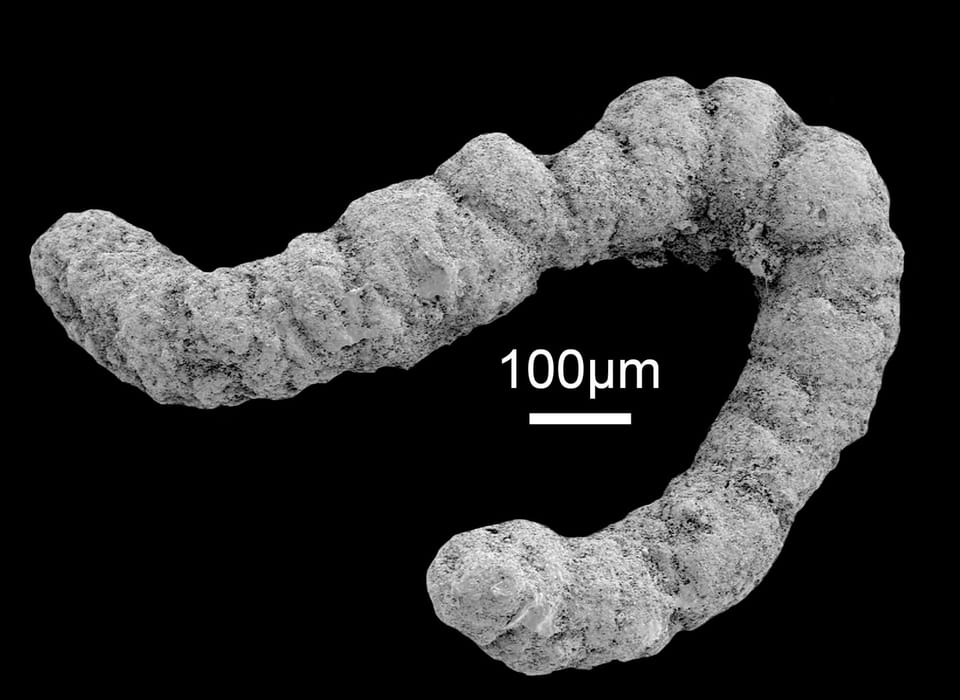
Before animals developed internal digestive tracts, the deep ocean remained an ecological desert.1 Simple creatures inhabited the sunlit shallows, soaking in nutrients across their soft outer tissues or sweeping microscopic particles into a single bodily opening.12 Because these organisms possessed no specialized internal digestive cavities, their metabolic byproducts exited as loose chemical waste that remained suspended in the surface waters.13 The vast expanse of the seafloor below had almost no steady supply of organic matter to sustain complex animal communities.1
For life to conquer the sea floor, energy had to travel downward against the natural tendency of organic matter to dissolve.23 The chain of events required animals to ingest whole morsels of food, extract what they could inside an internal chamber, and compress the indigestible remnants into dense solids.13 Unlike diffuse chemical waste, compacted pellets had enough mass to sink through the water column before bacterial decay could break them apart.23 When those parcels settled into the bottom mud, they delivered packets of concentrated energy and minerals to the sediment.13 That newly enriched seafloor mud created a niche for burrowing scavengers, whose tunnels aerated the substrate and made room for larger hunting animals to follow.32
A systematic review published in the journal Trends in Ecology & Evolution suggests that the arrival of this biological transport mechanism helped fuel the explosive diversification of animal life.23 Paleontologist Julien Kimmig of the Staatliches Museum für Naturkunde Karlsruhe and the Karlsruhe Institute of Technology, alongside paleobiologist Russell Bicknell of Flinders University in Australia, synthesized evidence from fossil deposits around the world to trace the co-evolution of animal guts and ancient waste.241 Their synthesis argues that the emergence of solid droppings initiated the ocean's first biological pump, pulling carbon and nutrients down to depth and unlocking ecological habitats that had previously lacked sufficient energy.12
The transition carries immense weight for understanding why complex body plans proliferated so rapidly during the Cambrian radiation.21 Explanations for that evolutionary burst have long focused on abiotic catalysts, such as rising levels of dissolved oxygen or shifts in seawater chemistry, together with the rise of armed predators.23 Yet physical conditions alone cannot explain how energy moved into deeper water to sustain an expanding web of macroscopic life.13 By examining the biological transport of waste, the researchers identified a self-reinforcing ecological engine that allowed animal life to expand into novel marine territory.13
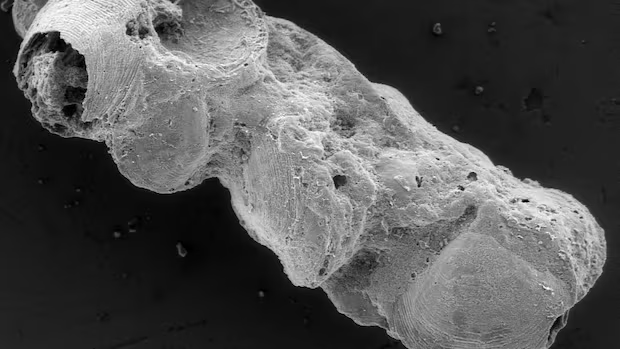
How did early digestive tracts transform the ancient ocean?
Early digestive tracts transformed the ocean by packaging loose metabolic waste into dense, sinking pellets that transported carbon, phosphorus, nitrogen, and iron from sunlit surface waters directly to the seafloor.12 In modern oceans, a similar biological pump continually sweeps surface nutrients into deep waters through falling marine snow and animal feces, supporting entire communities in regions sunlight never touches.12 According to the review by Kimmig and Bicknell, that planetary machinery began operating roughly 540 million years ago, at the boundary between the Ediacaran and Cambrian periods.1 Before that shift, the fossil record yields organisms that lived roughly 600 million years ago, but those early forms lacked a mouth-to-anus through-gut that could manufacture solid pellets.21
Geochemical evidence points to primitive digestive systems in soft-bodied organisms such as Kimberella around 550 million years ago, but true tubular guts visible in the fossil record first appeared in tube-dwelling worms known as Cloudina roughly 545 million years ago.3 Those earliest tracts were simple, straight tubes extending from mouth to anus.31 Over the subsequent 40 million years, animal digestive systems developed complex anatomical loops, specialized foreguts capable of grinding food, and distinct digestive glands that secreted enzymes to break down durable prey.12 These anatomical adaptations enabled organisms to consume larger chunks of nutrition and, as a necessary consequence, produce denser and larger droppings.13
The review notes that the earliest coprolites, which date to the dawn of the Cambrian around 538 million years ago in deposits in China, were microscopic balls made of thin sheets of waste. Over roughly 15 million years, these modest pellets grew into diverse macroscopic structures measuring up to several centimetres across.1 Sinking feces blanketed the sediment, providing a concentrated substrate where bacterial mats flourished.13 Worms and early arthropods burrowed into the seabed to feed on the organic-rich mud, churning sediment in ways that introduced oxygen into previously stagnant layers and created habitable niches for larger carnivores.32
What do fossil droppings reveal about early marine diets?
Fossilised droppings reveal what ancient predators and scavengers actually consumed by preserving intact mineralised remnants, such as shell shards and crushed trilobite exoskeletons, inside compacted waste.21 While fossilized mouthparts and claws indicate what an animal was anatomically capable of catching, coprolites supply direct empirical evidence of what was ingested and digested.2 The authors reviewed coprolite records and fossilized digestive tracts across more than 35 geological deposits worldwide, spanning from 540 million to 494 million years ago.12
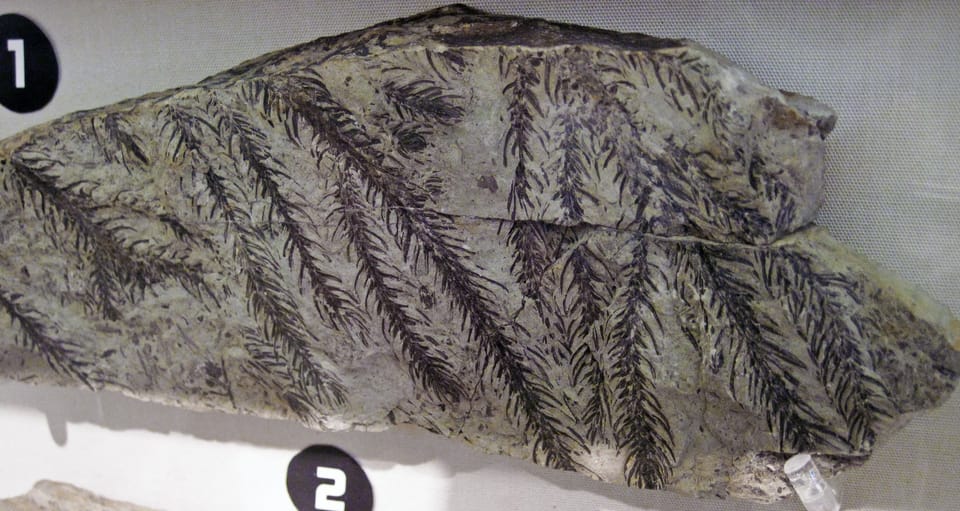
The fossilized waste recorded across those 35 deposits exhibits an astonishing morphological variety that mirrors the expanding anatomical diversity of Cambrian fauna.12 Researchers have documented spherical, cylindrical, and ellipsoid coprolites, as well as flattened, disintegrated spreads known in the paleontological literature as exploded fecal carpets.13 At the Raven's Throat River site in northwestern Canada, 500-million-year-old mudstone preserves coprolites measuring up to 5 centimetres in width alongside fully articulated fossils of trilobites and cone-shelled hyoliths that appear preserved in feeding position.1 Microscopic analysis of coprolites from deposits in Greenland and southwestern China has identified droppings packed with phosphate and tiny shell fragments, confirming that early predators were actively crushing hard-shelled prey and voiding the mineralized debris.2
In several Cambrian formations, including the Spence Shale in Utah and the Chengjiang deposit in China, researchers have uncovered concentric rings of fecal matter encircling deceased animal carcasses.3 These circular accumulations suggest that bottom currents swept drifting organic waste and shelly debris across the seafloor until they caught against resting bodies.3 Such associations show that fecal debris served as an abundant sediment-forming component that actively circulated along the Cambrian ocean floor.3
Where does the evidence reach its limit?
The compiled fossil record demonstrates that complex guts and diverse coprolites appeared alongside one another, but that shared timing cannot establish whether animal waste drove evolutionary diversification or merely resulted from it.2 Because the study is a systematic review synthesizing published literature from more than 35 localities rather than an analysis of newly discovered specimens, it tracks an empirical correlation across geological time without proving a direct causal direction.1 A radiation of larger, more active animals would naturally generate larger, more varied waste products as an incidental byproduct of acquiring more food.1 While the authors propose a positive feedback loop, the fossil record alone cannot prove that feces were the primary engine powering the Cambrian radiation.21
The survival of ancient soft tissues and fossilized feces is also distorted by uneven geological preservation.2 The preservation of guts and organic waste requires exceptional taphonomic conditions, such as rapid burial in fine-grained sediment devoid of destructive oxygen, which are characteristic of Burgess Shale-type deposits.2 These exceptional preservation windows are distributed unevenly through geological time and geographic space across the 35 studied deposits.21 An apparent surge in coprolite diversity 520 million years ago coincides with an abundance of well-preserved fossil beds, such as Sirius Passet in Greenland and Emu Bay in Australia, making it difficult to disentangle genuine evolutionary surges from shifts in fossil preservation.2
Despite these preservation limits, tracking fossilized feces fundamentally reframes how scientists reconstruct ancient trophic networks.2 For researchers mapping early marine ecology, coprolites provide an empirical anchor for food-web models that previously relied almost entirely on body shape and jaw anatomy.2 Understanding how digestive waste first seeded the deep ocean also clarifies how modern biogeochemical cycles originated.23 The fundamental question of why animals originally evolved internal guts and defecation remains an active evolutionary puzzle, but the physical reality of sinking waste undeniably altered the chemistry of the seafloor.32
The record
49 sentences trace to 4 sources.
-
1
AT
 Ars Technica
Third-party reporting
· arstechnica.com · 12 Aug 2026
Did poop enable the evolution of complex animals?
See the source
-
2
S
 scientificinquirer
Document
· scientificinquirer.com · 2 Nov 2026
A Review Argues the Cambrian Explosion Ran Partly on Faeces
See the source
- 3 We Wouldn't Be Here Without Poop | Defector See the source
- 4 Staff Palaeontology See the source