Surrounding tree cover shapes seed diversity in Brazil's Atlantic Forest
A synthesis across 52 forest fragments reveals that nearby tree cover and rainfall govern seed richness far more than the size of an individual wooded patch.
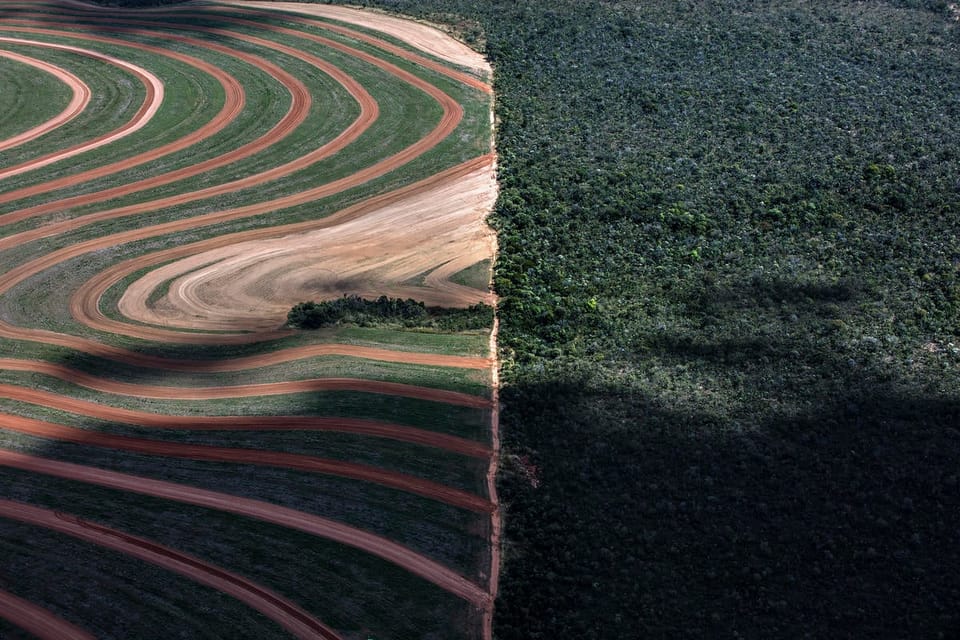
When a tropical forest is cleared for crops or pasture, the surviving woods are left behind as isolated islands in a transformed terrain. The common expectation among land managers has been that the largest surviving islands offer the safest haven for wildlife and the best prospects for forest renewal. In the heavily fragmented Atlantic Forest of Brazil, however, the mix of tree seeds that arrives on the ground does not depend primarily on the physical area of an individual wooded patch.123 Seeds land in rich diversity only when the broader landscape outside the patch retains substantial forest canopy.13
Understanding what governs the arrival of seeds is essential for the future of the biome. Brazil's Atlantic Forest has lost most of its original extent, leaving between 23 and 24 percent of its historical tree cover scattered across thousands of isolated fragments in densely settled regions.12 Forest restoration in this landscape requires knowing which parcels can sustain natural regeneration and which parcels are doomed to stall in an early degraded state. If conservation programs allocate funds to buy or fence off isolated fragments based purely on their acreage, they risk preserving areas that lack the biological traffic needed to sustain diverse plant life.
For a tropical forest to regenerate naturally, a strict sequence of events must occur. Mature canopy trees must first produce fruit that contains viable seeds. Fruit-eating birds and mammals must then consume the fruit and move across the landscape, voiding or dropping the seeds far from the parent plant. When those seeds land beneath the tree canopy or inside newly opened clearings, fast-growing pioneer plants provide the immediate shade and humidity needed for slow-growing hardwood seedlings to take root. If any link in that sequence breaks, the forest cannot replace its oldest canopy species.
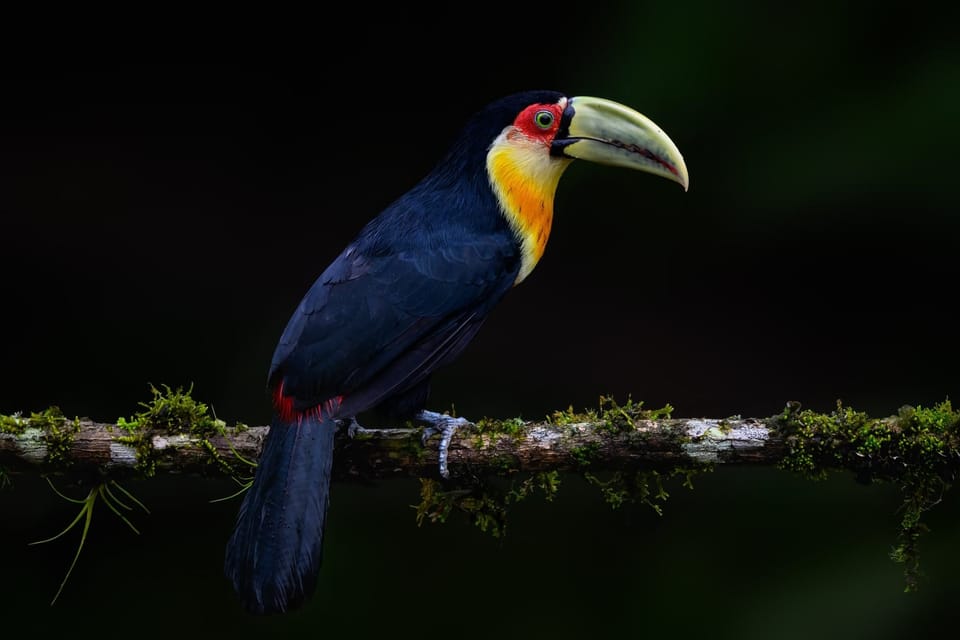
The central barrier in a fragmented countryside is that heavy seeds cannot cross wide farm fields on their own. Hardwood trees that form the forest canopy produce large, fleshy fruits designed to attract sizable fruit-eating animals. When human development isolates a small patch of woods amidst open agricultural land, large monkeys, toucans, and other substantial frugivores vanish from the area. Without those mobile animals moving between wooded patches, the arrival of large seeds halts completely.
A broad synthesis published in the Journal of Ecology shows that the richness of arriving seeds depends primarily on the total tree cover in the surrounding landscape and on regional rainfall, regardless of the individual fragment size.123 Luís Felipe Daibes, a researcher at the Rio de Janeiro Botanical Garden who led the investigation during a postdoctoral fellowship at São Paulo State University's Institute of Biosciences in Rio Claro, assembled the study alongside more than 60 co-authors, including Andre T. Cavassani of The Nature Conservancy.13 The researchers found that wooded patches embedded within a well-forested regional network received a broad spectrum of animal-dispersed tree seeds, whereas isolated patches received an impoverished mix dominated by hardy pioneer species.12
Why does surrounding forest cover matter more than patch size?
Surrounding forest canopy maintains the ecological bridges that fruit-eating animals need to travel across the countryside and disperse seeds.21 When the surrounding landscape contains high tree cover, birds and mammals travel freely between different parcels of woods, carrying seeds from diverse parent trees into fragments of every size. In contrast, an enormous forest patch surrounded by treeless monoculture behaves like a biological prison: animals cannot cross the boundary to import seeds from outside, and plants that lose their local pollinators or seed dispersers cannot easily be replaced.2
The study compiled records from 1,905 seed traps placed across 52 Atlantic Forest fragments that ranged in size from four hectares to several thousand contiguous hectares.12 Across those 52 sites, field teams tallied 1.3 million individual seeds and identified 1,029 plant taxa to at least the botanical family level.123 The compiled fieldwork spanned 34 years from 1987 to 2021, covering a latitudinal spread from 7 degrees South to 29 degrees South that reached from the northeastern corner of Brazil to its southern states.13
The synthesized data demonstrated that the total count of incoming seeds can behave in an unexpected way. Heavily fragmented landscapes often register a higher total volume of fallen seeds than well-connected forests.123 That elevated volume does not indicate a flourishing forest, because the seed rain in fragmented sites consists almost entirely of a few generalist pioneer species producing large numbers of tiny seeds.12 These small seeds travel easily on the wind or on small generalist animals, multiplying rapidly along sunbaked forest edges while large-seeded hardwood species fail to arrive.13
What happens when large seed dispersers disappear?
The loss of large frugivores breaks the natural cycle of forest succession, leaving isolated woods trapped in an indefinite pioneer phase. Pioneer species establish themselves rapidly in open clearings, creating shade and humid soil conditions that protect young plants from direct heat.12 In a healthy forest system, that protective shade allows slow-growing, shade-tolerant canopy trees to germinate and eventually replace the short-lived pioneer cover. When surrounding forest cover is stripped away, the large animals that carry canopy seeds never visit, preventing the second stage of succession from taking place.
Regional moisture levels also dictate which seeds can travel across the landscape. The synthesis revealed that fragments located in wetter climates received a higher proportion of animal-dispersed seeds than fragments situated in dry zones.123 In humid regions, trees invest heavily in succulent fruits that tempt wandering wildlife. In drier or heavily cleared landscapes, natural dispersal shifts toward non-zoochorous seeds moved by wind or gravity, producing a sparse assortment of drought-hardy weeds and shrubs.21
What can historical seed traps reveal about long-term recovery?
The findings describe the initial arrival of plant seeds on the ground, representing the starting potential for forest growth rather than a direct count of surviving trees. Seed traps, which consist of mesh nets or sieves measuring between 20 centimeters and one meter in diameter suspended beneath the forest understory, capture falling plant material over monthly collection cycles.12 A seed that lands in a collector demonstrates that dispersal occurred, but it cannot reveal whether the seed successfully germinates, escapes hungry seed-eating rodents, or survives seasonal dry spells.1
The dataset also combines field investigations conducted across three decades under different local goals, introducing unavoidable variation into trap dimensions and recording intervals.1 A forest fragment monitored in 1989 existed in a landscape configuration that may have changed considerably by 2019, meaning the regional forest cover metrics reflect broad geographic associations rather than a single synchronized snapshot.1 The synthesis was supported by the São Paulo Research Foundation, known as FAPESP, which funded research grants that produced the underlying field records from the 2000s onward.12
How should land managers choose which woods to preserve?
Conservation planners should prioritize preserving clusters of connected forest patches within a five-kilometer radius rather than focusing solely on acquiring the largest single patch available.12 Daibes and his colleagues calculated that when a wooded fragment sits within a five-kilometer landscape maintaining more than 60 percent forest cover, wildlife can exchange seeds reliably between neighboring patches, sustaining overall plant richness.12 For Brazilian environmental agencies designating legal reserves on rural agricultural properties, evaluating tree cover across that five-kilometer neighborhood provides a reliable guide for ensuring long-term botanical diversity.2
The record
25 sentences trace to 3 sources.
-
1
S
 scientificinquirer
Document
· scientificinquirer.com · 3 Nov 2026
For Atlantic Forest Seed Rain, Surrounding Forest Cover Matters More Than Fragment Size
See the source
-
2
E
 eurekalert.org
Third-party reporting
· eurekalert.org
In Atlantic Forest restoration, connection between fragments is more important than fragment size
See the source
- 3 Landscape features predict broad-scale seed rain patterns across fragments of the Brazilian Atlantic Forest See the source