Giant galactic clumps could dissolve into modest star clusters under sharper eyes
Simulations of the Extremely Large Telescope show its first-light camera can resolve distant stellar nurseries down to 20 parsecs, testing whether ancient galactic bulges formed from migrating giants or fragmented clusters.
Ten billion years ago, during the peak era of universal star birth known as cosmic noon, galaxies looked remarkably disorderly compared with the graceful spirals seen in the local universe today. Distant galaxies at redshifts between 2 and 6 were turbulent, thick, and studded with massive, glowing knots of star formation. Astronomers have spent two decades debating whether these colossal knots, conventionally called star-forming clumps, are genuine monolithic titans or optical illusions created by fuzzy telescope vision.
Understanding the true nature of these clumps is central to explaining how modern galaxies assembled their central cores. In prevailing theoretical models, cold gas pours into young galactic disks faster than it can stabilize, causing the disk to fragment under its own gravity through a physical process known as gravitational instability.2 If the resulting clumps are massive, compact, and long-lived, surviving for several hundred million years, friction against the surrounding disk will cause them to migrate inward toward the galactic core, coalescing to build the central stellar bulge.2 If instead these structures are fragile, low-mass groupings that blow apart from stellar winds and supernova explosions within 50 to 100 million years, they disperse before ever reaching the center, leaving galactic bulges to assemble through different mechanisms.2
A study posted to the arXiv preprint server on September 7, 2026, by lead author Matteo Simioni of the National Institute for Astrophysics in Padua and colleagues across Europe, indicates that astronomers will soon resolve this debate without relying on cosmic quirks of nature. Using detailed numerical simulations of the Multi-AO Imaging Camera for Deep Observations, known as MICADO, the researchers demonstrated that the 39-meter Extremely Large Telescope will routinely resolve star-forming clumps down to effective radii of just 20 parsecs in typical, unmagnified galaxies at redshift 2.31.23 The work demonstrates that ground-based adaptive optics can bridge a stubborn observational divide that has split extragalactic astronomy for more than a decade.
Why has measuring distant star clusters proved so contentious?
Existing observatories face a physical trade-off between the magnification of rare cosmic alignments and the statistical reliability of unmagnified galaxies. To discern small physical structures across billions of light-years, astronomers need telescopes with enormous light-gathering apertures, because optical diffraction naturally blurs any image into a central patch known as a point spread function. When observing distant galaxies without external aid, space observatories such as the Hubble Space Telescope and the James Webb Space Telescope are limited by their aperture sizes to resolving structures no smaller than 500 to 1,000 parsecs across at redshift 2.2 At that coarse resolution, multiple independent stellar nurseries blending together inevitably look like a single massive clump containing hundreds of millions of solar masses.2
To peer deeper, researchers have frequently turned to strong gravitational lensing, an effect where the gravitational field of a massive foreground galaxy cluster bends and magnifies the light from a background galaxy like an imperfect glass lens. Gravitational lensing amplifies light and stretches images, enabling astronomers to identify compact star clusters spanning tens of parsecs across.2 Yet strong gravitational lensing is intrinsically rare and introduces significant modeling uncertainties.2 Reconstructing the original shape and brightness of a lensed object requires complex mathematical models of the foreground cluster's dark matter distribution, which can bias measurements. Furthermore, because lensed sightlines inspect small, selective volumes of space, the most massive clumps with stellar masses exceeding one billion solar masses are virtually absent from lensed samples, leaving astronomers uncertain whether such giants actually exist or merely represent unresolved clusters of smaller nuggets.2
Matteo told Primary that the question of where this sub-cluster interpretation breaks down remains unresolved across different environments. "This is still an open question, and it is precisely what we want to explore with MICADO," Matteo said. "By peering into the distant universe at unprecedented spatial scales across a wide range of host galaxy masses and environments in blank fields, we will be able to map exactly where the sub-cluster interpretation holds and where true monolithic structures might exist."
How will a 39-meter mirror slice through atmospheric turbulence?
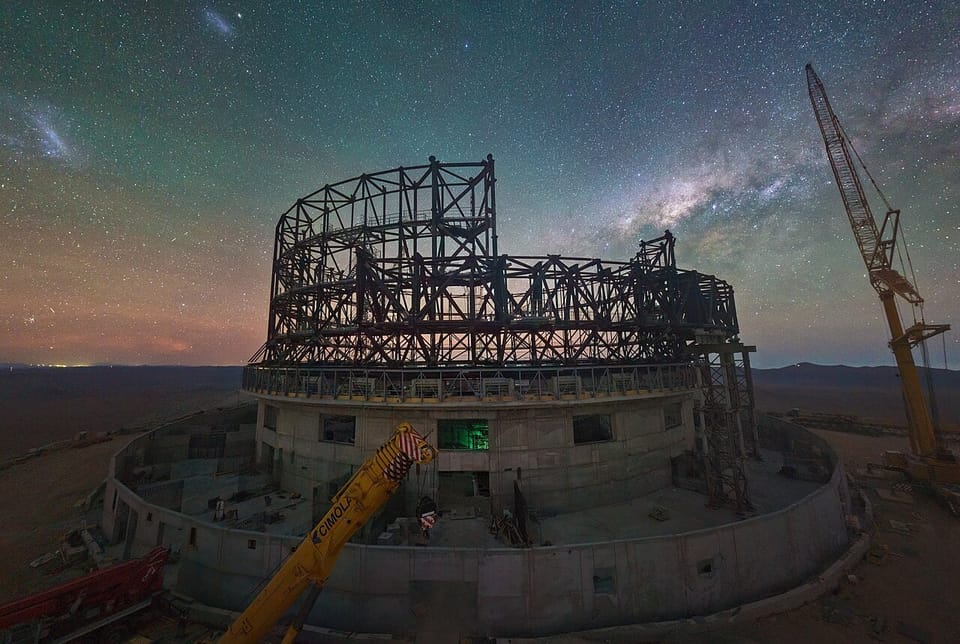
Adaptive optics systems overcome atmospheric blurring by measuring incoming wavefront distortions hundreds of times per second and reshaping flexible mirrors to cancel the turbulence. The European Southern Observatory is currently constructing the Extremely Large Telescope on Cerro Armazones in the Atacama Desert of Chile, featuring a 39-meter primary mirror that will collect more light than any optical telescope in history.42 Working at near-infrared wavelengths between 0.8 and 2.45 micrometers, the telescope's first-light imager, MICADO, will produce images with a core angular resolution of roughly 13 milliarcseconds in the K band, centered near 2.2 micrometers. That angular width is up to 6.5 times sharper than the infrared resolving power achieved by the James Webb Space Telescope.2
Explaining the physical baseline for this comparison, Matteo said the 6.5-fold gain follows directly from aperture dimensions at equivalent wavelengths. As Matteo explained to Primary, the team compared MICADO K-band imaging at 2.2 micrometers against the James Webb Space Telescope NIRCam camera using its F200W filter. While the space telescope achieves a point spread function of roughly 70 milliarcseconds at those wavelengths, the adaptive optics system on the 39-meter mirror delivers a core of around 13 milliarcseconds, matching the ratio between the primary apertures.
To establish how well the instrument will recover clump properties, Simioni and colleagues constructed synthetic observations using an idealized star-forming galaxy located at redshift 2.31, an epoch when the universe was less than three billion years old. The researchers generated 144 unique parameter combinations of clump brightness and physical size using the galaxy-fitting code GALFIT. Clump sizes spanned effective radii from 4 parsecs to 778 parsecs, distributed evenly across 24 logarithmic steps, placed against a uniform background surface brightness of 20 magnitudes per square arcsecond to represent the host galaxy disk. The team simulated two distinct operational configurations: an initial first-light stage relying on single-conjugate adaptive optics, which uses a single natural guide star, and a subsequent upgrade using multiconjugate adaptive optics with the MORFEO relay system, which deploys multiple guide stars to correct atmospheric turbulence uniformly across a wider patch of sky.
Each synthetic clump was converted into simulated detector images using the SimCADO package, accounting for instrument throughput, detector read noise, background sky glow, and realistic optical point spread functions.2 The researchers simulated each parameter combination 120 times to ensure statistical reliability.2 They evaluated observations in both the broad K band and a narrow-band filter centered on the Brackett-gamma spectral line, an infrared hydrogen transition at 2.166 micrometers that traces rest-frame hydrogen-alpha emission from active star formation at redshift 2.31.2
What can the simulated telescope see in ordinary galaxies?
Simulated observations show that MICADO will reliably detect and measure clumps down to effective radii of approximately 20 parsecs in unmagnified galaxies under optimal adaptive optics conditions.2 In the multiconjugate adaptive optics mode, which achieves a Strehl ratio of 61 percent in the K band by concentrating light tightly into the central diffraction core, the instrument recovered clumps with absolute ultraviolet rest-frame magnitudes as faint as negative 15. That brightness corresponds to modest, youthful stellar clusters rather than enormous galactic sub-components. Even under conservative first-light conditions, operating 30 arcseconds away from a natural guide star where single-conjugate performance yields a Strehl ratio of 12 percent, the instrument successfully characterized clumps down to an absolute ultraviolet magnitude of negative 16.8 across the same size range.
Matteo told Primary that the 20-parsec boundary represents the threshold where telescope optics can distinguish extended objects from point sources. At redshift 2.3, a physical scale of 20 parsecs spans approximately 2.3 milliarcseconds on the sky. When the shape of the point spread function is modelled with high precision, an extended 20-parsec clump can be separated from an unresolved point, whereas smaller structures become mathematically indistinguishable from point sources.
Addressing the difference between adaptive optics modes, Matteo noted that moving from multiconjugate to single-conjugate correction produces a shift in overall sensitivity without degrading the spatial resolution limit. The lower Strehl ratio scales the sensitivity threshold up by almost two magnitudes, but the instrument reliably recovers clumps down to 20 parsecs without size-dependent artefacts, provided the point spread function is accurately known.
The narrow-band simulations demonstrated that combining the Brackett-gamma filter with broad K-band continuum imaging allows astronomers to isolate hydrogen-alpha line emission without contamination.2 Matteo explained that star-forming clumps exhibit bright, narrow hydrogen-alpha emission lines whose luminosity traces ongoing stellar birth. In broad K-band imaging, light from this narrow spectral line is diluted across a 400-nanometer window dominated by host galaxy starlight. By pairing the broad filter with a 30-nanometer narrow-band filter, astronomers isolate the emission line and subtract the underlying continuum starlight, creating a clean map of ionized hydrogen gas.
Furthermore, because MICADO possesses a field of view of approximately 50.5 by 50.5 arcseconds, observers can capture entire unmagnified galaxies and multiple targets simultaneously, bypassing the narrow spatial constraints and field distortions that plague gravitational lensing surveys.3
What limits the certainty of these numerical projections?
These findings represent synthetic computer projections rather than empirical measurements of real astronomical bodies. The numerical models assumed circular, two-dimensional Gaussian light profiles superimposed on smooth, uniform galactic backgrounds, omitting the complicated dust lanes, spiral filaments, and severe crowding effects encountered in genuine high-redshift galaxies. In crowded star-forming regions, overlapping halos from neighboring clumps can introduce photometric errors and complicate size measurements.
The accuracy of future physical measurements will also depend heavily on telescope telemetry and mathematical reconstruction of the point spread function. In adaptive optics observations, the shape of the blurred stellar profile varies across the field and shifts rapidly with changing atmospheric temperatures and wind patterns. Because isolated foreground stars suitable for empirical calibration are rare in high-redshift extragalactic survey fields, astronomers must rely on automated algorithms reconstructing the optical profile from adaptive optics telemetry data.2 The authors noted that small systematic errors in point spread function reconstruction will directly affect size derivations, especially for compact targets smaller than 40 parsecs.2
Matteo told Primary that telemetry-based reconstruction proved sufficiently accurate in simulated tests to prevent severe systematic errors. At redshift 2, a 40-parsec clump spans roughly two-thirds of the K-band point spread function core, meaning size derivation relies entirely on profile fitting. In conservative off-axis simulations, the reconstructed template recovered the effective radius of a 40-parsec clump with an error of only a few parsecs, roughly a 10 percent error in size, and its brightness to within 0.1 magnitudes.
The analysis is based on a preprint accepted for publication in the Monthly Notices of the Royal Astronomical Society but posted to arXiv prior to formal peer-reviewed volume release. Final on-sky performance will depend on hardware completion and the real atmospheric behavior above Cerro Armazones.
What happens as hardware moves toward the mountain?
Astronomers anticipate that resolving unmagnified clumps will settle longstanding theoretical questions regarding the lifetime of disk substructures. If future observations confirm that giant kiloparsec clumps dissolve into tight groupings of 20-parsec clusters, theoretical models of disk instability will require adjustment.
Matteo said that demonstrating giant clumps are composed of small sub-units would fundamentally challenge the inward migration hypothesis. If MICADO demonstrates that giant kiloparsec-scale clumps are universally composed of sub-clumps, their individual masses of less than a few million solar masses would generate too little dynamical friction against the surrounding gas to pull them toward the galactic core before stellar winds and supernova feedback disperse them.
Hardware development for MICADO is progressing through mechanical integration across European research institutes. The instrument passed its final design review in July 2024 and is currently undergoing component assembly, integration, and testing. In France, the single-conjugate adaptive optics module completed initial closed-loop optical bench testing in 2026, achieving an 88 percent Strehl ratio in laboratory conditions at a wavelength of 1550 nanometers. Current project timelines schedule telescope commissioning for 2030, with standalone operations on the telescope's Nasmyth platform beginning by the end of 2030, followed by the integration of the MORFEO multiconjugate relay around 2033.5
This piece was prepared from the arXiv preprint and public records together with answers from Matteo to seven questions from the Primary news team, completed September 2026.
The record
39 sentences trace to 4 sources and 1 contributor.
- 1 Contribution — Matteo Simioni 25 statements added to this article
-
2
MS
 Matteo Simioni, Carmelo Arcidiacono, Andrea Grazian, Marco Gullieuszik, Elisa Portaluri, Alvio Renzini, Benedetta Vulcani, Anita Zanella, Francesca Annibali, Michele Cirasuolo, Richard Davies, Natasch
Paper
· arxiv.org · 9 Sep 2026
The MICADO first light imager for the ELT: Simulated Observations of Star Forming Clumps at Cosmic Noon
Preprint · may not have been peer reviewed
See the source
- 3 MICADO - Georg-August-Universität Göttingen See the source
- 4 ELT MICADO - Extragalactic Astronomy - LMU Munich See the source
-
5
A
arxiv.org
Paper
· arxiv.org
The MICADO first-light imager for the ELT The SCAO module AIT in France: from the 𝛽 flat configuration towards the flat and final configurations
Preprint · may not have been peer reviewed
See the source
arxiv.org1 page
hal.science1 page
Article history
-
Published 5 Nov 2026, 16:57Assembled by the Primary desk from 4 sources · 1 contributor · 39 cited sentences
-
Matteo Simioni, lead author
- Go to the sentence: Astronomers have spent two decades debating whether these colossal knots, conventionally called star-forming clumps, are genuine monolithic titans or optical illusions created by fuzzy telescope vision.
- Go to the sentence: If the resulting clumps are massive, compact, and long-lived, surviving for several hundred million years, friction against the surrounding disk will cause them to migrate inward toward the galactic core, coalescing to build the central stellar bulge.
- Go to the sentence: Furthermore, because lensed sightlines inspect small, selective volumes of space, the most massive clumps with stellar masses exceeding one billion solar masses are virtually absent from lensed samples, leaving astronomers uncertain whether such giants actually exist or merely represent unresolved clusters of smaller nuggets.
- Go to the sentence: "This is still an open question, and it is precisely what we want to explore with MICADO," Matteo said.
- Go to the sentence: "By peering into the distant universe at unprecedented spatial scales across a wide range of host galaxy masses and environments in blank fields, we will be able to map exactly where the sub-cluster interpretation holds and where true monolithic structures might exist."
- Go to the sentence: That angular width is up to 6.5 times sharper than the infrared resolving power achieved by the James Webb Space Telescope.
- Go to the sentence: As Matteo explained to Primary, the team compared MICADO K-band imaging at 2.2 micrometers against the James Webb Space Telescope NIRCam camera using its F200W filter.
- Go to the sentence: While the space telescope achieves a point spread function of roughly 70 milliarcseconds at those wavelengths, the adaptive optics system on the 39-meter mirror delivers a core of around 13 milliarcseconds, matching the ratio between the primary apertures.
- Go to the sentence: Simulated observations show that MICADO will reliably detect and measure clumps down to effective radii of approximately 20 parsecs in unmagnified galaxies under optimal adaptive optics conditions.
- Go to the sentence: In the multiconjugate adaptive optics mode, which achieves a Strehl ratio of 61 percent in the K band by concentrating light tightly into the central diffraction core, the instrument recovered clumps with absolute ultraviolet rest-frame magnitudes as faint as negative 15.
- Go to the sentence: Matteo told Primary that the 20-parsec boundary represents the threshold where telescope optics can distinguish extended objects from point sources.
- Go to the sentence: At redshift 2.3, a physical scale of 20 parsecs spans approximately 2.3 milliarcseconds on the sky.
- Go to the sentence: When the shape of the point spread function is modelled with high precision, an extended 20-parsec clump can be separated from an unresolved point, whereas smaller structures become mathematically indistinguishable from point sources.
- Go to the sentence: Addressing the difference between adaptive optics modes, Matteo noted that moving from multiconjugate to single-conjugate correction produces a shift in overall sensitivity without degrading the spatial resolution limit.
- Go to the sentence: The lower Strehl ratio scales the sensitivity threshold up by almost two magnitudes, but the instrument reliably recovers clumps down to 20 parsecs without size-dependent artefacts, provided the point spread function is accurately known.
- Go to the sentence: The narrow-band simulations demonstrated that combining the Brackett-gamma filter with broad K-band continuum imaging allows astronomers to isolate hydrogen-alpha line emission without contamination.
- Go to the sentence: Matteo explained that star-forming clumps exhibit bright, narrow hydrogen-alpha emission lines whose luminosity traces ongoing stellar birth.
- Go to the sentence: In broad K-band imaging, light from this narrow spectral line is diluted across a 400-nanometer window dominated by host galaxy starlight.
- Go to the sentence: By pairing the broad filter with a 30-nanometer narrow-band filter, astronomers isolate the emission line and subtract the underlying continuum starlight, creating a clean map of ionized hydrogen gas.
- Go to the sentence: The authors noted that small systematic errors in point spread function reconstruction will directly affect size derivations, especially for compact targets smaller than 40 parsecs.
- Go to the sentence: Matteo told Primary that telemetry-based reconstruction proved sufficiently accurate in simulated tests to prevent severe systematic errors.
- Go to the sentence: At redshift 2, a 40-parsec clump spans roughly two-thirds of the K-band point spread function core, meaning size derivation relies entirely on profile fitting.
- Go to the sentence: In conservative off-axis simulations, the reconstructed template recovered the effective radius of a 40-parsec clump with an error of only a few parsecs, roughly a 10 percent error in size, and its brightness to within 0.1 magnitudes.
- Go to the sentence: Matteo said that demonstrating giant clumps are composed of small sub-units would fundamentally challenge the inward migration hypothesis.
- Go to the sentence: If MICADO demonstrates that giant kiloparsec-scale clumps are universally composed of sub-clumps, their individual masses of less than a few million solar masses would generate too little dynamical friction against the surrounding gas to pull them toward the galactic core before stellar winds and supernova feedback disperse them.