Ancient galaxy clusters assembled quiet members much earlier than expected
Astronomers using the James Webb Space Telescope have discovered 11 quiescent galaxy candidates crowding a dense protocluster core 1.4 billion years after the Big Bang.
When astronomers look across the modern universe, the largest structures they see are galaxy clusters: gargantuan swarms of hundreds or thousands of galaxies bound together by gravity and suspended in clouds of superheated gas. The galaxies crowding the centres of these modern clusters are remarkably uniform. They are predominantly massive, elliptical systems made up of ancient, red stars, with almost no cold gas left to build new suns. For decades, astronomers have sought to understand when and how these giant cosmic cities formed, and why their central populations gave up star formation so early in cosmic history.
The standard picture of galaxy growth suggests that young galaxies spend their youth as gas-rich systems that vigorously form stars. Over billions of years, as gravity pulls them together into dense clusters, their gas gets stripped away, consumed, or heated by erupting supermassive black holes at their cores. Eventually, the galaxies run out of fuel, their star formation quenches, and their bright, blue, short-lived stars die off, leaving behind a fading embers glow dominated by older, red stars. Finding the initial epoch when this transformation takes place requires peering back into the first few billion years after the Big Bang, searching for protoclusters, the infant gravitational seeds destined to collapse into mature clusters.
To transform a turbulent nursery of young stars into a quiet, passive galaxy, a strict chain of astrophysical events must unfold. First, vast streams of primordial gas must fall into a shared gravitational well, cooling and compressing to assemble multiple gas-rich galaxies in close proximity. As these galaxies crowd together, gravitational interactions and collisions compress the cold gas further, igniting violent bursts of star formation. At the same time, central supermassive black holes accrete infalling matter, growing larger and launching powerful winds and jets into the surrounding space. If this energetic feedback heats or expels the remaining reservoir of cold gas, or if the gas is swept clean as galaxies plunge through a hot intracluster medium, star formation halts abruptly. Deprived of new fuel, the galaxy can no longer build massive blue stars, and its overall light gradually shifts toward the red wavelengths emitted by enduring, low-mass stars.
A newly reported discovery indicates that this quenching process was already underway in the infant universe, much earlier than traditional models anticipated. In a preprint posted to the arXiv server on September 21, 2026, an international research team led by Scott C. Chapman of Dalhousie University reported the detection of 11 ultra-red, quiescent-leaning galaxies crowded into the compact core of a massive protocluster designated SPT2349-56.1 The system dates to a redshift of 4.30, a time when the universe was only about 1.4 billion years old.12 While previous observations of this protocluster revealed dozens of violent, dust-obscured starbursts, the newly identified population shows signs of suppressed star formation and substantial stellar mass, demonstrating that distinct evolutionary paths were already branching out within the same crowded environment.1
What makes the SPT2349-56 cluster core unusual?
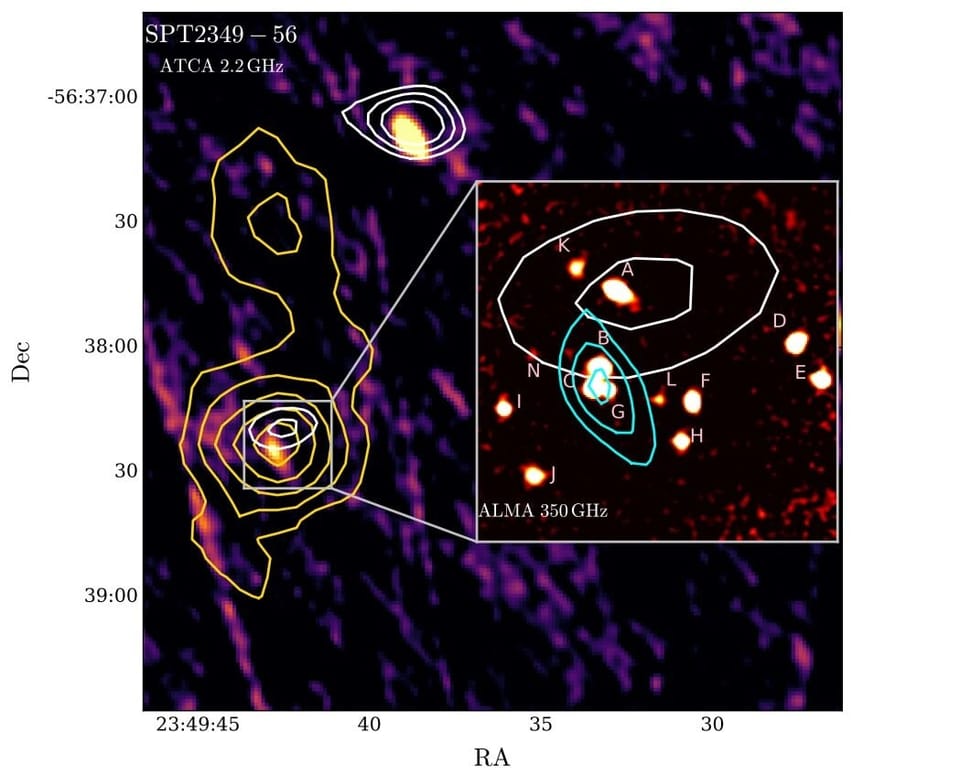
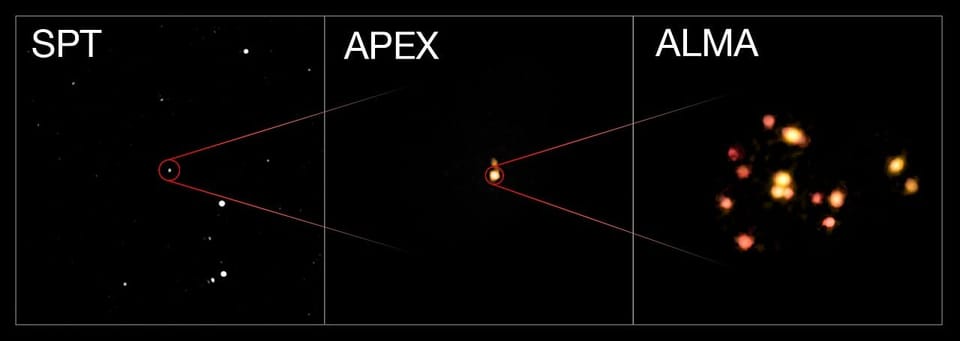
The protocluster SPT2349-56 stands out as one of the most extreme cosmic concentrations ever detected in the high-redshift universe. Originally spotted as an exceptionally bright millimeter-wave source in the South Pole Telescope survey, earlier spectroscopic observations with the Atacama Large Millimeter/submillimeter Array, or ALMA, revealed that its central core contains at least 14 gas-rich submillimeter galaxies packed into a projected diameter of only about 130 kiloparsecs.21 Each of those original galaxies was found to be producing stars between 50 and 1,000 times faster than the Milky Way, producing an aggregate star formation rate exceeding 10,000 solar masses per year within a region comparable to the size of a single modern galaxy halo.21
Subsequent ALMA observations expanded the known membership of SPT2349-56 to 35 galaxies confirmed through carbon-ion spectral line emission, establishing that the core is enveloped by a significant intracluster medium.1 The presence of this hot, diffuse gas was corroborated through the thermal Sunyaev-Zeldovich effect, where cosmic microwave background photons scatter off high-energy electrons within the cluster plasma.1 Such an environment creates fierce conditions for infalling systems: as galaxies barrel through the hot gas, ram pressure strips away their cold reservoirs, while active galactic nuclei powered by supermassive black holes blast energy into their surroundings. Despite this hostile setting, previous optical and infrared surveys failed to find the passive, non-starbursting galaxies expected to arise in such extreme overdensities, largely because the overwhelming submillimeter brightness of the dominant starbursts blinded older infrared instruments.
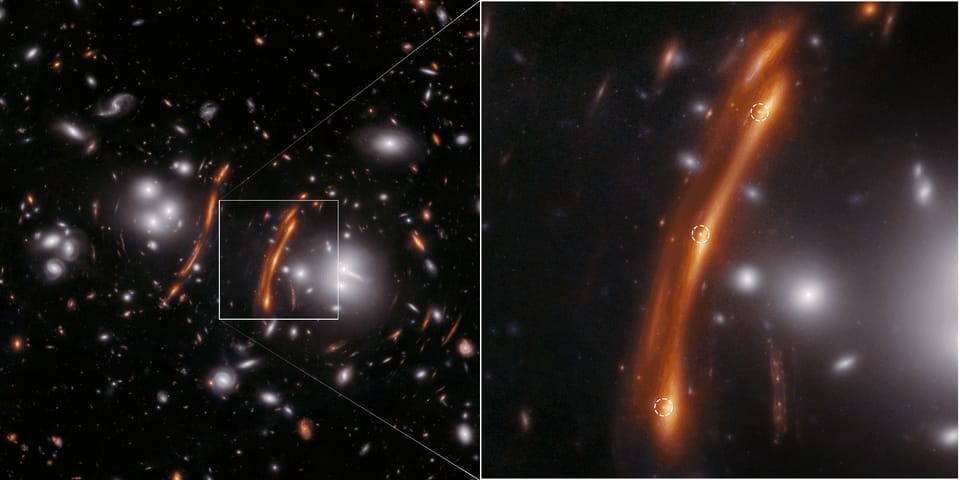
To peer past that glare, Chapman and colleagues turned to the James Webb Space Telescope, employing its Near-Infrared Camera, known as NIRCam, and its Mid-Infrared Instrument, known as MIRI.1 By imaging the protocluster core at near-infrared wavelengths of 2.0 and 4.4 microns alongside mid-infrared bands, the telescope provided the sharp spatial resolution and infrared sensitivity needed to detect faint, deeply reddened stellar systems nestled between the glaring submillimeter monsters.1
How did astronomers identify the red galaxies?
Astronomers identified the new population by searching for objects that appear extraordinarily faint at short wavelengths but surge in brightness at longer infrared bands. The researchers applied a specific color filter, selecting sources where the magnitude difference between 2.0 microns and 4.4 microns exceeded 2.0 magnitudes, paired with stringent brightness and signal-to-noise thresholds. This color criterion was chosen to capture the rest-frame Balmer break, an abrupt drop in stellar light below a wavelength of 364.6 nanometers that serves as a characteristic signature of older stellar populations or heavily dust-reddened systems.
This selection technique yielded 25 red sources across the wider NIRCam field of view, with all 25 residing within the central 0.25 square arcminute protocluster core.1 After cross-matching the candidates against existing submillimeter catalogs, the researchers identified 11 ultra-red galaxies that had never been detected in earlier ALMA observations.1 On average, these 11 systems exhibited a color difference between 2.0 and 4.4 microns of approximately 2.9 magnitudes, placing them among the reddest objects yet cataloged in the early cosmos. Six of these newfound objects form an intensely dense subgroup packed into a tiny sky area measuring just 4 arcseconds by 5 arcseconds adjacent to one of the central starburst galaxies.1
The spatial concentration of these 11 objects makes their physical association with the protocluster overwhelmingly likely. According to the preprint, the number density of these ultra-red systems in the core of SPT2349-56 is at least 2,000 times higher than that of comparable red galaxy populations identified in blank-field extragalactic surveys, such as the COSMOS-Web survey.1 A chance geometric alignment of so many rare, ultra-red objects along a single narrow line of sight is statistically improbable.
Are these red dots or extended galaxies?
The physical nature of these newly discovered systems depends heavily on whether their light is concentrated into a single point or smeared across an extended stellar disc. Recent deep JWST surveys of the early universe have uncovered a ubiquitous but mysterious population known as little red dots, or LRDs, which are extremely compact objects dating to between 800 million and 1.5 billion years after the Big Bang.1 Because little red dots are virtually point-like, astronomers continue to debate whether their extreme red hues originate from dust-obscured stellar envelopes or from powerful radiation generated by feeding supermassive black holes at their cores.
Chapman and colleagues evaluated the compactness of their 11 candidates using a ratio comparing the light within a central radius of 0.2 arcseconds against the total light within 0.5 arcseconds in the 4.4-micron band.1 Scott said this metric was chosen because it was "adopted by empirical experimentation by our colleagues as a good benchmark for separating truly unresolved galaxies from more extended galaxies in JWST NIRCam observing bands." Only one of the 11 sources met the strict mathematical compactness threshold used to classify canonical little red dots.1 The remaining 10 galaxies were visibly resolved by NIRCam, displaying diffuse spatial profiles that categorize them instead as extended red dots, or ERDs.1
Scott noted that while shorter wavelength imaging made the objects appear compact, "the fact that almost all are puffed up a bit in the redder 4.4micron image made it even more tantalizing that environmental processes in the violent core of this protocluster might be transforming the LRD population at this already early epoch." In wide-area field studies such as COSMOS-Web, extended red dots are approximately six times rarer than their point-like cousins, making the concentration of 10 extended systems in SPT2349-56 an extraordinary anomaly.14
Because these extended red dots possess broad envelopes of infrared emission, their light cannot be explained by an unresolved central black hole alone.1 Spectral energy distribution modeling using the CIGALE code revealed that their emission is dominated by substantial populations of stars, accompanied by only modest contributions from obscured active galactic nuclei.1 Furthermore, deep ALMA band-7 dust continuum measurements yielded stringent upper limits on obscured star formation, placing the bulk of the ERD population significantly below the standard star-forming main sequence, which describes the typical relationship between stellar mass and star formation rate in normal growing galaxies.1 Explaining what would falsify this conclusion, Scott told Primary: "if we found warm dust, we would mostly abandon the quiescent interpretation right there."
One system in the sample, cataloged as ERD1 or Q1, proved to be particularly remarkable. It is substantially brighter and more massive than any of the other extended red dots in the protocluster, with an estimated stellar mass of roughly 50 billion solar masses.1 Photometric redshift fitting confirmed that its spectral profile aligns closely with the protocluster redshift of 4.30.1 Because ERD1 lies far below the star-forming main sequence and exhibits a prominent Balmer break, the authors identified it as a prime candidate for a massive galaxy that has already quenched its star formation, shutting down the birth of new stars while the surrounding cluster is still in its infancy.1 However, Scott cautioned Primary about overinterpreting the current photometric data: "We don't actually know there is a strong Balmer break in ERD1 yet, although this is the best fit with our current data."
To explain how star formation could cease in these systems while neighboring galaxies continue to form stars furiously, Scott pointed to three possible physical channels. The first mechanism involves external environmental pre-processing, where the superheated intracluster gas strips away cold gas as infalling galaxies collide with the central high-pressure medium, leaving them without fuel. The second mechanism stems from active galactic nuclei feedback, where powerful radio jets hosted by three of the member starburst galaxies shut down star formation in nearby small galaxies. The third channel involves stellar feedback, either driven by supernova outflows from the surrounding starbursts or resulting from the extended red dots shutting themselves down following an earlier burst of star birth.
What the observations cannot confirm yet
The primary limitation of the study is that none of the 11 newly identified red galaxies have been confirmed through spectroscopic redshift measurements.1 Their association with SPT2349-56 rests on photometric modeling and spatial clustering, meaning the possibility remains that some sources could be foreground or background interlopers. Describing how future work will resolve this uncertainty, Scott said: "JWST can easily detect many spectroscopic or spectro-photometric features that will nail the redshifts precisely at z=4.30 if they are in the protocluster." The team will specifically search for spectral breaks corroborated with strong absorption lines such as Calcium K to settle the membership definitively.
The preprint also notes that earlier space-based observations from the Hubble Space Telescope in the rest-frame ultraviolet were too shallow to detect these deeply dust-reddened or passive systems. The current analysis relies on a two-filter NIRCam selection coupled with mid-infrared imaging from MIRI, meaning that fine details regarding stellar ages and star formation histories cannot be fully untangled without high-resolution spectroscopy. The projections and classifications are best-fit models derived from current photometric bands, not absolute physical determinations.
How early quenching reshapes our view of cosmic history
The discovery of extended red dots alongside ferocious starbursts in SPT2349-56 fundamentally alters how astronomers envision the earliest phases of galaxy cluster assembly. For years, theoretical models assumed that the dense cores of galaxy clusters formed through a relatively leisurely hierarchy, where galaxies grew independently in loose groups before coalescing into massive clusters billions of years later. Under that paradigm, the passive, red-sequence galaxies that dominate modern cluster cores were thought to have quenched their star formation at intermediate cosmic epochs, around two to three billion years after the Big Bang.
The coexistence of 11 ultra-red, star-suppressed galaxies within the same 130-kiloparsec core as 35 intensely starbursting submillimeter galaxies shows that galaxy evolution is far more accelerated and diverse in high-density environments. Dense protocluster cores do not wait for the universe to age before diversifying their populations. Instead, local environment acts as a cosmic catalyst, driving rapid star formation in some members while driving others toward premature retirement. If ERD1 and its companion galaxies represent an early stage in the emergence of passive cluster cores, they demonstrate that massive elliptical galaxies began assembling their mature stellar backbones when the universe was barely a tenth of its present age.
The immediate next step for astronomers will be securing deep spectroscopic observations using JWST's Near-Infrared Spectrograph to measure definitive redshifts for all 11 candidates. Dissecting the detailed spectral absorption lines will reveal the exact ages of their stars and determine precisely how long ago their star formation ceased. At the same time, higher-resolution submillimeter mapping will search for residual pockets of cold molecular gas, clarifying whether these red dots are truly dead or merely resting between starburst episodes.
The record
31 sentences trace to 3 sources and 1 contributor.
-
1
SC
 Scott C. Chapman, Kedar A. Phadke, Nikolaus Sulzenauer, Dazhi Zhou, Hollis Akins, Manuel Aravena, James R. Burgoyne, Caitlin M. Casey, Erin Foley, Ryley Hill, Nicholas LeVar, Monica Natalia Isla Llave
Paper
· arxiv.org · 21 Sep 2026
A large overdensity of LRD-like galaxies discovered by JWST in the SPT2349-56 protocluster at z=4.30
Preprint · may not have been peer reviewed
See the source
-
2
N
 nature.com
Paper
· nature.com
A massive core for a cluster of galaxies at a redshift of 4.3 - Nature
Journal article
See the source
- 3 Contribution — Scott C. Chapman 12 statements added to this article
- 4 COSMOS-web: The Overabundance and Physical Nature of “Little Red Dots”—Implications for Early Galaxy and SMBH Assembly See the source
arxiv.org3 pages
- COSMOS2025: The COSMOS-Web galaxy catalog of photometry, morphology, redshifts, and physical parameters from JWST, HST, and ground-based imaging
- Optical and near-infrared observations of the SPT2349-56 proto-cluster core at z = 4.3
- A large overdensity of LRD-like galaxies discovered by JWST in the SPT2349-56 protocluster at z=4.30
Article history
-
Published 5 Nov 2026, 18:19Assembled by the Primary desk from 3 sources · 1 contributor · 31 cited sentences
-
Scott C. Chapman
- Go to the sentence: While previous observations of this protocluster revealed dozens of violent, dust-obscured starbursts, the newly identified population shows signs of suppressed star formation and substantial stellar mass, demonstrating that distinct evolutionary paths were already branching out within the same crowded environment.
- Go to the sentence: Chapman and colleagues evaluated the compactness of their 11 candidates using a ratio comparing the light within a central radius of 0.2 arcseconds against the total light within 0.5 arcseconds in the 4.4-micron band.
- Go to the sentence: Scott said this metric was chosen because it was "adopted by empirical experimentation by our colleagues as a good benchmark for separating truly unresolved galaxies from more extended galaxies in JWST NIRCam observing bands."
- Go to the sentence: The remaining 10 galaxies were visibly resolved by NIRCam, displaying diffuse spatial profiles that categorize them instead as extended red dots, or ERDs.
- Go to the sentence: Scott noted that while shorter wavelength imaging made the objects appear compact, "the fact that almost all are puffed up a bit in the redder 4.4micron image made it even more tantalizing that environmental processes in the violent core of this protocluster might be transforming the LRD population at this already early epoch."
- Go to the sentence: Furthermore, deep ALMA band-7 dust continuum measurements yielded stringent upper limits on obscured star formation, placing the bulk of the ERD population significantly below the standard star-forming main sequence, which describes the typical relationship between stellar mass and star formation rate in normal growing galaxies.
- Go to the sentence: Explaining what would falsify this conclusion, Scott told Primary: "if we found warm dust, we would mostly abandon the quiescent interpretation right there."
- Go to the sentence: Because ERD1 lies far below the star-forming main sequence and exhibits a prominent Balmer break, the authors identified it as a prime candidate for a massive galaxy that has already quenched its star formation, shutting down the birth of new stars while the surrounding cluster is still in its infancy.
- Go to the sentence: However, Scott cautioned Primary about overinterpreting the current photometric data: "We don't actually know there is a strong Balmer break in ERD1 yet, although this is the best fit with our current data."
- Go to the sentence: To explain how star formation could cease in these systems while neighboring galaxies continue to form stars furiously, Scott pointed to three possible physical channels.
- Go to the sentence: The primary limitation of the study is that none of the 11 newly identified red galaxies have been confirmed through spectroscopic redshift measurements.
- Go to the sentence: Describing how future work will resolve this uncertainty, Scott said: "JWST can easily detect many spectroscopic or spectro-photometric features that will nail the redshifts precisely at z=4.30 if they are in the protocluster."