Sunflowers grow toward the dimmest lamp when caught between bright lights
When opposing lights cancel out, young seedlings turn toward a weaker side beam, revealing how decentralized plant tissues compute growth directions without a central brain.
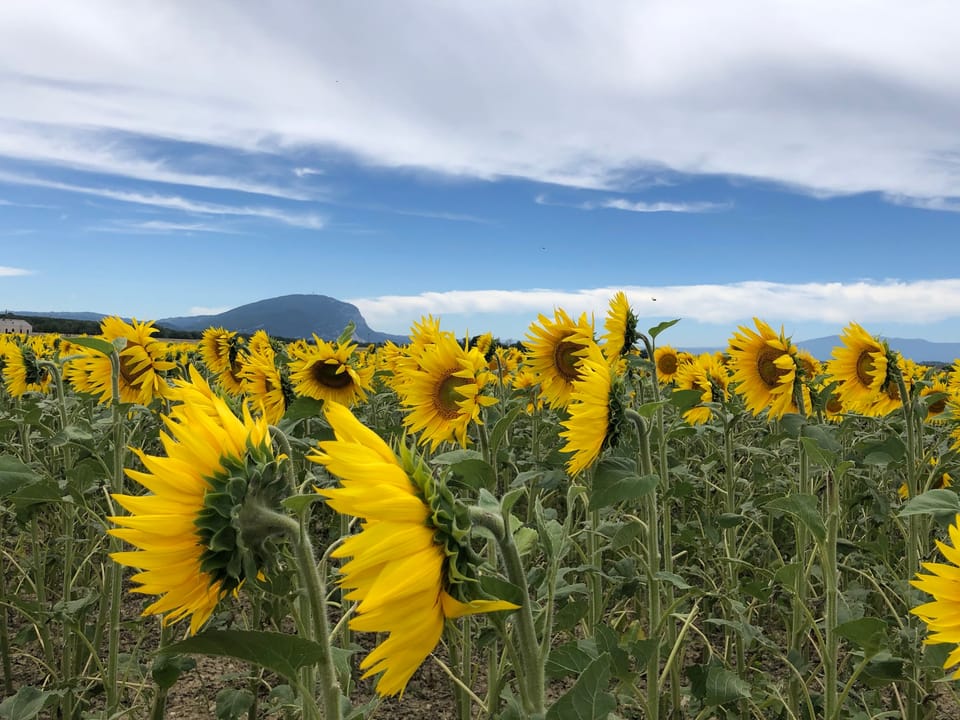
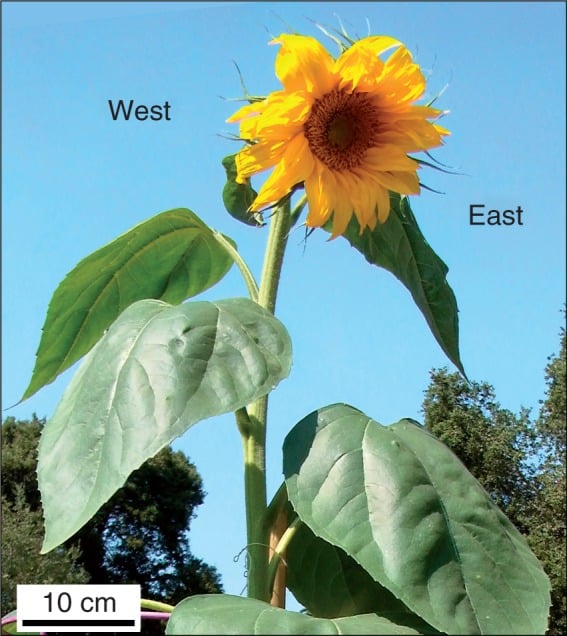
A growing seedling facing multiple directions of illumination does not simply track whichever lamp shines brightest. In everyday conditions, young sunflowers turn their stems toward the sun, orienting their growth so that broad leaves can capture light as it sweeps across the sky.12 When that natural pattern is replaced by conflicting artificial beams, however, the plant behaves in ways that upend ordinary assumptions about how organisms detect and follow energy in their surroundings.
Understanding how a plant steers its shoot matters because vegetation lacks nerves, eyes, or any central information hub. Animals process sensory inputs through brains that weigh different cues and issue muscle commands. Plants solve an equivalent navigational challenge using only local tissue responses. If biological structures made of independent, interconnected cells can evaluate competing sensory signals and settle on a coordinated physical movement, the underlying mechanics could illuminate how other headless living systems, from migrating immune cells to developing nerve fibers, navigate complex surroundings.34
To see how a shoot chooses its direction, consider the basic sequence that governs phototropism, the biological process of directional growth in response to light.32 When illumination strikes one side of a green stem, photoreceptive proteins near the tissue surface absorb those incoming photons.14 That absorption triggers internal biochemical cascades that modify growth rates across the circumference of the stem.13 The shaded flank elongates faster than the illuminated flank, bending the shoot toward the light. If beams arrive from several directions at once, each patch of tissue reacts to what hits it locally, and the physical shape of the curved stem reflects the sum of those local expansions.
A study published in the Proceedings of the National Academy of Sciences reveals that when conflicting light sources are carefully balanced, sunflower seedlings can completely bypass intense illumination to head toward a faint glow.14 When placed between two opposing strong lamps, the plants bend directly toward a third, dim light shining from the side.15 The competing strong signals effectively neutralize one another, allowing the subtle orthogonal cue to direct the entire plant.13
How do seedlings respond to three competing beams?
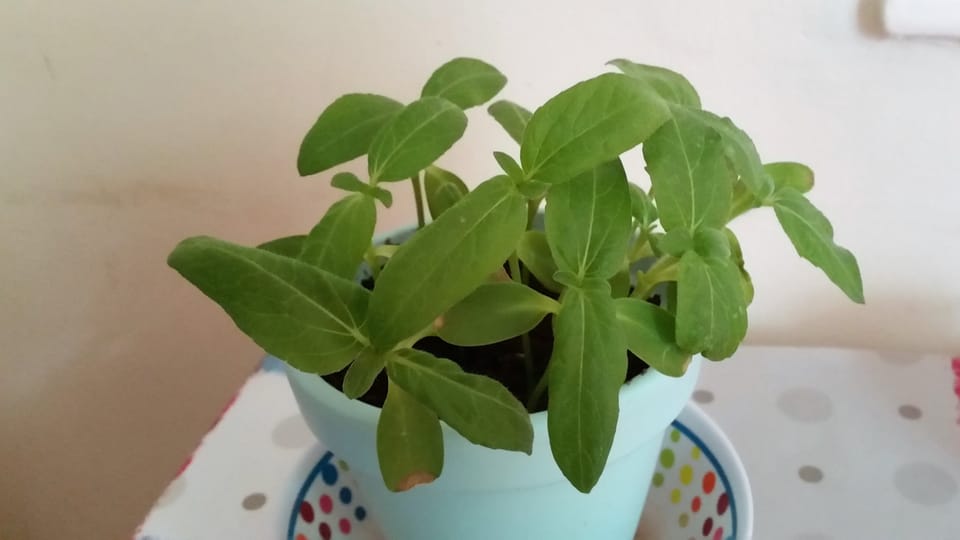
Seedlings placed between two equal opposing lights turn toward the weaker perpendicular light because the two dominant inputs balance each other out.41 A team led by Yasmine Meroz, a professor at Tel Aviv University's School of Plant Sciences and Food Security and the Center for the Physics and Chemistry of Living Systems, tested this behavior using week-old sunflower seedlings (Helianthus annuus) measuring between one and three centimeters tall.413
Working alongside PhD student Aharon Kampinsky, lab alumnus Amir Porat of the University of Cambridge, and Mathieu Rivière of Aix-Marseille Université, the researchers placed the seedlings under controlled blue light-emitting diodes, recording their movements with time-lapse photography over periods lasting at least 20 to 21 hours.314 In an initial baseline setup, the team illuminated the young plants using a single blue lamp.14 The brighter the lamp shone, the further the seedling bent toward it, but the relationship proved distinctly nonlinear: doubling the intensity of the light caused the stem to lean further, but not twice as far.14
The researchers next positioned two lamps on opposite sides of each seedling.14 When one lamp was brighter than the other, the stem bent toward the stronger source, leaning further as the difference in brightness between the two lamps widened.14 To test what happens when conflicting directional cues clash, the scientists then placed two equally bright lamps directly opposite each other, and added a third lamp at a 90-degree right angle that shone at less than half the intensity of either primary lamp.14
Across 34 seedlings tested in this three-way configuration, the stems bent sideways.1 The average growth direction pointed almost exactly toward the dim lamp, despite considerable variation among individual plants.1 Because the two bright lamps stimulated opposing flanks of the stem with identical strength, their growth-altering effects cancelled out.15 That left the faint perpendicular beam as the only unbalanced force guiding the shoot.13
Why does the plant compute growth nonlinearly?
Plants compute their heading through local, nonlinear signal processing that prevents extreme light from overwhelming their sensory tissues.43 In sunflower stems, directional sensing depends on light-absorbing proteins known as phototropins, which sit concentrated near the outer surface of the stem tissue.12 Each local section of the stem detects incoming photons independently, converting physical energy into internal biological instructions.14
Crucially, that conversion behaves nonlinearly, compressing the magnitude of bright inputs so that a light twice as intense generates an internal signal that is less than twice as strong.14 Because the plant does not carry sensory signals to a centralized brain to be pooled before a response begins, the ultimate direction of growth represents the vectorial sum of those locally compressed signals across the stem circumference.34 As Meroz stated, "The computation emerges from the way light is sensed and processed locally across the stem."14 The physical organization of the tissue itself determines how the organism perceives and navigates its environment.45
The researchers captured this decentralized behavior in a physical and geometric model.43 Their calculations show that when light arrives from multiple directions, this nonlinear compression can cause a plant to lean in a direction slightly different from the point of absolute physical maximum illumination, generating a biological effect analogous to an optical illusion.41 The model indicates that a plant's perceived maximum light direction can deviate from the physical reality by up to six degrees.1 In the laboratory experiments, however, the researchers could not directly confirm this six-degree shift, because young sunflower seedlings naturally wobble and trace irregular circles as they grow, masking subtle deviations.14
What are the limits of decentralized sensing?
The mathematical predictions describe steady artificial laboratory conditions rather than the dynamic natural environments where plants evolved.12 In outdoor fields, sunlight does not arrive as fixed, stationary points of narrow blue light from perpendicular angles.12 Instead, outdoor sunlight moves continuously across the sky as a broad, diffuse spectrum spanning ultraviolet, blue, red, and far-red wavelengths.
Earlier work by plant biologists at the University of California, Davis, published in PLOS Biology in 2023, demonstrated that solar tracking in outdoor sunflowers operates differently from indoor phototropic bending.2 While indoor seedlings bend toward blue lights using phototropin-mediated pathways, outdoor plants track the moving sun across the sky even when specific wavelengths such as blue, ultraviolet, red, or far-red light are blocked using shade boxes.2 Outdoor heliotropism relies on multiple light-sensing pathways coordinated by an internal circadian clock, meaning the three-lamp cancellation effect represents a laboratory demonstration of biophysical signal summing rather than a full accounting of how sunflowers operate under an open sky.2
The findings also cannot tell researchers whether the small perceptual distortions predicted by the mathematical model offer any evolutionary advantage, or whether they simply represent an unavoidable consequence of decentralized biological sensing.13 Because the predicted six-degree distortion could not be separated from natural stem swaying, confirming whether plants genuinely experience these directional errors will require higher-resolution tracking or methods that account for background stem movement.15
Even with these limits, the demonstration that opposing signals can cancel out to let a weaker signal guide growth establishes how complex information processing can emerge without neurons. As Meroz observed, this principle of decentralized sensing and signal integration could extend far beyond botany, describing how other headless biological structures, such as moving white blood cells or extending nerve axons, make navigational choices when faced with conflicting guidance cues in their surrounding tissues.43
The record
39 sentences trace to 5 sources.
-
1
TT
 Tudor Tarita
Document
· zmescience.com · 4 Nov 2026
What Happens When You Shine Three Lights on Sunflowers? The Plants Surprisingly Grow Toward the Dimmest One
See the source
-
2
S
 sciencedaily.com
Third-party reporting
· sciencedaily.com
How sunflowers see the sun
See the source
- 3 Perceptual Distortions in Plants: Decoding the Physics of Decentralized Sensing See the source
- 4 Newsroom See the source
- 5 Can Plants Experience Optical Illusions? A New TAU Study Suggests They Can See the source