Chiral atomic arrangements generate powerful optical responses from electric dipoles
Arranging atoms in twisted geometries allows purely electric interactions to mimic magnetic effects, producing sharp polarization-sensitive signals.
Many molecules and microscopic structures possess chirality, a geometric asymmetry meaning they cannot be superimposed on their mirror image, much like left and right hands. When light passes through chiral structures, left-handed and right-handed circularly polarized waves interact differently with the material. In individual atoms and simple atomic vapors, however, these chiroptical responses are exceedingly faint.1 Detecting the optical signature of handedness has historically required sensitive instruments because the underlying physical mechanism relies on a mismatch in interaction strengths.
The subtle nature of this signal matters across chemistry, pharmacology, and quantum optics. Chiral discrimination is vital for identifying molecular enantiomers, which are paired mirror-image molecules that can trigger entirely different biological reactions. In optical science, finding ways to amplify chiral interactions at the atomic scale offers a route to engineer compact quantum devices and polarization-sensitive photonic circuits. Achieving a strong response without requiring complex chemical synthesis has remained a key goal for atomic physicists.
In standard light-matter interactions, a chiral optical signal requires the photons to drive two distinct processes at once: an electric-dipole transition, where light moves electric charges back and forth, and a magnetic-dipole transition, where light interacts with magnetic moments. Because magnetic-dipole transitions are naturally several orders of magnitude weaker than electric ones, the interference between them produces only a very weak differential signal. To create a pronounced chiroptical effect, the interaction must find a way to circumvent this weak magnetic link entirely.
Why is atomic handedness usually so difficult to detect?
Atomic handedness typically produces a minimal signal because individual atoms lack geometric chirality and depend on faint magnetic transitions to register handed light. Marcella L. Xavier, Felipe A. Pinheiro, and Romain Bachelard investigated how this fundamental limitation can be bypassed by organizing atoms into spatial patterns. In research published in Physical Review A in August 2026, the physicists demonstrated that arranging simple atoms in chiral geometric configurations enables a strong collective chiroptical response mediated entirely by electric-dipole interactions.31
Thermal motion in unstructured gases quickly washes out any spatial order. Romain told Primary that the restless motion of the atoms in a vapor naturally prevent the emergence of chiral structures, which is why trapping the atoms in a regular structure, using techniques such as optical tweezers or stationary-wave-based optical arrays is critical to achieving chirality with atoms.
Rather than relying on the weak magnetic response of individual atoms, the collective configuration allows purely electric-dipole couplings between neighboring atoms to generate the chiral asymmetry. This mechanism eliminates the magnetic bottleneck. Related phenomena have been studied in other domains, such as work by David Ayuso and colleagues in Optics Express demonstrating that purely electric-dipole interactions can drive strong chiral responses in high harmonic generation within chiral molecules.4
How can atomic arrangements produce a strong chiral signal?
Atomic arrangements generate strong chiroptical signals when the physical distance between neighboring atoms is smaller than the wavelength of the light probing them. Using a coupled-dipole theoretical framework, Xavier, Pinheiro, and Bachelard identified a distinct physical regime where the chiroptical response becomes pronounced at these subwavelength separations.1 When atoms sit close together, photons scattered by one atom directly influence the neighboring atoms before escaping into free space, coupling the atomic dipoles into a coordinated ensemble.
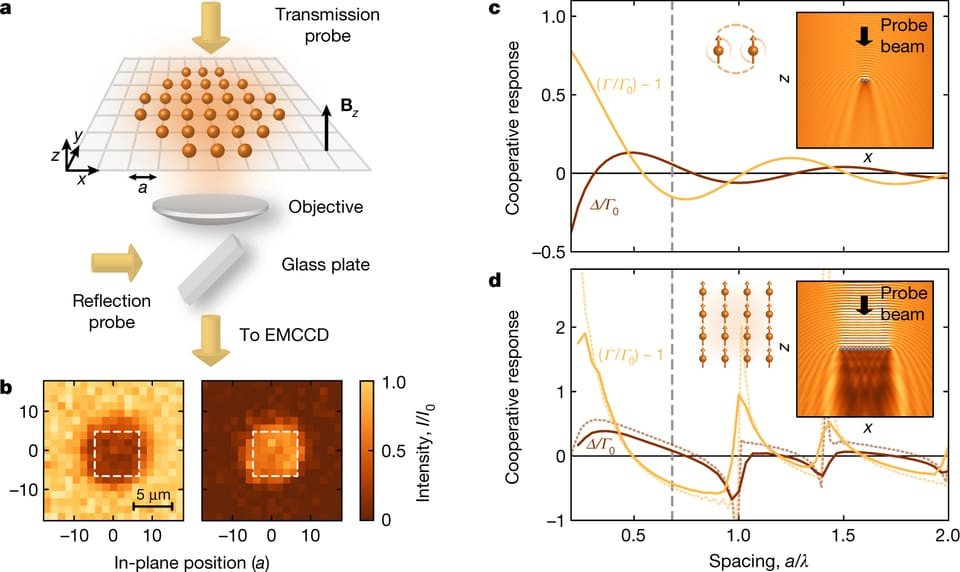
This collective interaction gives rise to subradiant modes, which are shared quantum optical states that trap light and suppress radiation back into the environment. The authors report that the giant enhancement in chiroptical response is directly linked to the formation of these subradiant collective modes.1 Romain explained to Primary that subradiance corresponds to specific configurations of atomic dipoles that prevent spontaneous emission in most directions, adding that different from superradiant modes which present a rather symmetric profile, the asymmetry of subradiant modes promotes chirality.
Furthermore, because these collective modes depend sensitively on the wavelength of the driving field, the strength and character of the chiral response can be tuned simply by shifting the probe light frequency.1 Romain noted that the very strong sensitivity of the handedness of the system to the frequency of the laser drive comes as a surprise since other observables such as the radiated power or excited population are much less sensitive, showing that the chiral nature of such systems depends on the precise balance between underlying collective modes.
The study connects with a broader body of research into cooperative atomic arrays. In Physical Review Letters, researchers K. E. Ballantine and J. Ruostekoski previously showed that collective optical interactions in atomic arrays can synthesize optical responses analogous to magnetic dipoles and multipoles, creating quantum surfaces capable of wavefront engineering.5 The findings from Xavier and colleagues show that spatial structuring also unlocks powerful chiral optical effects from purely electric interactions.
What limits the stability of these collective optical states?
Spatial geometry alone can introduce macroscopic optical properties that do not exist in isolated constituent particles, but maintaining those collective states requires tight positional control. The theoretical results establish a direct connection between spatial geometry and cooperative light-matter coupling, providing a physical mechanism to control polarization-sensitive transmission.1
The physical effect vanishes when the spacing between atoms grows too large. Romain noted that when the interatomic distance becomes comparable with the optical wavelength, near-field coupling between polarization channels drops away, causing the chiral properties to vanish.
These findings remain theoretical projections based on coupled-dipole simulations of idealized atomic configurations. Romain cautioned that the observed sensitivity of circular dichroism to interatomic distances means even minor positional fluctuations in optical tweezer beams could cause strong fluctuations in chiral properties. Romain also pointed out that while chiral properties scale up from four-atom structures to helices containing dozens of atoms, creating large atomic structures with well-controlled positions at subwavelength scales remains a significant experimental challenge.
Looking ahead, the mechanism provides a blueprint for developing chiral quantum optical devices, specialized optical filters, and enhanced sensors for chiral materials. Demonstrating whether these collective states remain stable in real-world atomic traps is the next hurdle for experimental teams testing the boundaries of structured atomic matter.
This piece was prepared from the paper published in Physical Review A and public records together with answers from Romain to six questions from the Primary news team, completed September 2026.
The record
14 sentences trace to 4 sources and 1 contributor.
-
1
ML
 Marcella L. Xavier, Felipe A. Pinheiro, Romain Bachelard
Paper
· arxiv.org · 2 Sep 2026
Strong Collective Chiroptical Response from Electric-Dipole Interactions in Atomic Systems
Preprint · may not have been peer reviewed
See the source
- 2 Contribution — Romain Bachelard 11 statements added to this article
-
3
A
arxiv.org
Paper
· arxiv.org
Quantum Physics Feb 2026
Preprint · may not have been peer reviewed
See the source
-
4
A
arxiv.org
Paper
· arxiv.org
Giant chiro-optical response in high harmonic generation
Preprint · may not have been peer reviewed
See the source
-
5
A
arxiv.org
Paper
· arxiv.org
Optical Magnetism and Huygens' Surfaces in Arrays of Atoms Induced by Cooperative Responses
Preprint · may not have been peer reviewed
See the source
Other consulted pages1 page
ar5iv.labs.arxiv.org1 page
arxiv.org1 page
arxiv.deeppaper.ai1 page
Article history
-
Published 10 Nov 2026, 22:43Assembled by the Primary desk from 4 sources · 1 contributor · 14 cited sentences
-
Romain Bachelard
- Go to the sentence: In individual atoms and simple atomic vapors, however, these chiroptical responses are exceedingly faint.
- Go to the sentence: Romain told Primary that the restless motion of the atoms in a vapor naturally prevent the emergence of chiral structures, which is why trapping the atoms in a regular structure, using techniques such as optical tweezers or stationary-wave-based optical arrays is critical to achieving chirality with atoms.
- Go to the sentence: Using a coupled-dipole theoretical framework, Xavier, Pinheiro, and Bachelard identified a distinct physical regime where the chiroptical response becomes pronounced at these subwavelength separations.
- Go to the sentence: The authors report that the giant enhancement in chiroptical response is directly linked to the formation of these subradiant collective modes.
- Go to the sentence: Romain explained to Primary that subradiance corresponds to specific configurations of atomic dipoles that prevent spontaneous emission in most directions, adding that different from superradiant modes which present a rather symmetric profile, the asymmetry of subradiant modes promotes chirality.
- Go to the sentence: Furthermore, because these collective modes depend sensitively on the wavelength of the driving field, the strength and character of the chiral response can be tuned simply by shifting the probe light frequency.
- Go to the sentence: Romain noted that the very strong sensitivity of the handedness of the system to the frequency of the laser drive comes as a surprise since other observables such as the radiated power or excited population are much less sensitive, showing that the chiral nature of such systems depends on the precise balance between underlying collective modes.
- Go to the sentence: The theoretical results establish a direct connection between spatial geometry and cooperative light-matter coupling, providing a physical mechanism to control polarization-sensitive transmission.
- Go to the sentence: Romain noted that when the interatomic distance becomes comparable with the optical wavelength, near-field coupling between polarization channels drops away, causing the chiral properties to vanish.
- Go to the sentence: Romain cautioned that the observed sensitivity of circular dichroism to interatomic distances means even minor positional fluctuations in optical tweezer beams could cause strong fluctuations in chiral properties.
- Go to the sentence: Romain also pointed out that while chiral properties scale up from four-atom structures to helices containing dozens of atoms, creating large atomic structures with well-controlled positions at subwavelength scales remains a significant experimental challenge.