Electric charge alters the shadows cast by hypothetical galactic wormholes
Simulations show that electrostatic charge combined with dark matter halos changes the silhouettes of theoretical spacetime tunnels, offering distinct visual signatures for event-horizon telescopes.
A celestial object that swallows light does not always have to be a black hole with an inescapable trapdoor. For decades, general relativity has permitted an alternative geometry in the form of a traversable wormhole, a theoretical tunnel through spacetime connecting two separate regions of the universe. If such a structure existed inside a galaxy, it would bend passing starlight and gather surrounding glowing gas into a bright ring surrounding a dark central silhouette, closely mimicking the shadow of a supermassive black hole.
Telling those two cosmic objects apart requires understanding how incoming matter and radiation behave as they graze the central void. Light rays that pass sufficiently close to a concentrated mass are deflected by gravity, and those that skim past the edge can orbit briefly before escaping toward an observer or plunging through the throat. If the wormhole also carries an electric charge, it exerts an electrostatic pull or push on passing charged particles alongside its gravitational tug. That added force alters the trajectory of surrounding gas and shifts the boundary where glowing matter fades into silhouette.
To produce this silhouette, several physical steps must take place in sequence. First, gas in the galactic center must drift inward toward the throat, heating up and emitting radiation as an optically thin disk. Next, photons emitted by this luminous gas must travel along paths curved by both mass-energy curvature and electrostatic forces. Some of these light rays slip across the throat into another universe or remote galactic sector, while others loop around the rim and escape toward terrestrial telescopes. The resulting boundary forms a dark central shadow bordered by a thin, glowing ring whose precise shape records the forces that shaped it.
In a theoretical study posted to the preprint server arXiv on September 9, 2026, Md Khalid Hossain, Humaun Kabir Laskar, Farook Rahaman, and Aritra Sanyal modeled how a charged wormhole embedded in a realistic galactic halo would deflect particles and cast a shadow.1 The authors grounded their spacetime metric in an exponential dark matter profile first proposed by the astronomer Yoshiaki Sofue, treating the surrounding galactic dark matter distribution as the physical source sustaining the wormhole geometry.23
How does galactic dark matter hold a wormhole open?
A traversable wormhole requires an unusual distribution of energy density and tension to keep its throat from snapping shut under gravitational collapse. Standard general relativity shows that ordinary matter tends to pull spacetime inward, which means sustaining an open conduit typically requires matter configurations that violate standard energy conditions. In earlier work on galactic structures, Farook Rahaman and Md Khalid Hossain at Jadavpur University demonstrated that Yoshiaki Sofue's exponential density profile, which accounts for the concentration of dark matter toward spiral galactic cores, can provide the mathematical shape function needed to satisfy the outward-flaring geometric requirement of a stable throat.3
When an electric charge is added to that dark matter distribution, the field introduces an additional electrostatic energy component into the governing Einstein-Maxwell field equations.3 The authors calculated the radial tension and lateral pressures across the surrounding halo, confirming that the effective shape function continues to flare outward at the throat while keeping the speed of sound through the fluid below the speed of light. That causality condition ensures the resulting charged galactic conduit remains theoretically stable under small radial and transverse disturbances.3

Maintaining a macroscopic galactic charge, however, raises practical questions about cosmic plasma. In response to questions from Primary about how such a field could avoid rapid neutralization, Farook explained that the charge parameter might reflect non-standard physics. Farook said that "the charge parameter Q should either be sufficiently small or have a physical mechanism that prevents efficient neutralization," noting that one possibility is an effective charge coupled to a dark-sector force rather than standard electromagnetism.
The profile itself also faces geometric limits if applied beyond spiral galaxies. In response to questions from Primary, Farook said that Sofue's exponential dark-matter profile satisfies the throat-flaring requirement "as long as the dark-matter density near the throat remains sufficiently low." Farook pointed out that a very dense galactic core or a steep central cusp would increase local mass density near the throat, potentially altering the shape function and preventing the throat from flaring open.
Why do independent deflection calculations match at high speed?
The path of a charged particle flying past a charged galactic wormhole depends directly on its velocity because relativistic motion reshapes how spatial curvature and electrostatic forces interact. Md Khalid Hossain and colleagues evaluated this deflection using two separate mathematical techniques: the Rindler-Ishak method, which uses an optical geometry known as the Jacobi metric, and the Gauss-Bonnet theorem, which integrates curvature over an exterior two-dimensional surface bounded by the particle trajectory.23
The preprint reported that when charged particles move at relativistic velocities approaching the speed of light, the deflection angles computed by both methods converge until they become nearly indistinguishable.2 At lower velocities, noticeable differences emerge between the two formalisms because velocity-dependent correction terms proportional to one minus the square of the velocity alter the trajectory equations.2 As a particle accelerates toward light speed, that velocity factor shrinks toward zero, harmonizing the predictions and aligning the massive particle trajectory with the bending experienced by pure light rays in strong gravitational lensing.
In response to questions from Primary regarding this convergence, Farook explained that in the ultrarelativistic limit where velocity approaches the speed of light, "the Jacobi metric approaches the optical, or null-geodesic, geometry of the spacetime." Farook noted that because both methods describe the same underlying optical geometry in that limit, they arrive naturally at identical deflection angles.
When velocities are lower, the two methods yield contrasting predictions. Asked which technique best captures real physical paths when they diverge, Farook told Primary that researchers rely on the Gauss-Bonnet formulation. Farook stated that "we regard the Gauss–Bonnet (GB) result as the more reliable description because it is formulated geometrically through the curvature of the Jacobi space and provides a coordinate-independent treatment of the particle trajectory," while treating the Rindler-Ishak method as a secondary comparison.
What would a telescope observe around the throat?
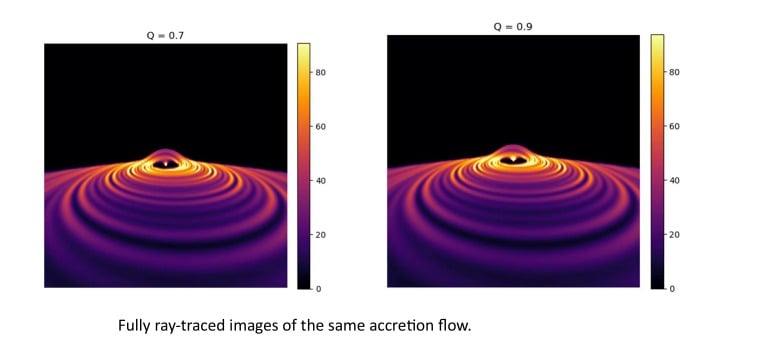
An observer looking at glowing gas surrounding a charged galactic wormhole would see a circular dark shadow framed by a luminous photon ring whose dimensions shift according to the net electrical charge. Using backward relativistic ray tracing through optically thin accretion flows, Md Khalid Hossain and coauthors tracked light rays originating in the glowing disk backward to their point of origin.21 Because the simulated spacetime is spherically symmetric, the resulting shadow cast against the luminous background retains a clean circular profile.2
The presence of electrical charge directly modifies both the radius of the shadow and the intensity distribution across the surrounding photon rings.2 Changing the charge parameter adjusts the critical impact parameter at which light rays become captured by the throat rather than escaping to infinity. As the authors found, these adjustments produce measurable shifts in the contrast and diameter of the central dark region, suggesting that high-resolution radio interferometry of galactic cores could test for the presence of charged wormholes alongside standard black hole geometries.
Distinguishing such a shadow from a spinning black hole requires looking for specific geometric deviations. Farook told Primary that because the wormhole model is static and spherically symmetric, its shadow boundary remains strictly circular. Farook noted that "a robust detection of horizon-scale structure that requires significant rotation or produces a persistent departure from circular symmetry" would challenge the static wormhole interpretation, since the model cannot generate the spin-induced distortions characteristic of rotating Kerr-Newman black holes.
What can the model explain and where does it fall short?
These calculations describe mathematical solutions within an idealized, spherically symmetric spacetime rather than confirmed physical detections. The model assumes an optically thin accretion flow and relies on a static, non-rotating throat geometry, whereas real astrophysical objects in galactic cores possess significant angular momentum and complex magnetic turbulence. In addition, the analysis depends on Yoshiaki Sofue's exponential dark matter profile representing the true distribution of matter at the inner core, an empirical curve that fits certain spiral galaxies but may not hold uniformly across all galactic centers. The work was posted as a preprint on arXiv and has not yet undergone formal peer review in that version, although an earlier foundational paper on neutral lensing was published in the International Journal of Geometric Methods in Modern Physics.5
The stability demonstrated in the study also has strict physical boundaries. In response to questions from Primary about how the structure handles external forces, Farook explained that the sound-speed causality test applies only to minor disturbances. Farook acknowledged that the causality condition "does not, by itself, guarantee stability against strong nonlinear astrophysical stresses, such as intense accretion, tidal disturbances, or significant plasma and electromagnetic interactions."
Even with these theoretical constraints, the findings establish concrete observational signatures for non-standard compact objects. By demonstrating how electric charge changes the geometry of photon rings and particle trajectories within realistic galactic halos, the research offers observational astronomers specific features to compare against imaging data collected by global telescope arrays.
This piece was prepared from the arXiv preprint and public records together with answers from Farook to six questions from the Primary news team, completed September 2026.
The record
21 sentences trace to 4 sources and 1 contributor.
- 1 Charged galactic wormholes: Shadow imaging, accretion disks, and charged-particle deflection See the source
-
2
MK
 Md Khalid Hossain, Humaun Kabir Laskar, Farook Rahaman, Aritra Sanyal
Paper
· arxiv.org · 9 Sep 2026
Charged galactic wormholes: shadow imaging, accretion disks, and charged-particle deflection
Preprint · may not have been peer reviewed
See the source
-
3
A
arxiv.org
Paper
· arxiv.org
Gravitational lensing due to charged galactic wormhole
Preprint · may not have been peer reviewed
See the source
- 4 Contribution — Farook Rahaman 17 statements added to this article
-
5
A
arxiv.org
Paper
· arxiv.org
Gravitational lensing due to charged galactic wormhole
Preprint · may not have been peer reviewed
See the source
Other consulted pages1 page
ar5iv.labs.arxiv.org1 page
Article history
-
Published 13 Nov 2026, 14:17Assembled by the Primary desk from 4 sources · 1 contributor · 21 cited sentences
-
Farook Rahaman
- Go to the sentence: In earlier work on galactic structures, Farook Rahaman and Md Khalid Hossain at Jadavpur University demonstrated that Yoshiaki Sofue's exponential density profile, which accounts for the concentration of dark matter toward spiral galactic cores, can provide the mathematical shape function needed to satisfy the outward-flaring geometric requirement of a stable throat.
- Go to the sentence: When an electric charge is added to that dark matter distribution, the field introduces an additional electrostatic energy component into the governing Einstein-Maxwell field equations.
- Go to the sentence: The authors calculated the radial tension and lateral pressures across the surrounding halo, confirming that the effective shape function continues to flare outward at the throat while keeping the speed of sound through the fluid below the speed of light.
- Go to the sentence: That causality condition ensures the resulting charged galactic conduit remains theoretically stable under small radial and transverse disturbances.
- Go to the sentence: Farook said that "the charge parameter Q should either be sufficiently small or have a physical mechanism that prevents efficient neutralization," noting that one possibility is an effective charge coupled to a dark-sector force rather than standard electromagnetism.
- Go to the sentence: In response to questions from Primary, Farook said that Sofue's exponential dark-matter profile satisfies the throat-flaring requirement "as long as the dark-matter density near the throat remains sufficiently low."
- Go to the sentence: Farook pointed out that a very dense galactic core or a steep central cusp would increase local mass density near the throat, potentially altering the shape function and preventing the throat from flaring open.
- Go to the sentence: The preprint reported that when charged particles move at relativistic velocities approaching the speed of light, the deflection angles computed by both methods converge until they become nearly indistinguishable.
- Go to the sentence: At lower velocities, noticeable differences emerge between the two formalisms because velocity-dependent correction terms proportional to one minus the square of the velocity alter the trajectory equations.
- Go to the sentence: As a particle accelerates toward light speed, that velocity factor shrinks toward zero, harmonizing the predictions and aligning the massive particle trajectory with the bending experienced by pure light rays in strong gravitational lensing.
- Go to the sentence: In response to questions from Primary regarding this convergence, Farook explained that in the ultrarelativistic limit where velocity approaches the speed of light, "the Jacobi metric approaches the optical, or null-geodesic, geometry of the spacetime."
- Go to the sentence: Farook stated that "we regard the Gauss–Bonnet (GB) result as the more reliable description because it is formulated geometrically through the curvature of the Jacobi space and provides a coordinate-independent treatment of the particle trajectory," while treating the Rindler-Ishak method as a secondary comparison.
- Go to the sentence: Because the simulated spacetime is spherically symmetric, the resulting shadow cast against the luminous background retains a clean circular profile.
- Go to the sentence: The presence of electrical charge directly modifies both the radius of the shadow and the intensity distribution across the surrounding photon rings.
- Go to the sentence: Farook noted that "a robust detection of horizon-scale structure that requires significant rotation or produces a persistent departure from circular symmetry" would challenge the static wormhole interpretation, since the model cannot generate the spin-induced distortions characteristic of rotating Kerr-Newman black holes.
- Go to the sentence: The work was posted as a preprint on arXiv and has not yet undergone formal peer review in that version, although an earlier foundational paper on neutral lensing was published in the International Journal of Geometric Methods in Modern Physics.
- Go to the sentence: Farook acknowledged that the causality condition "does not, by itself, guarantee stability against strong nonlinear astrophysical stresses, such as intense accretion, tidal disturbances, or significant plasma and electromagnetic interactions."