Hidden solar storms take shape across the Sun's far side
Acoustic tracking of far-side active regions reveals how standard space weather models underestimate the Sun's total magnetic energy by up to a fifth, according to a new computational framework.
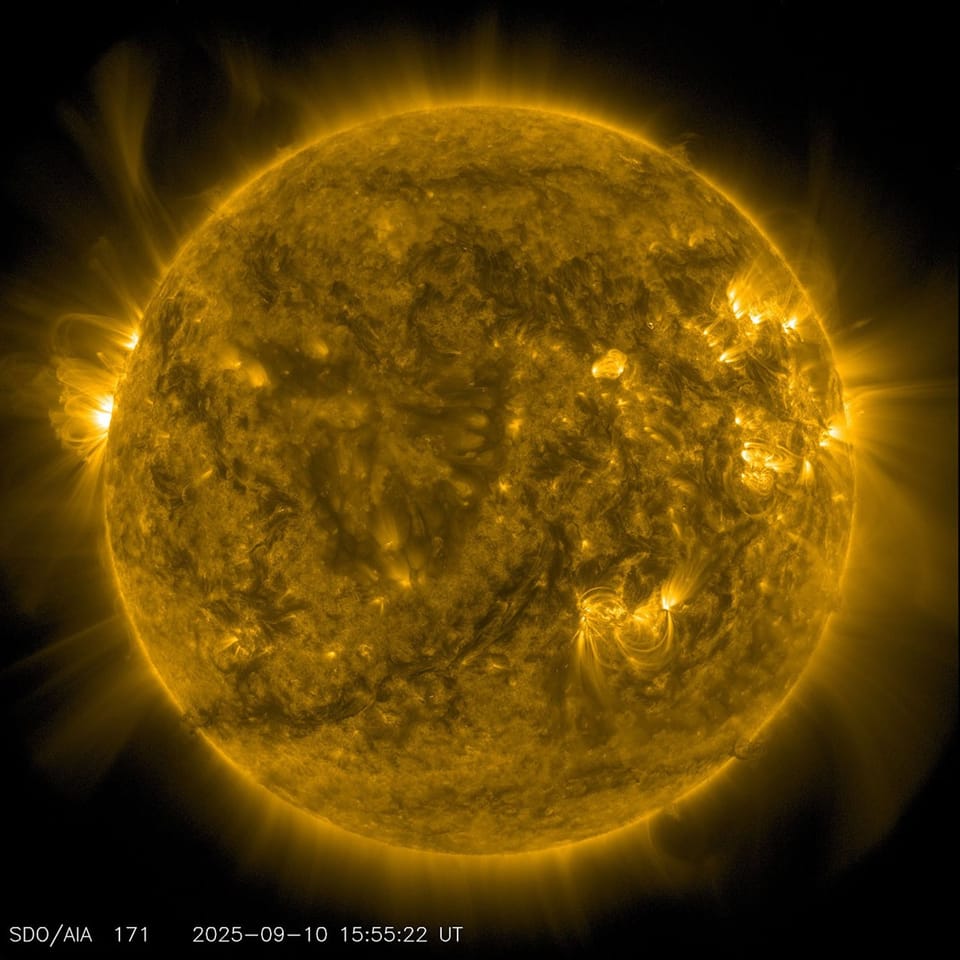
The Sun is a rotating sphere of hot, electrically conducting gas that turns on its axis roughly once every 27 days, but human observatories anchored near Earth can see only one half of its surface at any given moment.1 Giant bundles of magnetic field lines, known as active regions or sunspot groups, regularly emerge from deep within the solar interior and break through the visible surface.23 On the near side facing Earth, telescopes record these magnetic eruptions in sharp detail, mapping their size, polarity, and growth over time.23 On the far side of the Sun, identical magnetic eruptions occur out of direct line of sight, remaining completely hidden from conventional optical instruments for up to two weeks until solar rotation carries them around the eastern horizon.21
These hidden magnetic eruptions matter because the Sun's surface magnetic field dictates the structure of the entire solar atmosphere and drives space weather throughout the solar system.2 When twisted magnetic field lines above sunspot groups snap and reconnect, they release powerful solar flares and coronal mass ejections that travel across interplanetary space.34 These coronal mass ejections can strike Earth, disrupting high-frequency satellite communications, perturbing global positioning systems, and inducing damaging electrical currents in power grids. Computational space weather models rely on continuous, full-surface maps of the solar magnetic field to forecast when and where high-speed solar wind streams and plasma eruptions will strike Earth's magnetic envelope.24
A study posted to the arXiv preprint server on September 2, 2026, by lead author Bibhuti Kumar Jha, an astrophysicist at Southwest Research Institute in Boulder, Colorado, and seven colleagues demonstrates a method to incorporate far-side acoustic observations into magnetic transport simulations.2 The authors report that standard simulations relying solely on near-side observations miss between 10 percent and 20 percent of the Sun's total magnetic flux budget during active periods.2 The preprint describes a probabilistic filtering framework that converts acoustic signatures recorded on the near side into verified far-side magnetic regions, allowing physicists to track sunspot groups across the entire solar sphere.2
How does acoustic energy reveal hidden solar structures?
Sound waves travelling through hot solar plasma can map magnetic regions that remain hidden behind the Sun.1 Magnetic field on the Sun evolves through a continuous cycle of subsurface emergence, horizontal transport, and mutual cancellation.21 Concentrated tubes of magnetic field rise buoyantly from the solar interior and pierce the photosphere, creating bipolar active regions consisting of paired positive and negative magnetic poles.2 Once these magnetic features emerge on the surface, large-scale horizontal plasma currents begin to shear and transport them.2 Differential rotation carries equatorial plasma around the Sun faster than polar plasma, while a slower meridional circulation drags magnetic flux poleward.2 At the same time, turbulent convection cells, known as supergranulation, buffet and diffuse the magnetic field lines in random directions across the surface.24
Because direct magnetic measurements exist primarily for the hemisphere facing Earth, solar physicists reconstruct the global magnetic field using numerical algorithms known as surface flux transport models.3 These models ingest daily near-side magnetograms, which are telescope images that measure the line-of-sight strength and direction of surface magnetic fields, and then calculate how that observed magnetic flux will advect and diffuse as the Sun rotates.21 When an active region rotates onto the far side, the model continues to simulate its slow transport and decay according to known surface flow equations.3 However, if a completely new active region bubbles up on the far side, or if an existing region undergoes an unexpected growth spurt while out of view, the transport model has no observational input to signal that new magnetic flux has appeared.23
To solve this observational blind spot, researchers turned to helioseismology, the study of acoustic pressure waves echoing through the solar interior.1 Turbulent convection near the solar surface generates millions of sound waves that propagate through the hot plasma, refract in the deep interior, and bounce off the far-side surface before returning to the Earth-facing hemisphere.4 Strong magnetic fields alter the temperature and sound speed of the plasma, shortening the travel time of acoustic waves that reflect within an active region.4 By measuring Doppler velocity shifts in optical lines on the near side using instruments such as the Helioseismic and Magnetic Imager aboard NASA's Solar Dynamics Observatory, researchers calculate acoustic phase shifts that pinpoint active regions on the hidden hemisphere.21
Why do acoustic maps require statistical filtering?
Spurious noise signatures generated by turbulent sound scattering mimic magnetic active regions on acoustic phase maps. Acoustic travel-time maps provide an indirect view of the far side but suffer from significant measurement noise and artifacts known as ghost active regions. In their preprint, Bibhuti Kumar Jha and colleagues at Southwest Research Institute, Northwest Research Associates, Stanford University, the Naval Research Laboratory, and the National Solar Observatory explain that wave scattering, projection geometry, and center-to-limb effects create spurious phase shifts that resemble true magnetic concentrations. Past observations from the Global Oscillation Network Group indicated that approximately 10 percent of active regions identified in seismic maps do not correspond to real brightenings in extreme ultraviolet observations.2 Ingesting these false acoustic detections directly into a surface flux transport simulation would inject artificial magnetic energy into the model, distorting global field topologies.2
To separate real magnetic features from seismic noise, Jha and his co-authors constructed a logistic regression classifier that evaluates candidate detections against historical satellite observations.2 The team analyzed a benchmark dataset spanning May 13, 2010, to August 18, 2014, when NASA's twin Solar Terrestrial Relations Observatory spacecraft, known as STEREO, provided near-continuous extreme ultraviolet imaging of the far side in the 304 Angstrom emission line of ionized helium.23 Because extreme ultraviolet brightness scales with magnetic activity, the STEREO observations served as ground truth to label acoustic detections from the Helioseismic and Magnetic Imager as either genuine active regions or false ghosts.23
The classification framework first isolates candidate active regions in acoustic magnetic flux maps using an adaptive intensity threshold based on iterative sigma clipping. This statistical technique calculates the background mean and standard deviation of the image while iteratively removing bright outlier pixels until the background values converge.2 The researchers applied an intensity threshold of the background mean plus five standard deviations, followed by an area cutoff of approximately 120 millionths of a solar hemisphere, to eliminate small transient noise spikes. For every remaining candidate patch, the algorithm extracts physical descriptors: flux-density-weighted heliographic latitude and Carrington longitude, total absolute magnetic flux, average field strength, and the cosine of the heliocentric angle.2
The logistic regression model assigns a probability score to each candidate region based on these physical parameters.2 Bibhuti Kumar Jha and colleagues determined that applying a probability threshold of 0.73 eliminates 90 percent of ghost active regions in the historical dataset while maintaining a detection precision of 0.93 for true active regions.2 Jha told Primary that a simple 50/50 detection threshold would identify most real active regions, but it would also allow about 80% of these ghost detections into the data. Because false regions could contaminate magnetic maps and reduce the reliability of space-weather models, Jha said the team adopted a stricter benchmark chosen specifically to reject about 90% of the ghost detections. This decision involves an accepted trade-off, Jha explained, noting that while the team may miss some weaker but genuine active regions, the filter greatly reduces the number of false detections entering their models. The authors also derived an empirical power-law scaling relationship between the helioseismic flux maps and the Advective Flux Transport model flux scale.2 This calibration ensures that when a verified far-side detection passes the probability filter, the simulation injects an accurate quantity of magnetic flux, maintaining consistent total energy across multiple solar rotations.2
What does the hidden hemisphere reveal about the solar magnetic budget?
Excluding far-side active regions causes global solar simulations to lose up to one fifth of their total magnetic field strength during solar maximum.2 Applying the calibrated framework to global solar simulations demonstrates that conventional surface flux transport models systematically underestimate the Sun's total magnetic flux budget by approximately 10 percent to 20 percent.2 When an emerging active region on the far side is omitted, the simulated solar atmosphere lacks the magnetic energy required to reproduce coronal streamers, coronal holes, and open magnetic field lines accurately.24 In their analysis of long-term simulations, Jha and his team found that inserting helioseismically detected active regions restores the missing unsigned magnetic flux, tracking the continuous emergence and decay of sunspot groups across consecutive 27-day solar rotations in close agreement with subsequent near-side observations.2
Jha explained to Primary that this missing flux varies systematically across the solar activity cycle. Because many active regions emerge across the entire solar surface during solar maximum, relying solely on near-side views leaves out roughly 10% to 20% of the Sun's total magnetic flux budget. During quieter phases, Jha noted that fewer active regions form, causing the omitted flux to shrink to around 5% or even drop below to zero during low-activity or quiet periods.
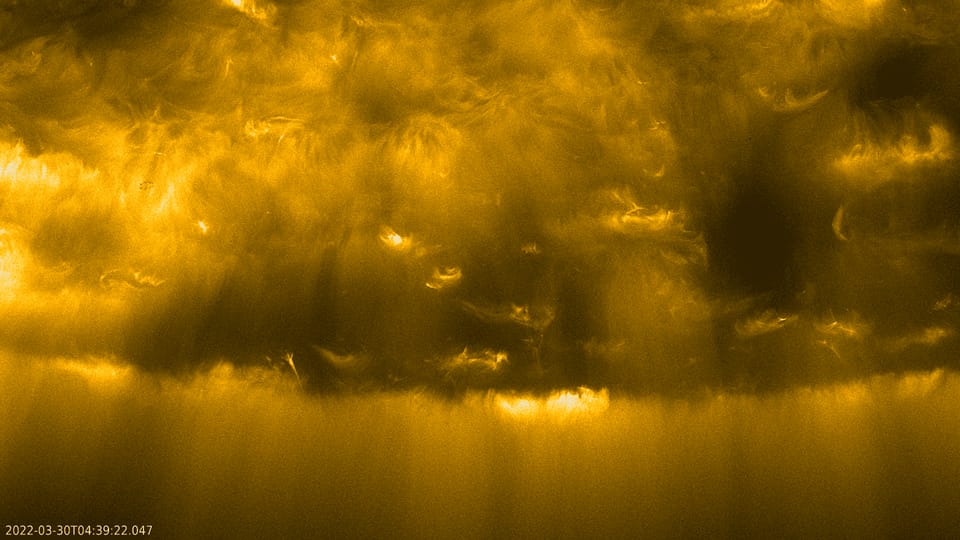
The study highlights how far-side magnetic emergence reshapes large-scale solar wind structures.24 Earlier research cited by the authors showed that omitting even a single major active region on the far side can alter the predicted boundaries of coronal holes and shift the position of the heliospheric current sheet, the wavy electrical boundary that divides opposing magnetic polarities across the interplanetary solar system.41 By maintaining an up-to-date representation of far-side flux emergence, space weather models can generate more reliable predictions of solar wind speed and geomagnetic disturbances days before active regions rotate into direct view of Earth.42
What are the limitations of helioseismic magnetic mapping?
Sound waves reflecting through the solar interior map the concentration of magnetic structures without revealing their magnetic polarity.41 The probabilistic detection framework is a mathematical filter operating on indirect physical measurements, not a direct telescope observation of far-side magnetic fields.2 Acoustic phase shifts indicate where magnetized plasma is concentrated, but sound waves cannot measure the positive or negative sign of the magnetic vector.41 Consequently, the transport model must assign magnetic polarities synthetically, relying on empirical rules such as Hale's polarity law, which dictates that leading and following sunspots in opposite solar hemispheres exhibit predictable magnetic orientations throughout an 11-year solar cycle.14 When rare anti-Hale or highly complex multipolar regions emerge on the far side, synthetic bipole insertion cannot capture their internal magnetic twist.4
Furthermore, helioseismic imaging possesses an effective spatial resolution fundamentally limited by acoustic wavelengths in solar plasma, which spans roughly four degrees in heliographic coordinates. This resolution prevents the detection of small, short-lived active regions below the 120 millionths of a solar hemisphere threshold.2 The empirical calibration between seismic phase shift and magnetic flux was trained on observations from Solar Cycle 24, meaning instrumental drift or unusually quiet solar conditions could require recalibration.2 Co-author Kiran, a researcher at the National Solar Observatory, told Primary that a calibration trained on Cycle 24 should remain reliable provided the acoustic-to-magnetic relationship does not change substantially, but noted that during an unusually violent maximum or a deep minimum, that relationship may change and introduce bias, in which case the conversion would likely need to be updated or retrained. The research was posted as a preprint and has not yet completed formal peer review.2
Where are far-side magnetic models heading next?
Operational space weather forecasting centers are beginning to integrate continuous far-side acoustic data feeds directly into their numerical pipelines.4 Incorporating probabilistic far-side detections into operational space weather pipelines represents a crucial practical step toward autonomous, real-time forecasting of the solar environment.2 Routine data feeds from the Solar Dynamics Observatory and the ground-based Global Oscillation Network Group already generate acoustic phase maps every 12 hours, providing the raw observational stream needed to drive continuous flux transport models without waiting for specialized far-side spacecraft.
Future validation will draw on direct magnetic observations collected by the Polarimetric and Helioseismic Imager aboard the European Space Agency's Solar Orbiter mission, which occasionally views the solar far side from an inclined orbit.14 Kiran explained in response to questions from Primary that although the Polarimetric and Helioseismic Imager aboard Solar Orbiter provides direct measurements of the magnetic field on the Sun's far hemisphere, those observations are available only for a few months each year. Because direct spacecraft views remain intermittent, Kiran noted that magnetic flux estimates derived from far-side active regions identified in helioseismic maps play a critical role in ensuring uninterrupted monitoring. Combining direct magnetograms from Solar Orbiter with continuous helioseismic tracking will allow researchers to refine polarity assignments, test acoustic conversion factors under varying solar conditions, and improve global space weather models that safeguard satellite infrastructure and power networks on Earth.42
This piece was prepared from the arXiv preprint and public records together with answers from Bibhuti Kumar Jha and Kiran to 4 questions from the Primary news team, completed September 2026.
The record
63 sentences trace to 4 sources and 2 contributors.
-
1
A
 arxiv.org
Paper
· arxiv.org
Combined Surface Flux Transport and Helioseismic Far-side Active Region Model (FARM)
Preprint · may not have been peer reviewed
See the source
-
2
BK
Bibhuti Kumar Jha, Lisa A. Upton, K. D. Leka, Ruizhu Chen, Junwei Zhao, Shea Hess Webber, Ignacio Ugarte-Urra, Kiran Jain
Paper
· arxiv.org · 2 Sep 2026
A Probabilistic Framework for Incorporating Helioseismic Far-Side Active Regions into SFT Models
Preprint · may not have been peer reviewed
See the source
-
3
A
arxiv.org
Paper
· arxiv.org
The Advective Flux Transport Model: Improving the Far-Side with Active Regions observed by STEREO 304Å
Preprint · may not have been peer reviewed
See the source
- 4 Helioseismic Far-side Active Region Model (FARM) See the source
- 5 Contribution — Bibhuti Kumar Jha 6 statements added to this article
- 6 Contribution — Kiran 3 statements added to this article
Other consulted pages1 page
alphaxiv.org1 page
vitagri.org1 page
meetingorganizer.copernicus.org1 page
ar5iv.labs.arxiv.org1 page
arxiv.org7 pages
- A Probabilistic Framework for Incorporating Helioseismic Far-Side Active Regions into SFT Models
- A Probabilistic Framework for Incorporating Helioseismic Far-Side Active Regions into SFT Models
- Combined Surface Flux Transport and Helioseismic Far-side Active Region Model (FARM)
- The Advective Flux Transport Model: Improving the Far-Side with Active Regions observed by STEREO 304Å
- HiFAR: Multi-Stage Curriculum Learning for High-Dynamics Humanoid Fall Recovery
- Combined Surface Flux Transport and Helioseismic Far-side Active Region Model (FARM)
- A Probabilistic Framework for Incorporating Helioseismic Far-Side Active Regions into SFT Models
Article history
-
Published 13 Nov 2026, 14:17Assembled by the Primary desk from 4 sources · 2 contributors · 63 cited sentences
-
Bibhuti Kumar Jha, lead author
- Go to the sentence: Jha told Primary that a simple 50/50 detection threshold would identify most real active regions, but it would also allow about 80% of these ghost detections into the data.
- Go to the sentence: Because false regions could contaminate magnetic maps and reduce the reliability of space-weather models, Jha said the team adopted a stricter benchmark chosen specifically to reject about 90% of the ghost detections.
- Go to the sentence: This decision involves an accepted trade-off, Jha explained, noting that while the team may miss some weaker but genuine active regions, the filter greatly reduces the number of false detections entering their models.
- Go to the sentence: Jha explained to Primary that this missing flux varies systematically across the solar activity cycle.
- Go to the sentence: Because many active regions emerge across the entire solar surface during solar maximum, relying solely on near-side views leaves out roughly 10% to 20% of the Sun's total magnetic flux budget.
- Go to the sentence: During quieter phases, Jha noted that fewer active regions form, causing the omitted flux to shrink to around 5% or even drop below to zero during low-activity or quiet periods.
-
Kiran, a researcher at the National Solar Observatory
- Go to the sentence: Co-author Kiran, a researcher at the National Solar Observatory, told Primary that a calibration trained on Cycle 24 should remain reliable provided the acoustic-to-magnetic relationship does not change substantially, but noted that during an unusually violent maximum or a deep minimum, that relationship may change and introduce bias, in which case the conversion would likely need to be updated or retrained.
- Go to the sentence: Kiran explained in response to questions from Primary that although the Polarimetric and Helioseismic Imager aboard Solar Orbiter provides direct measurements of the magnetic field on the Sun's far hemisphere, those observations are available only for a few months each year.
- Go to the sentence: Because direct spacecraft views remain intermittent, Kiran noted that magnetic flux estimates derived from far-side active regions identified in helioseismic maps play a critical role in ensuring uninterrupted monitoring.