Hyperbolic spaces can reconstruct complete maps from fragmented distance data
A mathematical framework establishes that chordal networks allow exact recovery of missing hyperbolic measurements, offering new structural tools for mapping complex branching trees and networks.
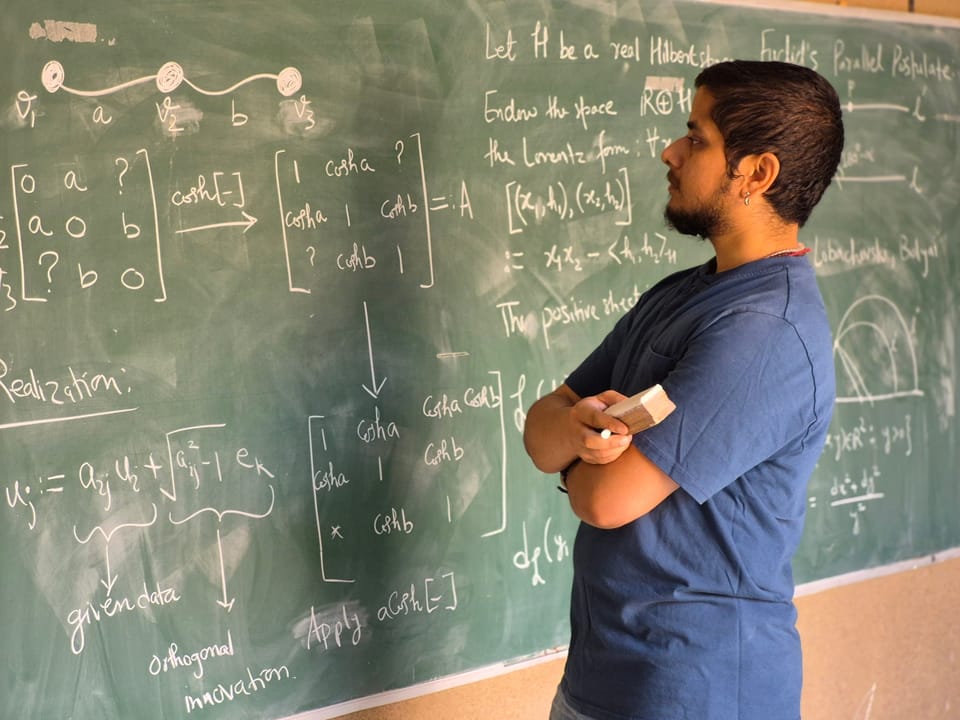
When a surveyor sketches a network of roads on a flat plain, the straight lines between landmarks follow the familiar rules of Euclidean geometry. Measuring the separation between a central town and three outlying villages, together with the distances between adjacent settlements, locks the position of every point into place. If a river cuts between two villages and the direct path between them remains unmeasured, the rigid properties of flat space allow mathematicians to calculate that missing gap with exact precision. The surrounding network of known roads constrains the unmeasured coordinates, preventing the distant landmarks from drifting into arbitrary positions.
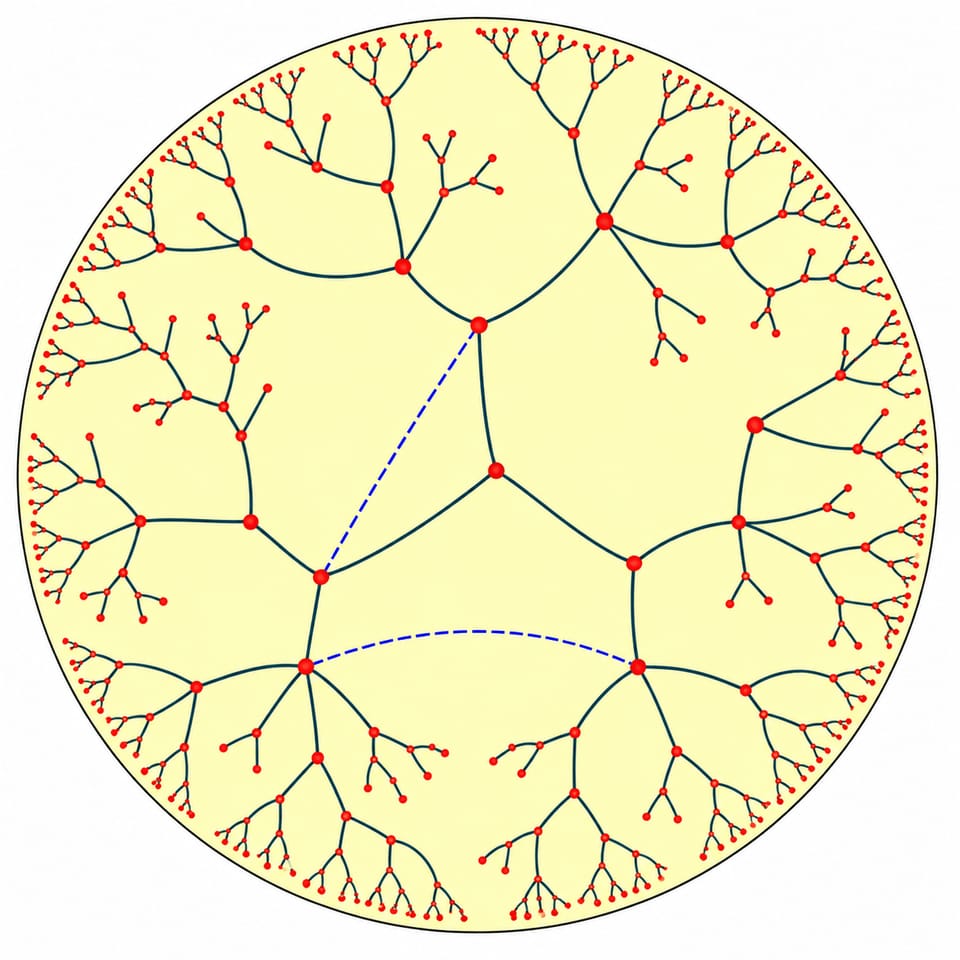
That geometric rigidity collapses when physical data describes expansive branching systems instead of flat landscapes. Evolutionary lineages, corporate reporting structures, communication backbones, and internet routing directories multiply outward in branching cascades. For every step an observer takes away from a central root, the number of potential endpoints multiplies, rapidly outpacing the physical area available on a flat sheet of paper. Planar surfaces lack the room to accommodate these branching structures without squeezing distant leaves together, distorting the true evolutionary or operational distance between related nodes. To represent these expanding hierarchies without introducing artificial compression, researchers turn to hyperbolic geometry, a curved mathematical realm where available space expands exponentially in every direction, behaving like the fluted, ruffled boundary of a sea sponge.
Surveying distances inside these curved hyperbolic domains introduces severe computational obstacles whenever only an incomplete fraction of pairwise separations can be measured directly. A preprint posted to the arXiv server on September 10, 2026, by mathematicians Mihai Putinar and Prateek Kumar Vishwakarma establishes a comprehensive completion theory for hyperbolic distance data.1 Their work proves the exact geometric conditions under which an incomplete table of hyperbolic measurements can be filled out into a valid, distortion-free map of points residing on the curved surface of a Lobachevsky space, a standard non-Euclidean manifold characterized by uniform negative curvature.
Why do branching networks resist flat geometric calculation?
Branching networks resist flat geometric calculation because their surface area multiplies much faster than the perimeter of a flat circle can accommodate.1 On an ordinary flat surface, the circumference of a circle grows in direct linear proportion to its radius. In a hyperbolic plane, the circumference of a circle expands as an exponential function of that radius, offering vast peripheral capacity that comfortably houses sprawling genealogical trees. When an evolutionary tree branches repeatedly across millions of generations, the genetic divergence separating modern organisms mimics this exponential flare, fitting naturally into hyperbolic space without crushing distantly related organisms into artificial proximity.
Reconstructing a complete map from partial surveys requires organizing pairwise distances into a structured grid known as a distance matrix, where each numerical entry records the physical separation between two specific points. In practical data collection, such as surveying active data cables across telecommunication routers or sequencing mutations across living species, observers record only a small fraction of the possible pairings, leaving most cells in the matrix blank. Matrix completion represents the mathematical discipline of filling those empty cells with mutually consistent numbers so that the finished table describes an actual configuration of points residing in a target geometric space.1
Mathematicians resolved this problem for spherical surfaces and flat Euclidean space decades ago. In 1984, researchers proved that an incomplete positive semidefinite matrix can be completed if and only if the network of known entries avoids unbridged cycles of four or more points.1 In 1995, a parallel theorem established that Euclidean distance matrices obey that exact same local-to-global principle.1 Yet hyperbolic space resisted a universal completion rule because its underlying metric space possesses an indefinite signature, meaning the mathematical formulas that calculate distance involve subtractions that can easily produce impossible, imaginary values if an unmeasured entry is filled incorrectly.
How can an indefinite hyperbolic space behave like a positive kernel?
Hyperbolic space behaves like a positive geometric kernel once an anchoring operation fixes a single reference point and measures all other vectors relative to that chosen origin.1 In the standard hyperboloid model of Lobachevsky space, every point rests on the upper sheet of a two-sheeted hyperboloid in a space equipped with a Lorentzian bilinear form, an algebraic product that assigns a positive square to one temporal dimension and negative squares to all spatial dimensions. This mixed algebraic signature prevents the raw matrix of hyperbolic cosines from being positive semidefinite, a mathematical property where all submatrices yield non-negative quadratic forms.
The paper resolves this obstacle by adapting a classical concept introduced in 1948 by the Soviet mathematician Mark Grigorievich Krein, who studied continuous screw lines in Lobachevsky spaces.1 Putinar and Vishwakarma showed that selecting any single point as an anchor transforms the indefinite table of hyperbolic measurements into an anchored positive semidefinite kernel.1 In this transformed table, the entries correspond to the hyperbolic cosines of the measured distances, corrected by an anchoring formula that strips away the indefinite temporal component.
Asked about the intuition behind this anchoring procedure, Mihai said in response to questions from Primary that the consistency across different anchor choices reflects the fundamental symmetry of the space: "Lobachevsky space carries an important property called two-point homogeneity. That is two pair of points at equal distance can be transformed into each other by a rigid motion. Similar to the Euclidean space or the sphere. The classification of two-point homogeneous spaces, as models of the physical space, goes back to RIemann's famous 1854 Habilitationschrift, it was crafted into a set of axioms by Hermann Helmholtz and independently completed a century later by Hsien-Chung Wang and Jacques Tits. The scarcity of geometries revealed by their classification is notable. Lobatchevsky space is one of them."
By treating this anchor as an algebraic pivot, the authors showed that testing whether a partial hyperbolic matrix can be realized by real points reduces to checking whether its local anchored submatrices remain positive semidefinite.1 When the curvature is zero, this anchoring formula reduces exactly to the classical Schoenberg transform used in flat Euclidean distance geometry. When the curvature equals negative one, the formula introduces a multiplicative product correction that mirrors the natural hyperbolic metric.
Which measurement patterns guarantee that missing entries can be found?
Measurement patterns guarantee complete recovery if and only if their underlying specification graph is chordal, meaning every loop of four or more surveyed points contains a shortcut edge dividing the cycle into smaller triangles.1 Putinar and Vishwakarma proved that chordality is both the strictly necessary and sufficient structural condition for local hyperbolic measurements to extend into a global distance matrix.1 If a network contains an open four-point loop lacking a cross-strut measurement, there exist local distance assignments that are individually valid around the ring but mutually incompatible across the missing diagonal.
Mihai explained the simple geometric origin of this boundary in comments to Primary: "Hyperbolic distance, as much as Euclidean or spherical distance, satisfies the triangle inequality: the length of a side in a triangle is less than or equal to the sum of the lengths of the other two sides. This explains why chordality is a necessary and sufficient condition for distance matrix completion in each of the three geometries."
Beyond proving that valid completions exist on chordal networks, the preprint provides three explicit algebraic recipes for constructing the missing entries. When the surveyed points form a simple tree structure with no loops at all, the researchers derived a product-distance completion.1 In this construction, the hyperbolic cosine of the distance between two separated nodes equals the alternating product of the hyperbolic cosines along the path connecting them. For more intricate chordal networks made of overlapping clusters, the authors generalized this rule into matrix-valued transfers along an algebraic clique-tree.1
The canonical completion produced by this clique-tree procedure possesses two distinctive mathematical signatures. First, the matrix inverse of the completed kernel is sparse, containing nonzero values only where measurements were originally prescribed in the graph.1 Second, the researchers established that this canonical matrix uniquely maximizes the absolute determinant among all possible valid hyperbolic extensions, providing a clear variational principle that singles out the most natural geometric completion.1
Discussing why determinant maximization identifies the natural completion, Mihai told Primary: "Among all hyperbolic realizations of the observed distances, one has maximal volume. It is the one that invents no relationship the data did not record: each new point contributes a direction orthogonal to everything already there, the hyperbolic counterpart of conditional independence. In the Euclidean parallel setting the canonical completion was naturally related to maximal entropy, seen as volume in disguise. In the hyperbolic context is pure geometry encoded in orthogonality."
What limits the accuracy of these completed hyperbolic maps?
The accuracy of these completed hyperbolic maps depends strictly on whether the clusters of known measurements are linked together by single points or by broader shared cliques.1 The authors analyzed the metric distortion of their explicit completions, comparing the reconstructed hyperbolic distances against the true shortest-path lengths across the original graph. For tree networks, the product-distance completion becomes an exact isometry in the scaling limit, meaning that as the graph grows larger, the reconstructed distances match the underlying tree path lengths with zero geometric distortion.1
Prateek Kumar Vishwakarma, co-author of the work, clarified that this zero-distortion behavior represents an asymptotic property rather than an absolute finite result: "Strictly speaking, the reconstruction is not an exact isometry at any finite scale. Rather, its multiplicative distortion converges to the optimal value of one in the scaling limit. Equivalently, the excess distortion above that of an exact isometry tends to zero. This is uniform over all finite trees, provided every edge has a positive length and the shortest scaled edge becomes sufficiently large."
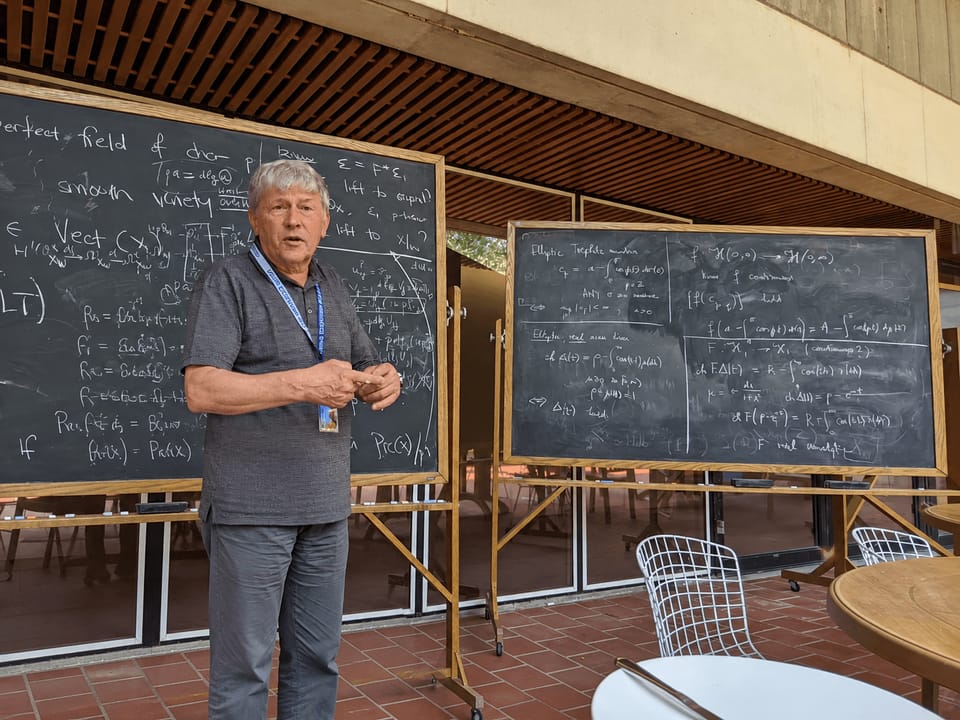
Vishwakarma noted that the primary breakdown within tree structures arises from vanishing edge lengths, explaining that convergence fails if the shortest edges shrink as scaling increases. If an edge has zero length, the completion becomes singular, causing distinct points to collapse together in the reconstructed space. Beyond simple trees, the geometry introduces structural obstructions when clusters overlap across wider shared boundaries.
For general chordal graphs, however, the paper uncovered a sharp structural dichotomy governed by the size of the separators that divide overlapping cliques.1 When two dense measurement clusters overlap at only a single shared point, called a singleton separator, the completed distance behaves predictably and preserves the local geometry without strain.1 When two clusters share two or more points simultaneously, the rigidity of the multi-point intersection forces a geometric compromise, introducing unavoidable metric distortion across the unmeasured pairs.
Vishwakarma cautioned against overinterpreting this structural threshold when analyzing dense real-world data: "A step too far would be to conclude that dense networks, or even all networks with multi-vertex clique separators, are unsuitable for hyperbolic reconstruction. Our dichotomy is a worst-case statement about the clique-product completion: a separator containing two or more vertices permits admissible data with arbitrarily large distortion. It does not say that every dataset on such a graph will be badly reconstructed. For practitioners, separator size should therefore be interpreted as a warning rather than a prediction of failure: dense networks may still produce accurate embeddings. Conversely, the favourable side of the dichotomy guarantees a uniform distortion bound, while the actual performance still depends on the edge lengths and the choice of completion. The boundary identifies where the graph's structure alone can provide protection; beyond it, the data must carry the guarantee."
These mathematical conclusions describe idealized hyperbolic spaces and exact algebraic conditions rather than noisy empirical collections. The theoretical guarantees assume that the observed distances contain no measurement noise and that the underlying graph strictly satisfies chordality. If an empirical dataset contains unbridged loops or severe measurement perturbations, the exact algebraic completion algorithms cannot be applied directly without first modifying the network or discarding contradictory entries. Furthermore, the preprint has been posted to a preprint server and has not yet undergone peer review.
Mihai noted that the inability to link non-chordal structures stems from two specific topological features: "In general a non-chordal graph data admits local hyperbolic embeddings. Glueing them into a global embedding fails for two reasons: loops with no shortcut make completion impossible and respectively the obstruction appearing at pairs of divisions linked by a committee rather a single gatekeeper."
What do these geometric completions unlock for practical data analysis?
These geometric completions unlock rigorous recovery guarantees for sparse hierarchical data in biology, finance, and telecommunications. In phylogenetic analysis, biologists compare genetic mutations across hundreds of species to reconstruct ancestral evolutionary trees.1 Direct genetic sequencing is often incomplete, leaving massive gaps in the pairwise comparison tables. By framing phylogenetic reconstruction as a chordal hyperbolic matrix completion problem, researchers can mathematically guarantee whether a given set of genetic comparisons contains enough structural information to recover the entire lineage tree uniquely.
Similar advantages emerge in computer network architecture and machine learning. Internet routers routinely calculate geographic routing tables to direct network traffic efficiently, and large financial networks map transactional relationships across trading institutions. Because both communication networks and corporate hierarchies exhibit natural tree-like branching, embedding their structural data into hyperbolic coordinates significantly reduces memory overhead while preserving neighborhood relationships.1 The maximum-absolute-determinant principle developed by Putinar and Vishwakarma provides an explicit, deterministic algorithm for filling in missing telemetry data without resorting to computationally expensive optimization heuristics.
The preprint opens several mathematical questions regarding how these completion theorems behave in spaces of constrained physical dimension. While the authors proved that a global completion always exists in a sufficiently large Hilbert space, determining the minimum embedding dimension required to hold a specific completed matrix remains an active problem. Future investigations will examine whether these algebraic transfer principles can be extended to noisy observations, bridging the gap between exact matrix completion theory and modern statistical machine learning.
This piece was prepared from the arXiv preprint and public records together with answers from Mihai and Prateek Kumar Vishwakarma to six questions from the Primary news team, completed September 2026.1
The record
49 sentences trace to 1 source and 2 contributors.
-
1
MP
 Mihai Putinar, Prateek Kumar Vishwakarma
Paper
· arxiv.org · 10 Sep 2026
Hyperbolic distance matrix completion
Preprint · may not have been peer reviewed
See the source
- 2 Contribution — Mihai Putinar 4 statements added to this article
- 3 Contribution — Prateek Kumar Vishwakarma 6 statements added to this article
Other consulted pages1 page
Article history
-
Published 13 Nov 2026, 14:17Assembled by the Primary desk from 1 source · 2 contributors · 49 cited sentences
-
Mihai Putinar
- Go to the sentence: Asked about the intuition behind this anchoring procedure, Mihai said in response to questions from Primary that the consistency across different anchor choices reflects the fundamental symmetry of the space: "Lobachevsky space carries an important property called two-point homogeneity. That is two pair of points at equal distance can be transformed into each other by a rigid motion. Similar to the Euclidean space or the sphere. The classification of two-point homogeneous spaces, as models of the physical space, goes back to RIemann's famous 1854 Habilitationschrift, it was crafted into a set of axioms by Hermann Helmholtz and independently completed a century later by Hsien-Chung Wang and Jacques Tits. The scarcity of geometries revealed by their classification is notable. Lobatchevsky space is one of them."
- Go to the sentence: Mihai explained the simple geometric origin of this boundary in comments to Primary: "Hyperbolic distance, as much as Euclidean or spherical distance, satisfies the triangle inequality: the length of a side in a triangle is less than or equal to the sum of the lengths of the other two sides. This explains why chordality is a necessary and sufficient condition for distance matrix completion in each of the three geometries."
- Go to the sentence: Discussing why determinant maximization identifies the natural completion, Mihai told Primary: "Among all hyperbolic realizations of the observed distances, one has maximal volume. It is the one that invents no relationship the data did not record: each new point contributes a direction orthogonal to everything already there, the hyperbolic counterpart of conditional independence. In the Euclidean parallel setting the canonical completion was naturally related to maximal entropy, seen as volume in disguise. In the hyperbolic context is pure geometry encoded in orthogonality."
- Go to the sentence: Mihai noted that the inability to link non-chordal structures stems from two specific topological features: "In general a non-chordal graph data admits local hyperbolic embeddings. Glueing them into a global embedding fails for two reasons: loops with no shortcut make completion impossible and respectively the obstruction appearing at pairs of divisions linked by a committee rather a single gatekeeper."
-
Prateek Kumar Vishwakarma, co-author
- Go to the sentence: Prateek Kumar Vishwakarma, co-author of the work, clarified that this zero-distortion behavior represents an asymptotic property rather than an absolute finite result: "Strictly speaking, the reconstruction is not an exact isometry at any finite scale. Rather, its multiplicative distortion converges to the optimal value of one in the scaling limit. Equivalently, the excess distortion above that of an exact isometry tends to zero. This is uniform over all finite trees, provided every edge has a positive length and the shortest scaled edge becomes sufficiently large."
- Go to the sentence: Vishwakarma noted that the primary breakdown within tree structures arises from vanishing edge lengths, explaining that convergence fails if the shortest edges shrink as scaling increases.
- Go to the sentence: If an edge has zero length, the completion becomes singular, causing distinct points to collapse together in the reconstructed space.
- Go to the sentence: When two dense measurement clusters overlap at only a single shared point, called a singleton separator, the completed distance behaves predictably and preserves the local geometry without strain.
- Go to the sentence: When two clusters share two or more points simultaneously, the rigidity of the multi-point intersection forces a geometric compromise, introducing unavoidable metric distortion across the unmeasured pairs.
- Go to the sentence: Vishwakarma cautioned against overinterpreting this structural threshold when analyzing dense real-world data: "A step too far would be to conclude that dense networks, or even all networks with multi-vertex clique separators, are unsuitable for hyperbolic reconstruction. Our dichotomy is a worst-case statement about the clique-product completion: a separator containing two or more vertices permits admissible data with arbitrarily large distortion. It does not say that every dataset on such a graph will be badly reconstructed. For practitioners, separator size should therefore be interpreted as a warning rather than a prediction of failure: dense networks may still produce accurate embeddings. Conversely, the favourable side of the dichotomy guarantees a uniform distortion bound, while the actual performance still depends on the edge lengths and the choice of completion. The boundary identifies where the graph's structure alone can provide protection; beyond it, the data must carry the guarantee."