Milky Way stars can accelerate the collapse of dark matter cores
Simulations show that ordinary stars drag self-interacting dark matter halos into rapid gravitational collapse, altering the vertical thickness of the surrounding galactic disk.
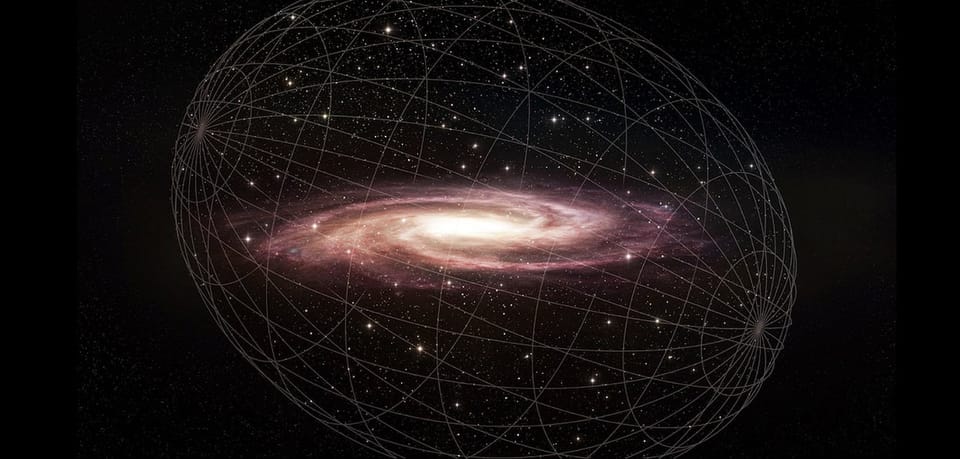
A familiar picture of a galaxy places its stars inside a vast, ghostlike scaffold of dark matter that holds everything together while remaining entirely indifferent to the luminous matter adrift within it. In the traditional picture of cold dark matter, particles feel only the pull of gravity, gathering over cosmic time into an unyielding central peak that stays quiet for billions of years.1 Yet when dark matter particles are permitted to collide with one another, the heart of a galaxy behaves less like an inert architectural frame and more like a fluid governed by thermodynamics. It can absorb heat, expand into a gentle bubble, and eventually shed its thermal energy to plunge into runaway gravitational collapse.
For decades, astrophysicists expected that in large systems resembling our Milky Way, this final inward plunge would take far longer than the present age of the universe.1 In an isolated halo made exclusively of dark matter, collisions between particles happen too infrequently to drive the system into runaway collapse before cosmic time runs out. If such a collapse cannot occur within the lifespan of our galaxy, astronomers have little reason to search for its structural signatures among the stars of the Milky Way disk.
In a study posted to the arXiv preprint server on September 9, 2026, Zeineb Mezghanni, Elliot Y. Davies, Adriana Dropulic, Gonzalo Herrera, Abdelaziz Hussein, and Lina Necib investigated how the presence of ordinary stars changes that timeline.1 Working across the Massachusetts Institute of Technology, the University of Copenhagen, and Harvard University, the authors examined the gravitational coupling between stellar structures and self-interacting dark matter halos, reporting that the pull of a central galactic disk and bulge fundamentally alters the life cycle of the invisible halo.1
The physical chain of events that governs this process depends on how heat moves through a self-gravitating cloud. In models of self-interacting dark matter, particles scatter elastically off each other, allowing energy to conduct between different parts of the halo. In standard cold dark matter halos, the inner core is dynamically colder than the hotter surrounding envelope, which means thermal conduction initially pushes heat inward toward the centre.1 Because gravitationally bound systems possess a negative heat capacity, adding thermal energy to the central region causes it to expand and drop in density, forming a flat core.1 As scattering continues over billions of years, the core eventually grows hotter than the outer envelope, which reverses the direction of heat flow outward.1 Losing energy to the surrounding envelope, the core contracts, grows denser, experiences more frequent collisions, and accelerates toward a runaway state known as gravothermal core collapse.
How do stars speed up dark matter collapse?
Ordinary stars accelerate dark matter core collapse by deepening the central gravitational potential well and forcing dark particles to collide more frequently.12 When a galaxy builds up a dense concentration of stars at its centre, the added gravity pulls the surrounding dark matter inward, a phenomenon known as adiabatic contraction. This gravitational contraction raises both the physical density and the velocity dispersion of the dark matter particles in the inner ten kiloparsecs of the galaxy.1 Because the rate of elastic collisions between self-interacting particles rises when particles are packed closer together and move faster, the stellar component rapidly hastens every phase of the gravothermal cycle.
To measure the size of this effect, the researchers set up controlled numerical simulations using the public GIZMO code to track an isolated Milky Way-sized galaxy over 10 billion years.1 They modelled the system with a total dark matter halo mass of 9.90 times 10 to the 11th solar masses, comparing runs containing only dark matter against runs that included a stellar disk of 1.20 times 10 to the 10th solar masses and a central bulge of 2.90 times 10 to the 10th solar masses.1 The authors tested self-interaction cross sections per unit mass of 1.0, 2.5, and 5.0 square centimetres per gram, alongside a traditional cold dark matter baseline.
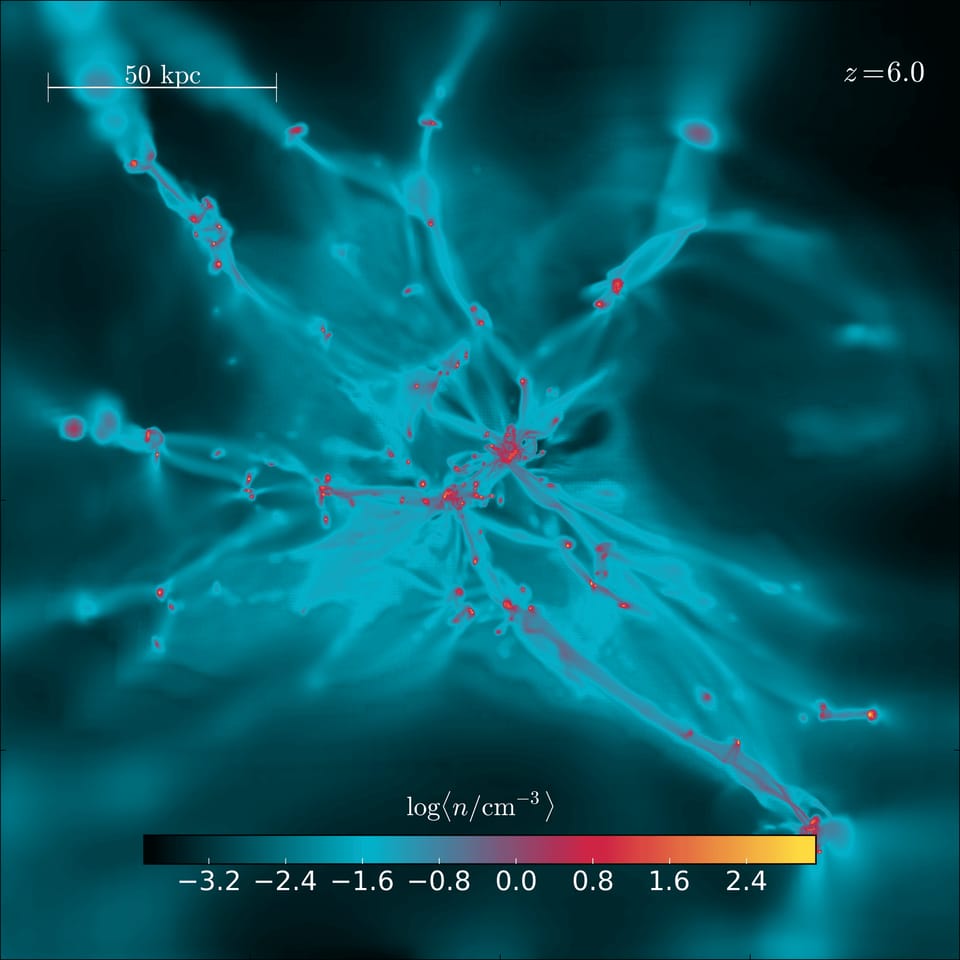
The simulations revealed that the presence of the stellar disk and bulge shortens the predicted core collapse timescale by a factor of approximately 40 compared to simulations containing dark matter alone.1 In the isolated dark matter runs, a halo with a cross section of 1.0 square centimetre per gram merely expanded into a broad core, ending the 10-billion-year simulation with an inner density roughly an order of magnitude lower than the cold dark matter cusp at a radius of 0.3 kiloparsecs.1 With the stellar disk and bulge included, the exact same cross section entered the core collapse phase well within the lifetime of the galaxy, driving the central density upward toward a sharp cusp.1
The reversal of inward heat flow occurs much earlier in the presence of baryonic matter because the deepened potential increases the central velocity dispersion from the outset. In an isolated dark matter halo, the central dispersion begins at modest values, keeping the collision rate low and causing the core-expansion phase to linger indefinitely. When the mass of a stellar disk and bulge is embedded in the centre, dark matter particles fall inward and gain kinetic energy, reaching elevated velocity dispersions that extend outward across the inner ten kiloparsecs. The thermal contact between this heated central region and the colder intermediate halo triggers outward heat transfer, compressing the core and triggering runaway collapse on timescales that fit easily within cosmic history.
What happens to the shape of the galactic disk?
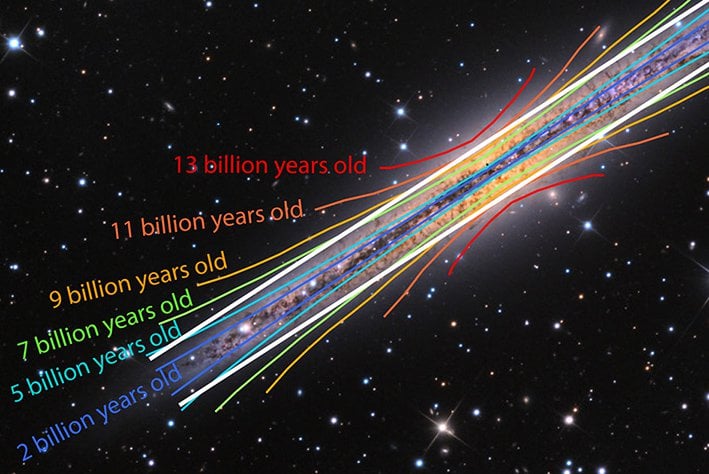
The gravitational force exerted by the collapsing dark matter core pulls nearby stars closer to the galactic mid-plane, causing the inner disk to thin while forcing the outer disk to flare outward.1 The vertical thickness of a stellar disk reflects a balance between the random vertical velocities of stars and the gravitational restoring force pulling them back toward the central plane.1 When the dark matter core collapses and concentrates mass at the galactic centre, the local restoring force strengthens considerably. Stars orbiting in the inner regions are pulled into a tighter, thinner layer, reducing the local scale height of the disk.
Farther out from the galactic centre, the geometric response flips. Because mass has concentrated heavily in the inner core, the outer disk experiences a weaker relative hold, causing the stellar disk to flare out vertically at larger radii. The authors found that this combination of inner thinning and outer flaring becomes increasingly pronounced as the dark matter self-interaction cross section increases from 1.0 to 5.0 square centimetres per gram.1 By establishing this two-way coupling, the researchers showed that the spatial profile of a stellar disk preserves a record of the halo's internal particle interactions.
This structural response offers an empirical bridge between dark matter models and observations of galactic morphology. While dark matter cannot be photographed directly, the positions and vertical distributions of millions of stars across the Milky Way can be mapped with astrometric surveys. As self-interacting dark matter contracts into a dense central cusp, the steepening vertical gravitational gradient leaves a telltale geometric distortion across the galactic plane, establishing a physical diagnostic that does not depend on hypothetical non-gravitational signals.
What are the limits of the current models?
These numerical simulations represent idealized isolated galaxies that exclude interstellar gas, ongoing star formation, and the broader cosmological mergers that characterize galaxy assembly.1 The projections describe how a live stellar disk and a self-interacting halo interact dynamically under stable conditions over 10 billion years, rather than offering an exact historical reconstruction of our own Milky Way. The simulated central bulge was assigned a mass of 2.90 times 10 to the 10th solar masses, which is larger than the dynamical estimate of the Milky Way bulge of 1.5 to 2.0 times 10 to the 10th solar masses, though the authors note that only about 36 percent of their simulated bulge mass sits within three kiloparsecs to compensate for the omitted gaseous reservoir.1 Furthermore, the findings are posted on a preprint server and have not yet undergone formal peer review. If real cosmic environments introduce turbulent gas flows or repeated dwarf galaxy impacts, those external forces could perturb the delicate balance between the disk and the contracting core.
Asked how the collapse timeline would respond if the simulated bulge mass were reduced to match dynamical estimates of 1.5 times 10 to the 10th solar masses, Gonzalo Herrera, a co-author on the paper, explained the underlying gravitational mechanism to Primary. Herrera said that "what matters for the collapse isn't the label on any one component; it's how much ordinary matter sits in the inner few kiloparsecs, because that's what pulls the dark matter inward and makes it collide more often." By that standard, Herrera noted that their simulation is already conservative, explaining that "only about a third of our bulge, roughly 1.2 x 10^10 solar masses, lies within three kiloparsecs, which is below the Milky Way's own dynamical bulge estimate of 1.5 x 10^10."
Herrera noted that the total bulge mass was permitted to run higher because the simulations omit interstellar gas entirely, whereas the simulated disk and bulge combined closely match the Milky Way's overall baryonic inventory. Lowering the bulge mass would lengthen the gravothermal timeline, Herrera observed, stating that "dialing the bulge down to 1.5 x 10^10 would make core-collapse to take longer than we report, by about ~50%." For the lowest cross section tested, Herrera pointed out that semi-analytical estimates still predict collapse within galactic history, though confirming that timeline will require dedicated simulations.
Asked how cosmological assembly and mergers might alter this gravothermal timeline in massive systems, Lina told Primary that "this is an interesting question that is hard to answer without a detailed simulations." Lina pointed out that previous research in smaller environments highlights the complexity of assembly history, noting, "In a recent work, we showed that mergers slow down gravothermal collapse in dwarf galaxies." Addressing the extension of those dynamics to larger systems like the Milky Way, Lina added that "how that process translates to larger masses will remain to be seen and worked out."
The interplay between mergers, gas dynamics, and dark matter self-interactions highlights why isolated numerical experiments serve as controlled benchmarks rather than final predictions. In dwarf galaxies, violent gravitational disruptions and satellite infalls can inject orbital energy back into the central dark matter halo, puffing up the core and delaying its gravothermal demise. Whether similar energetic disruptions can completely counteract the intense adiabatic contraction provided by massive stellar bulges in giant spiral galaxies remains an open question for the next generation of hydrodynamic simulations.
What questions remain for future observations?
Confirming whether self-interacting dark matter drives core collapse in spiral galaxies will require detailed surveys of stellar disk thicknesses across large galaxy populations. While earlier investigations focused primarily on dwarf galaxies or assumed simplified spherical distributions of stars, observing the vertical structure of extended disks gives astronomers a practical diagnostic. A dark matter cross section as low as 1.0 square centimetre per gram, well beneath the established upper observational limit of 10 square centimetres per gram for the Milky Way, is sufficient to trigger core collapse when coupled to a realistic stellar disk.1
Astronomers can now look for correlated patterns of inner disk thinning and outer flaring in statistical samples of disk galaxies. If observed disks systematically match the structural warps predicted by these simulated halos, researchers will gain an empirical method to measure dark matter self-interactions using ordinary starlight. Understanding how the baryonic and dark components sculpt each other brings the field closer to identifying whether dark matter particles truly collide, transforming our understanding of galactic architecture across the cosmos.
This piece was prepared from the arXiv preprint and public records together with answers from Lina and Gonzalo Herrera to two questions from the Primary news team, completed September 2026.
The record
26 sentences trace to 2 sources and 2 contributors.
-
1
ZM
 Zeineb Mezghanni, Elliot Y. Davies, Adriana Dropulic, Gonzalo Herrera, Abdelaziz Hussein, Lina Necib
Paper
· arxiv.org · 9 Sep 2026
Baryon-Accelerated Core Collapse in SIDM Halos and its Imprint on Galactic Disks
Preprint · may not have been peer reviewed
See the source
-
2
A
arxiv.org
Paper
· arxiv.org
Dark Bondi Accretion Aided by Baryons and the Origin of JWST Little Red Dots
Preprint · may not have been peer reviewed
See the source
- 3 Contribution — Gonzalo Herrera 3 statements added to this article
- 4 Contribution — Lina Necib 3 statements added to this article
Other consulted pages1 page
alphaxiv.org1 page
ar5iv.labs.arxiv.org1 page
arxiv.org5 pages
- Exploring Self-Interacting Dark Matter Halos with Diverse Baryonic Distributions: A Parametric Approach
- Mergers Matter: Gravothermal Collapse in Dwarf Halos with Self-Interacting Dark Matter
- Mergers Matter: Gravothermal Collapse in Dwarf Halos with Self-Interacting Dark Matter
- Exploring Self-Interacting Dark Matter Halos with Diverse Baryonic Distributions: A Parametric Approach
- Baryon-Accelerated Core Collapse in SIDM Halos and its Imprint on Galactic Disks
Article history
-
Published 13 Nov 2026, 14:17Assembled by the Primary desk from 2 sources · 2 contributors · 26 cited sentences
-
Lina Necib
- Go to the sentence: Asked how cosmological assembly and mergers might alter this gravothermal timeline in massive systems, Lina told Primary that "this is an interesting question that is hard to answer without a detailed simulations."
- Go to the sentence: Lina pointed out that previous research in smaller environments highlights the complexity of assembly history, noting, "In a recent work, we showed that mergers slow down gravothermal collapse in dwarf galaxies."
- Go to the sentence: Addressing the extension of those dynamics to larger systems like the Milky Way, Lina added that "how that process translates to larger masses will remain to be seen and worked out."
-
Gonzalo Herrera, co-author
- Go to the sentence: Herrera said that "what matters for the collapse isn't the label on any one component; it's how much ordinary matter sits in the inner few kiloparsecs, because that's what pulls the dark matter inward and makes it collide more often."
- Go to the sentence: By that standard, Herrera noted that their simulation is already conservative, explaining that "only about a third of our bulge, roughly 1.2 x 10^10 solar masses, lies within three kiloparsecs, which is below the Milky Way's own dynamical bulge estimate of 1.5 x 10^10."
- Go to the sentence: Lowering the bulge mass would lengthen the gravothermal timeline, Herrera observed, stating that "dialing the bulge down to 1.5 x 10^10 would make core-collapse to take longer than we report, by about ~50%."