Quantum particles resist spatial boundaries when relativity governs the laboratory
Testing particle position across an entire spatial slice inherently gathers cosmic information, but conditioning measurements inside finite laboratory chambers preserves relativistic locality.
In ordinary life and non-relativistic physics, finding an object in one place seems straightforward: a pebble is either inside a box or somewhere outside it, and looking into the box does not immediately alter the distant universe. In the subatomic world governed by quantum mechanics, location is already described by probabilities rather than definite points. When special relativity enters the description, requiring that no physical signal travels faster than light, locating a particle becomes remarkably elusive. For decades, mathematical theorems have suggested that standard quantum notions of position clash directly with relativistic principles, threatening the very concept of an individual particle.
Understanding this clash matters because modern fundamental physics rests on two pillars that must live together: special relativity and quantum theory. The framework that unites them, known as quantum field theory, describes nature in terms of extended fields rather than permanent miniature spheres. Yet particle colliders, radiation monitors, and quantum sensors all record discrete detection events that physicists interpret as particles arriving at specific detectors. If the mathematical theory cannot cleanly define what it means for a particle to be localized in space without permitting superluminal signaling or mathematical contradictions, the foundation linking quantum fields to laboratory observations remains fragile.
The root of the puzzle can be traced through a clear chain of physical requirements. First, an observer sets up an apparatus across space to determine where a particle is located at a chosen moment in time. Second, if quantum theory assigns a probability of detection to a small region, finding the particle there means it cannot appear simultaneously in a distant region during the same measurement. Third, because an ideal particle is a single entity, failing to find it in one place provides instant information that it must reside somewhere in the remaining expanse of the universe. In a relativistic universe where space and time are intertwined, sharing information across an entire instantaneous slice of space links distant regions together in ways that can disrupt standard assumptions about independent measurements.
In a preprint posted to the arXiv repository in September 2026, Valter Moretti, a mathematical physicist at the University of Trento and the Trento Institute for Fundamental Physics and Applications in Italy, proposes an explanation for why traditional locality arguments break down for particle localization, while offering a mathematical path to resolve the problem.1 Moretti demonstrates that elementary localization observables associated with a full spatial slice do not satisfy the mathematical criteria needed to invoke relativistic independence. Instead of pointing to a flaw in Einstein causality, Moretti argues that the breakdown stems from treating an idealized particle detection as an operation spanning the entire universe. By replacing that idealization with conditional measurements confined inside realistic, bounded laboratories, Moretti shows that relativistic locality and quantum position can peacefully coexist.
Why does relativistic physics make particle position so difficult to define?
Particle position resists simple definition in relativistic quantum theory because sharp boundaries allow quantum wave functions to leak superluminal probabilities across space. In non-relativistic textbook quantum mechanics, spatial position is represented by projection-valued measures, which are sharp mathematical operators that assign an absolute probability of 100 percent to finding a particle within an arbitrarily small region.1 In the middle of the twentieth century, Theodore Newton and Eugene Wigner attempted to construct equivalent position operators for relativistic particles, but subsequent analyses revealed that their framework retained deep theoretical tensions with causality.1
A major turning point arrived through the work of Gerhard Hegerfeldt in the nineteen-seventies and nineteen-eighties, who showed that any quantum system with strictly positive energy cannot remain sharply confined inside a bounded spatial region without instantaneously developing non-zero probabilities at distant points.1 If a particle were sharply confined within a box at one millisecond, its probability of detection outside that box would become strictly positive an instant later, implying faster-than-light propagation. To overcome this obstacle, physicists adopted unsharp localization observables known as positive operator-valued measures, or generalized measurement operators, where detection probabilities inside any bounded region remain strictly less than one.1 Valter noted that Domenico P.L. Castrigiano at the Technical University of Munich has developed and substantially clarified this conceptual shift, giving it a modern, mathematically rigorous formulation. Castrigiano’s work played a crucial role in the results presented in Valter’s paper
Even with unsharp measurements, a second barrier emerged in 2002 when Hans Halvorson and Rob Clifton published a celebrated no-go theorem.1 Halvorson and Clifton proved that under seemingly natural assumptions, including energy positivity and spatial translation symmetry, requiring localization operators in causally separated regions to commute, or be mathematically independent, forces all localization probabilities to become trivial. In algebraic quantum field theory, often formulated through the Araki-Haag-Kastler axiomatic framework, physical locality is represented precisely by this commutativity requirement, which states that operations performed at spacelike separation cannot interfere with each other.1 The Halvorson-Clifton theorem therefore appeared to demonstrate an insurmountable contradiction between the existence of particle positions and relativistic microcausality.1
Why does testing particle location fail to trigger the standard rules of spatial independence?
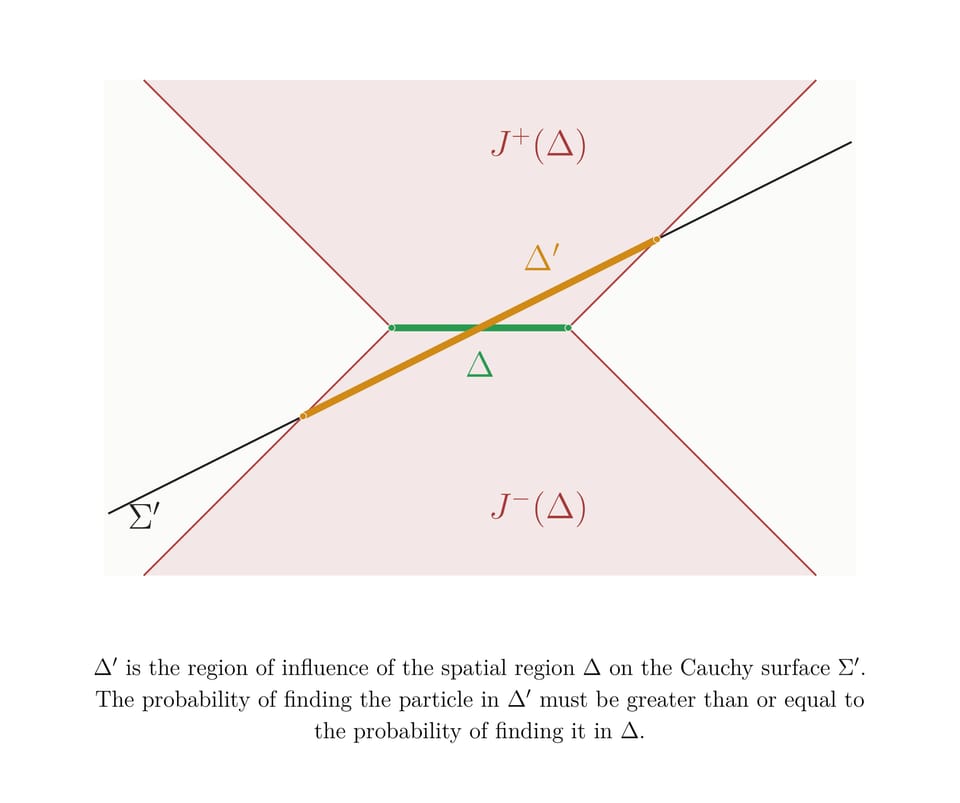
Testing particle location across an entire spatial slice fails to trigger independence rules because the measurement inherently gathers information about the global rest space rather than a confined local patch. To investigate why the Halvorson-Clifton obstruction arises, Moretti turned to an operational measurement framework pioneered by the late physicist Paul Busch, to whose memory Moretti dedicated the work. Busch established that commutativity between quantum operations can be derived from elementary operational demands: the no-signaling condition, which prevents faster-than-light communication, and relativistic consistency, which demands that the statistical outcome of consecutive spacelike measurements does not depend on the temporal order in which they occur.1
Moretti examined whether these operational principles actually compel commutativity for relativistic spatial localization observables.1 Following Busch, Moretti adopted a local detectability principle, which dictates that if instruments operate within an open spacetime region to detect a particle in a spatial area, that spatial area must be contained inside the instrument spacetime region.1 When a physicist conducts a comprehensive particle search across an entire rest space, technically known as a Cauchy surface, finding or not finding the particle in a small region automatically yields information about the complementary region encompassing the rest of the universe.
Because an elementary particle is assumed to possess the propensity to appear at a unique location during an exhaustive position measurement, detecting its absence in a selected region confirms its presence elsewhere on that spatial slice. Moretti proved that the elementary observable representing this binary outcome is localized not within an arbitrarily small spacetime neighborhood of the target region, but within a spacetime domain containing the entire rest space.1 Consequently, two elementary localization observables associated with disjoint spatial patches are not situated in causally separated spacetime regions.1 Their spacetime envelopes overlap globally, meaning the mathematical preconditions required to trigger Busch no-signaling and relativistic-consistency arguments are never met. The absence of commutativity in Halvorson-Clifton models is therefore not an exotic physical pathology, but a direct consequence of asking a global question across the entire cosmos.
Explaining this breakdown in foundational assumptions, Valter said in response to questions from Primary that "the intuitive assumption that breaks down is the idea that an observable labelled by a finite spatial region D is therefore localized in D." As Valter pointed out, "if we fill the entire space with detectors, a particle (a) necessarily localizes somewhere and (b) localizes at a single point." Because of this binary exhaustiveness, "if the particle localizes in D, we immediately know that it is not localized in the complement of D, and vice versa," meaning that "the information that the particle is not localized in the complement is therefore embodied in the detector associated with D." Under this perspective, when such an instrument forms part of an exhaustive covering of space, "it ceases to be a local object from Busch's operational perspective."
How can physical laboratories restore independence through conditional detection?
Physical laboratories restore operational commutativity by replacing global spatial searches with conditional measurements that evaluate particle position only after confirmation that the system has entered a bounded experimental chamber.1 Real-world experimental physicists never monitor the entirety of infinite space simultaneously; they operate within localized facilities bounded by physical walls, vacuum chambers, and finite detector arrays. Moretti formalized this realistic scenario by introducing conditional localization observables defined specifically for a bounded spatial region interpreted as a laboratory.
In this laboratory picture, Valter explained to Primary, the experimenter places detectors only inside the bounded chamber rather than across the entire universe, asking: "Given that the particle has been found in D, in which of the detectors located inside D was it found?" When two causally separated laboratories operate in disjoint regions, their detection premises are mutually exclusive. As Valter stated, "if I know that the particle has been found in D, in one of the detectors located there, then I cannot also find it in D', and therefore in any of the detectors located in D'." Within this conditional structure, the mathematical assumption of probability additivity across separated chambers no longer holds, circumventing the Halvorson-Clifton no-go theorem.
To construct these operators, Moretti leveraged an established result from quantum information theory known as the gentle measurement lemma, which states that an measurement whose outcome occurs with near certainty causes an imperceptibly small disturbance to the underlying quantum state.1 By applying this principle, Moretti formulated conditional positive operator-valued measures that calculate the probability of detecting a particle inside a specific subregion, given that an initial detector has already confirmed the particle presence within the laboratory. This formulation holds with increasing theoretical precision the closer the laboratory entrance detection probability approaches certainty.1
Clarifying how the gentle measurement lemma functions, Valter emphasized that the analysis does not evaluate consecutive measurements performed on a single particle in real time. Instead, an ensemble of particles is prepared in identical states, and the lemma serves as a technical device to justify a counterfactual comparison. Valter explained that the framework compares the statistics of an experiment conducted strictly inside a bounded laboratory against a hypothetical scenario where detectors cover all space and an observer restricts attention to the laboratory subset, demonstrating that the conditional probabilities match classical Bayes rules when detection approaches certainty.
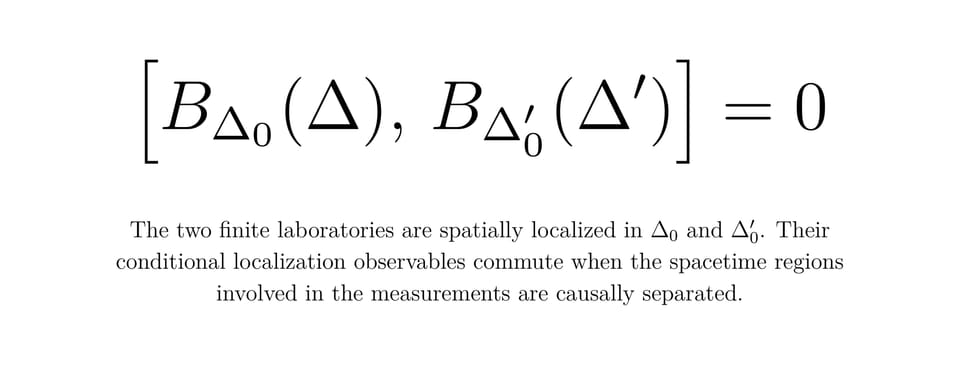
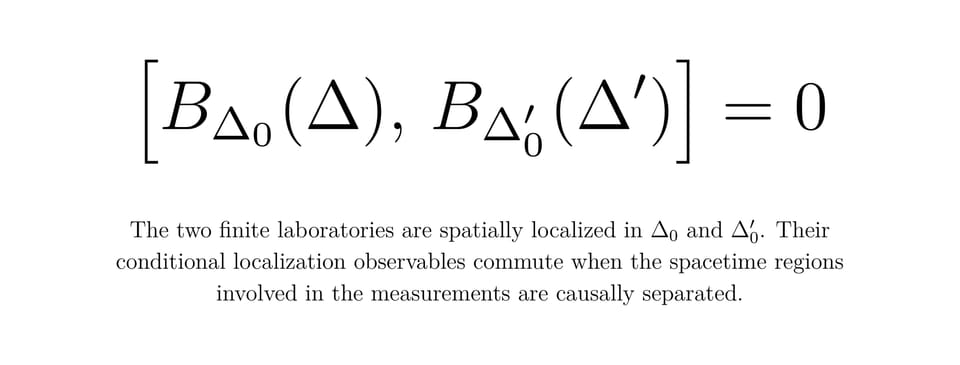
Unlike the global observables that inspect the entire universe, these conditional localization operators remain strictly confined to the spacetime domain of the laboratory. When two distinct laboratories are separated by spacelike intervals, so that light cannot travel between them during the duration of the experiments, Moretti showed that their conditional localization operators can satisfy mathematical commutativity.1 This conditional mechanism allows localized quantum observables to conform to the Araki-Haag-Kastler framework without collapsing into the mathematical triviality identified by Halvorson and Clifton. Position observables can thus inhabit local operator algebras, provided theorists restrict their questions to what transpires inside actual laboratory boundaries.
To establish that these conditional observables commute in a concrete physical system, Moretti developed an explicit model in a companion paper published in Letters in Mathematical Physics, utilizing the stress-energy-momentum tensor of a massive scalar field.3 Because quantum field energy densities can take negative values due to the Reeh-Schlieder property, Moretti employed quantum energy inequalities developed by Christopher Fewster at the University of York to bound negative contributions. Through Haag duality, Moretti proved that the resulting laboratory observables commute at spacelike separation. Valter noted that disproving this commutativity would be equivalent to falsifying the basic commutation relations of quantum field theory itself.
What are the boundaries of these localization results?
These mathematical derivations are theoretical proofs within quantum measurement theory and algebraic field theory rather than empirical data gathered from physical laboratory experiments. The primary paper by Valter Moretti is posted on the arXiv repository and represents a preprint that has not completed formal peer review. While the companion paper demonstrating concrete field models appeared in Letters in Mathematical Physics, the analysis in this first paper relies on idealizations of single-particle sectors in flat Minkowski spacetime, leaving open questions about how localization behaves in curved spacetimes or strongly interacting systems.
The physical picture also hinges on the regime where detection inside the laboratory approaches certainty, where the gentle measurement lemma establishes standard conditional probability rules. If the probability of finding the particle inside the laboratory falls significantly below certainty, formalizing quantum conditional probabilities becomes considerably more intricate. Furthermore, treating a quantum excitation as an isolated particle assumes that interactions have ceased, an assumption common in scattering experiments but one that breaks down during intense localized quantum interactions.
The wider implications of Moretti analysis touch how theoretical physicists interpret the interface between abstract field algebras and tangible laboratory measurements. For decades, the tension between particle localization and algebraic microcausality led some physicists to suggest that the concept of a particle should be discarded entirely from relativistic quantum theory in favor of pure field states. Moretti results suggest instead that the particle concept remains mathematically and physically viable, provided it is freed from the unrealistic assumption that an observer can interrogate an infinite spatial slice all at once. By aligning measurement operators with the operational reality of bounded laboratories, physicists gain a coherent language that respects both the causal limits of special relativity and the discrete signatures observed in everyday particle detectors.
Moving forward, researchers will examine how Moretti conditional localization observables behave in specific physical systems and how they connect to alternative frameworks. In the preprint, Moretti notes that modular localization, an alternative approach developed from Wigner representations by Bert Schroer and subsequent researchers, reintroduces projection-like structures that approximate Newton-Wigner localization at distances much larger than the particle Compton wavelength. Comparing these unsharp conditional operators with modular localization models remains an active theoretical goal. For now, the general analysis demonstrates that the long-standing paradoxes of relativistic localization may not reflect a failure of quantum reality, but rather the necessity of remembering that every real measurement happens inside a finite room.
The record
22 sentences trace to 2 sources and 1 contributor.
-
1
VM
 Valter Moretti
Paper
· arxiv.org · 11 Sep 2026
Spatial Localization of Relativistic Quantum Systems: The Commutativity Requirement and the Locality Principle. Part I: A General Analysis
Preprint · may not have been peer reviewed
See the source
- 2 Contribution — Valter Moretti 12 statements added to this article
-
3
A
arxiv.org
Paper
· arxiv.org
Spatial Localization of Relativistic Quantum Systems: The Commutativity Requirement and the Locality Principle. Part II: A Model from Local QFT
Preprint · may not have been peer reviewed
See the source
Other consulted pages3 pages
arxiv.org2 pages
Article history
-
Published 13 Nov 2026, 14:14Assembled by the Primary desk from 2 sources · 1 contributor · 22 cited sentences
-
Valter Moretti, a mathematical physicist at the University of Trento and the Trento Institute for Fundamental Physics and Applications…
- Go to the sentence: Moretti proved that the elementary observable representing this binary outcome is localized not within an arbitrarily small spacetime neighborhood of the target region, but within a spacetime domain containing the entire rest space.
- Go to the sentence: Explaining this breakdown in foundational assumptions, Valter said in response to questions from Primary that "the intuitive assumption that breaks down is the idea that an observable labelled by a finite spatial region D is therefore localized in D."
- Go to the sentence: As Valter pointed out, "if we fill the entire space with detectors, a particle (a) necessarily localizes somewhere and (b) localizes at a single point."
- Go to the sentence: Because of this binary exhaustiveness, "if the particle localizes in D, we immediately know that it is not localized in the complement of D, and vice versa," meaning that "the information that the particle is not localized in the complement is therefore embodied in the detector associated with D."
- Go to the sentence: Under this perspective, when such an instrument forms part of an exhaustive covering of space, "it ceases to be a local object from Busch's operational perspective."
- Go to the sentence: Physical laboratories restore operational commutativity by replacing global spatial searches with conditional measurements that evaluate particle position only after confirmation that the system has entered a bounded experimental chamber.
- Go to the sentence: In this laboratory picture, Valter explained to Primary, the experimenter places detectors only inside the bounded chamber rather than across the entire universe, asking: "Given that the particle has been found in D, in which of the detectors located inside D was it found?"
- Go to the sentence: As Valter stated, "if I know that the particle has been found in D, in one of the detectors located there, then I cannot also find it in D', and therefore in any of the detectors located in D'."
- Go to the sentence: To construct these operators, Moretti leveraged an established result from quantum information theory known as the gentle measurement lemma, which states that an measurement whose outcome occurs with near certainty causes an imperceptibly small disturbance to the underlying quantum state.
- Go to the sentence: This formulation holds with increasing theoretical precision the closer the laboratory entrance detection probability approaches certainty.
- Go to the sentence: When two distinct laboratories are separated by spacelike intervals, so that light cannot travel between them during the duration of the experiments, Moretti showed that their conditional localization operators can satisfy mathematical commutativity.
- Go to the sentence: To establish that these conditional observables commute in a concrete physical system, Moretti developed an explicit model in a companion paper published in Letters in Mathematical Physics, utilizing the stress-energy-momentum tensor of a massive scalar field.