Mouse egg cells rebuild an organelle sorting hub during follicle growth
Maternal mitochondria undergo renewed inspection after dormancy when cellular scaffolding reassembles to filter damaged components and center the oocyte nucleus, according to new research in mice.
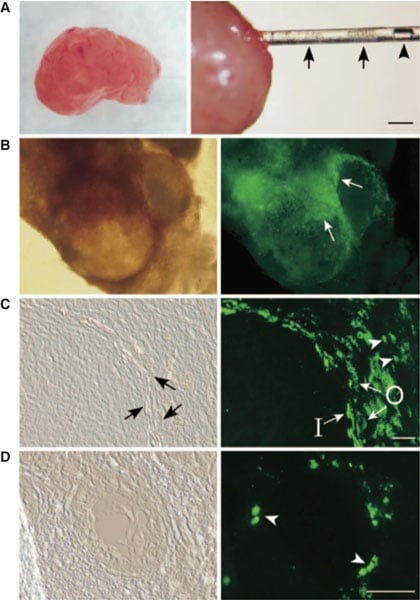
An animal egg cell carries the responsibility of seeding the next generation, supplying half of the genetic code and nearly all of the cellular machinery required to sustain early life. For months or years, these immature cells remain suspended in ovarian tissue, enduring extended stretches of inactivity without losing the capacity to power an embryo. In species ranging from frogs to mice, an oocyte, the biological term for an immature egg cell, must protect its energy-generating mitochondria and surrounding components from cumulative damage. If an egg inherits compromised organelles, development can stall before an embryo even implants.
To prevent defective parts from propagating, developing oocytes across the animal kingdom rely on a specialized cellular hub called the Balbiani body.12 This structure gathers vital internal parts into a localized aggregation, where cellular systems can monitor organelle quality.12 In lower vertebrates such as frogs and fish, the Balbiani body persists for long stretches of time, remaining visible throughout ovarian development.12 In mammals, however, the structure seemed to disappear early in development, creating an enduring puzzle about how mammalian eggs manage their internal maintenance once follicular growth begins.
A preprint posted on September 3, 2026, to the bioRxiv repository shows that the mammalian structure does not disappear permanently. Researchers Q. Yin and A. C. Spradling report that the mouse Balbiani body reassembles in growing follicles after a period of dormancy, resuming its active role in organelle selection and eventually guiding the spatial organization of the entire egg cell.1
The cellular life cycle of an egg cell follows a precise biological progression. Early in ovarian development, the immature oocyte packages its essential cellular equipment into a central cluster to inspect damaged components before entering a dormant phase known as quiescence. While resting inside a primordial follicle, the tiny protective envelope that shelters the dormant egg, active sorting pauses and the cluster appears to dismantle. When hormonal cues activate the follicle, the egg awakens and must rapidly evaluate its metabolic parts to prepare for fertilization. Once that inspection concludes, the structural scaffold disassembles so that mitochondria and membrane networks can distribute evenly through the expanding cytoplasm, while mechanical tensions draw the cell nucleus into the exact center of the oocyte.
How do dormant egg cells manage their internal machinery?
Developing egg cells assemble a temporary cluster of vital structures known as the Balbiani body to organize and inspect their internal contents.12 The Balbiani body represents a universal feature of early oocyte development across diverse animal species, first forming during zygotene, an early stage of cell division when paired chromosomes align.1 In mice, this gathering takes shape during pre-follicular oogenesis, the developmental window before protective follicles enclose the immature egg.1 Prior to the new preprint, researchers did not know whether the mouse Balbiani body persisted during and after the primordial follicle state, because mammalian structures appeared far more fleeting than the durable versions documented in non-mammalian organisms.1
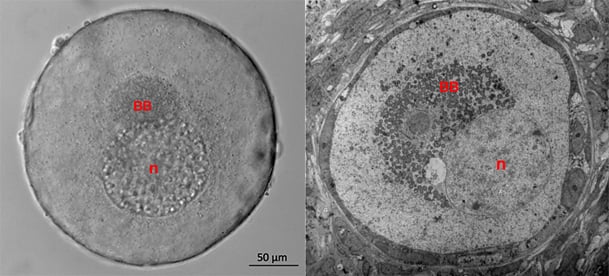
Yin and Spradling describe the mammalian Balbiani body as a system whose activity pauses during dormancy.1 While the resting egg remains quiescent in the ovary, organelle sorting stops. According to the preprint, the mouse Balbiani body functions on a schedule interrupted by dormancy, sharing fundamental organizational properties with the long-lived structures observed in zebrafish and Xenopus clawed frog oocytes.1
Allan, a researcher on the study, explained that the apparent absence of the structure in later mammalian stages was largely an artifact of earlier scientific assumptions. Allan said in response to questions from Primary that mouse follicles "were originally thought not to have a Balbiani body (Bb),, until my lab described a mouse Bb in 2007 in early follicles from very young mice just before these follicles entered dormancy." Allan added that because the early mammalian cluster looked different from amphibian counterparts, many biologists doubted it was genuine and assumed it would never return. When following organelle layout across stages, Allan said, "we found that this axis does persist based on microtubule organization" and observed that "a more typical Balbiani body re-formed from the old arrested Balbinai body using its original microtubule organizing center."
Similar organelle clusters appear widely across animal phyla, supporting the view that this filtering architecture represents an ancient evolutionary adaptation. In the bush-cricket Meconema meridionale, researchers documented that the Balbiani body forms an expansive mitochondrial network during meiotic prophase.2 A 2024 investigation published in Scientific Reports by Malgorzata Sekula, Waclaw Tworzydlo, and Szczepan M. Bilinski showed that this insect network multiplies during previtellogenesis, increasing mitochondrial counts by 2.4 times between early and mid-stages, and by another 2.7 times into late stages.2 The authors demonstrated that the insect network later divides into smaller clusters, where individual mitochondria showing lower electrical membrane potential are isolated by cellular membranes and digested through mitophagy, an internal degradation system that removes damaged organelles.2 Allan noted that this broad phylogenetic distribution underlines the fundamental nature of the mechanism, telling Primary that while minor variations occur between species, "the basic process going on in Bbs are likely to be important and conserved across animals including humans."
What happens when the resting follicle begins to grow?
Growing mouse follicles trigger the complete reassembly of the Balbiani body around a single microtubule-organizing center.1 This organizing center, a cellular anchor that nucleates and directs the internal protein filament network, acts as the architectural foundation for the rebuilt structure. Yin and Spradling report that the resurrected hub gathers a comprehensive collection of cellular components, including energy-producing mitochondria, the Golgi apparatus that packages cellular proteins, the endoplasmic reticulum membrane network, and endosomes responsible for vesicular trafficking.1
The physical restoration of the hub does not mean the resting follicle had shed every trace of its components during dormancy. Clarifying the reassembly process, Allan told Primary, "We did not say that nothing remains but the MTOC." Allan explained that "residual organelles such as Golgi and mitochondria from the original Bb survive for months in the quiescent follicles, and it remains possible that the residual Bb continues to function at a low level in dormancy." When physiological signals awaken the cell through "an insulin like pathway that turn up metabolism to break out of dormancy," nutrient uptake resumes and protein production rises, driving the structural rebuilding of the hub around its persistent core anchor.
This dense gathering allows the cell to resume active quality control over its metabolic engines. The authors report that the Balbiani body has been postulated to facilitate the selection of functional mitochondria and the removal of compromised cellular components.1 According to the preprint, the reassembled mouse structure persists throughout active follicle enlargement, maintaining organelle oversight until its quality control tasks reach completion.1
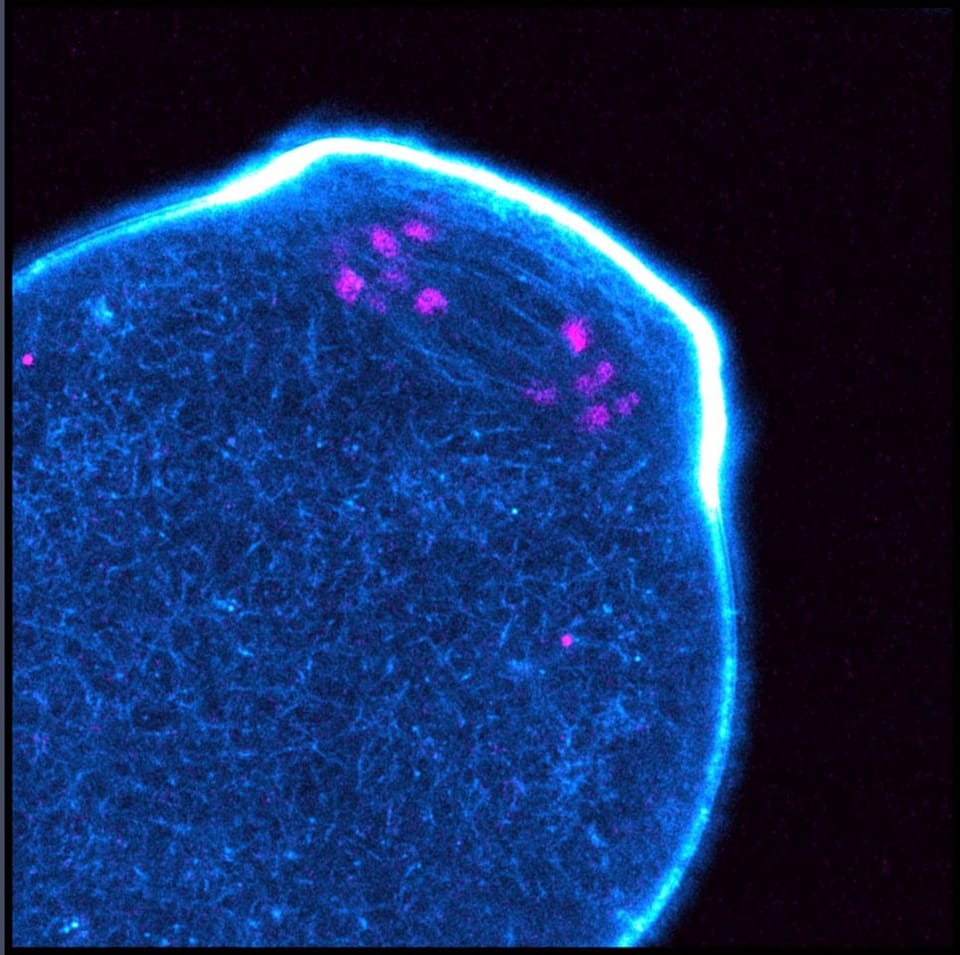
How the cell distinguishes healthy organelles from defective ones remains an open biological question. Allan noted that while early Drosophila models permit direct tracking of mitochondrial genomes to document a "substantial decrease of the mutant mitochondrial genomes and enrichment of the normal ones," the exact mammalian sorting mechanism is still being investigated. Allan said that although the rebuilt mouse hub holds numerous mitochondria, "it is not yet known whether the repairs or selection takes place within the Bb, at the edge of the Bb or even elsewhere in the cytoplasm." Allan pointed out that the structure "might still be mainly a passive collection of the finished and pristine organelles." When asked what molecular signal marks the end of organelle quality control, Allan stated that "no single marker can guarantee that an organelle has been refurbished," adding that researchers currently infer dissolution occurs when rejuvenation is finished or when the cell shifts toward final cytoplasmic polishing.
How does the sorting center dismantle after its work?
Opposing mechanical forces inside the oocyte pull the organizing center toward the outer cell cortex and dissolve the Balbiani body.1 The microtubule-organizing center moves away from its initial perinuclear location, which sits adjacent to the cell nucleus, migrating outward toward the cortex, the dense structural layer just beneath the outer cell membrane.1 Yin and Spradling report that this directed migration relies on balanced counter-forces generated between the cell's microtubule network and its actin filaments.1
As these opposing mechanical forces tug the organizing center to the periphery, they simultaneously draw the oocyte nucleus into the physical center of the cell.1 The dispersal of the Balbiani body releases the verified organelles to scatter across the cytoplasm, positioning the egg cell for the final stages of maturation. Allan noted that unraveling how the cell coordinates these opposing structural forces remains a primary goal for future work, telling Primary, "We were surprised and interested in the opposite effects produced by actin and microtubules in the Bb and it is one of the findings raised by this study that Dr. Yin plans to study in the future."
The findings presented in the study represent observational findings from laboratory mouse models and have been posted as a preprint on bioRxiv that has not yet undergone formal peer review. Yin and Spradling base their conclusions on structural tracking of organelle assemblies across follicular stages without directly measuring metabolic health or multi-generational fertility outcomes. The observations describe how organelle clusters reconfigure in response to internal cytoskeletal tensions, but they do not establish whether disrupting this reassembly causes specific developmental defects or reduces embryo viability.
Understanding that mouse eggs revive a paused Balbiani body aligns mammalian reproductive biology more closely with that of fish and amphibians. The discovery suggests that organelle quality control remains an active requirement during the intense growth phase of mammalian oocytes, extending beyond the developmental steps completed before birth. Future investigations will need to determine the exact biochemical signals that trigger Balbiani body reassembly when follicles awaken, as well as the precise mechanisms by which the structure identifies and discards malfunctioning mitochondria.
This piece was prepared from the bioRxiv preprint and public records together with answers from Allan to six questions from the Primary news team, completed September 2026.
The record
30 sentences trace to 2 sources and 1 contributor.
-
1
YQ
 Yin, Q., Spradling, A. C.
Paper
· biorxiv.org · 3 Sep 2026
The mouse oocyte Balbiani body reassembles in growing follicles to continue organelle selection and upon dispersal influences nuclear position
Preprint · may not have been peer reviewed
See the source
-
2
N
 nature.com
Paper
· nature.com
Balbiani body of basal insects is potentially involved in multiplication and selective elimination of mitochondria - Scientific Reports
Journal article
See the source
- 3 Contribution — Allan 15 statements added to this article
Other consulted pages1 page
mito.news1 page
pmc.ncbi.nlm.nih.gov1 page
Article history
-
Published 13 Nov 2026, 14:16Assembled by the Primary desk from 2 sources · 1 contributor · 30 cited sentences
-
Allan, a researcher on the study
- Go to the sentence: Researchers Q. Yin and A. C. Spradling report that the mouse Balbiani body reassembles in growing follicles after a period of dormancy, resuming its active role in organelle selection and eventually guiding the spatial organization of the entire egg cell.
- Go to the sentence: According to the preprint, the mouse Balbiani body functions on a schedule interrupted by dormancy, sharing fundamental organizational properties with the long-lived structures observed in zebrafish and Xenopus clawed frog oocytes.
- Go to the sentence: Allan said in response to questions from Primary that mouse follicles "were originally thought not to have a Balbiani body (Bb),, until my lab described a mouse Bb in 2007 in early follicles from very young mice just before these follicles entered dormancy."
- Go to the sentence: When following organelle layout across stages, Allan said, "we found that this axis does persist based on microtubule organization" and observed that "a more typical Balbiani body re-formed from the old arrested Balbinai body using its original microtubule organizing center."
- Go to the sentence: Allan noted that this broad phylogenetic distribution underlines the fundamental nature of the mechanism, telling Primary that while minor variations occur between species, "the basic process going on in Bbs are likely to be important and conserved across animals including humans."
- Go to the sentence: Growing mouse follicles trigger the complete reassembly of the Balbiani body around a single microtubule-organizing center.
- Go to the sentence: Clarifying the reassembly process, Allan told Primary, "We did not say that nothing remains but the MTOC."
- Go to the sentence: Allan explained that "residual organelles such as Golgi and mitochondria from the original Bb survive for months in the quiescent follicles, and it remains possible that the residual Bb continues to function at a low level in dormancy."
- Go to the sentence: When physiological signals awaken the cell through "an insulin like pathway that turn up metabolism to break out of dormancy," nutrient uptake resumes and protein production rises, driving the structural rebuilding of the hub around its persistent core anchor.
- Go to the sentence: The authors report that the Balbiani body has been postulated to facilitate the selection of functional mitochondria and the removal of compromised cellular components.
- Go to the sentence: According to the preprint, the reassembled mouse structure persists throughout active follicle enlargement, maintaining organelle oversight until its quality control tasks reach completion.
- Go to the sentence: Allan noted that while early Drosophila models permit direct tracking of mitochondrial genomes to document a "substantial decrease of the mutant mitochondrial genomes and enrichment of the normal ones," the exact mammalian sorting mechanism is still being investigated.
- Go to the sentence: Allan said that although the rebuilt mouse hub holds numerous mitochondria, "it is not yet known whether the repairs or selection takes place within the Bb, at the edge of the Bb or even elsewhere in the cytoplasm."
- Go to the sentence: Allan pointed out that the structure "might still be mainly a passive collection of the finished and pristine organelles."
- Go to the sentence: Yin and Spradling report that this directed migration relies on balanced counter-forces generated between the cell's microtubule network and its actin filaments.