Ordered magnetic fields channel energetic electrons across a distorted galaxy
High-energy particles can journey across tens of thousands of light-years to illuminate isolated galactic outskirts, according to radio observations and particle transport simulations of NGC 2442.
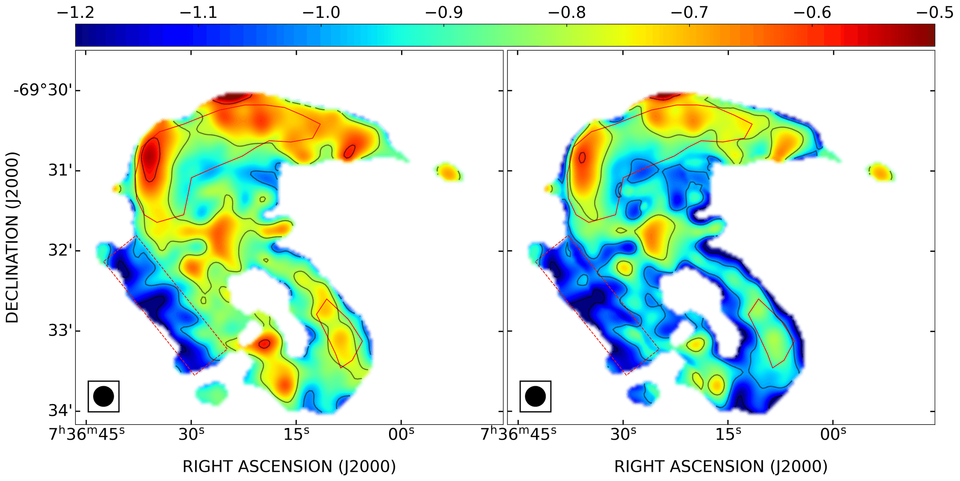
When astronomers look at a typical spiral galaxy through radio telescopes, the glowing pattern usually mirrors the birth of massive stars. Giant stars form inside dense clouds of molecular gas, live brief and furious lives, and detonate as supernovas. Those cataclysmic explosions blast subatomic particles into the surrounding interstellar space at speeds approaching the velocity of light. Among these cosmic rays, lightweight electrons spiral around magnetic lines of force, emitting synchrotron radiation, a form of non-thermal radio light produced whenever charged particles accelerate through magnetic fields. Because these energetic electrons surrender their kinetic energy rapidly through collisions with ambient light and magnetic fields, their bright radio glow generally hugs the star-forming spiral arms where they were born, fading quietly away as the particles dissipate across interstellar space.
In the southern constellation Volans, inside an asymmetric barred spiral galaxy designated NGC 2442, that tidy correlation between star formation and radio light falls apart. Roughly 15.5 megaparsecs from Earth, a distance corresponding to approximately 50 million light-years, sits an intense, isolated patch of synchrotron emission far out on the galaxy's southeastern perimeter.1 The feature lies well beyond the primary stellar disk and completely lacks hot newborn stars, ionized gas clouds, or warm dust emissions that usually accompany active starburst nurseries.1 For decades, the presence of this detached radio beacon, known colloquially among astronomers as the island, posed an unresolved physical dilemma: high-energy electrons cannot survive indefinitely, so an energetic population glowing brightly in a cosmic wasteland must either be continuously replenished from afar or accelerated on the spot by an unseen local engine.
A study posted on the preprint server arXiv by Shengtao Wang and colleagues at Yunnan University examines that puzzle, combining multi-frequency radio observations with two-dimensional computer simulations. The researchers analyzed data from several observatories, including the Australian Square Kilometre Array Pathfinder and the MeerKAT telescope in South Africa.1 The paper reports that the strange radio feature, historically nicknamed the island, is populated by cosmic-ray electrons that traveled across vast interstellar distances from distant star-forming arms along tightly ordered magnetic fields.1
Why do high-energy electrons matter for the evolution of galaxies?
Cosmic rays inject non-thermal pressure into the interstellar medium, which counterbalances gravity and dictates how gas circulates through a galaxy. Although subatomic particles make up a minuscule fraction of total interstellar mass, their combined energy density rivals the thermal pressure of hot gas and the magnetic pressure of galactic fields. When supernovas launch these relativistic particles into the interstellar medium, the gas and dust residing between stellar systems, they establish an outward pressure gradient. That cosmic-ray pressure inflates vast magnetic bubbles, drives vertical winds of gas away from the galactic plane, and alters the rate at which cold clouds collapse into new stellar generations. Understanding how these particles move through space is therefore essential for understanding whether a galaxy continues to build stars or gradually exhausts its reservoir of star-forming fuel.
Electrons are particularly sensitive probes of cosmic-ray physics because their radiation losses impose a strict, clock-like limit on their lifetimes. As a relativistic electron journeys across a galaxy, it spirals through magnetic fields, shedding energy in the form of radio synchrotron waves. Simultaneously, the electron collides with background photons, such as starlight and the cosmic microwave background, boosting those photons to higher energies while losing its own momentum in a process known as inverse-Compton scattering. Together, synchrotron and inverse-Compton losses drain an electron's energy within tens of millions of years, an eye-blink compared to the multi-billion-year lifespan of a typical galaxy.
Because higher-energy electrons lose their energy substantially faster than lower-energy ones, the steepness of a galaxy's radio spectrum reveals how long those particles have been traveling. When particles are freshly accelerated in supernova remnants, they emit a relatively flat spectrum, meaning the intensity of radio emission declines slowly as observing frequencies increase. Over time, the energetic electrons burn out first, causing the spectrum to plunge steeply at gigahertz frequencies. By tracking how this radio spectral slope changes from star-forming cores to outer disks, astronomers can retrace the propagation corridors of cosmic rays and measure how rapidly they age.
How do cosmic rays navigate a disturbed spiral?
Cosmic-ray electrons propagate through galaxies by diffusing along magnetic field lines, scattering off magnetic turbulence while drifting away from star-forming hubs. When magnetic fields are tangled and chaotic, electrons bounce erratically in all directions, wandering through the gas via isotropic diffusion, where particles disperse equally in three dimensions without a preferred orientation. In contrast, when magnetic fields are stretched into coherent, ordered configurations, electrons glide along the field lines with minimal cross-field deflection, traveling across immense galactic distances before losing their kinetic energy.
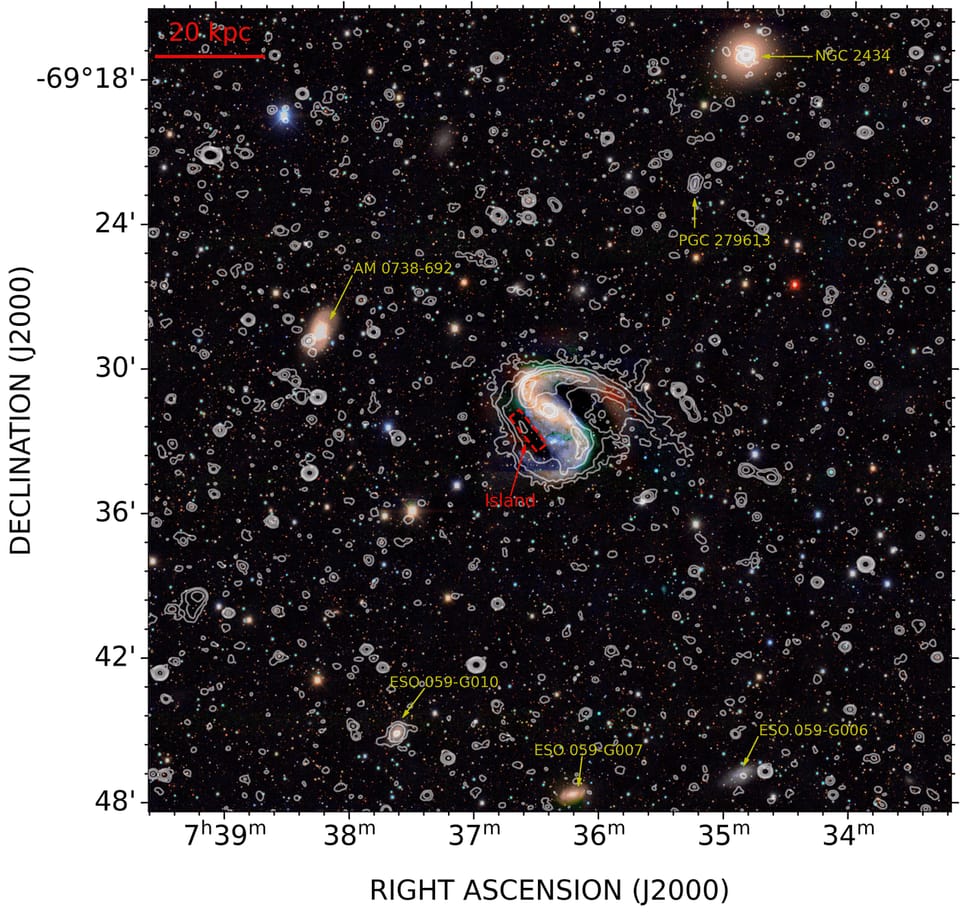
In an isolated, undisturbed galaxy, magnetic fields generally follow regular spiral tracks, but NGC 2442 has undergone violent external trauma. Located about 15.5 megaparsecs away from Earth, a distance equal to roughly 50 million light-years, NGC 2442 resides in a crowded group of galaxies that have subjected it to severe gravitational harassment. A past encounter with a massive neighbor pulled its northern spiral arm into a stretched, elongated filament spanning more than 20 kiloparsecs from the central core, while leaving its southern arm broad, open, and visibly warped.1 This gravitational tugging, along with the friction generated as the galaxy ploughs through hot intergalactic gas, disrupted the system's gas distribution and warped its magnetic architecture.
The study reports that this turbulent history left a distinct mark on the galaxy's radio spectrum. Over the frequency range from 408 megahertz to 5 gigahertz, NGC 2442 displays an integrated total radio continuum spectral index of -0.96 with an uncertainty of 0.04, and a non-thermal synchrotron spectral index of -1.21 with an uncertainty of 0.04.1 According to the preprint, these values are notably steeper than those observed in typical nearby spiral galaxies, showing a sharp spectral break near 1 gigahertz.1 That sharp spectral break provides clear observational evidence that the entire population of cosmic-ray electrons inside NGC 2442 has undergone substantial radiative aging.1
Asked whether local shocks or turbulence along the tidal arms might re-energize the electrons rather than whole-galaxy cooling, co-author Tayyaba said in response to questions from Primary that the team tested that scenario. Tayyaba explained that the team examined whether disturbances could reinvigorate the particle population in place, noting: "Instead we observe a fairly uniform steepening across the galaxy, which points to the electrons gradually losing energy as they age rather than being significantly reaccelerated in specific locations."
Where did the electrons in the radio island come from?
The electrons glowing within the southeastern island originated in distant star-forming regions and traveled along ordered magnetic fields, rather than forming in place. In their survey of the galaxy, the authors confirmed that the island feature shows an average synchrotron spectral index of approximately -1.09, which is a steep spectrum indicating an aged, mature population of particles.1 Crucially, multi-wavelength comparisons using optical hydrogen-alpha data, infrared imagery, and both near-ultraviolet and far-ultraviolet maps showed no trace of young stars or ionized gas in that region. Without stars exploding in supernovas to produce new electrons, the particles had to arrive from elsewhere.
To understand that journey, the researchers measured the characteristic distance that electrons travel before losing their radio-emitting power. By comparing the radio emission with maps of star formation, the team derived effective propagation lengths of 0.65 to 0.89 kiloparsecs at radio frequencies between 943 and 1700 megahertz, dropping to 0.44 kiloparsecs at 5 gigahertz.1 The paper states that these propagation distances correspond to an effective cosmic-ray diffusion coefficient on the order of 10 to the 28th power square centimeters per second.1 Under the assumption of energy equipartition, where magnetic energy density equals cosmic-ray energy density, the authors derived an average galactic magnetic field strength of 10.8 microgauss.1
Tayyaba told Primary that the drop in propagation length at higher frequencies reflects fundamental cooling physics: "The decrease is mainly driven by the physics of the electrons themselves. Higher energy electrons lose energy more quickly, so they cannot travel as far before fading from view."
The researchers then tested how electrons could cross several kiloparsecs of interstellar space into the island before burning out. Using CRPropa, a specialized software framework designed to simulate the trajectory of relativistic particles in astrophysical environments, the authors ran two-dimensional propagation models comparing isotropic diffusion against anisotropic diffusion.1 In the isotropic model, where particles diffuse uniformly in all directions, electrons could not reach the island in sufficient quantities to reproduce the observed radio brightness. In contrast, anisotropic diffusion directed along ordered magnetic field lines channeled the particles directly into the southeastern outskirts, providing an efficient transport corridor that fully accounts for the bright synchrotron glow.1
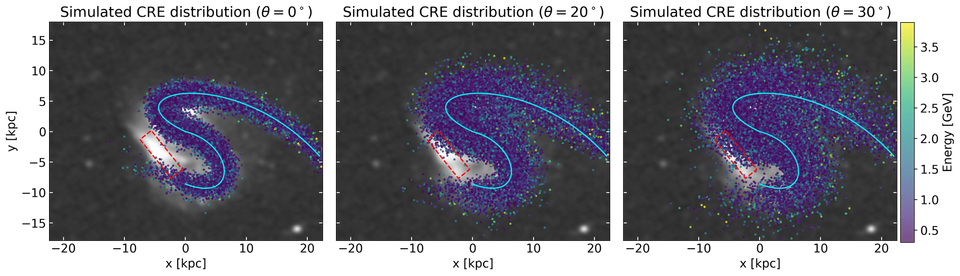
Tayyaba noted that particle containment depends directly on magnetic structure: "It comes down to how "bumpy" the magnetic field is. Cosmic rays tend to follow the galaxy's magnetic "highways". In this region, the magnetic field is unusually well ordered, which keeps the particle moving along the field lines instead of wandering randomly into the surrounding interarm regions."
What can the current models not tell us about the system?
The simulations rely on two-dimensional representations of the galactic plane and do not track how cosmic rays escape vertically into space. In a natural disk galaxy, magnetic fields twist into three-dimensional loops, and hot gas winds can blow energetic particles into a surrounding halo thousands of light-years above the disk. Simulating the galaxy as a flat sheet restricts particle diffusion entirely to the plane, potentially overestimating how many electrons reach distant outskirts by preventing vertical leakage.
Tayyaba highlighted those physical boundaries, telling Primary: "Our models simplify the galaxy into a flat disk, which is useful for understanding the main transport pathways but does not capture everything. In reality, some cosmic rays can escape above and below the galaxy, and the magnetic field has a complex 3D structure."
The derived field values also rest on the equipartition assumption, which presumes that the energy stored in galactic magnetic fields matches the energy carried by cosmic rays. When galaxies suffer severe tidal harassment, external forces can compress magnetic field lines without compressing cosmic rays in equal measure, shifting the system out of balance. Tayyaba acknowledged that while equipartition departures introduce numerical uncertainty into the exact timescales, "our main conclusion does not change: cosmic-ray electrons are travelling preferentially along ordered magnetic fields, and isotropic diffusion alone cannot explain the observed structure." Furthermore, the preprint has been posted to arXiv and has not yet completed peer review.1
What happens next in testing magnetic corridors?
Confirming whether ordered magnetic corridors supply peripheral radio islands will require high-precision polarimetric observations with future radio observatories. If magnetic fields truly channel electrons across the southeastern outskirts, polarized radio waves should reveal smooth, coherent magnetic orientations aligning the starburst arm with the island. Tayyaba outlined what observational discoveries would force the team to abandon their channeling picture, pointing to deep polarimetric imaging and spectral profiles across the feature's rim.
Tayyaba told Primary that two distinct observational outcomes would challenge the transport scenario: "First, deep polarisation imaging; the kind SKA-class facilities will deliver; that showed a patchy, low polarisation fraction and no coherent field orientation connecting the star forming arm to the island would undercut the idea of an ordered magnetic corridor. Second, if a future spectral index map showed the island itself flattening toward its outer edge, that would suggest local particle injection rather than particles that arrived aged from far away, and we'd have to seriously entertain in-situ acceleration instead of transport."
As next-generation observatories like the full Square Kilometre Array come online, astronomers will map polarized fields across hundreds of interacting galaxies. For NGC 2442, the current evidence shows that even when active star formation ceases in an outlying patch of space, ordered magnetic highways can ferry high-energy particles across tens of thousands of light-years, keeping the darkened fringes glowing long after the parent stars have moved away.
This piece was prepared from the arXiv preprint and public records together with answers from Tayyaba to 6 questions from the Primary news team, completed September 2026.
The record
26 sentences trace to 1 source and 1 contributor.
-
1
SW
 Shengtao Wang, Xiaohui Sun, Volker Heesen, George Heald, Jiangtao Li, Chao-Wei Tsai, Stefan W. Duchesne, Andrew J. Battisti, Yik Ki Ma, Amit Seta, Jun Xu, Naomi McClure-Griffiths, Christopher J. Risel
Paper
· arxiv.org · 10 Sep 2026
Cosmic-ray electron propagation in the peculiar barred spiral galaxy NGC 2442
Preprint · may not have been peer reviewed
See the source
- 2 Contribution — Tayyaba Zafar 12 statements added to this article
Other consulted pages1 page
arxiv.org2 pages
atlas-of-galaxies.mpifr-bonn.mpg.de1 page
emergentmind.com1 page
ned.ipac.caltech.edu1 page
Article history
-
Published 13 Nov 2026, 14:16Assembled by the Primary desk from 1 source · 1 contributor · 26 cited sentences
-
Tayyaba Zafar
- Go to the sentence: The paper reports that the strange radio feature, historically nicknamed the island, is populated by cosmic-ray electrons that traveled across vast interstellar distances from distant star-forming arms along tightly ordered magnetic fields.
- Go to the sentence: That sharp spectral break provides clear observational evidence that the entire population of cosmic-ray electrons inside NGC 2442 has undergone substantial radiative aging.
- Go to the sentence: Tayyaba explained that the team examined whether disturbances could reinvigorate the particle population in place, noting: "Instead we observe a fairly uniform steepening across the galaxy, which points to the electrons gradually losing energy as they age rather than being significantly reaccelerated in specific locations."
- Go to the sentence: By comparing the radio emission with maps of star formation, the team derived effective propagation lengths of 0.65 to 0.89 kiloparsecs at radio frequencies between 943 and 1700 megahertz, dropping to 0.44 kiloparsecs at 5 gigahertz.
- Go to the sentence: Under the assumption of energy equipartition, where magnetic energy density equals cosmic-ray energy density, the authors derived an average galactic magnetic field strength of 10.8 microgauss.
- Go to the sentence: Tayyaba told Primary that the drop in propagation length at higher frequencies reflects fundamental cooling physics: "The decrease is mainly driven by the physics of the electrons themselves. Higher energy electrons lose energy more quickly, so they cannot travel as far before fading from view."
- Go to the sentence: Using CRPropa, a specialized software framework designed to simulate the trajectory of relativistic particles in astrophysical environments, the authors ran two-dimensional propagation models comparing isotropic diffusion against anisotropic diffusion.
- Go to the sentence: In contrast, anisotropic diffusion directed along ordered magnetic field lines channeled the particles directly into the southeastern outskirts, providing an efficient transport corridor that fully accounts for the bright synchrotron glow.
- Go to the sentence: Tayyaba noted that particle containment depends directly on magnetic structure: "It comes down to how "bumpy" the magnetic field is. Cosmic rays tend to follow the galaxy's magnetic "highways". In this region, the magnetic field is unusually well ordered, which keeps the particle moving along the field lines instead of wandering randomly into the surrounding interarm regions."
- Go to the sentence: Tayyaba highlighted those physical boundaries, telling Primary: "Our models simplify the galaxy into a flat disk, which is useful for understanding the main transport pathways but does not capture everything. In reality, some cosmic rays can escape above and below the galaxy, and the magnetic field has a complex 3D structure."
- Go to the sentence: Tayyaba acknowledged that while equipartition departures introduce numerical uncertainty into the exact timescales, "our main conclusion does not change: cosmic-ray electrons are travelling preferentially along ordered magnetic fields, and isotropic diffusion alone cannot explain the observed structure."
- Go to the sentence: Tayyaba told Primary that two distinct observational outcomes would challenge the transport scenario: "First, deep polarisation imaging; the kind SKA-class facilities will deliver; that showed a patchy, low polarisation fraction and no coherent field orientation connecting the star forming arm to the island would undercut the idea of an ordered magnetic corridor. Second, if a future spectral index map showed the island itself flattening toward its outer edge, that would suggest local particle injection rather than particles that arrived aged from far away, and we'd have to seriously entertain in-situ acceleration instead of transport."