Drain flies build their body axis without the standard insect gene
A study in PLOS Biology shows that moth flies recruit an entirely different gene to establish head-to-tail polarity, revealing how distinct developmental networks reach identical body shapes.
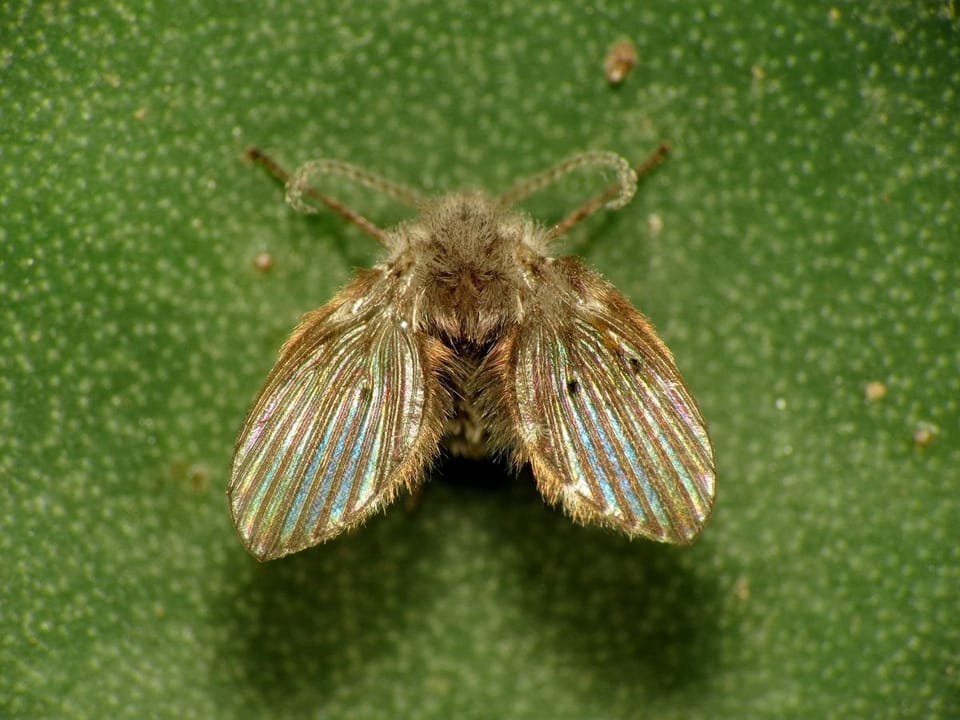
Every animal embryo faces a single, decisive question in its earliest hours: which end becomes the head, and which end becomes the tail. In the standard laboratory fruit fly, Drosophila melanogaster, that choice has long been treated as a settled problem of molecular biology.12 A mother deposits a regulatory gene named bicoid at one tip of her egg before laying it.13 When the egg begins dividing, protein from that maternal message spreads inward from the front margin, instructing nearby nuclei to build a head and chest rather than an abdomen.3
For decades, that textbook cascade stood as the canonical model of embryonic orientation. Yet an inconvenient biological detail complicates the neat narrative: the vast majority of fly species do not possess bicoid at all.12 The gene is an evolutionary newcomer restricted to certain lineages of higher flies.13 Despite lacking that master switch, roughly 150,000 described species of flies in nature develop an orderly head at one end and an abdomen at the other.12 Somehow, different lineages solve the exact same structural puzzle with completely distinct molecular parts.
Biologists call this convergence developmental systems drift.12 The underlying gene networks wander apart over evolutionary time while the final anatomical outcome remains unchanged.12 A mother fly must provide an initial chemical signpost at the anterior pole of the egg; that signpost must then loosen tightly bundled DNA inside embryonic nuclei so that essential head-building genes can turn on; finally, the resulting signals must partition the embryo into distinct anatomical regions before cell walls form around each dividing nucleus. When one regulatory link changes, natural selection preserves the overall body plan as long as that essential sequence finishes intact.
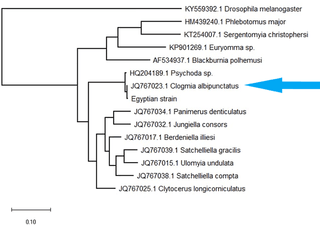
A peer-reviewed study published in August 2026 in PLOS Biology by Ezra E. Amiri, Muzi Li, Urs Schmidt-Ott and colleagues at the University of Chicago reveals how an unrelated fly species performs this task.32 The researchers examined the moth fly, Clogmia albipunctata, a fuzzy insect commonly known as the drain fly that thrives in damp domestic spaces like bathroom drains and plant saucers.12 The investigation revealed that drain flies establish their head-to-tail axis by co-opting odd-paired, an ancient gene that already performs a separate developmental job during later larval segmentation.13
How does the drain fly set its body axis?
The drain fly sets its head-to-tail polarity by deploying an alternative version of odd-paired directly to the front of the unfertilized egg.12 In both fruit flies and moth flies, odd-paired normally acts downstream in the segmentation cascade, running later in development to help divide the embryonic trunk into regular body segments.12 In the moth fly lineage, however, mothers transcribe an early maternal message from the same gene, producing an almost identical protein located exclusively at the prospective head end of the egg before fertilization occurs.13
Evolution repurposed that second message, known as an alternative transcript isoform, into a primary anterior trigger without disrupting the gene's older developmental obligations.12 In the cell nucleus, genomic DNA is wrapped around structural proteins into a compact architecture called chromatin, which acts as a physical barrier preventing transcription factors from reading genetic instructions.12 The early maternal protein encoded by odd-paired behaves as a pioneer factor, binding to tightly packed regions and loosening the local chromatin structure at the anterior pole during early cleavage stages.31
The study found that maternal odd-paired activity opens access to two specific regulatory genes: homeobrain and sloppy-paired.32 Once those regions are opened, the embryo begins transcribing both genes in complementary domains across the front half of the blastoderm, establishing the earliest anterior boundaries.3 In fruit flies, the bicoid protein breaks symmetry by targeting dozens of different genes, most notably an early segmentation switch called hunchback.12 In the drain fly, the early form of odd-paired does not appear to target hunchback at all, relying instead on homeobrain and sloppy-paired to initiate head development.12
How did the researchers track chromatin across the embryo?
The researchers tracked molecular activity in single embryos across consecutive nuclear division cycles by combining whole-genome sequencing with tests of physical DNA accessibility.3 Because Clogmia albipunctata lacked the extensive experimental catalog available for fruit flies, the research group first assembled and annotated a de novo reference genome for the moth fly.31 They then isolated individual wild-type embryos at distinct developmental checkpoints, specifically nuclear cycles 11, 12, 13, and early and late stages of cycle 14, before cells finish sealing themselves off from one another.3
To evaluate how easily regulatory machinery could reach specific genes, the authors deployed ATAC-seq, an experimental technique that uses a modified enzyme to insert molecular tags into open, exposed stretches of DNA while leaving tightly wound stretches untouched. In fruit flies, early blastoderm divisions exhibit almost continuous chromatin opening. In contrast, the authors observed both extensive opening and substantial closing of chromatin across the slower division cycles of the moth fly, which run roughly three times longer prior to nuclear cycle 14 than corresponding stages in fruit flies.3
To confirm that maternal odd-paired drives this selective opening, the researchers knocked down its early message using isoform-specific RNA interference and recorded the resulting shifts in chromatin accessibility and RNA production. In companion experiments, they assessed the moth fly ortholog of zelda, a gene that produces a ubiquitous zinc-finger protein known to assist general zygotic genome activation. The resulting profiles showed that while Zelda helps open genomic regions across the entire embryo, maternal odd-paired uniquely dictates opening at the homeobrain and sloppy-paired loci at the anterior margin.3
What are the limits of the moth fly model?
These findings show how a single insect species establishes embryonic symmetry, but they do not prove that all flies lacking bicoid rely on the same downstream targets.12 The experiments demonstrate that maternal odd-paired opens chromatin at homeobrain and sloppy-paired in Clogmia albipunctata, yet whether those two downstream genes are sufficient on their own to organize the entire head across other primitive fly families remains unknown.21 The observations come from laboratory populations of a single moth fly species measured under controlled conditions, and they do not directly reconstruct each intermediate evolutionary transition.
The measurements also rely on experimental knockdowns and molecular accessibility assays rather than live observation of natural ecological populations. While the presence of open chromatin indicates that a regulatory sequence is physically exposed to transcription factors, accessibility alone does not guarantee continuous high levels of gene expression throughout later tissue differentiation. Furthermore, the timing of cleavage cycles and chromatin remodeling differs substantially between species, meaning identical regulatory proteins may operate under very different temporal constraints depending on how rapidly an embryo divides.
Why do diverse species share identical body plans?
Comparing developmental networks across diverse species reveals that evolution frequently swaps the upstream switches of an embryo while preserving the anatomy that those switches construct. In 2019, Schmidt-Ott and colleagues discovered that unrelated, widely conserved genes take over the role of bicoid in other non-model insects.12 In crane flies and anopheline mosquitoes, a gene family known as pangolin provides the maternal anterior determinant, while harlequin flies rely on a factor called panish, and culicine mosquitoes use cucoid.3
Each distinct determinant family uses different structural motifs to bind DNA.3 The fruit fly protein bicoid relies on a homeodomain, pangolin uses high-mobility group and C-clamp domains, and odd-paired relies on classical zinc-finger motifs.3 Despite these structural disparities, each mechanism accomplishes the identical mechanical goal: breaking spatial symmetry in an egg by selectively remodeling chromatin at one margin before generalized embryonic transcription begins.
The researchers plan to extend their comparisons across additional dipteran lineages to catalog which components of embryonic gene networks resist evolutionary alteration and which components drift freely over millions of years.12 With approximately 150,000 described fly species populating terrestrial and aquatic ecosystems, each lineage represents an independent natural test of how basic biological architecture can be reorganized without collapsing the final animal form.12
The record
34 sentences trace to 3 sources.
-
1
S
 scientificinquirer
Document
· scientificinquirer.com · 16 Nov 2026
Different Genes, Same Body Plan: How a Drain Fly Tells Its Head From Its Tail
See the source
-
2
E
 eurekalert.org
Third-party reporting
· eurekalert.org
Different genes, same result: How flies evolved multiple ways to define heads and tails
See the source
-
3
J
 journals.plos.org
Third-party reporting
· journals.plos.org
Asymmetric chromatin accessibility underlies anterior-posterior axis specification in moth fly embryos
See the source