Grove snails tune five different slimes from one base recipe
Adjusting amounts of collagen and calcium allows land snails to produce glues, lubricants, and protective shields without maintaining separate biochemical factories.
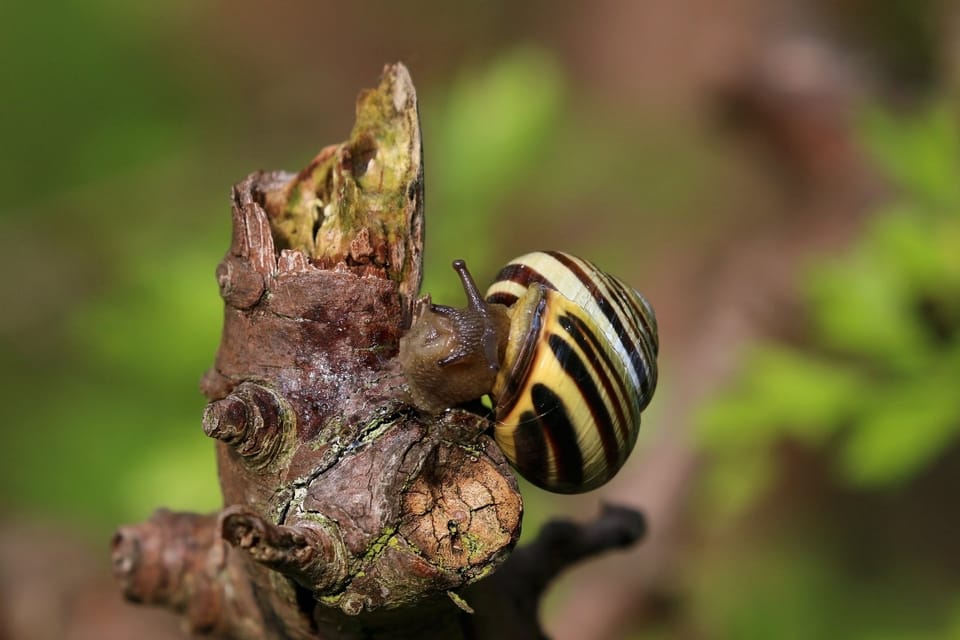
On a garden path after a rainfall, snail slime appears to be a single, uniform substance: a shiny trail left behind on wet stone. For the snail making it, however, that fluid is not one material. The animal can glide across sharp edges without injury, cement its shell firmly to vertical surfaces, or produce a frothy barrier to ward off predators. Each task demands a substance with completely different physical traits, ranging from frictionless liquid to stubborn glue.
Understanding how a soft-bodied creature creates such a wide array of mechanical materials matters because human industry usually solves these problems by manufacturing entirely separate chemical compounds. An industrial adhesive, a machine lubricant, and a protective sealant rely on distinct raw ingredients and energy-intensive manufacturing processes. If a single organism can generate all three from a shared biochemical foundation at ordinary outdoor temperatures, the underlying mechanics could offer a blueprint for simpler, sustainable adhesives and medical gels.
To produce different mechanical behaviors, an animal must change how its molecular network holds together. In any biological gel, long protein chains float in water. When those chains remain loose and untethered, they slide past one another easily, creating a fluid that lubricates movement. If neighboring chains become linked together by mineral particles or charged atoms, the network stiffens into a cohesive mesh that resists stretching. Adding rigid mineral crystals turns that mesh into a brittle, durable shield. By controlling how tightly the network binds, an animal can shift the same basic mixture across the spectrum from liquid to solid.
A study published in August 2026 in the journal Science revealed that the grove snail, known scientifically as Cepaea nemoralis, produces five distinct functional secretions using one shared base recipe.12 Mariella Gabler, a researcher in physical chemistry at the Max Planck Institute of Colloids and Interfaces in Germany, led the investigation alongside corresponding author Franziska Jehle.34 The team discovered that the snail does not run multiple chemical production lines.14 Instead, the animal alters the concentration of a primary structural protein and uses calcium to dial in the desired physical behavior.12
How does a single animal produce five distinct slimes?
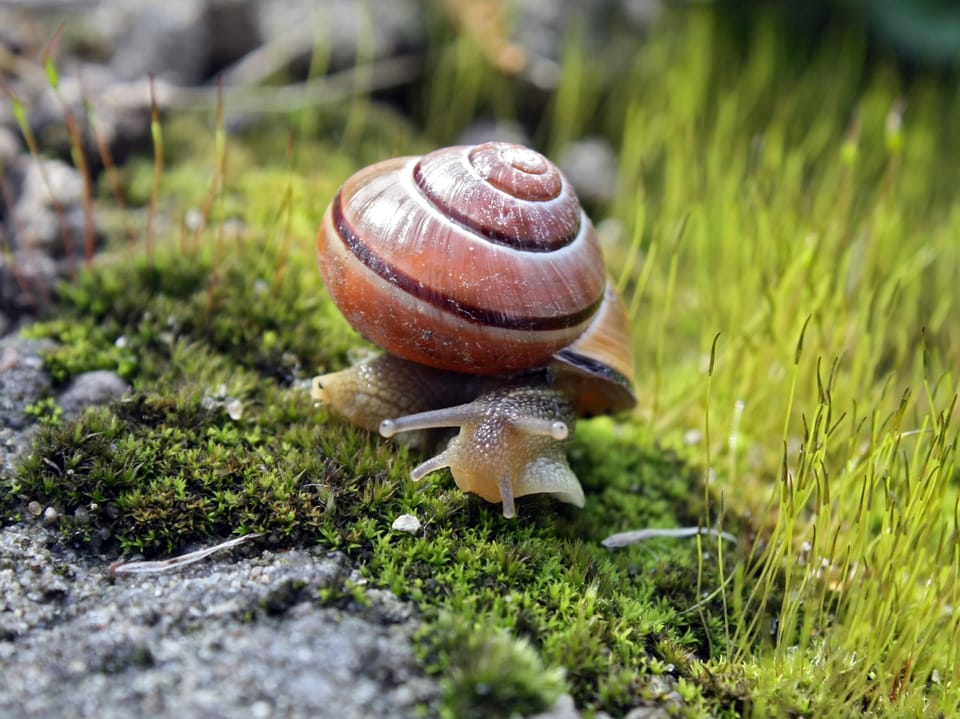
The grove snail produces different secretions by varying the density of its protein scaffold and adjusting the amount of calcium mixed into the fluid.45 Gabler and her colleagues examined five specific secretions: a slippery lubricant used for gliding, an adhesive that anchors the shell to surfaces, a protective coating that seals the shell during winter hibernation, a stretchy yellow slime that resists tearing, and a bubbly defensive froth.12 Across all five varieties, proteomic analysis showed a remarkably similar set of proteins, dominated by collagen VI, a fibrous protein familiar for providing structural strength in human skin and joints.41
The snail changes the material properties by altering the proportion of collagen VI and introducing amorphous calcium carbonate, a non-crystalline form of the mineral stored in its glandular tissue.41 When the snail increases the total protein content, the network becomes more dense and tough.43 In wet secretions, calcium exists as dissolved charged atoms that cross-link adjacent protein strands, pulling the gel into a sticky adhesive.12 In dry secretions, calcium acts as a precursor that crystallizes into calcite, producing a hard, brittle seal that protects the dormant snail from drying out.34
What tools revealed the chemical recipes?
Researchers uncovered the snail's secretion recipes by combining protein profiling, material mechanics testing, and high-resolution imaging on samples coaxed from live snails.12 Gabler and her team collected grove snails from grounds outside their institute following rain showers, maintaining them on a diet of cucumbers, salad, and lichen.34 To gather the various secretions, Gabler collected lubricant mucus as snails moved across wet glass, harvested adhesive and protective films with fine tweezers, and stimulated defensive secretions using a miniature spoon-tipped spatula.3
Laboratory analysis demonstrated that the primary difference among the five fluids lay in the physical architecture created by calcium and collagen rather than the arrival of unique, task-specific molecules.14 As Fratzl, a director at the Max Planck Institute of Colloids and Interfaces, observed, natural materials routinely achieve vast functional diversity with minimal building blocks, making the snail's modular strategy particularly striking for materials science.4
What are the limits of the current findings?
The published findings describe the composition and structural mechanics of the five secretions, but they do not provide a complete mechanical map of the materials under all real-world stresses. The study relies on samples gathered from a single terrestrial species, leaving open whether related mollusks employ identical molecular tuning dials. Furthermore, the work identifies the presence of mineral and protein variations in collected droplets, but it does not map the precise neurological or physiological mechanisms the snail uses to meter out calcium ions into its glandular ducts in real time.1
Translating these biological mechanisms into synthetic products will also require overcoming significant manufacturing hurdles. Laboratory synthesis of collagen VI networks cross-linked with amorphous minerals is far more difficult to replicate at scale than observing the process inside living mollusk tissue.
Where could calcium-tuned materials lead next?
Materials scientists and biomedical engineers could adapt the snail's strategy to formulate single-source polymers that transition between different functions on demand. In medicine, a fluid based on the snail's lubricant mucus could coat surgical tools or catheters to minimize tissue friction during insertion, while an adhesive variation modeled on the clinging secretion could function as a biodegradable surgical sealant to close internal wounds without synthetic sutures.32 Similar principles could inspire non-toxic industrial glues that disassemble when exposed to specific ionic washes.41
The next experimental step involves attempting to duplicate the snail's calcium cross-linking in artificial peptide gels without relying on harvested animal proteins. Determining whether synthetic polymer networks can achieve the same range of mechanical flexibility with simple mineral additives will test whether the grove snail's elegant economy can work in human manufacturing.
The record
19 sentences trace to 5 sources.
-
1
S
 scientificinquirer
Document
· scientificinquirer.com · 16 Nov 2026
One Recipe, Five Slimes: How Snails Tune Their Mucus With Calcium
See the source
-
2
E
 eurekalert.org
Third-party reporting
· eurekalert.org
From slippery to sticky: How snails engineer their “slime”
See the source
-
3
B-
 BPR - Blue Ridge
Third-party reporting
· npr.org · 6 Aug 2026
Sticky or slippery? Snails can change their slime to meet the moment
See the source
- 4 Following the trail of slime See the source
- 5 Snail slime does many jobs thanks to calcium See the source